O P I N I O N
by Geoff Vasil
On Wednesday, November 16th 2011, the Tolerance Center in Vilnius hosted a conference called: Tolerance and Totalitarianism. Challenges to Freedom.


O P I N I O N
On Wednesday, November 16th 2011, the Tolerance Center in Vilnius hosted a conference called: Tolerance and Totalitarianism. Challenges to Freedom.
I commend Didier Bertin’s knowledgeable and sensitive observations in his article “Lithuania and the Memory of the Holocaust.” My comments here are more in the form of a PS to Mr. Bertin’s words. My take-off point is his reference to the term “Double Genocide,” a government-endorsed concept that has been bandied about in Lithuanian political circles in recent times. But more about this later. Mr. Bertin borrows the term for application in a different dual context: the original genocide of the Jewish people and the current movement on the part of the Lithuanian government to neutralize if not to obliterate the remembrance of the Holocaust.
Updates (newest first):
His views finally came through in English in a German documentary film
Mr. Racinskas calls prominent Holocaust survivor a liar on the commission’s website
He tries to deny LAF murders “on racial basis” before arrival of German forces in 1941
Says European Commission “spits in the face” when it fails to accept a Double Genocide resolution from the Baltics
The following is DefendingHistory.com’s translation (from the tape) of the concluding speech of the 29-30 June 2011 conference (reports here and here), delivered by Ronaldas Račinskas, director general (sometimes listed as executive director) of the government sponsored ‘International Commission for the Evaluation of the Crimes of the Nazi and Soviet Occupation Regimes in Lithuania’ (known for short as the ‘Red-Brown Commission’), which is housed in the Office of the Prime Minister of Lithuania. It can serve as a potent example of the state-sponsored Holocaust Obfuscation movement which presents one face domestically, a second in the European Parliament, and a third to naive Western Holocaust Studies groups.
Simple, really. Tell the locals there was no Holocaust, just a complicated morass of mixed-up perpetrators and victims (and heck, those Jews were mostly communists anyway). Tell the European Parliament there were two equal genocides and they must legislate the equality of totalitarian regimes. And tell the foreign Jews and the West you need money to pursue Holocaust studies and commemoration. They’ll have to believe you. After all, you’re in the prime minister’s office of an EU government. Elementary, really?
VILNIUS—The following is the text of HE Polish ambassador Janusz Skolimowski’s 26 November letter in Veidas, which the ambassador copied to Lithuania’s Minister of the Interior. This authorized English translation was kindly provided to Defending History by the Embassy of Poland here. The letter followed one by seven other ambassadors regarding the same events in Lithuania.
From: Ambassador of the Republic of Poland in Vilnius
To: Editor-in-Chief of the weekly magazine “Veidas”
For the attention of: Mr. Raimundas Palaitis, Minister of the Interior of the Republic of Lithuania
Concerns: Article of Petras Stankeras dated November 14th, 2010:
“The International Military Tribunal at Nuremberg — the biggest legal farce in history”
Dear Mr. Editor-in-Chief,
Ponár (Polish Ponary, Lithuanian Paneriai) is the mass murder site outside Vilnius where around a hundred thousand civilians were murdered by the Nazi regime. Some 70,000 of them were the Jews of Vilna and its region.
Before the war the site was known as a bucolic holiday and picnic spot set in the forest. During the year-long Soviet rule in 1940-1941, large pits were dug for an oil storage facility. After the Nazi invasion the site was converted to a mass murder operation with the ready-dug pits serving as mass graves.
The vast majority of the murderers were local nationalist volunteers organized by the Nazis for the purpose of annihilating the country’s Jewish population. The eyewitness account of Christian Polish journalist Kazimierz Sakowicz was brought out in an academic English edition by Yale University Press in 2005 (Ponary Diary).
The small museum at the site has generally won acclaim for providing authentic information in a very small space and modest means. The primary address in Lithuania for visitors and locals wishing to learn more about the site is the Green House in central Vilnius.
AMONG RECENT ADDITIONS:
Leib Koniuchowsky’s The Lithuanian Slaughter of its Jews. 121 Testimonies; sequel
David Bankier’s Holocaust Testimonials from Provincial Lithuania (Yad Vashem)
Holocaust Atlas by Milda Jakulytė-Vasil
Holocaust Map; List of Towns and Cities
Lithuanian Yiddish Video Archive (LYVA) including numerous eyewitness accounts; Testimonies from The First Week (from 22 June 1941); Latvia
DH Sections
Note: This list does not include translations from the Yizkor Book or memoir literature on individual towns. Many can be accessed by town name on JewishGen, via the Holocaust Map of Lithuania (using prewar residence as point of departure) or the current Lithuanian Holocaust Atlas project that documents the mass graves of Lithuania and their history.
Yitzhak Arad, “The Murder of the Jews in German Occupied Lithuania (1941-1944)”.
Leonidas Donskis, “The Inflation of Genocide” in EuropeanVoice.com, 24 July 2009. Alternate link.
Dovid Katz, “List of Locations” in www.dovidkatz.net.
Andrius Kulikauskas, “How did Lithuanians Wrong Litvaks?” in Defending History, 5 February 2015.
Karen Sutton, The Massacre of the Jews of Lithuania, Gefen: Jerusalem 2008.
Katy Miller-Korpi, “The Holocaust in the Baltics” in SCAND 344, May 1998.
United States Holocaust Memorial Museum. Encyclopedia: “Lithuania”.
Yad Vashem Shoah Resource Center: “Lithuania”.
Yad Vashem Shoah Resource Center. Extract from a Report by Karl Jaeger.
Yitzhak Arad, The Holocaust in the Soviet Union. University of Nebraska: Lincoln & Yad Vashem: Jerusalem 2009, 701 pp.
Yitzhak Arad, Ghetto in Flames. Holocaust Publications: Washington DC 1983.
Christoph Dieckmann, “The Role of Lithuanians in the Holocaust” = pp. 149-168 in Beate Kosmola and Feliks Tych (eds), Facing the Nazi Genocide: Non-Jews and Jews in Europe, Berlin: Metropol, 2004.
David Gaunt, Collaboration and Resistance during the Holocaust: Belarus, Estonia, Latvia, Lithuania. Peter Lang: Bern 2004.
Martin Gilbert, The Holocaust: The Jewish Tragedy. Fontana / Collins 1990 [and other editions]. On Lithuania: pp. 51, 78, 154, 182, 234-5, 281, 339. 620, 722, 798-9, 799. On Vilnius: pp. 22, 39, 60, 91, 92, 168, 170, 177, 185-6, 192-5, 206-8, 216-7, 219, 228, 233, 234, 246, 339, 486, 544, 559, 568-9, 583, 590, 592-3, 595, 598, 606-7, 608, 620, 699, 703-4, 735, 777, 788. On Kaunas: pp. 51, 117-8, 124, 153, 155, 157, 161, 168, 178, 180-1, 189-90, 196, 199, 208, 222-7, 229, 234, 235, 323, 520, 554, 593-4, 640-1, 645-6, 664, 678. 702, 741, 783, 786, 799.
Martin Gilbert, Atlas of the Holocaust. William Morrow 1993 [and other editions]. On Lithuania: Maps 4, 5, 11, 12, 14, 25, 26, 33, 36, 42, 74, 75, 87, 88, 98, 99, 182, 214, 274, 316. On Vilnius: 1, 2, 4. 11, 14, 28, 3, 71, 73, 75, 83, 86, 87, 94, 96, 98, 170, 176, 185, 186, 195, 202, 208, 209, 210, 215, 219, 224, 226, 244, 247, 260, 261, 267, 272, 274, 308, 311, 313, 314.
Martin Gilbert, Never Again. Universe Publishing [and other editions; also available in Lithuanian translation]. On Lithuania: pp. 12, 13, 19, 20, 22, 49, 62, 63, 64, 64, 71, 99, 105, 109, 147, 151, 153, 158, 160, 177. On Vilnius: pp. 17, 38, 40, 41, 44, 48, 56, 68, 69, 70, 79, 81, 119, 125, 163, 167, 168, 175. On Kaunas: pp. 7, 17, 49, 63, 68, 69, 78, 96-9, 100, 101, 109, 119, 124, 125, 148, 152, 161, 171, 174.
Sara Ginaite, Resistance and Survival: The Jewish Community in Kaunas, Lithuania, 1941-1944. Mosaic Press: Oakville, Ontario 2006. [also available in Lithuanian]
Masha Greenbaum, “The Bloodbath” = pp 302-339 in her The Jews of Lithuania. A History of a Remarkable Community 1316-1945. Gefen Publishing House: Jerusalem & Hewlett, NY 1995.
Dovid Katz, “On three definitions: Genocide, Holocaust Denial, Holocaust Obfuscation” in Leonidas Donskis (ed), A Litmus Test Case of Modernity. Examining Modern Sensibilities and the Public Domain in the Baltic States at the Turn of the Century [= Interdisciplinary Studies on Central and Eastern Europe 5], Peter Lang: Bern 2009, pp 259-277. At: https://holocaustinthebaltics.com/2009SeptDovidKatz3Definitions.pdf
Ernst Klee, Willi Dressen & Volker Riess (eds), “Pogroms in Kaunas and elsewhere in Lithuania” = pp 23-58 in their ‘The Good Old Days’. The Holocaust as Seen by its Perpetrators and Bystanders. Foreword by Hugh Trevor-Roper [Oxford University]. Free Press (Macmillan): New York 1991.
Herman Kruk, The Last Days of the Jerusalem of Lithuania. Edited and introduced by Benjamin Harshav. Translated by Barbara Harshav. Yivo and Yale University Press: New Haven & London 2002.
Dov Levin, “World War II, the Holocaust and the Jewish Survivors” = pp 187-247 in his The Litvaks. A Short History of the Jews in Lithuania. Yad Vashem: Jerusalem 2000.
Joseph Levinson (ed), The Shoah (Holocaust) in Lithuania. Vilna Gaon Jewish State Museum: Vilnius 2006. [Note: original edition in Lithuanian].
Rachel Margolis, Partisan from Vilna[memoir]. With an introduction by Professor Antony Polonsky. Afterword by Marjorie Margolis. Academic Studies Press: Boston 2010.
Ephraim Oshry, The Annihilation of Lithuanian Jewry. Judaica Press: New York 1995. [original Yiddish edition: Khurbn Lite, NY 1951].
Dina Porat, “The Holocaust in Lithuania. Some Unique Aspects” = pp. 159-174 in David Cesarani (ed.), The Final Solution. Origins and Implementation, Rutledge: New York 1996.
Joshua Rubenstein and Ilya Altman (eds), “Lithuania” = pp 277-315 in their The Unknown Black Book. The Holocaust in the German-Occupied Soviet Territories.Indiana University Press: Bloomington & Indianapolis 2008.
Kazimierz Sakowicz, Ponary Diary 1941-1943. A Bystander’s Account of a Mass Murder. Edited by Yitzhak Arad. Preface by Rachel Margolis [rediscoverer of the manuscript and publisher of the original Polish edition of 1999]. Yale University Press: New Haven & London 2005.
Michael Shafir, Between Denial and “Comparative Trivialization”: Holocaust Negationism in Post-Communist East Central Europe. Hebrew University: Jerusalem 2002 [= The Vidal Sasoon International Center for the Study of Antisemitism, ACTA no. 19].
N.N. Shneidman, Jerusalem of Lithuania: The Rise and Fall of Jewish Vilnius. Mosaic Press: Oakville, Ontario 2002.
N.N. Shneidman, Three Tragic Heroes of the Vilnius Ghetto. Mosaic Press: Oakville, Ontario 2002.
Sara Shner-Neshamit, “Jewish-Lithuanian Relations during World War II: History and Rhetoric” = pp 167-184 in Zvi Gitelman (ed), Bitter Legacy. Confronting the Holocaust in the USSR. Indiana University Press: Bloomington & Indianapolis.
Lyn Smith, Remembering: Voices of the Holocaust. Carroll & Graf: New York [memoir by Juozas Aleksynas, member of the 12th & 13th Lithuanian police battalion, on pp 96-98].
Karen Sutton, The Massacre of the Jews of Lithuania. Lithuanian Collaboration in the Final Solution 1941-1944. Gefen Publishing House: Jerusalem & New York 2008.
Abraham Tory, Surviving the Holocaust. The Kovno Ghetto Diary. Edited with an introduction by Martin Gilbert. Textual and historical notes by Dina Porat. Harvard University Press: Cambridge, Mass 1990.
Tomas Venclova, “Jews and Lithuanians” in his Forms of Hope. Sheep Meadow Press: 2002.
Sima Ycikas, “Lithuanian-Jewish Relations in the Shadow of the Holocaust” = pp 185-213 in Zvi Gitelman (ed), Bitter Legacy. Confronting the Holocaust in the USSR. Indiana University Press: Bloomington & Indianapolis.
Isaac Zibuts et al, The Sounds of Silence. Traces of Jewish Life in Lithuania. R. Paknio Leidykla: Vilnius 2009. [Note: parallel, concurrent edition in Lithuanian].
Galina Žirikova (compiler), The Collections of the State Archive of Lithuania: A Soure of Research on the Holocaust in Lithuania. Vilna Gaon State Jewish Museum: Vilnius.
Efraim Zuroff, Operation Last Chance: One Man’s Quest to Bring Nazi Criminals to Justice. Palgrave Macmillan: New York & Basingstoke 2009.
◊
Esther Goldberg Gilbert, wife and partner to Sir Martin Gilbert and an accomplished Holocaust scholar in her own right, today published a second bold article in the Canadian Jewish News on Holocaust issues in Lithuania. The new piece, a follow-up to her first on the subject last month, became necessary, in the view of some observers, in light of a renewed campaign of harassment, degradation and attempted dismissals , against Ms. Kostanian, enabled and enacted out by the highest echelons of the parent museum’s government sponsored leadership, as well as the state’s “Double Genocide industry.” The new article is available as PDF, and herein:
2010Oct7EstherGoldberg (1)
PROPHET AMOS AWARDS
DH SECTION ON COURAGEOUS CITIZENS OF LITHUANIA
A number of citizens of Lithuania from diverse backgrounds have spoken out against antisemitism, racism, and Holocaust Obfuscation. See the Defending History sections dedicated to the authors Vytenis Povilas Andriukaitis, Kristina Apanavičiūtė Sulikienė, Evaldas Balčiūnas, Aleksandras Bosas, Milan Chersonski, Algis Davidavičius, Leonidas Donskis, Pinchos Fridberg, Vilma Fiokla Kiurė, Regina Kopilevich, Andrius Kulikauskas, Fausta and Michael Maass, Julius Norwilla, Jacob Piliansky, Kamilė Rupeikaitė, Geoff Vasil (Vasiliauskas), Nida Vasiliauskaitė, Tomas Venclova, Lina Žigelytė and others.
◊
Lithuanian film directors are at the forefront of producing bold new documentaries. See recent works by Saulius Beržinis and Alicija Žukauskaitė.
◊
SEE ALSO:
LITHUANIAN HOLOCAUST RESCUERS PAGE
AND THE
FIRST-WEEK RESCUERS PAGE (JUST GETTING STARTED — CONTRIBUTIONS WELCOME)
1 April 2016. Defending History: ‘Media Reaction and Reviews: Vanagaitė and Zuroff’s ‘Mūsiškiai’.
11 March 2016. Defending History: Neo-Nazis given central Vilnius again on March 11th Independence Day’ by Vilma Fiokla Kiurė.
29 February 2016. Jewish Community of Lithuania: ‘Lithuanian Jewish Community requests findings on Holocaust crimes of Molėtai priest’ by Faina Kukliansky.
29 February 2016. The Times of Israel: ‘Holocaust haunts Lithuanians as painful past comes to light’ by Vaidotas Beniusis.
29 February 2016. Defending History: ‘Media Reaction and Reviews: Vanagaitė and Zuroff’s ‘Mūsiškiai’.
11 February 2016. Lithuanian Jewish Community: ‘Musicians of the symphony of the lie’ by Sergejus Kanovičius.
4 January 2016. DefendingHistory.com: ‘Let’s dismantle the Sports Palace and revoke the revocation of hospitality’ by Andrius Kulikauskas.
24 December 2015. Defending History: ‘When both law enforcement and politicians cover up racism’ by Vilma Fiokla Kiurė.
14 December 2015. Defending History: ‘It’s not just about old Jewish cemeteries’ by Milan Chersonski.
7 December 2015. Defending History: ‘Why would the “Genocide Center” in Vilnius manipulate history and glorify murderers’? by Kristina Apanavičiūtė Sulikienė.
20 November 2015. VilNews.com: ‘Doing business in Lithuania — a country where rule of law is not expected’ by Grant Arthur Gochin.
16 November 2015. Defending History: ‘Roma in Lithuania: But what does the government need to do?’ by Vilma Fiokla Kiurė.
10 November 2015. Lithuanian Jewish Community: ‘Litvak youth protest honoring of General Vetra in Vilnius’ [extracts in English from the full 9 Nov. article in Lithuanian in 15min.lt by Paulius Gritenis].
4 October 2015. Defending History: ‘Police prevent Kaunas Jewish guide Chaim Bargman from attending annual memorial for the annihilated Jews of Ukmergė (Vilkomir)’ [introducing video interview of Chaim Bargman in Yiddish].
2 October 2015. Defending History: ‘Impressions of a conference on “Antisemitism, Radicalization and Violent Extremism”’ by Vilma Fiokla Kiurė.
25 September 2015. Defending History: ‘Vilnius names street for beloved Lithuanian rescuer Ona Šimaitė’.
1 September 2015. Defending History: ‘Public shrines to a Holocaust collaborator and a “secret” petition: A strange summer’s media circus’ by Evaldas Balčiūnas.
23 August 2015. Defending History: ‘What it is to defend your own history’ by Kristina Apanavičiūtė Sulikienė.
29 July 2015. i24: ‘Lithuania’s choice: between real and false heroes’ by Sergey Kanovich.
19 July 2015. Defending History: ‘What’s The Story With the Mass Grave Uncovered near Šiauliai (Shavl)?’ by Evaldas Balčiūnas?.
3 May 2015. Defending History: ‘Why we have not, do not and will not talk about the Holocaust in Lithuania’ by Rūta Vanagaitė. Posted on 4 May 2015 in En.Delfi.lt / The Lithuania Tribune.
1 May 2015. Defending History: ‘Legacy of Rūta Vanagaitė’s 17 April 2015 Conference at Vilnius City Hall’.
30 April 2015. Defending History: ‘A Jewish hideout discovered in Butrimonys’ by Andrius Kulikauskas.
24 April 2015. Lithuania Tribune / En.Delfi.lt: ‘Lithuanians and Jews: What’s changed and what hasn’t over the last 40 years?’ by Tomas Venclova.
20 April 2015. Defending History [courtesy of International Conference on Holocaust Education]: ‘Lithuanians and Jews: What’s changed and what hasn’t over the last forty years?’ by Tomas Venclova. In Delfi.lt (24 April 2015).
13 April 2015. H-Net. Humanities and Social Sciences Online: ‘Origins of the Holocaust in Lithuania’ by Andrius Kulikauskas.
12 Apil 2015. Defending History: ‘Graffiti debate on Hitler in a Vilnius housing complex’ [photograph] by Julius Norwilla.
6 April 2015. Defending History: ‘A new book on the Kaunas (Kovno) Ghetto by Arūnas Bubnys’ by Geoff Vasil.
30 March 2015. Defending History: ‘New memorial, on state land in western Lithuania, honors alleged murderer of thousands of civlians’ by Evaldas Balčiūnas.
19 March 2015. Mi Zdes: Correspondence between Vilnius Holocaust survivor Pinchos Fridberg and Yico director Jonathan Brent in Russian translation. In English (in DH); reprint in Operation Last Chance (Simon Wiesenthal Center). In Yiddish.
19 March 2015. Defending History: ‘An “Inner” View of the Neo-March on Vilnius, 2015′ by Geoff Vasil.
19 February 2015. Defending History: ‘February 16th 2015 in Kaunas…’ by Evaldas Balčiūnas.
5 February 2015. Defending History: ‘How did Lithuanians wrong Litvaks?’ by Andrius Kulikauskas.
4 February 2015. Defending History: ‘The Nazis are just nuts’ by Geoff Vasil.
2 February 2015. Defending History: ‘The Bubnys event at the 2015 Jewish Community Auschwitz commemoration’ by Julius Norwilla.
29 January 2015. Defending History: ‘Nine poems by Aleksandras Bosas’.
30 November 2014. Defending History: ‘Tomas Venclova speaks out on Banderism and its European analogues’.
23 November 2014. Defending History: ‘Member of Lithuania’s Jewish community speaks out on neo-Nazi Parades, and govt. flowers at monument to Hitler’s soldiers’ by Jacob Piliansky.
20 November 2014. Defending History: ‘What is the “program for Roma integration” in Lithuania?’ by Vilma Fiokla Kiurė.
11 November 2014. Defending History: ‘Meilach Stalevich (1923 — 2014)’ by Dovid Katz.
8 November 2014. LatvianNews.lv: ‘Herberts Cukrus. A criminal. Just a criminal’.
5 October 2014. Defending History: ‘Annual memorial for the Jews of Svintsyán (Švenčionys): small but well done’ by Defending History staff.
24 September 2014. Defending History: ‘Seven Prophet Amos Awards for human rights courage in Lithuania’.
21 September 2014. Tsemakh Shabad’s 150th birthday celebrated in style at the Lithuanian parliament’ by Defending History staff.
24 August 2014. Jewish Community of Lithuania: ‘Volunteers tackle cobwebs and dust at Vilna Ghetto Library’ by Geoff Vasil.
17 August 2014. Defending History: ‘Vilnius daily’s report on the Dyukov affair’.
26 July 2014. Defending History: ‘Aleksandras Bosas (1951—2014)’ by Geoff Vasil.
8 July 2014. Defending History: ‘Defending History’s Evaldas Balčiūnas again disturbed by police at his workplace’.
17 June 2014. Defending History: ‘The politics of history’ by Evaldas Balčiūnas.
22 May 2014. Defending History: ‘DH staff writer Evaldas Balčiūnas is investigated by Lithuanian police’.
22 May 2014. Defending History: ‘Statement of staff writer Evaldas Balčiūnas on summons from police’ by Evaldas Balčiūnas.
8 April 2014. Defending History: ‘Roma: Presumption of Guilt’ by Vilma Fiokla Kiurė.
28 March 2014. Defending History: ‘Is Vilnius police criminal division harassing veteran Holocaust researcher?’
21 March 2014. Defending History: ‘Holocaust Survivor stands up against proposal to close down Russian language media in Lithuania’.
8 March 2014. Defending History: ‘Olga Zabludoff’s comment on a February 2014 Yivo symposium’. Original 7 March 2014 publication in the Algemeiner Journal.
3 March 2014. Pinchos Fridberg’s Youtube: ‘Lakhn iz gezunt’ by Pinchos Fridberg [in Yiddish]. Reaction to a comment posted at Olga Zabludoff’s 13 February 2014 op-ed in the Algemeiner Journal.
23 February 2014. Defending History: Prof. Pinchos Fridberg’s sound file ‘Lakhn iz gezunt’ (in Yiddish) in response to R. Račinskas’s comment to Olga Zabludoff’s 13 February 2014 article in the Algemeiner Journal. Background here and here.
11 February 2014. Tablet: ‘A comment from Professor Pinchos Fridberg, Vilnius’. Reprint in DefendingHistory.com.
10 February 2014. Antifa.lt: Antifa.lt announces its 16 February 2014 protest against neo-Nazi march in central Kaunas; On Facebook.
21 January 2014. JosephLevinson.com: Joseph Levinson website launched.
17 January 2014. DefendingHistory.com: ‘Forget me knot’ by Geoff Vasil (Vailiauskas).
24 December 2013. DefendingHistory.com: ‘A Love Story’ by Pinchos Fridberg.
23 December 2013. Lithuania Tribune: ‘Lithuanian PM criticizes MP Bradauskas for statement on rescuers of Jews’.
22 December 2013. DefendingHistory.com: ‘Raising Cain on the Resurrection of Abel’ by Geoff Vasil (Vasiliauskas).
7 December 2013. DefendingHistory.com: ‘Žilvinas Butkus (Vilnius) and the Association of Lithuanian Jews (Tel Aviv) release August 2009 document’.
1 December 2013. DefendingHistory.com: ‘“Higher mathematics” of the Lithuanian Holocaust’ by Pinchos Fridberg.
1 November 2013. DefendingHistory.com: ‘Chersonski replies to Aleksandravičius on the 2012 Kaunas reburial of the 1941 Nazi puppet prime minister’ by Milan Chersonski.
26 October 2013. DefendingHistory.com: ‘The “humanity” of the rewriters of history” by Evaldas Balčiūnas.
25 September 2013: DefendingHistory.com: ‘Chersonski replies to Aleksandravičius on the 2012 Kaunas reburial with full honors of 1941 Nazi puppet prime minister’ by Milan Chersonski [in Russian; English translation forthcoming].
18 September 2013: DefendingHistory.com: ‘“And, of course, the research that our commission’s historians are carrying out is very important”’ by Pinchos Fridberg.
13 September 2013. DefendingHistory.com: ‘In Parubanka, Roma people say history is repeating itself by Lina Žigelytė.
29 August 2013. The Baltic Times: ‘How memory prevails’ by Leonidas Donskis.
2 July 2013. DefendingHistory.com: ‘Marching with the words: “No to falsification of history”‘ by Milan Chersonski.
23 June 2013. Around ten young anti-fascists from Antifa Lietuva stage a march in Kaunas protesting the glorification of the Lithuanian Activist Front who unleashed murder upon local Jewish populations on this date in 1941 in dozens of locations. Milan Chersonski reports from Kaunas. More on Antifa.lt and Facebook. The banner carried translates: ‘Real heroes rescued people instead of killing them. Remember the victims of the Holocaust’.
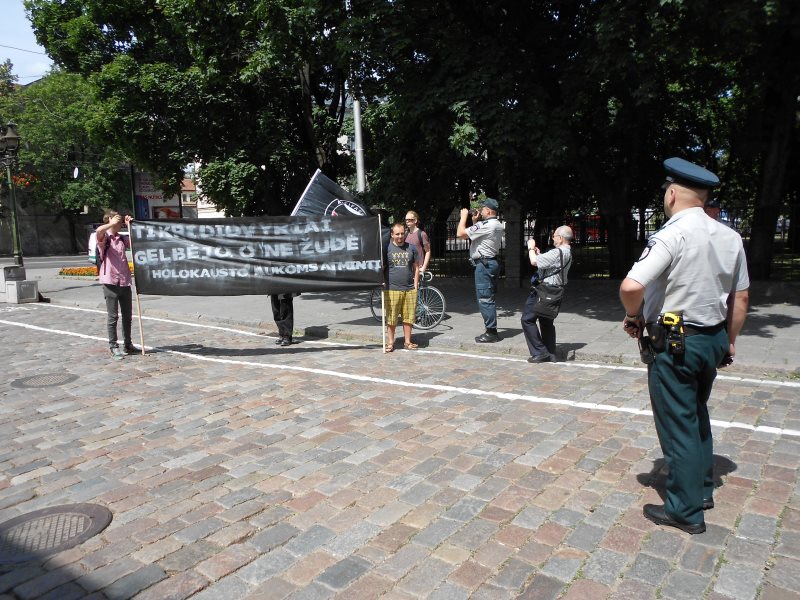
Antifa Lietuva’s sign reads: “Real heroes rescued people instead of killing them. Remember the victims of the Holocaust”
6 June 2013. DefendingHistory.com: ‘The unwritten biography of Jonas Žemaitis: a tale of twists and turns’ by Evaldas Balčiūnas.
27 May 2013. DefendingHistory.com: ‘Rehabilitation of the past as a tool of modern politics’ by Milan Chersonski.
22 April 2013. Jerusalem Report: ‘Lithuania’s deceit’ by Bernard Dichek [see interviews with Fania Brantsovsky and Milda Jakulytė-Vasil].
10 April 2013. Defending History: ‘In Obeliai (Abél) and Rokiškis (Rákishok): More state-sponsored glorification of Nazi collaborators’ by Geoff Vasil.
29 March 2013. Žibutė (Lithuanian Feminist Program): Antifascism and a campaign of terror.
16 March 2013. Delfi.lt: ‘Latvių SS legiono veteranų eitynėse žygiavo J.Panka bei R.Čekutis, A.Paleckis’ by Eglė Samoškaitė.
15 March 2013. DefendingHistory.com: ‘Believe it or not: Lithuanian parliament honors organizers of neo-Nazi march in central Vilnius’ [with full translation of Dovydas Pancerovas’s courageous article].
15 March 2013. DefendingHistory.com: ‘Lithuania’s Social Democratic Party issues statement against neo-Nazi march’.
14 March 2013. Lithuania Tribune: ‘Social Democrats censure “manifestations of ultranatnionalism”’.
14 March 2013. DefendingHistory.com: ‘Isn’t it time for the author of the myth to apologize?’ by Pinchos Fridberg.
11 March 2013. DefendingHistory.com: ‘3,000 participants in “unauthorized” neo-Nazi march in central Vilnius on 2013 independence day’ by Anna Shepherd [with reports on the courageous groups of Lithuanian citizens who turned out to oppose the neo-Nazi march in central Vilnius].
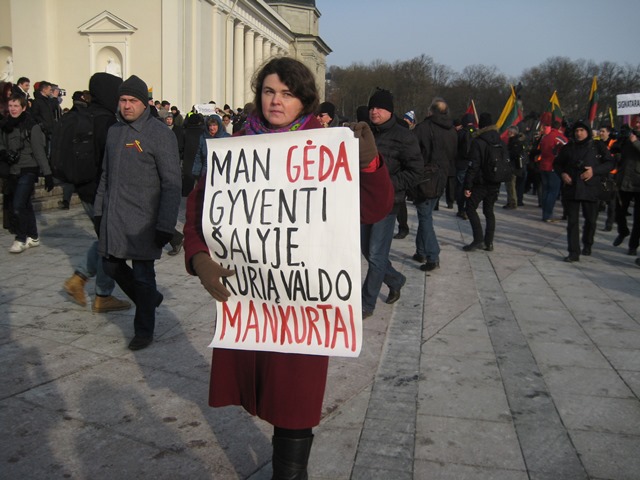
Fiokla Kiure carries a protest sign at the neo-Nazis’ independence day march in central Vilnius on 11 March 2013. Sign reads: “I’m ashamed to live in a country that’s run by Mankurts.”
24 February 2013. DefendingHistory.com: ‘Evaldas Balčiūnas remembers February 16th 2013 march in central Kaunas’ by Evaldas Balčiūnas.
23 February 2013. DefendingHistory.com: ‘A counter-question to Lithuanian journalist Artūras Račas’ by Pinchos Fridberg.
23 February 2013. DefendingHistory.com: ‘The real dope on the February 16 neo-Nazi march in Kaunas (Kovno), Lithuania’ by Geoff Vasil.
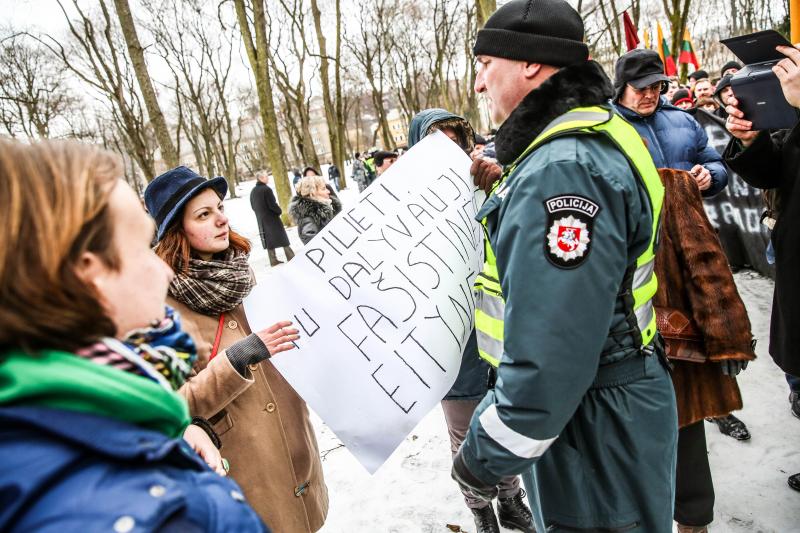
A number of courageous young Lithuanians, affiliated with antifa.lt and anarchija.lt were among the tiny number of protesters at the February 16th neo-Nazi march in Kaunas that featured on the front banner the Nazi puppet prime minister of 1941. They were harassed by police who demanded their names and addresses. By contrast the police were highly courteous to Efraim Zuroff and Dovid Katz who came to monitor and protest the event.
14 February 2013. DefendingHistory.com: ‘Righteous among the nations: Zháger (Žagarė).
14 February 2013. The Baltic Times: ‘Lithuanian PM is against instigation of ethnic hatred’.
14 February 2013. DefendingHistory.com: ‘Pinchos Fridberg provides chronology of a provocation’.
8 February 2013. VilNews.com: ‘A poem about the witches among us’ by K.R. Slade.
1 February 2013. Obzor: ‘Two questions of the leaders of the Jewish Community of Lithuania’ by Pinchos Fridberg [in Russian].
31 January 2013. DefendingHistory.com: ‘Why Christine Beresniova is out of order’ by Geoff Vasil.
16 January 2013. Jewish Community of Lithuania: ‘Instead of truth about the Holocaust — Myths about saving Jews’ by Pinchos Fridberg.
15 January 2013. The Algemeiner: ‘Instead of truth about the Holocaust — Myths about saving Jews’ by Pinchos Fridberg.
• Eight Lithuanian parliamentarians (six MPs and two MEPs) courageously sign the Seventy Years Declaration. They are rapidly attacked by the foreign minister, and defended by UK MP Denis MacShane, who wrote to each. The New York Times reports. Jewish Chronicle. Algemeiner Journal. MP Vytenis Povilas Andriukaitis (now minister of health) replied powerfully. So did UK MP and author Denis MacShane. Andres Spokoiny’s tribute to MP Andriukaitis.
• Hundreds of Lithuanian citizens of all backgrounds, resident in Lithuania and in a dozen countries, courageously sign Olga Zabludoff’s petition asking the Lithuanian government to ban the neo-Nazi march from the central boulevard of Lithuania’s beautiful capital Vilnius on its proud independence day of March 11th.
• Many Lithuanian citizens, resident in Lithuania and elsewhere, courageously sign Krystyna Anna Steiger’s petition. It started as a petition asking Vytatyas Magnus University to cancel events honoring the 1941 Nazi puppet prime minister. Upon achievement of that goal it shifted to asking the government to cancel its reburial ceremonies. Following the reburial, it evolved to the current petition asking the government to remove memorials to Nazi collaborators on public property.
• Eight of the nine demonstrators who picketed the opening of a racist-homophobe’s art exhibition at Vilnius University on 27 September 2012 are Lithuanian citizens. Details here.
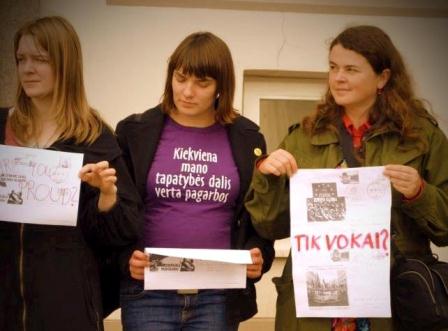
Among the nine demonstrators against Vilnius University’s mounting of an exhibit of the works of an antisemitic, racist, homophobic artist. Report at: https://defendinghistory.com/vilnius-university-calls-antisemitic-artist-humanistic-as-bold-young-lithuanian-intellectuals-protest-but-bloomington-borns-remains-silent/42357.
• Among the major bold and courageous contributions to the debate by Lithuanian personalities in 2012: Vytenis Povilas Andriukaitis 1, 2, 3, 4; V.T. Andriukaitis & A. Sysas; Saulius Beržinis; Algis Davidavičius; Leonidas Donskis 1, 2; Darius Udrys, Alicija Žukauskaitė.
———
3 October 2012. DefendingHistory.com: ’Ignas Vylius-Vėlavičius: Lithuanian patriot or Holocaust perpetrator?’ by Evaldas Balčiūnas.
25 September 2012. Delfi.lt: ‘Parodos detektyvas VU: žydai pasipiktino dailininku, kairieji organizuoja protestą, universitetas sutrikęs’ [‘A detective story about an exhibit at Vilnius University: Jews upset by artist, leftists organize protest, university in disarray] by Eglė Samoškaitė.
17 September 2012. DefendingHistory.com: ‘Lithuania’s state Jewish museum responds to survivors’ concerns about London meetings together with (antisemitic) Genocide Center’ by Kamilė Rupeikaitė.
30 July 2012. DefendingHistory.com: ‘Crying over dead Jews’ by Geoff Vasil. Republication in the Algemeiner Journal. Republication in 15min.lt. August 1st 2012 pick of the day on Jewish Ideas Daily.
6 July 2012. DefendingHistory.com: ‘The Holocaust? It happens to everyone…’ by Algis Davidavičius.
4 July 2012. DefendingHistory.com: ‘Reburial as a means for the rewriting of history’ by Milan Chersonski.
29 June 2012. Defending History.com: ‘Another “resistance hero” or — war criminal who selected Jews for mass murder?’ by Evaldas Balčiūnas.
20 May 2012. DefendingHistory.com: ‘Dramatic confrontation on the floor of the Lithuanian parliament’.
17 May 2012. VilNews.com: ‘Juozas Ambrazevičius-Brazaitis is no hero’ by Darius Udrys. Republished in 15min.lt. Republished in the Lithuania Tribune.
29 April 2012. Lietuvos rytas: ‘Musicians speaking out against racism: “You need to love your country with songs, not fists’ by Eglė Šilinskaitė. English translation here.
29 April 2012. Lietuvos rytas: ‘Musicians speaking out against racism: “You need to love your country with songs, not fists’ by Eglė Šilinskaitė. English translation here.
28 April 2012. DefendingHistory.com: ‘The history of three “Lithuanian Freedom Army” (LFA) colonels who served the Nazis” by Evaldas Balčiūnas.
12 April 2012. DefendingHistory.com: ‘MP Vytenis Andriukaitis: Open letter to Genocide Center’s “chief specialist” Ričardas Čekutis’ by Vytenis Povilas Andriukaitis. [= authorized English translation of 5 April 2012 Balsas.lt article]
11 February 2012. DefendingHistory.com: ‘Lithuanian parliamentarian Vytenis Andriukaitis, signatory of 70 Years Declaration, replies to foreign minister, cites “moustache” remark and the implications of ‘double genocide”‘. [An authorized translation of the Lithuanian article by Vytenis Andriukaitis that appeared on Delfi.lt on 9 February 2012]
22 January 2012. DefendingHistory.com: ‘Lithuanian foreign minister berates his country’s parliamentarians who signed “70 Years Declaration”; Says Hitler = Stalin except for length of their moustaches’. Republished on Operation Last Chance.
20 January 2012. DefendingHistory.com: ‘The Seventy Years Declaration on the anniversary of the final solution conference at Wannsee’ [including eight Lithuanian signatories].
♦
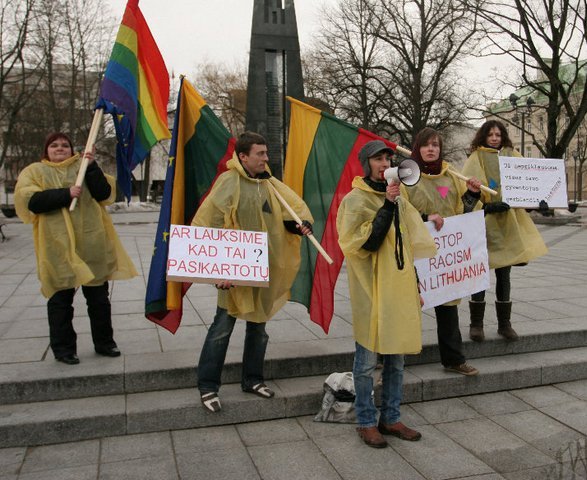
Five courageous members of the Tolerant Youth Association of Lithuania (http://www.tja.lt) staged a small but powerful counter-demonstration against the neo-Nazi march held on 11 March 2011.
Shimon Alperovich interviewed by Frank Bendle on Taz.de, 4 February 2011.
Evaldas Balčiūnas, ‘Lithuanian State Commemorates Murderers’ on Anarchija.lt, 22 March 2011. Authorized English translation by Geoff Vasil available here.
Monika Bonckute, ‘The bureaucrat who thought he was a victim’ in Lietuvos rytas, 8 March 2011. Authorized English translation by Geoff Vasil available here.
Mečys Laurinkus, ‘Fascist demonstrators: a real problem for Lithuania’s future’ in Lietuvos rytas, 26 March 2011. English translation.
Geoff Vasil (Vasiliauskas), ‘Lithuania and Tolerance’ on DefendingHistory.com, 10 January 2011.
Nida Vasiliauskaitė, ‘Fascism in National Cellophane’ on DefendingHistory.com, 16 February 2011.
Andrejus Žukovskis, ‘Jerusalem of Lithuania is saddened’ in Diena.lt, 23 April 2011.
♦
Shimon Alperovich (Simonas Alperavičius), public letter to Irena Degutiene, chair of the Lithuanian parliament, 4 October 2010. English translation by Geoff Vasil.
Andrius Bielskis, ‘If we don’t recognize the Holocaust we won’t take responsibility for the tragedy’ on Delfi.lt, 10 December 2010. English translation by Geoff Vasil.
Monika Bončkutė, ‘Rejecting tolerance, Lithuanians enjoy the role of victim’ in Lietuvos rytas, 9 April 2010. English translation by Geoff Vasil.
Monika Bončkutė, ‘Pure-blooded Lithuanians need Jewish Litvaks’ in Lietuvos rytas, 21 January 2010. English translation by Geoff Vasil.
Leonidas Donskis, ‘What happened to us?’ in the Baltic Times, 15 April 2010.
Leonidas Donskis, ‘Where is that line?’ on DefendingHistory.com, 11 December 2010.
Leonidas Donskis, ‘Kada tiesa pagaliau mus išlaisvins?’ [When will the truth finally set us free?] on his blog, 1 September 2010. Authorized English translation by Geoff Vasil.
Andrius Navickas, ‘Holokaustas ir atminties gydymas’ on Bernardinai.lt, 23 September 2010. English translation by Geoff Vasil.
Algirdas Paleckis, ‘The legacy of fascists and fascism in Lithuania’, paper delivered at the World Without Nazism Conference, Kiev, 21 June 2010.
Nida Vasiliauskaitė, ‘On 1941, the Jews, and Us’ on DefendingHistory.com, 13 December 2010.
Tomas Venclova, ‘Aš dūstu’ [I am suffocating] on Bernardinai.lt, 14 July 2010. Excerpt in English here. Full authorized translation by Geoff Vasil here.
♦
Leonidas Donskis, ‘The inflation of genocide’ in EuropeanVoice.com, 24 July 2009.
Daiva Repečkaitė, ‘How the word spreads’ on author’s blog Wonderland, 4 December 2009.
Daiva Repečkaitė, ‘Delfi’s “McCarthyism” continues’ on author’s blog Wonderland, 14 November 2009.
Rasa Rimickaitė, ‘Dantesque emptiness’ in Jerusalem of Lithuania, April-June 2009.
Darius J. Ross, ‘Sticks and stones’ in The Baltic Times, 23-29 April 2009.
Darius Udrys, The Road to Freedom: Lithuania / Kelias i Laisve: Lietuva. Documentary film on blip.tv.
‘Tomas Venclova on Lithuania’s intellectuals’, 15 July 2009.
Dr Efraim Zuroff, director of the Simon Wiesenthal Center’s Israel Office, pays tribute to citizens who assisted Operation Last Chance, in his Operation Last Chance, pp 156-160(see Recent Books → 2009 → Zuroff).
♦
Leonidas Donskis, ‘Hostages to an ill-begotten theory’ in Transitions Online, 10 October 2008.
‘Lithuanian academic blasts war crimes probe of ex- Yad Vashem chief’ in Haaretz, 5 October 2008.
Geoff Vasil (Vasiliauskas), ‘Analyzing Lithuanian antisemitism. The “double genocide” theory refuses to quit’ in Jewish Currents, November 2008; alternate link.
♦
Report on a project of the House of Memory led by Linas Vildziunas, September 2006.
♦
♦
V. Brandišauskas’s review of A. Liekis’s book (2000) on the first weeks of the Holocaust in Lithuania. English translation.
♦
♦
♦
♦
♦
♦
The eminent Lithuanian scholar and poet Tomas Venclova (Yale University) published the first Lithuanian version of his valiant essay, ‘Jews and Lithuanians’ in the samizdat journal Tarbut in 1975. The standard English version appears in his Forms of Hope.
♦
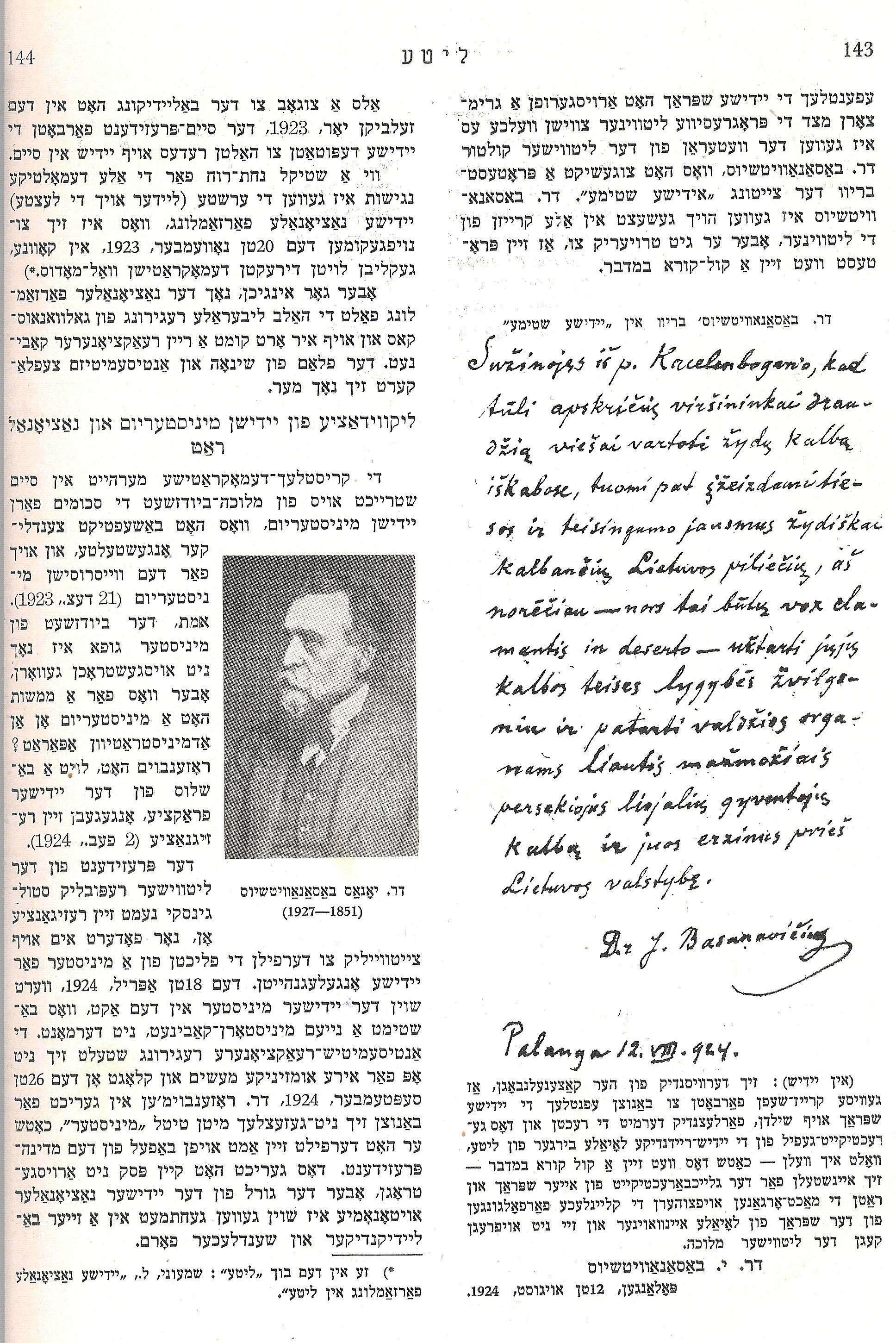
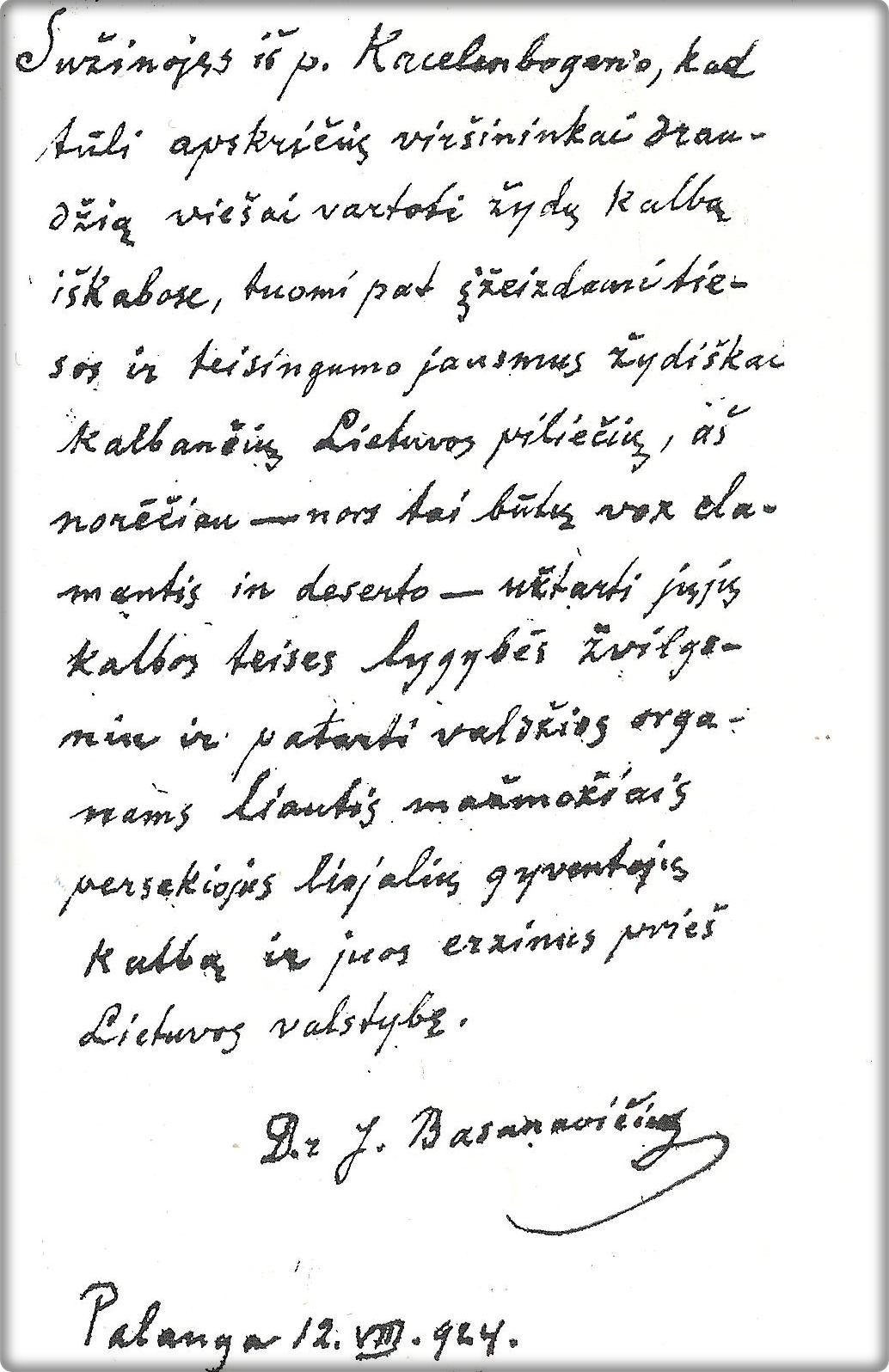
Dr. Jonas Basanavičius (1851-1927), a principal founder of the Lithuanian revival of modern times, and editor of the first newspaper in the language, wrote this letter in 1924 to a Jewish newspaper, upon hearing of plans to ban Yiddish signs in public places. The English translation is followed by a facsimile of the original Lithuanian letter, taken from M. Sudarski’s Líte (New York 1951), p. 143. A facsimile of the page is available here.
“Having learned from Mr. Katsenelenbogen that certain district leaders are banning the public use of the Yiddish language on signs, and thereby violating the sense of justice of the Yiddish speaking citizens of Lithuania, I would like — though it be a cry in the wilderness — to defend their language on the basis of equality, and to advise the organs of government to stop persecuting, pettily, the language of loyal residents, and to stop making them feel aggrieved by the Lithuanian government.”
- Dr. J. Basanavičius
- Palanga, 12 August 1924
APOLOGIES
THIS PAGE HAS MOVED HERE:
SEVEN SOLUTIONS
Algirdas Brazauskas (1932-2010), visionary first elected president and later prime minister of free Lithuania died today in Vilnius. In each of his land’s highest offices he proved himself a leader in the grand spirit of the multicultural Grand Duchy of Lithuania who will be properly appreciated long after our time.
From the start of Lithuania’s new history as a proud democratic nation, Algirdas Brazauskas understood that it did no good for his country that war criminals had been rehabilitated by ultranationalist officials.
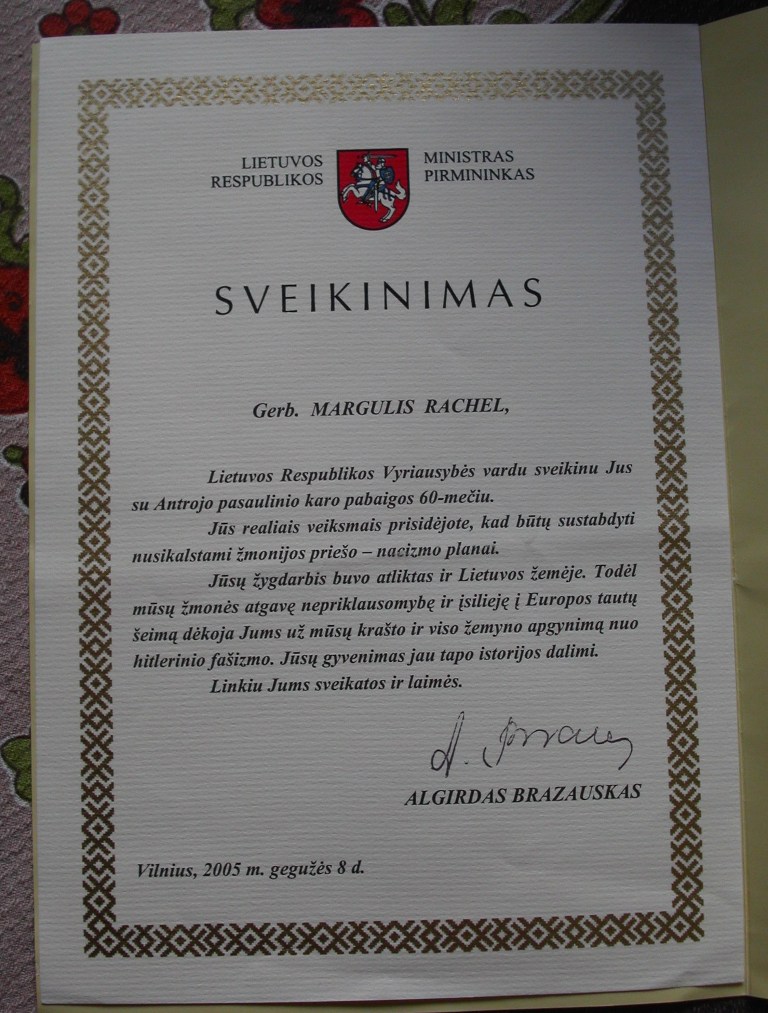
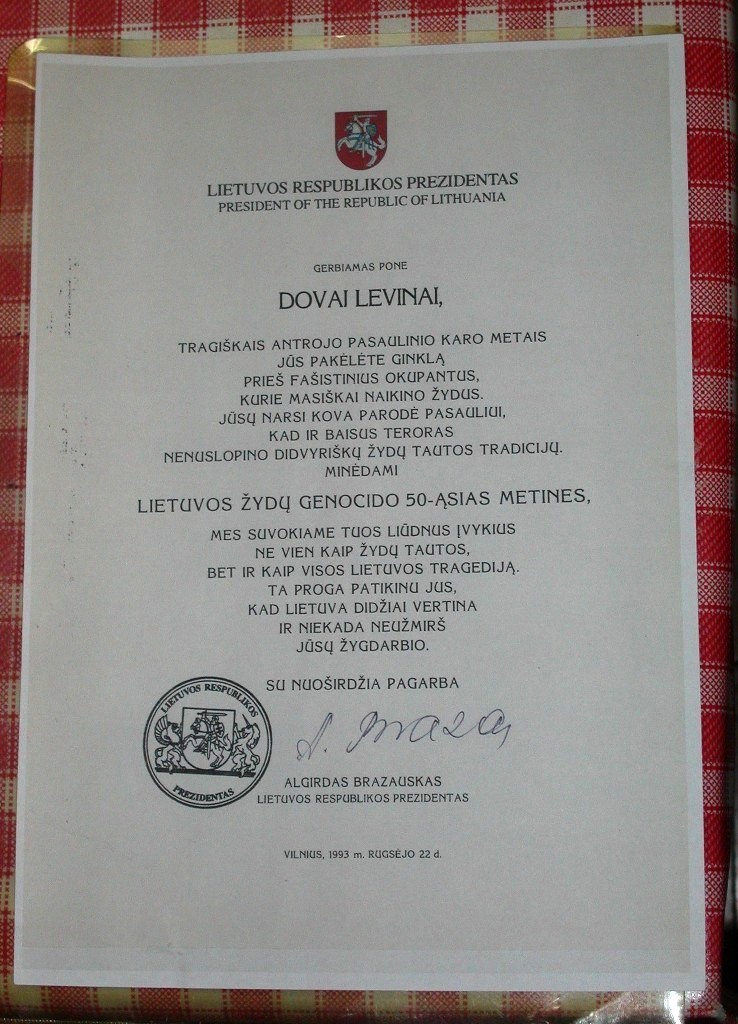
He paid tribute to Jewish partisan veterans for helping to free Lithuania from Nazi tyranny. As president, he honored Prof Dov Levin. As prime minister, he issued a certificate of recognition to Dr Rachel Margolis.
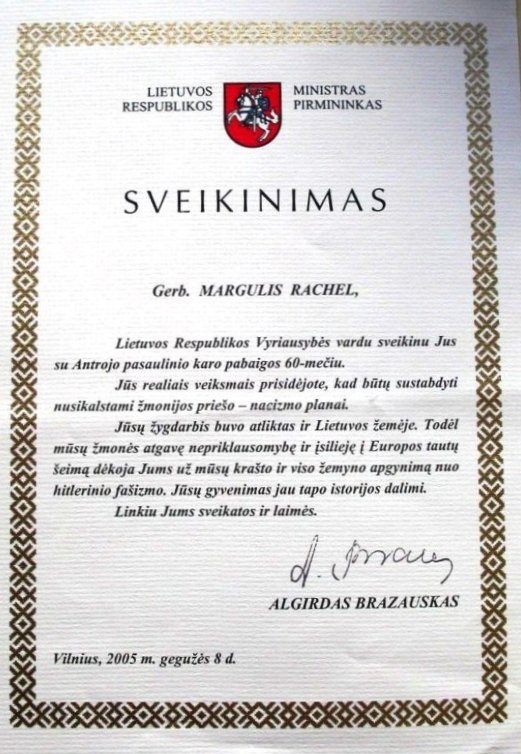
President Brazauskas’s historic speech to the Israeli Knesset in Jerusalem on 1 March 1995 will never be forgotten (full text here).  But in modern Litvak collective memory, there is perhaps one incident, that took place one day before, that will be remembered even more. The Lithuanian delegation was met by a picket line of Holocaust survivors near Yad Vashem. One elderly survivor, Y. Brosh, whose entire family was murdered at Ponar, made his feelings known robustly. Like the other survivors who protested, he was wearing a yellow star on his jacket. President Brazauskas went over to to the man, hugged him and kissed him.
Officials from Lithuania’s state prosecution service came to the Jewish Community’s premises at Pylimo Street 4 in Vilnius today — during a Holocaust Remembrance Day event — to ask community officials for information about Joseph Melamed, 85, a Tel Aviv resident. The news spread rapidly and caused disquiet among the small remnant community.
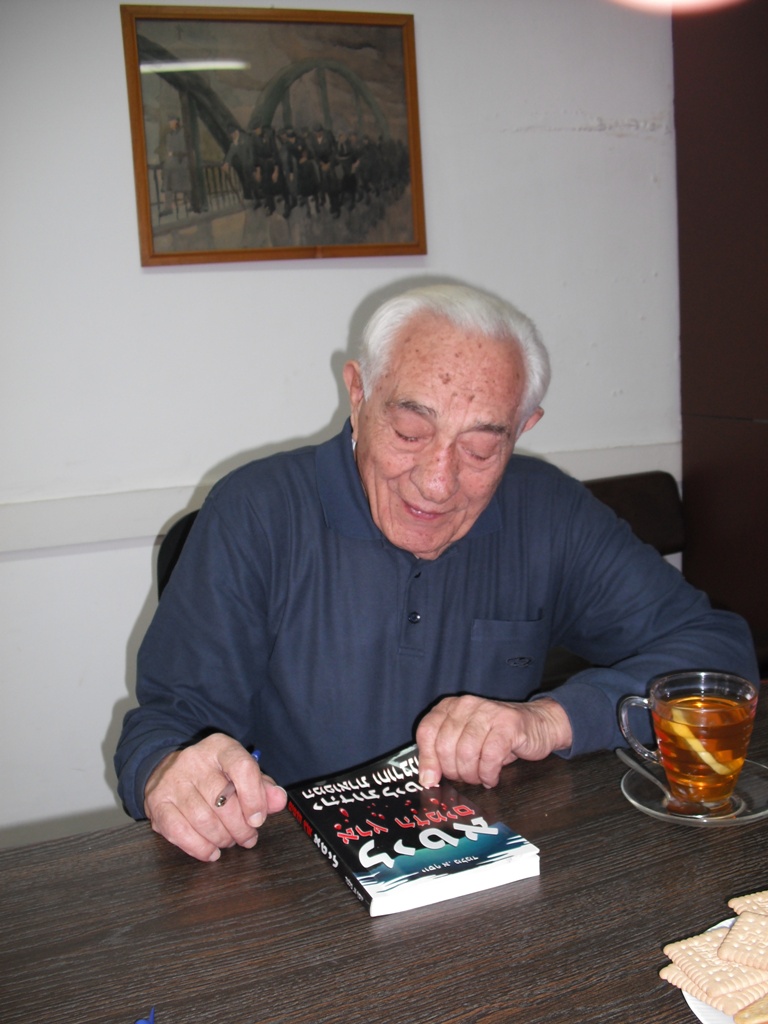
Attorney Joseph Melamed, a Holocaust survivor, with his Hebrew book ‘Lita’ (Lithuania) in his office at the Association of Lithuanian Jews on King David Boulevard in Tel Aviv
Mr. Melamed, head of the Association of Lithuanian Jews in Israel, possibly the world’s last active Litvak survivor organization, is himself a Holocaust (Kovno Ghetto) survivor, a veteran of the anti-Nazi partisans, veteran of the Israeli war of independence in 1948, a retired Israeli diplomat and a prominent attorney. He is the author and editor of various works about the Lithuanian Holocaust.
Prosecutors told the Lithuanian Jewish Community that they are ‘investigating’ Mr. Melamed in relation to his organization’s publication of lists of alleged local war criminals who are alleged to have participated in the annihilation of Lithuanian Jewry. A few of the people on these lists are considered ‘national heroes’ by various nationalist elements, especially those who joined the anti-Soviet resistance in and after 1944.
◊
This essay first appeared in Transitions on Line on 10 October 2008, with the following editor’s note: “Lithuanian authorities in late September closed their two-year investigation into the wartime partisan activities of Yitzhak Arad, a Lithuanian-born Israeli historian and a former head of the Yad Vashem Holocaust memorial, reportedly on the urging of the European Union and the United States. Prosecutors said there was insufficient evidence to link Arad to possible war crimes committed by Soviet partisans during a 1944 fight with German forces that left many Lithuanian civilians dead. The authorities are still considering whether to put two Lithuanian Jewish women, Fania Brantsovskaya (Brantsovsky) and Rachel Margolis, on the witness stand in connection with the killings.”
It is republished here with Professor Donskis’s permission. For a history of the issue, see our page on the subject of Holocaust survivors defamed by prosecutors.
See more of Professor Donskis’s work in Defending History.
A disturbing tendency has recently appeared in Lithuania. In the words of the eminent scholar of Yiddish Dovid Katz, this tendency may best be described as the “Holocaust Obfuscation movement.” Its essence lies in subversion of the logic and evidence of the Holocaust, whitewashing or at least selectively reading the history of the Second World War and drastically shifting the roles of victims and evil-doers.
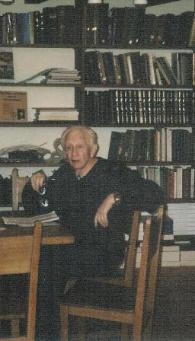
Professor Meir Shub
Holocaust in the Baltics, established on 6 September 2009, is dedicated to the memory of Professor Meir Shub (1924—2009), pictured at right teaching a class at Vilnius University in the early 2000s.
A historian and philosopher, he dedicated the last decades of his life to rebuilding Jewish studies in Vilnius, despite severe health issues deriving from his World War II wounds sustained as a Red Army soldier during the struggle against Nazism.
He was determined to inspire and train students of all backgrounds who would freely research Judaic topics, including the Holocaust. He was convinced that the success of these studies depended on the retention of a robust and intellectually free-feeling Jewish community component in such projects in Eastern Europe.
Meir Shub’s booming voice (which grew louder as his deafness worsened), straight talk, and high Litvak expectations of his students were trademarks. He is sorely missed. He played a pivotal role in achieving the first Oxford-Vilnius agreement in Judaic studies, and, in 1991-1992, was a visiting fellow at the Centre for Hebrew and Jewish Studies at Oxford University. His works include a study of the Gaon of Vilna.
◊
Last week I was caught in a debate with myself: whether or not to appear, despite the feeling of nausea, in a discussion with Lithuanian historians, writers and poets at the International Book Fair in Jerusalem. The idea made me so sick that in the end I decided to stay away and I also convinced my friend, former partisan and former chairman of Yad Vashem Yitzhak Arad, to excuse himself from the discussions.
This English version of the essay (the original Lithuanian text appeared in Lietuvos aidas, 28 November 2008) first appeared in the English edition of Jerusalem of Lithuania (Oct-Dec 2008, PDF here) and is republished here with the author’s and editor’s permission.
I have already written that we live in a period of not only monetary inflation, but of concept and value inflation as well. In our time oaths have become worthless, while formerly a person who broke one lost not only all of his own power, but the capacity to represent his values and to participate in the public sphere as well. Nothing, other than his own person and his private life, remained. He no longer had the right to speak on behalf of either his group, his nation, or his society.