


OPINION | MEMOIRS | LITVAK AFFAIRS | LITHUANIA | POLITICS OF MEMORY
◊
by Harry Gorfine
◊
“Pakelk galva pakelk galva! Paupių piliečiai”
Emigrating from Czarist Vilna to Petticoat Lane – escaping pogroms to reside near Jack the Ripper
From the Ripper to the high seas, heading for the Land Downunder
Returning to Lita – a vicarious journey of ancestral discovery and historical revelation
◊
Prologue
I first visited Lithuania in July 2007, a side-excursion courtesy of an around-the-world air ticket which allowed one return flight within Europe. This was ostensibly a business trip, with Japan and North America my main destinations, but as an avid martial artist I’d organized some training during a few days’ stopover in Helsinki, as I flew westwards between continents in accordance with the fare rules. I chose Vilnius as the within-Europe stage of the trip, as it was only a short ~100 min flight from Vantaa Airport and I anticipated that I would discover more about my ancestry in the city where my great-grandparents claimed they were born, raised, and married during the latter half of the nineteenth century. Although I knew that my great-grandparents were Jewish, I didn’t think about them as unassimilated Litvaks living segregated from the natives. As far as I was concerned, they were Lithuanians born into families of the Jewish faith in a land that at the time was under czarist rule of the Russian Empire.
This initial foray into “the land of rain” was the catalyst for almost two decades’ visitation, now having spent an aggregate of around five years there during twenty trips, mostly in the warmer summer months when it has seldom rained. I’ve experienced various aspects of contemporary Lithuanian life and culture, more as an alien resident than tourist, with many sites yet to explore as my travels are more opportunistic than planned. I even organized a modest international conference in Vilnius during the summer of 2014 and worked there full-time for six months in 2019 before Covid restrictions confined me to my homeland for the following two years. Traditional local cuisine is something to which I have become accustomed, often an acquired taste with many recipes ironically borrowed from Litvaks, for instance cepeliniai, kugelis (be kiaulės kairės ausies), and bulvių blynai, but I have yet to eat varna (crow) which is fried, not baked in a pie.
Unlike my great-grandparents, I was not born into Judaism, although one quarter of my DNA is Ashkenazic. In contrast to my paternal ancestry, I know far more about my maternal lineage, including that Greenland 929 (a man of the Viking Greenlander cultural group, residing in the Western Settlement near Nuuk, Greenland, circa 893–1155 CE) and I shared a common maternal ancestor who existed around 1350 BCE. I’m no historian, my formal studies of the subject ceased in middle high school, but I am a scientist accustomed to evidence-based analysis and objective interpretation.
Despite substantial effort since 2006, my initial somewhat naive quest to discover the shtetl and residential buildings in which my great-grandparents dwelt has been unsuccessful. Instead, I have been able to establish what life might have been like for them, vicariously through the narratives of other Litvak families with a putative connection, mostly variants of my Yiddish-derived surname, which is “completely fine” by me. DNA testing reveals that a sizeable proportion of my ancestry stems from the Pale of Commonwealth, encompassing Eastern Poland, Western Belarus, and Ukraine, with Lithuania roughly in the middle. This is of course biased towards the pool of people who, despite personal security risks, have submitted their DNA for genealogical testing. Although DNA unequivocally demonstrates connections from generations ago, in the absence of records as documentary evidence it cannot explain how individuals with DNA sequences in common are connected.
The extensive account which follows melds various aspects of my genealogical quest, with my personal experiences and perspectives, and interpretative synthesis of numerous diverse published works I have read and critically appraised from a layman’s standpoint. In common with many visitors to Lithuania, initially I had no idea that most of its Jewry had been “lost” during the early 1940s following six centuries of habitation. Invariably, there will be much in common with more erudite articles written by other scribes who have trodden similar paths of ancestral exploration. Nevertheless, the opinions expressed are my own, arising from imperfect “constructs” that are continually challenged and revised as new revelations are evaluated and accommodated. Making sense of the complex dynamics of past and present collective human behaviour patterns punctuated by idiosyncrasy is indeed a challenge.
Reflecting on unifying the elements of this missive into a central theme, it is perhaps apt to invoke the myth of Janus, the Roman doorkeeper presiding over the nexus between past and present. What can we learn from the past that can inform the present to prepare us to enter through a gateway to the future?
◊
Fašistai and fashionistas
Descending a path that zigzags its way down an escarpment from the hilltop of the now gentrified Bohemian Užupio respublikos (Republic of Užupis) in Vilnius, I find myself in the picturesque valley below on the right bank of the Vilnia river. Paplauja, as this valley was known prior to World War II, once thrived with Jewish industry and craftwork, yet overt reminders of this history have been erased as if scoured out by the fluvial forces of the river. Residents and visitors alike often remain blissfully ignorant of the rich past and its abrupt cessation. Instead, they are engulfed by the sensory impact of the present with the clear waters of the Vilnia (in Yiddish the Vilénke) flowing swiftly over well-worn rocks and the bright greenery of aquatic vegetation towards the more voluminous, turbid and sluggish mainstream waters of the Neris (in Yiddish the Vilíye), its confluence directly opposite the Old Vilna Jewish Cemetery (Senosiose Vilnijos žydų kapinėse).
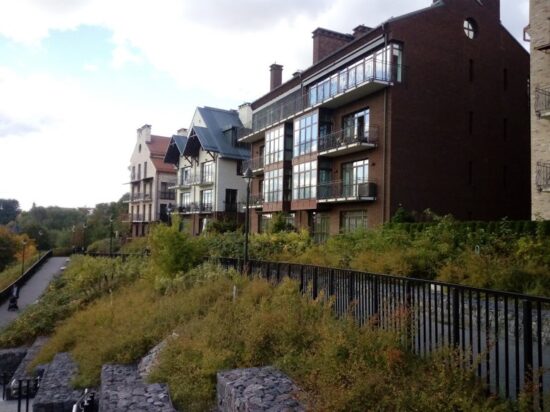
Atop the escarpment above the right bank of the Vilnia upė, accessible from Polocko g. which traverses uphill from Užupis.
Looking back up the escarpment there is a small, paved square at the top of the path with the Vilniaus Bernardinų kapinių koplyčia behind the tree-lined boundary. Bernardine Cemetery is the second-oldest cemetery in Vilnius still accepting customers, mostly with Polish and Slavic names on the headstones. Whereas it has only been open for business for two centuries, the Old Jewish Cemetery at Piramont, in Shnípishok (today the Šnipiškės district) operated from the fifteenth century according to Jewish sources, and from 1592 according to surviving municipal records, until 1831 (see here and here).
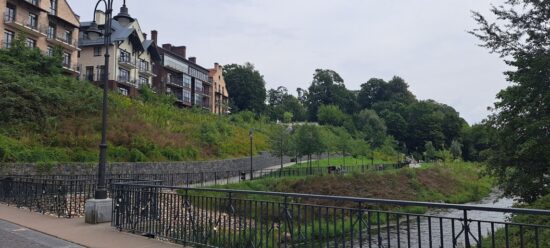
The escarpment along the right bank of the Vilnia upė viewed from Paupys. The extensive landscaping was likely funded with assistance from the EU, hence the expensive stainless-steel handrails, granite paving stones and gabion retaining walls, beyond the financial means of ratepayers in the Vilnius municipality (an example here).
Controversy has continually dogged the cemetery ever since its desecration by the Soviet Regime erecting an ugly brutalist concrete sports stadium on part of the site after repurposing pilfered headstones as entrance steps to Communist administration buildings throughout the City of Vilnius. The concave, wave-shaped stadium is akin to a tsunami poised to metaphorically erase what remains of sacred Jewish history at the site. Today, local entrepreneurs aided and abetted by municipal apparatchiks have been pursuing redevelopment of what they view as a lucrative commercial construction opportunity, a National Convention Centre, as if there isn’t already enough such venues in the city (see reports from the last decade). With only several thousand Jewish citizens remaining in the part of Lita that is within today’s Republic of Lithuania, courtesy of indigenous Lithuania’s enthusiastic participation in the Holocaust, perhaps the prevailing opinion is that they can scarcely claim to be needing it anymore. In fact, the “cremated” ashes of most of their departed relatives (~70,000) were mixed with the soil of the tranquil Paneriai (Ponar) Forest, so perhaps they should bless the memories of pre-war departed Litvaks alongside those murdered in the forest by local Lithuanians enabled by a modest number of invading Nazis.
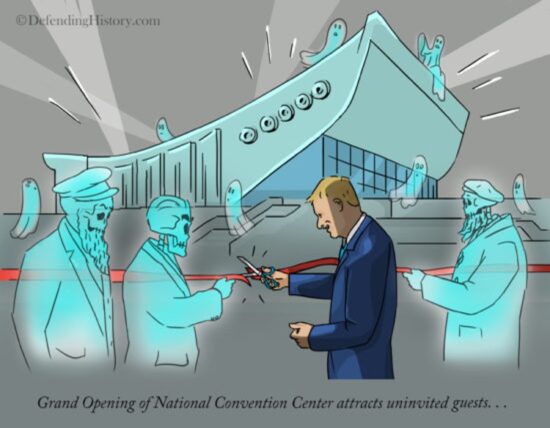
Desecration – a matter of National Convention. Photo: DefendingHistory.com
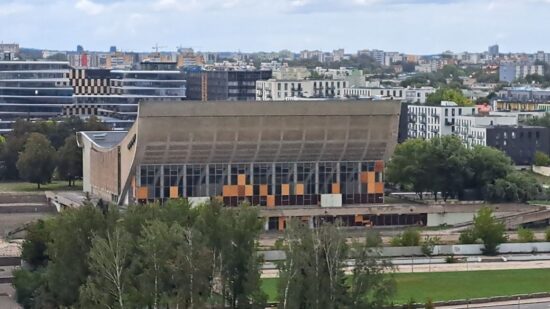
The brutalist Soviet sports legacy as it stands today in Šnipiškės on the right bank of the Neris River, desecrating the Old Jewish Cemetery.
Crossing a wide contemporary footbridge, I enter the former industrial suburb now known as Paupys, situated on the left bank of the Vilnia. During the interwar period many Jewish artisans plied their various trades to fabricate and merchandise useful goods under the governance of the Polish Wilno Voivodeship (1920–1939), and the area with its canals and islands, long since gone, provided respite from the travails of daily grind with taverns and cheap brothels. This valley of toil and leisure came to an abrupt end with the Soviets marching in during September 1939, following the dismemberment of Poland, and temporarily gifting its administration (a month later) to the Republic of Lithuania (capital: Kaunas) under a bilateral “Soviet–Lithuanian Mutual Assistance Treaty” (Lietuvos-Sovietų Sąjungos savitarpio pagalbos sutartis), as a ruse for subsequent Soviet occupation. When the Lithuanians took over, clashes occurred between Poles and Communists, with the former taking out their anger on Jews as scapegoats, variously assaulting them and raiding their shops whilst the Lithuanian Police turned a blind eye. Soon adverse economic consequences descended upon the entire community where
“… unemployment was rampant, food was in short supply, valuables were stolen by the Soviet army, war refugees were gathering from other former Polish territories … The Lithuanian government decided to implement a land reform similar to the land reform executed in the 1920s. Large estates would be nationalized and distributed to landless peasants in exchange for redemption dues payable in 36 years. Politicians hoped that such reform would weaken pro-Polish landowners and would win peasants’ loyalty to the Lithuanian state. By March 1940, 90 estates and 23,000 hectares were distributed. Lithuanians proceeded to “re-Lithuanize” cultural life in Vilnius Region. They closed many Polish cultural and educational institutions, including Stephan Batory University [now Vilnius University] with over 3,000 students. Lithuanians sought to introduce the Lithuanian language in public life and sponsored Lithuanian organizations and cultural activities.”
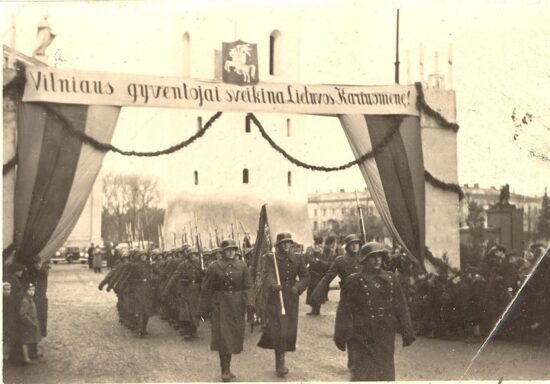
Lithuanian soldiers symbolically entering Vilnius by marching through Katedros aikštė to take control in 1939. Credit: personal album of Kęstutis Makariūnas, nuclear physicist and former chairman of the Lithuanian Science Council. Accessed online.
Prospects for autonomy espoused by the Russian Soviet regime were too good to be true for ethnic Lithuanians, and the dark spectre of occupation reappeared prophetically when the proclaimed Lithuanian Soviet Socialist Republic was incorporated into the Soviet Union on 3 August 1940, after the Soviets predictably claimed that Lithuania had breached the terms of the Treaty (and staged a rigged election). A short-lived episode of repression and deprivation ensued, followed by the deluded Lithuanian welcome of prospective emancipation when German Nazis invaded on 22 June 1941 (Operation Barbarossa, the Nazi invasion of the Soviet Union). The Nazis presided over what is arguably the most brutal and complete annihilation of Jews during the Holocaust, until they were defeated in The Battle of Memel on 28 January 1945, and of course World War II in Europe more generally on 8 May 1945, resulting in a resumption of Soviet autocratic governance of Lietuva.
By then, Lithuania’s hands were indelibly inked with the blood of 96.4% of its Litvak citizenry, from whom the nation had previously prospered. Without the enthusiastic participation of Lithuanians, it is doubtful that such a large concentration of Jews would have met with grisly, untimely, and underserved deaths. The Soviet Union’s eventual victory over Germany, in concert with its Western allies, in effect brought about the realization of the 1939 Molotov-Ribbentrop Pact, ensuring an aggregate of five decades of brutally oppressive dictatorial rule from Moscow under seven Soviet Leaders starting with Josef Stalin and ending with Mikhail Gorbachev when the USSR collapsed in 1991 and Lithuania regained its independence (proclaiming it in March 1990).
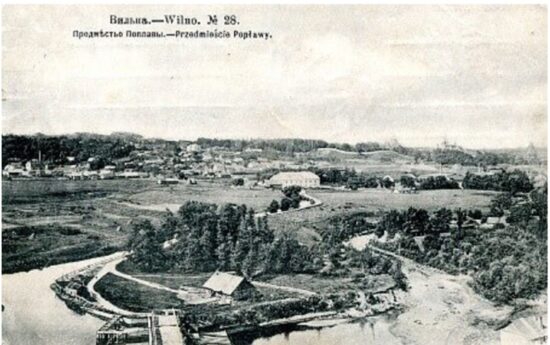
Meandering Vilnia River showing the islands, channels and marshes from two centuries ago that gave Paplauja its name. Source: LRT.lt.
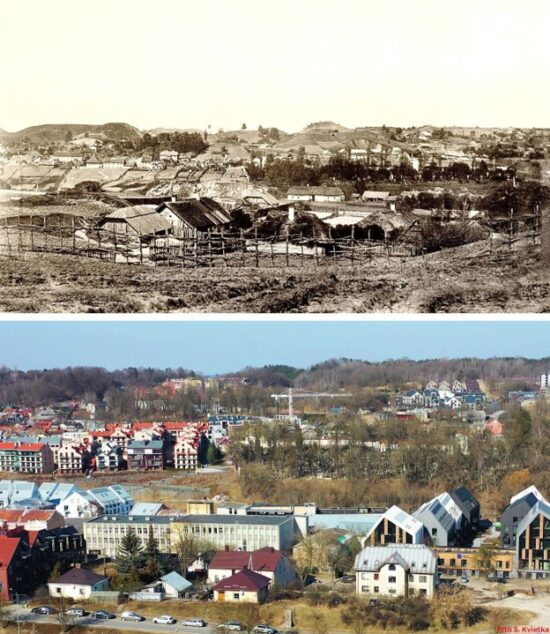
Until relatively recently, Paupys had become run-down from sheer neglect, ignorance and disdain for Lithuanian ethnic cultural values on the part of the Soviet occupiers, and later from municipal disinterest on the part of the City of Vilnius, with its priorities lying elsewhere after regaining independence.
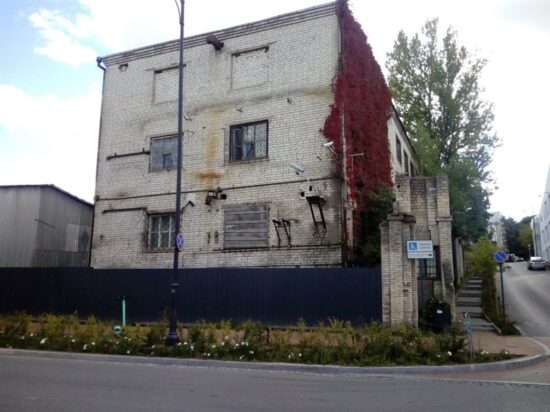
A Soviet industrial legacy remains in Paupys; a repurposed building now appropriately decorated by red ivy and rust marks.
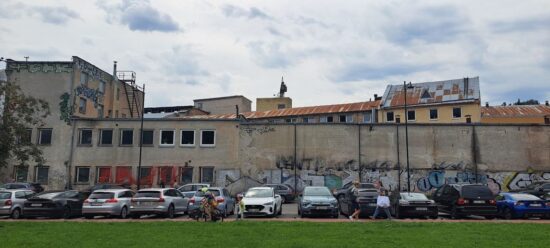
A Soviet industrial legacy remains in Paupys; a repurposed building now decorated by graffiti artists of dubious creative talent.
Over the past decade, the valley has been transformed into the now gentrified Paupys, emblematic of a contemporary renaissance in and around Vilnius, as increasing numbers of young, upwardly mobile, professionals continue to gravitate from the regional cities and countryside to the diesel and dust of the wealthier iconic capital. Užupis (a Lithuanian translation of Zaretsha, the earlier Slavic name, meaning “across the river”) has intrinsically transformed, but has superficially, retained the persona of a Bohemian enclave of creatives and hippies, squatting in architecturally attractive heritage buildings that had long fallen into disrepair replete with a characteristic dankness from decay. Rising property values accompanied by the prospects of expensive renovation costs, have created an apparent urban spillover as new contemporary architectural construction has proceeded apace in the adjacent valley of “Paplauja”.
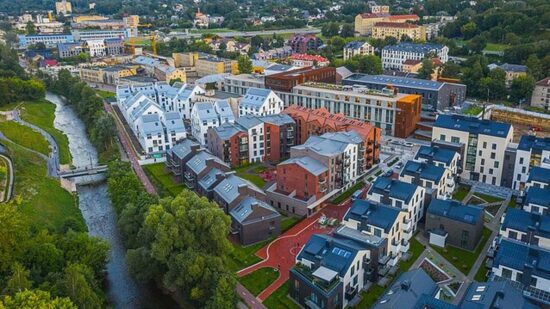
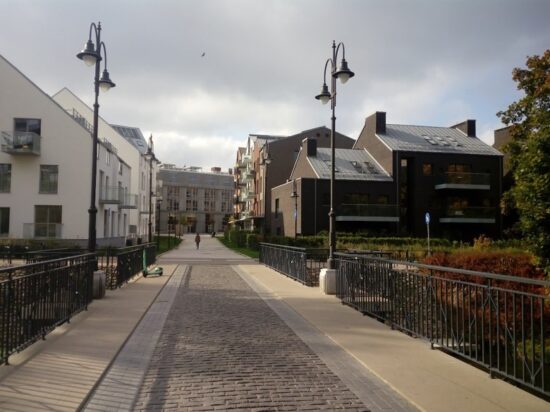
Paupys streetscape viewed from the footbridge across the Vilnia River with a ubiquitous green e-scooter parked to obstruct the less ambulant as a signature “tell someone who cares” statement.
Stepping off the bridge, I deftly weave along Vilnios takas among a seemingly endless procession of cyclists, e-scooter riders, skaters, joggers, and pram pushers using this busy riverside pathway. “Urbanistas” collectively seeking respite from the confines of their modern architecturally curated apartments, beneath summer shade afforded by the leafy canopy of the trees, established among the riparian vegetation.
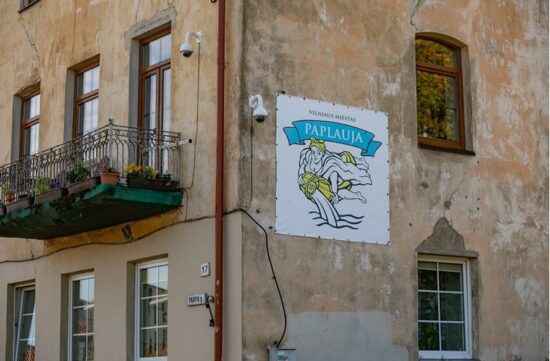
Paupys streetscape today, with a Paplauja sign nodding to its historic past. Source: LRT.
Claims by former City of Vilnius mayor, Remigijus Šimašius, of an exemplar in urban planning might be accurate in terms of architecture, landscaping, public amenity, and construction quality, but it is unclear whether long-term environmental issues, including potential for catastrophic flooding in the valley arising from future extreme weather events associated with changing climatic conditions, were considered by the municipality. It is somewhat ironic that Šimašius decries the Bauhaus architecture of the Soviets, yet the new buildings in Paupys are essentially steel and concrete structures, with their aesthetics stemming from creative use of external cosmetics, akin to many of its residents and the more flamboyant among local visitors. Of course, internally, these ~USD$1M medium density dwellings are luxurious in comparison to past pilkas (grey) Soviet austerity in prescribed daugiabučiai (apartment block) design.
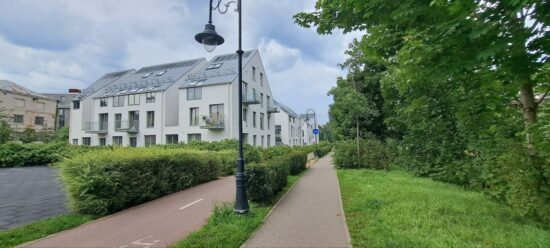
Contemporary Paupys apartments (daugiabučiai) bordering the takas.
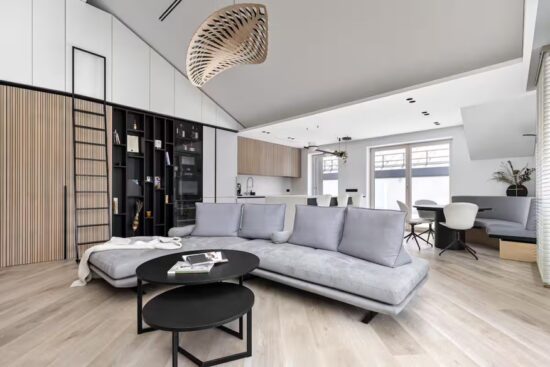
Turning right to head onto Aukštaičių gatvė, one can’t help but notice the hipsters and fashionistas who stand out among the throng, displaying assets acquired from fashion houses, gym memberships, tattoo studios and cosmetic surgeons’ salons. Toned, over-dimensional, muscle men with six-pack midriffs and bulging biceps, sporting man-buns and coiffed beards, courtesy of regular visitation of establishments such as Herr Katt (Uzupio g. 17 Uzupis), and svelte young women displaying enhancements from judiciously implanted silicones and injectable fillers, conveniently available at Sapiegos klinika in the main street (Aukštaičių st. 4C, Paupys), parade along the main drag. Solarium-tinted ebony skins stretched taut over anatomically enhanced and gym-toned musculature (Aukštaičių st. 7), seemingly de rigueur for all sexes, function as artistic canvases for an array of symbolic pagan and sentimental ink sketches, and occasionally, and not so patriotically, featuring an erroneous string of kanji, a Polynesian pe’a or a Celtic knot (see here and here). Sagginess and wrinkling, if it exists, is carefully “airbrushed out” with a regular inoculation of Botox, and unwanted cellulite is vacuumed away before it despoils the next selfie. Accompanying these amoral depauperates are designer-doodle dogs and miniaturized balls of fluff on toothpick sized legs, connected to their owners via decorative leads, and bejewelled collars for the women. For the virile vyrai (men) it’s thickset boof-headed, Mastiff or Staffy crosses, with angry appearances accessorized with heavy metal chains and studded collars.
One can but wonder about compatibility of hipsterishly indulging in café culture whilst pursuing an attractive morphotype, but perhaps the pyragai (cakes) and pyragaičiai (pastries) are mostly for display purposes, and the kava (coffee) is consumed juoda be sukraus (black without sugar), and the shakes are hydrated protein powder. Then again, I‘ve observed svelte young women deftly dissect and rapidly devour a pair of plump cepeliniai topped generously with grietinė (sour cream) and spirgas (deep fried cubes of smoked pork rind in liquefied fat) during brief lunch breaks. Perhaps the effects remain hidden in arterial walls.
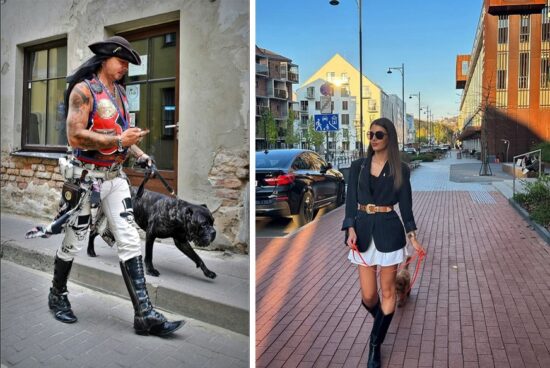
Eccentricity meets chic: the image of the gentleman in the pirate costume walking his didelis slobbering Italian Cane Corso pet past ‘Lucille’s Blues Bar’ in Rūdninkų 20 g. in the Senamiestis was sourced from here. The image of the mažas fluffy doodle dutifully following its model mistress westwards along Aukštaičių gatvė, Paupys, is from here.
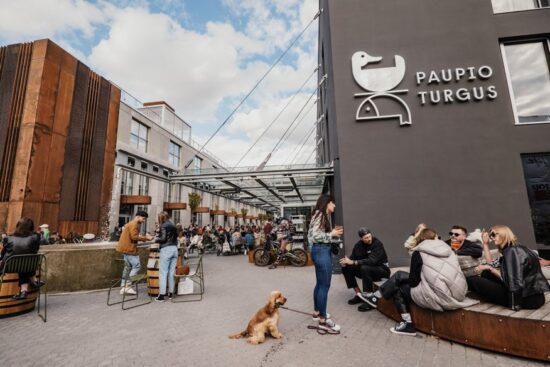
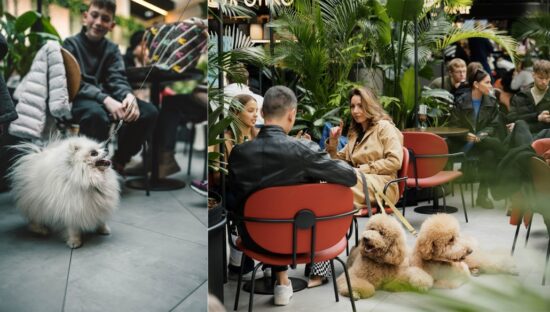
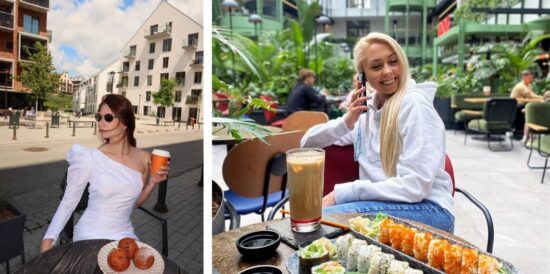
Daugiau poutama ir madingi žmonės lauko. The left image was sourced here, and the one at right here.
◊
“Pakelk galva pakelk galva! Paupių piliečiai.”
I feel like shouting at the gathered crowd, disrupting the vibe to gain their attention, using a variant of the oft-repeated nationalistic trope “Raise your head, Lithuanian”.
I’m imaging myself atop a soapbox, megaphone in hand proclaiming to gentrified citizens of Paupys,
“The ghosts of the paupers of HKP 562 are looking down from above upon your hedonistic Paupio lifestyle. Yes, you, the depauperate fashionista Yuppies with the designer puppies. Your self-obsessed superficial display of faux affluence, in tandem with your indifference to your forebears’ crimes against Lithuanian Jewish humanity, are astoundingly reprehensible. Stop, have a look around, take pause to reflect upon what could have been in 2025 but for what had transpired by 1945. Only about 10% of the HKP inmates survived, but this was the largest single group of survivors of Lithuania’s horrific participation in the Holocaust. Thanks not to Lithuanians, nor local Poles, it was a Nazi officer with a conscience who saved these wretched Jews from an untimely and unnecessary death.”
My leg muscles complain as I climb the precariously steep wooden steps that clatter noisily on their steel-framed staircase leading up from the garden of the “Downtown Forest Hostel and Camping” backpacker hostel. I emerge through a wrought iron gate in a fence on the northern side of Subačiaus gatvė which skirts the top of the southerly escarpment above the valley. The dreaded drėgmė (humidity) on this 26°C summer day is saturating my shirt, sandwiched between my back and daypack, causing me to stop to draw breath. I extract my water bottle from the daypack and take a welcome swig to quench my parched mouth, whilst directing my gaze towards the pair of pale-yellow brick tenements with red terracotta tile roofs at numbers 47–49. These identical twin apartment houses were built in 1898 to house approximately 4000 poor Jews, using a benevolent fund established by Baron Morris Hirsch Rothschild. I cross the street, thankful for the pedestrian lights that afford me the kind of safety from being mown down by hot-tempered Lithuanian men that was unavailable to Jews in the early 1940s. After a relatively easy 250 meter walk, taking care to avoid tripping on concrete raised to acute angles by the roots of oaks and elms, or soiling my shoes by stepping in a randomly deposited malodorous dog turd (šunų išmatos), I find myself staring across a courtyard between the twin buildings. A brown granite monument is visible above some steps at the far end, close to Drujos gatvė. Beneath the star of David, chiselled into the polished surface, is an inscription which gives testament to the deaths of most of the 2000 inmates of this forced labor camp. Despite on numerous occasions being driven past this location en route to Vilnius railway and bus stations during my annual visits, for more than a decade I was unaware of its existence, let alone its Litvak-Holocaust significance.
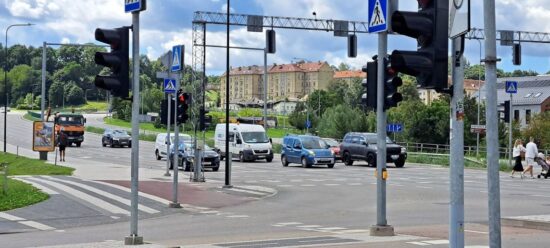
View of HKP 562 from the corner of Manufakturu g. and Drujos g.
Vilnius’ version of the renowned ‘Oskar Schindler’, Major Karl Plagge, convinced his superiors that the Jews under his watch in the Heereskraftfahrpark HKP 562 forced labor camp were skilled automotive technicians, essential workers who could not be spared for other activities, including participating as victims in a “liquidation”. A devout Nazi from an early age, Plagge was nevertheless distressed by his colleagues’ propensity to inject solid lead projectiles into the heads of the hapless Jews they encountered.
Sombre pondering of the extinguished lives that belonged to the 200 or so skeletons that remain interred beneath the courtyard carpark and lawn, my thoughts also stray to the first-hand story of Sidney Handler when nine years old, whose mother shoved him hastily into an open closet off a landing as they descended the stairwell, with armed Schutzstaffel on levels above and below. In a documentary video, he recounts losing control of his bowels after a German bayonet narrowly missed his malnourished torso as it pieced through the wooden door of the janitorial closet in which he was hiding. A few children survived this 1944 kinderaktion by hiding for hours beneath boards running across the trusses in the roof space above the upper sixth storey in hideously hot and stifling conditions. It is in the documentary Karl Plagge — The German Soldier Who Saved the Jews.
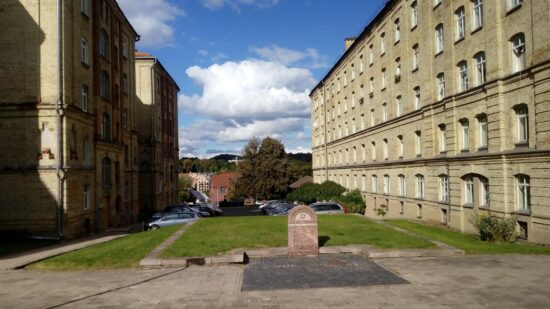
HKP 562 still standing, with ~200 buried beneath the courtyard (sources: here and here). Scars in the southeast-facing wall of Building 2 attest to executions of its former Jewish residents.
Collective denialism, dissociative amnesia, and deeply seated xenophobia infests the minds of many older Lithuanians who cannot bring themselves to confront their ironically “Catholic” nation’s complicity in playing a leading role in the Holocaust. Instead, those who know about the truth either put it to the back of their minds or cloak their forebears’ past crimes as Nazi collaborators beneath a veil of heroic partisan resistance against the former Soviet regime. History is revised, fictitiously “enriched” with valorization of barbarous war criminals, some of whom are memorialized in the street names in many towns, even in contemporary urban developments.
School students of the post-independence nineties were indoctrinated in a distorted history subtly imbued with antisemitism, yet somewhat ironically, contemporary curricula in an increasing number of secondary schools embrace the remembrance of pre-war Jewish culture and Jewish lives “lost” during the Holocaust, falling short of directly confronting the barbarism of how these lives were abruptly terminated and possible explanations about why. Aside from what they might have retained from their school history classes, younger post-independence generations appear in many instances preoccupied with superficial trappings of Western consumerist culture underpinning capitalist economies. In many instances, they eschew the societal benefits of tolerance and pursuit of equity stemming from a liberalism of which their parents were deprived. This is despite what they might have been taught about the vicissitudes of life and need for community resilience. A resilience that cannot come from false narratives of pseudo-heroism during times of conflict. Visibly, there is an unfortunate childlike fascination with shiny new trinkets and gadgets.
I postulate, that the cringeworthy bravado and nationalism belies a collective insecurity from suddenly having to step into a big person’s shoes to think critically, make responsible decisions and be held accountable for one’s stuff-ups. Sovietism is seemingly so ingrained that it continues to drive a need to invent a contemporary patriotic folklore, equally false as the stereotype of Litvak passivity. In contradiction to these tropes, Litvaks actually fought back bravely and defiantly against their tormentors in many instances, albeit unsuccessfully, with only a few surviving until war’s end. In stark contrast to their espoused bravado, Lithuanians allowed or even, according to some accounts, welcomed the entry of the Soviet military, which took over virtually unimpeded (as a consequence of the bilateral 1939 treaty described earlier). Then, when their enthusiasm or indifference was repaid by a year of tyranny, folklore informs us that they “bravely” chased after their oppressors in June 1941 (the so-called “June Uprising” or Birželio sukilimas), and again, after five decades of totalitarianism, in January 1991. Yet the Soviets did not depart in fear of sabre-rattling Samogotian warriors, they fled because, in the first instance in 1941 the Nazis were invading from the west as part of the largest invasion in human history, Hitler’s Operation Barbarossa, and in the second 50 years later, the USSR disintegrated.
False narratives morphing pretentiously into historical pseudo-facts peddled to the citizenry in true Soviet fashion by the machinery of government. Internal propaganda, which many among younger generations choose to ignore out of disinterest, as they are far too preoccupied with material acquisitions and hedonistic pleasures unknown to their forebears during Soviet rule. I further postulate that this conglomeration of nationalistic and materialist attitudes, predicated on false narratives and misplaced trust in the “rules based global order” of the past three decades, renders modern Lithuania more vulnerable to geopolitical disruption and less resilient to perturbations of its economy and consequent impacts on community well-being. There is a need for collective honesty and clear-sightedness.
Across Europe, alt-Right nationalism is on the rise and its minor political “ideologues” are gaining ground by entering government via unstable coalitions. In Lithuania, Lietuva, this has manifest as Nemuno Aušra (The Dawn of Nemunas) led by an aptly named young (40s) antisemitic xenophobe, Remigijus Žemaitaitis, who hails from Šilutė in Samogotia. Controversially, he has been accused of being pro-Russian, as he’s opposed to sanctions, implying ironically that he’s anti-patriotic. In 2023, he was dismissed from the Freedom and Justice Party he represented at the time, and impeached for breaching Lithuania’s constitution over statements that he made on social media (five antisemitic posts on Facebook, two of which quoted a well-known Lithuanian rhyme about murdering Jews) about Jews being responsible for Soviet repressions against Lithuanians. He “falsely claimed that a 1944 massacre in the village of Pirčiupiai was committed by Jews and Russians instead of its actual perpetrators, the Nazi German Schutzstaffel (SS), and further wrote that Lithuanians had suffered a greater Holocaust than Jews.” Despite the Constitutional Court’s conclusion in April 2024 that he has “grossly violated the Constitution and broken his oath of office, and has disregarded the requirements of his constitutional status as a Member of the Seimas to respect and obey the Constitution” by engaging in hate speech, and his consequent resignation from parliament to avoid a vote on his dismissal, he was subsequently re-elected six months later and is now a member of the Lithuanian government coalition because, bizarrely, the minority ruling Lithuanian Social Democratic Party (LSDP) hypocritically required Nemuno Aušra coalitional support to form government. Further to this, “In December 2025, Žemaitaitis was convicted of making Antisemitic remarks and fined 5,000 euros ($5,800)”. Sources: Politico; LRT; Lrytas.lt; CST/TAU; SAJR.
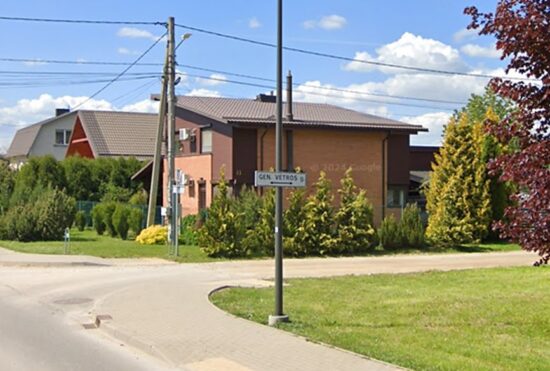
Residential street ‘GEN. VETROS g.’ in the Kaunas suburb of Aleksotas named after the infamous Jonas Noreika AKA General “Vetra” (Storm) of the LAF, who was allegedly responsible for internment and extermination of 15,000 Jews, (Source: Google Maps Street View). Jews from the Kovno Ghetto were used as forced labor at the Aleksotas Airfield.
◊
Emigrating from Czarist Vilna to Petticoat Lane — escaping pogroms to reside near Jack the Ripper
I also pause to think of my paternal great-grandparents Rokhl and Shimen Gorfayn (Rachel and Simon Gorfine), Jewish paupers who doubtless suffered deprivations under the czarist Russian Empire. I imagine that they eloped to England in 1881 when faced with the prospect of Shimen’s conscription into the Imperial Russian Army. This alone would be reason enough to depart the land of their birth, as conscripts were required to serve for twenty-five years, without opportunity to observe the Jewish Sabbath. Although it seems Shimen was not particularly religious, he most likely didn’t want to be sacrificed as cannon fodder on the front line of a battle not of his making. Jews were placed in the forefront of Russian Army advances, as they were considered expendable. Adding to this motivation, was social instability, with Jews increasingly subject to pogroms being perpetrated by their fellow Russian citizens, mostly ethnic Lithuanian gentiles, after the assassination of the Czar.
It is of little wonder that they walked “100 miles” carrying only meagre possessions, almost certainly paying a boatman to row them across the Nemunas River (in Yiddish the Nyémen), under the cover of darkness, possibly in the vicinity of Jurbarkas (Yiddish: Yúrberik), where they would have disembarked in Prussia on the left bank. They were likely met by entrepreneurial Germans of Plagge’s parents’ generation, bereft of his empathy, to take possession of fake identity papers in exchange for jewellery or other valuables, and then travelled overland, most likely via a combination of walking and hitching rides on horse-drawn wagons (in exchange for valuables and at risk of being robbed), to arrive at the docks at Bremerhaven. Dodging outbreaks of cholera whilst waiting in jostling queues, eventually they would have purchased their passage to London in steerage, from an enterprising steamship company exploiting the large numbers of people fleeing the squalor and deprivation of existence in Eastern Europe.
Disembarking at the docks in London’s poverty-stricken and overcrowded East End after several days steaming across the English Channel, they took up residence at 40 Montague Street, Mile End New Town, close to the famous Petticoat Lane in the Whitechapel district of East London, where prospects were favourable for the illiterate Shimen to ply his trade as a tailor amidst other Yiddish speakers.
“From 1882, a wave of Jewish immigrants fleeing persecution in eastern Europe settled in the area. The chapels, which had previously served the Huguenot community, were adapted as synagogues. Many Jewish relief societies were founded to aid the poor. Jewish immigrants entered the local garment industry and maintained the traditions of the market.”
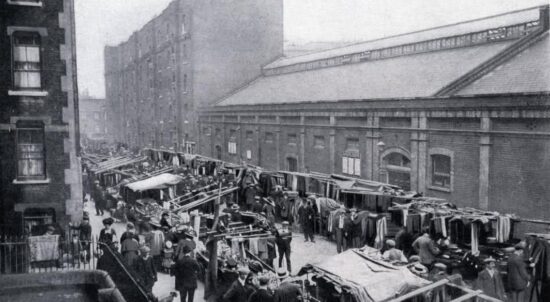
Goulston Street cloth market 1888. Source: online.
A decade later, following the birth of three “healthy” kids and one infant death, on 30 September whilst they slept in Apartment 228 of the Brunswick Buildings, Jack the Ripper left a blood and faecal stained white cloth fragment of a shawl (or apron), as a calling card in the adjacent tenement building in Goulston Street. The piece of cloth had been cut from the mutilated and disembowelled corpse of his sixth female victim, 46 year old Catherine Eddowes. Catherine may or may not have been a whore, but she reputedly enjoyed more than an occasional drink. The gruesome discovery of her body by police in Mitre Square at 1:44 AM, was followed by an officer finding the cloth fragment deposited 400 metres away inside the stairwell entrance to apartments 108 to 119 of the Wentworth Model Dwellings. Chalked on the wall above the apron fragment was the infamous “The Juwes are the men that will not be blamed for nothing,” triggering an antisemitic rumor mill. To avoid it causing a race riot, police were ordered by their commissioner to wash this chalked statement from the wall, after recording it. Antisemitic graffiti was commonplace in Whitechapel during this period.
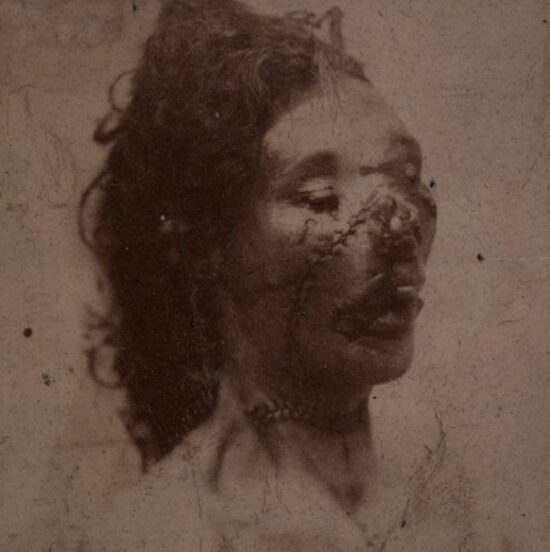
Mortuary photograph of Catherine Eddowes, a victim of Jack the Ripper. Original photograph in collection of Royal London Hospital Archives and Museum, catalog number MC/PM/5/2/5. Public domain.
◊
From the Ripper to the high seas, heading for the Land Downunder
Three and one half years later, in the late winter of 1892, the young family of six headed to Southampton, presumably by train (they would not have walked as Rokhl would have been six months pregnant with my grandfather), from where they boarded the ‘SMY Hohenzollern I’, under the command of Captain Von Collen, setting sail on 20 March bound for a new life in Australia. Three months later, and three weeks after the birth of my grandfather, Hyman Moses, whilst traversing the Bay of Bengal, they disembarked in Melbourne on 4 May 1892, and the Hohenzollern sailed onwards to Sydney, its final port of call. Apart from some heavy weather off the Portuguese coast, and in the Great Australian Bight during the approach to Adelaide, and of course the birth of my grandfather, the voyage was reportedly uneventful.
They took up residence in Carlton, on the northern side of Melbourne, and Shimen set about establishing a small clothing factory at 163 Elizabeth Street, in the central business district, with another Jew, S. Cohen. It is unclear whether their business was successful, but records show that they fell afoul of local Victorian labour laws by exploiting young women trainees as seamstresses for excessive hours and were fined accordingly. The penalty for their offense was almost 10 pounds sterling, a hefty sum at the time, which likely bankrupted them.
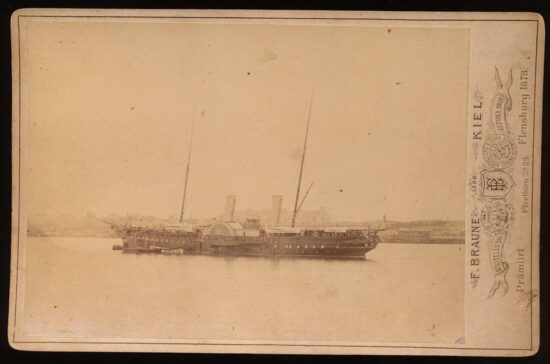
Passenger ship SMY Hohenzollern (formerly Kaiser Wilhelm’s imperial yacht) registered in Bremen. Its voyage to Australia was likely its last before it was renamed and eventually scrapped. It was a side-wheel paddleboat, 90.65 m LOA and capable of a speed of 15.7 knots (or 29 km/h) built between 1876 and 1878 by the Norddeutscher Schiffbau AG of Kiel. Source: online.
After settling in Melbourne, another four children were born, bringing the tally to eight along with the challenges that housing, feeding and clothing a larger family creates, although perhaps the last challenge might not have been so problematic for a tailor. Information about their lives is scant, aside from what can be gleaned from censuses and electoral rolls.
Police records show that on 30 March 1900, a warrant of commitment was issued by police for Shimen, by then known as Simon, who then spent 24 hours in prison for defaulting on paying a 5 shilling fine for transgressing the Education Act, presumably arising from truancy of one of the kids. Then, on 11 June 1901, Rokhl (of the aptly named, 96 Cardigan St, Carlton) posted a notice in the Victorian Police Gazette inquiring Shimen’s whereabouts, so perhaps familial responsibilities had become a bit too much to endure, and he’d gone AWOL. Records show the family members residing in various residences in the adjacent inner Melbourne suburbs of North Carlton and Fitzroy, but not all at the same address. The younger daughters lived with Rokhl, and younger sons with Shimen, indicating that the couple may have been estranged, at least for financial reasons, and/or perhaps to avoid any further offspring arriving on the scene.
Indeed, Shimen might have gone walkabout seeking alternative prospects because of his conjugal deprivation. In any case, he did not have that much longer to extract some pleasure from life, as he died at the ripe young age of 48. Rokhl was dead not that long after at age 50, and my grandfather bettered his parents by reaching the age of 56, dying in 1948. His younger brother Sam only made it to 50, dying in Royal Park Hospital, a mental health facility, perhaps because he was suffering from PTSD arising from his frontline experiences in France during World War I. Sam was shot twice, once in the neck, and later in his hand after being sent back to the front following recovery from his neck wound. As with many frontline soldiers, he also suffered from trench foot. The others fared much better longevity-wise but were greatly outdone by their children, with my father and two of his brothers reaching their early 90s, and a cousin, the son of Shimen and Rokhl’s youngest daughter, almost attaining a century.
Were my great-grandparents better off leaving Vilna, and later London (in each instance probably to escape from intolerable poverty and violence targeted towards Jews)? It does seem that the two decades spent in the former, and the decade in the latter, took their toll. Australia, despite being referred to as “The Lucky Country” (a misrepresentation when quoted literally) did not alleviate their poverty nor, it seems, did it enhance their longevity, but their offspring and their children have fared markedly better. There are no stories or family lore to determine if they were content with the last phase of their lives as voluntary Jewish migrants, but their children escaped the Holocaust, and for that the many, among the now four successive generations who have and continue to live in relative comfort, should be grateful.
◊
Returning to Lita – a vicarious journey of ancestral discovery and historical revelation
The next time I traverse along the riverbank in Paupys I am walking a dog with friends, but this is no pedigreed designer breed, he’s a relatively placid cross-bred rescue dog from a shelter, who once plied 6 kilometers between the small town of Rukla, pop. ~2000, in which he was a vagabond fed by outdoor workers, and the much larger town of Jonava, pop. ~30,000, to visit his canine “girlfriends”.
Jonava (Yiddish Yáneve) was the hometown of famed author, the late Grigory Kanovich, who among his many literary contributions wrote a semi-autobiographical novel, The Shtetl Love Song, about his formative years in the town. I mention this because a few years ago a friend pointed out an online photo of a young woman, Basia (Batya), with whom I share a variant of a Yiddish surname (Gorfein). The captioned image was posted on the Facebook page of the Beigeliu krautuvėle (bagel shop at Pylimo g. 4 Vilna, which has recently been subjected to repetitive antisemitic vandalism = windows smashed, presumably in response to the situation in Gaza), but there was no way of me knowing if we shared common ancestry, mostly for the obvious reason that few of her generation survived, and that many among the few in Lithuania who did, did not emphasize their Judaism.
Further Internet sleuthing via the Jonava Museum website revealed a series of high-resolution digital images, picturing Basia variously with friends and her two brothers, Shimen and Asher, scanned from photographs taken during the period leading up to the Holocaust. The LivakSIG website also came to the party with some background information about the family, including that their father Mendl (son of Aron ‘Gorfain’) was from Kamenets-Litovsk in the Brest region of what was Poland but is now Belarus, and married their mother Reizl (daughter of Abram Zak), a Jonava local, in the town on 21 October 1911. That Mendl, of the same generation as my grandfather, originated from the Brest region, means a direct connection of my family to Jonava is likely tenuous. A committed and well-read Zionist, Mendl dedicated much of his time to the welfare of the Jonava Jewish community until his untimely death.
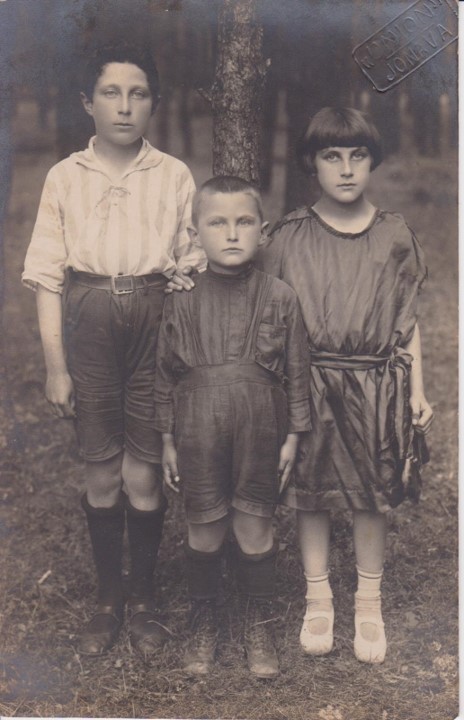
Shimen, Asher and Basia Gorfein Source: online. (Notice that the shoes worn by Shimen look like girls not boys summer footwear. Perhaps this was typical at the time, but it was probably an indicator of poverty.)
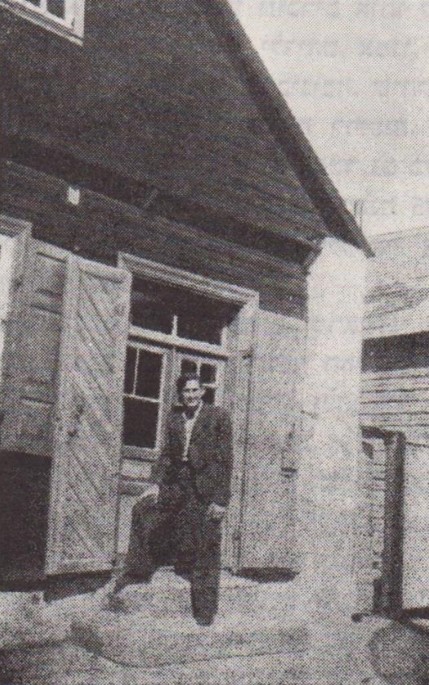
Asher Gorfein outside the family grocery store in Vilniaus g., Jonava. Source: Jonava Yizkor Book (via website of the Jonava museum), edited by Shimen in 1973, although the photo reproductions are of coarser resolution (the link provided is for a version translated into Lithuanian).
The eldest of the three children, active in Hashomer Hatzair like many of his contemporaries, Shimen Gorfein (b. 1-Sep-1912) survived because he was undertaking Eliyah at Kibbutz Amir in Israel during the Holocaust. Following the Israeli trend, he Hebraicized his surname from Gorfein (which means “splendid” or “very fine”) to Noy (which means “beauty” or “splendor”). Online LivakSIG records show that on 29 April 1937, Basia (Batya; b. 28-Apr-1914) married “Jackgnel Wilftraibitsch” (could be ‘Jacques Wulf Raibitsch’ or Czech surname Traibitsch/Trabitsch’ as searches reveal no other record of his name) from Palestine (born in Berlin in 1911) in Kaunas. Presumably, they then lived in Israel, so like Shimen, who is recorded as having married Rivke Katz from Plungė (Plungyan in Yiddish) on 2 March 1933 in Kaunas, Basia escaped evaded the depravity and murder of the Shoah.
Their mother Reyzl had died from a chronic illness prior to August 1941, when during late summer on Wednesday the 13th of the month, their younger brother Asher and father Mendl were slaughtered by Lithuanians in the Girialki (Giraitė) Forest, about 1.5 kilometers from the town. One among circa 200–250 massacres of various scales and levels of organization, mostly perpetrated at sites located on the outskirts of towns and villages throughout the country. It was Lithuanian men, in absence of duress, who overwhelmingly conducted the murders, with some eyewitness accounts from among the few Jewish survivors and Lithuanian gentiles, that these volunteer žydšaudžiai (Jew shooters) were more brutal, callous, and in some cases more sadistic, than the handful of Nazis supervising. In the Jonava Yizkor book, Shimon Noy writes:
“And now — now let us arise, overcome, and record the memory of your townsfolk in the past tense: They once were, they existed, and are no longer. For us, Jonava no longer exists. It was wiped out and will not arise again.
The atrocity took place in the pleasant grove, in the place to which we were attracted on the Sabbath walks of your youth. This was the place where the Hashomer Hatzair group organized its meetings, games and activities; the place where the “Genuzia” and “Syuniut” organized their parties on moonlit May evenings, and where mixed couples would dance to the sounds of the band of wind instruments. On that bitter and violent day of 1941, a Satanic dance was organized by human beings, and the evergreen trees witnessed hellish scenes and absorbed the bloodcurdling screams. The gentiles did not stand aside. They did not wait for the arrival of the Nazis.”
Shimon Noy’s fragmented story, gleaned mostly from a brief narrative illustrated by photographs, is similar to the detailed accounts of Grigory Kanovich, and the families of other survivors from Lithuania’s Jewish Litvak community. It provides insight about what transpired, for those of us who visited the country in naivety and were gullibly subject to all-too common tropes which seek to minimise complicity and erase guilt, oft repeated to varying extents still to this day by patriotic Lithuanian gentiles. These descendants of a generation of killers struggle to come to terms with any notion that their forebears were antisemitic war criminals, regardless of any bravery they exhibited in resisting the Soviet occupation.
Likewise, the leaders of this small nation, are still blinking in the bright daylight of emancipation from the darkness of Soviet oppression. Acceptance of their own national trauma in no way equates their suffering to that which befell Jews, nor does it absolve the nation of its crimes. I’m dismayed that contemporary Lithuania’s national sense of insecurity and self-pity about past suffering and oppression, as genuine as this may be, renders it incapable of the maturity reasonably expected of a member nation of the European Union and the North Atlantic Treaty Organisation. Instead, they revert to type in continuing to elicit propagandist tropes, ingrained by five decades of Soviet occupation. Many Lithuanians revere their war heroes and “partizanai” and are incapable of comprehending that these heroes can be major war criminals.
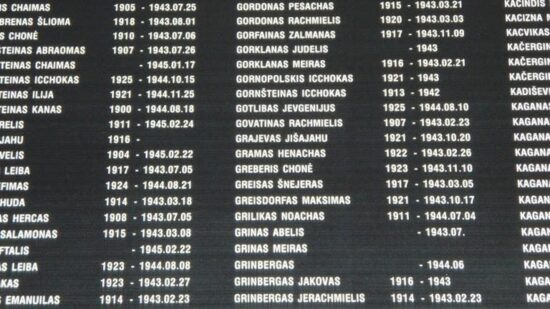
I, too, might have had “partisans” among the forebears of my extended family, as one bearing a Lithuanianized version of my surname, Zalmanas Gorfainas, was shot and killed on 9 Nov 1943, aged 26, presumably while fighting alongside Red Partisans against the Lithuanian Police and Wehrmacht under the command of the Nazi invaders. I found his name while perusing an honor board, displayed in a small museum in Pylimo g. in Vilnius, around fifteen years ago, the display having since disappeared to parts unknown. Coincidentally, the National Library of Australia has a digital copy of the 1895 naturalisation certificate for a Zalman Gorfain, a 26 year old hairdresser living in Carlton, Melbourne, Australia, but without evidence of a connection to my forebears despite extensive online searching.
Then there is Khane Gorfing (nee Kobrovsky), husband Yitskhok, sons Shim7n (aged seven) and Khayiml (aged three) from Marcinkonys, a railway town at the border of Lithuania and White Russia (Belarus), who escaped the small ghetto and certain death to spend several winter months hiding in a bunker deep within a Lithuanian forest. They survived under the protection of Khane’s brothers, Jewish resistance fighters with fearsome reputations among the local Lithuanian peasantry, accompanied by fickle, and occasionally untrustworthy Red Partisans, and fugitive Lithuanian associates of the NKVD. Her brothers were raiding villages and hamlets in the dead of night seeking food, clothing and munitions for their small group.
Meanwhile, Lithuanian peasants “foraged” for Jewish valuables, fortunes they believed were hidden in the forests near their villages. Of course, not all peasants were vile immoral thieves, some taking perilous risks sheltering Jews, and others supplying food, clothing and implements (occasionally weapons) for a price, but equally prepared to sell the Jews out to murderous Lithuanian police and German soldiers to save their own necks if suspicions were aroused about them aiding the “Bolševikų žydai”. Indeed, one kind peasant provided temporary shelter to Khane and her youngest child in their hour of need. At different periods, they were hiding alternately on the Lithuanian and Belarusian sides of the border, in what was disputed territory between the Lithuanian and German regimes. In practical terms this meant avoiding or fending off the murderous Lithuanian police on the western side, and the relatively less vicious Germans on the eastern side, where there was greater security provided by the presence of Russian resistance fighters, especially in 1944.
After spending the summer of 1943 without incident in a Lithuanian forest near Lake Trikampis, situated 5.5 kilometers northwest of Marcinkonys, between the settlements of Rudnia and Kašetos, their small group was spotted by peasants from the village of Milioniškės (Varėna district municipality, within the Alytus County), who reported the Jews’ presence to Lithuanian Police, spurring the police to set about rounding them up. In trying to flee as the police closed in on them, Khane and Khayiml were captured and severely beaten, and Yitzchok and Shiml who were running ahead were shot dead from behind by the infamous žydšaudys Bobonis and his fellow serial killer, Lekavicius. After watching on helplessly as her husband and eldest son were killed, Khane wrestled with a police shooter while he was taking aim at her nephew, Yakov Kobrovsky, enabling him to escape, but with her and infant Khayiml suffering a further beating because of her resistance.
Detained by Lithuanian police, Khane and Khayiml were initially taken to the village Milioniškis, where Khane was stripped half-naked and humiliatingly paraded through the streets whilst being brutally whipped, to the amusement of Lithuanian villagers, men and women alike, who turned up to gawk, snigger, taunt and derisively cheer at the hapless Jewish woman and her urchin child. They were then transferred to a prison in Méritsh (Merkinė), where this torturous treatment occurred on multiple occasions, prior to her being informed by the Lithuanian Police one evening that she and her pre-school aged son would be shot the following morning. Stringing her along like this was seemingly because despite being repeatedly pressed about it, she did not divulge the location of her belongings, which they erroneously believed she had hidden.
Incarcerated in a dank holding cell, on what was to be their final night of existence, during the predawn hours while Khayiml slept, Khane tried to hang herself to avoid witnessing her remaining son’s death (as misguided as this might seem). Fortuitously, the shoelaces she used in a makeshift noose had perished sufficiently to break under the weight of her emaciated and ravaged body. As the first rays of dawn streamed through the gaps in the lockup, using an old bent up metal wheel Khane scraped enough of the moist earth from beneath the door to free Khayiml and herself, and flee under the dim half-light to eventually, with assistance from a kindly Lithuanian peasant and more than a modicum of sheer luck (Bobonis had been responsible for guarding the prison and he and Lekavicius came perilously close to locating her following her escape), rejoin her comrades hiding in the relative safety of Russaya Puschaka, deep within the Belarusian forest, under the protection of the Red Partisans.
Indeed, the surviving Kobrovsy brothers had come under the protection of the Soviet military fighting the Germans. The Russians relied on the Jew’s local knowledge of the forest and surrounding villages. On 11 July 1944, after the Kobrovskys had just played a vital role blowing up yet another supply train, they learned that the Russians had prevailed, Germany had capitulated, and they were now liberated. No doubt many contemporary Lithuanians despise their liberation from war by Soviet Russia, with the ultra-ethnonationalists among them regretful that the Nazis did not prevail. This despite the Nazi regime having no intention of allowing Lithuania to be a self-governing nation with its own identity. In contrast to Lithuanians, some Jews considered Soviet deportation to Siberia preferable to the Lithuanian-Nazi collaborative plan for their ethnic cleansing, which is understandable given that the odds for their survival in Siberia were orders of magnitude higher.
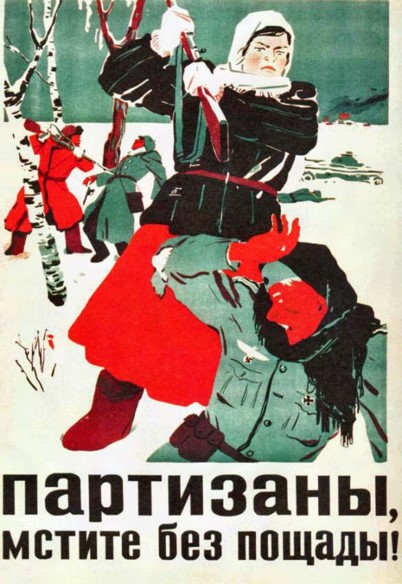
“Partisans, Avenge without Mercy!” Soviet Union, World War II. Source: online.
If I were to take a leaf out of Lithuania’s book of national patriotism, which venerates partisan groups such as the Miško broliai (Forest Brothers), then I should be proud about the possibility that distant relatives of mine were among those Red Partisans who exacted revenge or nekóme on the local perpetrators of the Holocaust. I’m reminded of a recent documentary series about the late Green brothers (LT: Žalieji broliai; YD: Greniman), Boris (Dov-Ber) and the younger Fima (Chaim), who migrated to Australia after the war in 1949.
Originating from Dzisna (Disna, Yiddish Dísne) (N55.566393, E28.214311, Vitebsk Region, Belarus), on the left bank of the Daugava River, which flows northeasterly into Latvia, they lost their entire sizeable family to Lithuanian and German barbarity during the Holocaust. Indeed, following a successful search for Boris, who had fled into the forests after the Nazis invaded, Fima returned to his hometown of Dunilavičy (Yiddish Denílevitsh, ~ 80 km SW of Dzisna, around 60 km east of the Lithuanian border) to discover his wife and young child dead among a pile of bodies, after they had been shot during a massacre of the town’s Jews.
Taking advantage of his prior experience as a senior military commander in the Russian Army at a supply depot in Bialystok in Poland, Boris formed the Jewish underground combat unit Nekóme (Yiddish for revenge, Israeli Hebrew nekamá), which employed guerilla tactics to fight against the Lithuanians and Germans in the forests straddling the Lithuania-Belarus border region. As watchmakers, Boris and Fima had acquired technical skills useful for underground resistance, particularly radio communications for reconnaissance and survival, and explosives for vengeful sabotage. Nekóme merged with 250 fighters of the United Partisan Organisation of Vilna, a group from the Vilna Ghetto whose leader took over command from Boris. After the war, Boris used a senior position he held in the government of Belarus to forge documents that identified non-Polish Jews as ethnic Poles, thereby enabling them to escape to Poland from the USSR. Eventually this was discovered by authorities, placing his life in jeopardy, so rather than face execution he fled to follow Fima, who had already emigrated from Europe to Australia (see also Boris’s obituary; review of the documentary).
It is suspected that, aside from putting as much distance as possible between their new and former homelands, a strong motivation for Fima and Boris migrating to Australia might have been to avenge the deaths of their family members and fellow Jews, via at least one clandestine extrajudicial killing from among the 800–900 war criminals (known to the Australian Security and Intelligence Organisation, ASIO), who escaped prosecution by also migrating to Australia, under assumed identities or signing false declarations which were never validated. Circumstantial evidence points towards unexplained deaths of several Lithuanian expatriates who met their untimely demise under unusual circumstances, including implausible altercations with motor vehicles, and bizarre suicide scenarios (e.g. extracting the pin from a hand grenade placed next to one’s head whilst lying on the ground in bushland to render a headless corpse). Others mysteriously went missing and became untraceable. Whether voluntarily or otherwise, is unknown.
Contemporary Lithuania continues to struggle with its emancipated identity and transition from communist to capitalist environments. Those who were young adults under the USSR can recall the difference from then to now, but millennials have mostly only known a life of materialistic aspiration that attempts to emulate aspects of Western culture promoted by commercial and social media. Crass advertising pervades Lithuanian TV networks, with US-style adverts in place of communist propaganda. In other words, the material trappings of Western democracies, so evident in the attire and public posing of the younger residents of Paupys, and similar new inner urban housing developments elsewhere. Of course, many still attend Mass, especially on Joninės (Mid-Summer), Žolinė (Assumption Day), and other holidays that mark the Lithuanian calendar. As in Chile, Catholicism in Lithuania is infused with Pagan ritualism.
All countries have adherents to extremes of ideology, but in Lithuania a fierce sense of identity, conflates with nationalism, and in some cases ultranationalism reminiscent of Nazism, that many myopically fail to comprehend paves the way towards authoritarian governance. As sociopathic despots emerge to lead nations, courtesy of bastardised, faux or severely flawed democratic processes, aided and abetted by a corrupt coterie of cognitively dissonant sycophants and mentally defective cronies hell-bent on destroying world order, the risk is that a populace, such as that of Lithuania, could end up with the very form of governance to which it is ostensibly averse. This is despite obsessively maintaining a collective gaze in fear and trepidation towards the “enemy in the east”. Despite revelling in their independence, there is failure to recognize the role that the likes of Gorbachev played in the disintegration of unity among the USSR, seemingly despised by Lithuanians and Russians alike.
One trope is that Lithuania chased the Soviets out of the country, which is the kind of false narrative expected to emanate from the Kremlin. Indeed, several years ago, in a moment of pageantry, a former young “progressive” mayor of Vilnius (mentioned earlier) strode onto a stage at the Lithuanian National Philharmonic Society to exuberantly proclaim this revisionist bravado at the “Champion Cities Summit 2023”. In contemporary Lithuania many laud the ‘Birželio sukilimas’, or June Uprising, all too conveniently ignoring that the mobilization of Nazi forces to execute Operation Barbarossa, with imminent arrival in Lithuania, was motivation enough for the NKVD and Soviets to flee eastwards, with the LAF metaphorically and actually shooting at their backs, and murdering countless civilians, notwithstanding that there were minor battles and skirmishes between the fleeing Soviet military and LAF/TDA militia. Indeed the glorification of the local murderers of Jewish citizens, whose rampages even before the arrival or establishment of authority by the invading Germans at the end of June 1941 claimed thousands, has been a major issue for many years.
In some ways, Lithuania’s acceptance of Nazi entry without much resistance was consistent with mostly not resisting the entry of the Soviets one year earlier. It wasn’t only some Jews who welcomed the Soviet arrival, there were numerous Lithuanians including some in the military who supported the Soviets. It’s as if Lithuanian nationalists’ shame and pent-up anger about their collective inability or reluctance to defend against the Soviets was unleashed upon the Jews as scapegoats, under the “moral” protection of the Nazis. Of course, it’s more complicated than this, with LAF founder Kazys Škirpa holed up in Berlin remotely directing de-Judaification activities in conjunction with the Nazi war machine.
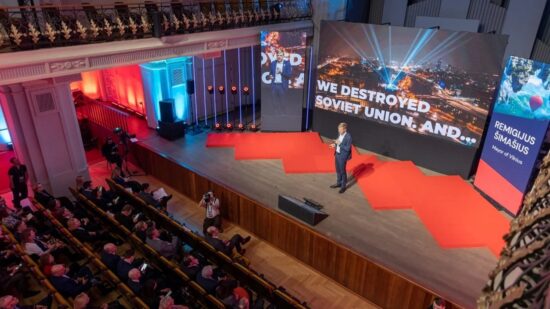
Former mayor (2015−2023) of Vilnius Remigijus Šimašius. Source: Times of Israel blogs.
Another trope is the absurd red-equals-brown construct which equates the impact of the Holocaust with Soviet deportations and brutal oppression of dissenters, directed at both ethnic Lithuanians and Jews, and resulting in thousands of deaths. Simple statistics illustrate that Russian troops killing thirteen demonstrators at the siege of the TV tower in Vilnius on 13 January 1991, a source of national trauma, for which Gorbachev was blamed is in no way equivalent to the barbaric slaughter of dozens of Jewish civilians at Lietūkio garažas on 27 June 1941.
Although Lithuania has often led the way in technological innovation, any notion that images, originally captured in 1941 by a Wehrmacht photographer, were generated by Russian propagandists using secret AI software would be preposterous. In this latter instance, the hapless Jews were not protesting or causing civil unrest, they were killed because they were different, scapegoated as communist, and were incorrectly considered to have become affluent at the expense of native Lithuanians, and unfortunately happened to be in the vicinity of the intersection of Miškio gatvė and Vytauto prospektas at the time. Despite the number of Lithuanian gentiles deported from 1944 until Stalin’s death in 1953 being similar (by one estimate about 245,000 and another 132,000) to the number of Lithuanian Jews impacted by the Nazi occupation (up to 220,000), the odds were more in favour of gentile survival (69–79% assuming 75,000 deaths in the first reference and 28,000 in the second “Out of 132,000 people who were deported to the “eternal exile” in 1941-1952 even 28,000 died of diseases, starvation or unbearable labour. Other 50,000 people could not return to Lithuania for a long time or never made their way back.”) with many (~41%) eventually repatriated. Regardless of statistical comparison, attempts to equate one conflict with another simply conflate the specific issues, obscuring their differences, and ignoring the complexities in an effective obfuscation of truth and reality.
◊
What now?
“Butch: You okay?
Marsellus: Naw man. I’m pretty fuckin’ far from okay.
Butch: What now?
Marsellus: What now? Let me tell you what now. I’ma call a coupla hard, pipe-hittin’ niggers, who’ll go to work on the homes here with a pair of pliers and a blow torch. You hear me talkin’, hillbilly boy? I ain’t through with you by a damn sight. I’ma get medieval on your ass.
Butch: I meant what now between me and you?
Marsellus: Oh, that what now. I tell you what now between me and you. There is no me and you. Not no more.”
(Credit: IMDb Pulp Fiction quotes, Ving Rhames: Marsellus Wallace)
Lithuanians have come a long way since the 1991 “January Uprising” in adopting much of the good, but arguably way too much of the bad which typifies the West (it’s no surprise that younger people fluent in English seem to have slight American accents and use American pronunciation, courtesy of their unhealthy diet of Western TV), yet the older citizens who I’ve befriended over the past two decades seem incapable of shedding ingrained Soviet mōrēs. As youths, they were taught or arguably indoctrinated far too well. Notwithstanding individual differences, as a nation they have for the most part failed at acknowledging and atoning for tormenting, torturing, raping, barbarically slaughtering and robbing the entire Jewish population, leaving less than 5% survivors (3.6% to be precise), many of whom subsequently departed over the ensuing decades. Today, apparently there are under 3,000 Jewish citizens, less than the number of Jews in some individual regional towns in the summer of 1941.
Just as I’m unlikely to ever know about the lives of my great-grandparents while they were growing up in Lita, or what befell their siblings and extended families during the Holocaust, we will never know about the lives which could have been but for the premature and totally unnecessary deaths of over 200,000 Lithuanian Jews. Murdered by the hands of perhaps as many as 25,000 barbaric Lithuanian men (~0.2% of the male population), actively aided and abetted by Lithuanian women, who informed on Jews to Lithuanian Police and Nazi SS, looted Jewish property, and gathered at pogroms to depravedly gawk, mock and cheer while Jewish men and women were subjected to humiliating and excruciatingly painful beatings and torture that more often than not ended in their gruesome deaths. Germans were the orchestrators, but the Jewish blood is equally on the hands of Lithuanians, passed down through several generations, with the country seemingly bereft of any preparedness to cleanse with a sincere national atonement befitting a modern mature democracy. Were these people psychopaths or was it a case of the “Lucifer Effect” to use the phrase coined by the late Professor Philip Zimbardo, instigator of the infamous Stanford Prison Experiment, to explain “…How Good People turn Evil“?
Islamophobia also plays a role, as once did antisemitism, aided and abetted by sensationalist and exaggerated reporting by the news media about the negative consequences of mass immigration of Middle Eastern refugees into the EU, which we see weaponized by US extremists (see article by Brendon O’Connor, Professor, Department of Government and International Relations, & United States Studies Centre, University of Sydney).
As well as news articles and TV coverage about robberies and violent assaults committed by Middle Eastern immigrants in Scandinavian countries, particular attention is given to the alleged hybrid warfare by Belarus sponsoring migrants from the Middle East (mostly Iraqi) and Africa (mostly Congolese) to cross its western border illegally into the EU via Latvia, Lithuania, and Poland.. The reality is that as of 2025, there were about 3,000 documented Muslim immigrants residing in Lithuania i.e. ~0.1% of the resident population (compared to 0.1M in Finland, 0.7M in Sweden, 4.6M in Germany, and 6.9M in France), and in 2021, 3,836 people crossed illegally from Belarus.
It is a legacy of decades of Russian occupation and oppression, which sees Lithuania often swimming upstream and out-of-sync with a majority of the Western World in its attempts at international diplomacy. Establishing the Taiwanese Representative Office in Lithuania in 2021 as a de facto embassy contravened the “One country, two systems” policy of the People’s Republic of China. Lithuania’s support for overseas nationalist governments is also inextricably linked with its financial need to attract corporate investment and bilateral partnerships, and to encourage valuable Jewish tourism from the Litvak diaspora. In effect, Lithuania was trading off opportunities to export goods and services to China in preference for Taiwan, but given the amount of Chinese manufactured products on the shelves of Lithuanian stores compared with a decade or more ago, the Lithuania Government’s diplomatic decision to formally recognize Taiwan was an own goal.
Sadly, my paternal family history is not unique among those of Ashkenazic Jewish descent. As much as I feel safe traipsing the streets of Paupys and the adjacent Vilnius senamiestis (Old Town), I sincerely hope that the enemy will never attack from the east, regardless of whether I’m in Lithuania or safely back in my home country 16,000 kilometers away. I equally hope that this small nation of only 2.7 million resident citizens can outgrow its inferiority complex and mature sufficiently to no longer feel compelled to valorize partizanai who were war criminals whilst concomitantly demeaning their victims. Justifying this glorification via historical revisionist and denialist narratives inevitably results in a bogus patriotism.
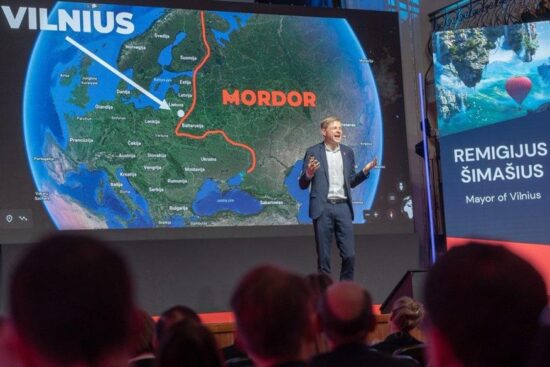
“The enemy from the East” is omnipresent in Lithuanian psyche. Source: online.
◊
Epilogue
Authenticity, transparency, tolerance, empathy and cooperation. These are critical existential traits honed through periodic self-reflection and practical application. It is absurdly obvious that we cannot change the past, yet historical revisionism, selective denialism, and confirmation bias are continually skewing or falsifying historical narrative.
Pursuit of personal ambitions through agendas designed to disrupt and destabilize societal harmony seem to be at the crux of motives among political and community leaders for spreading mis- and disinformation about the past. Rallies of followers are conducted in real and virtual echo chambers in which public debate is stifled, dissenters are gaslit or “disappeared” and “manufacturversies” are confected to fuel public outrage and fear among receptive audiences. False rhetoric is amplified and reinforced by recklessly coded AI algorithms, creating a circularity of falsehoods in which truth becomes “fake news” discarded in favor of misinformation and lies spreading contagiously around the world via unscrupulous social media platforms. Billionaire owners become ever wealthier, reinforcing corporate incentives to go harder at pushing well beyond ethical boundaries and societal norms. Emerging trends that are clearly not in the broader public interest define a new normal more likely to foment conflict and war than promote peace.
Objectively studying events in Lithuania’s long history can enlighten us about patterns of behavior best avoided if we want our grandchildren and their grandchildren to live peacefully and harmoniously, but we must strive to discriminate truth from fiction, and Lithuanians need to forsake the addictive Kool-Aid that quenches their thirst for a national identity founded on misinformation, and instead raise their heads to objectively confront the reality of their nation’s heinous past. Only by admitting to the crimes of its forebears, and taking responsibility for them, can the country justifiably promote itself as a proud nation worthy of being acknowledged globally among the ranks of modern democracies.
◊
Biosketch
Harry Gorfine is a scientist who has spent the past forty-five years gathering, analyzing and interpreting data, to inform policy decisions to promote sustainability of natural resources, the writer is an advocate of speaking truth to power without fear or favor. Descended from Litvaks and Australian by birth, he is widely travelled and has spent considerable time conducting research and mentoring postgraduate students in Lithuania and China.
◊
Bibliography
-
THE HEROIC RESISTANCE AND LIQUIDATION OF THE JEWS OF MARCINKONIS ⎯Testimonies of Khane Gorfing, Leyb Kobrovsky, Khayim Kobrovsky and Shloyme Peretz, In ‘The Lithuanian Slaughter of its Jews” by Leyb Koniuchowsky. p. 465.
-
https://www.academia.edu/113726127/Controversies_of_the_Memory_of_the_Second_World_War_in_Lithuania_Between_Cosmopolitan_and_Nationalist_Approaches
-
https://theconversation.com/australia-is-still-reckoning-with-a-shameful-legacy-the-resettlement-of-suspected-war-criminals-after-wwii-217378
-
https://insidestory.org.au/distant-crimes-nearby-perpetrators/
-
Reeder, P.; Jol, H.; Freund, R.; McClymont, A.; Bauman, P.; Šmigelskas, R. Investigations at the Heereskraftfahrpark (HKP) 562 Forced-Labor Camp in Vilnius, Lithuania. Heritage 2023, 6, 466-482. https://doi.org/10.3390/
heritage6010024 -
Excursion in a former labor camp HKP in Vilnius
-
Karl Plagge – The German Soldier Who Saved the Jews | Free Documentary History
◊
List of Images■ Image 7. Meandering Vilnia River showing the islands, channels and marshes from two centuries ago ■ Image 14. Contemporary Paupys apartments (daugiabučiai) bordering the takas. ■ Image 20. View of HKP 562 from the corner of Manufakturu g. and Drujos g. ■ Image 22. Residential street “GEN. VETROS g.” in the Kaunas suburb of Aleksotas named after the infamous Jonas Noreika AKA General “Vetra” (Storm) of the LAF, who was allegedly responsible for interment and extermination of 15,000 Jews, (Source: Google Maps Street View https://maps.app.goo.gl/ ■ Image 26. Shimen, Asher and Basia Gorfein Source: https://www.limis.lt/ ■ Image 27. Asher Gorfein outside the family grocery store in Vilniaus g., Jonava. Source: Jonava Yizkor Book, available on the Jonava museum website (jonavosmuziejus.lt), edited by Shimen in 1973, although the photo reproductions are of coarser resolution [link is for a version translated into Lithuanian].
|