Welcome! Please come and visit DefendingHistory.com. Recent reports here. Or, review our 18 year history history by scrolling to the end of our dated posts and work your way up. Our 2026-2027 cultural projects are listed below.
◊
Welcome! Please come and visit DefendingHistory.com. Recent reports here. Or, review our 18 year history history by scrolling to the end of our dated posts and work your way up. Our 2026-2027 cultural projects are listed below.
◊
◊
“Soviet rule has disappeared. The Jews are left behind as fair game.”
Entry of July 7, 1941. From Surviving the Holocaust: Kovno Ghetto Diary, by Avraham Tory.
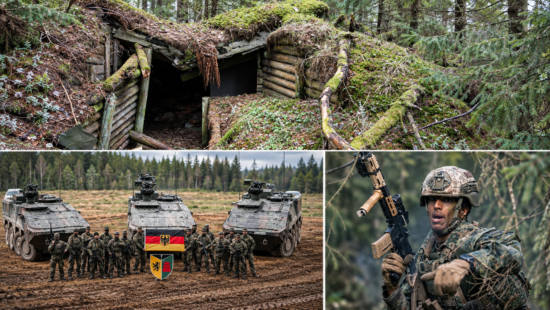
In the late sixties while working in a small company in Brussels my Jewish boss who had been “geschmuggelt’’ out of the ghetto in Lvov (former Lemberg, now Lviv, Ukraine) in a truck, before it was liquidated in 1942, had repeatedly told me that after his escape he had repeatedly tried to join with partisan groups in the area, mostly Polish or Ukrainian. Had they known that he was Jewish, he would have been killed outright. His luck was that he could pass himself off as a Pole as he spoke the language well. He had been fifteen years old at the time. I remembered these words recently on the occasion of the scandal that has erupted these past months regarding the Jewish Partisan Fort in the Rūdninkai Forest (Yiddish; Rudnitsker vald) which is now in danger of being erased due to the presence in that zone of the new German NATO Panzer Brigade (Litauenbrigade).

EFFECTS OF THE LITHUANIAN GOVERNMENT’S ‘MAGIC WAND’? Left: Public monument to Holocaust collaborator Juozas Krikštaponis (photo: Seimas). Right: One of the collapsing bunkers at Lithuania’s only relic of the Jewish anti-Nazi resistance that sits next door to Germany’s new Panzer brigade and may soon disappear (photo: DefendingHistory.com).
[last update]
see also: BOOKS SECTION
New: Prof. Karen Sutton’s review
◊
VILNIUS—Rabbi Sholom Ber Krinsky, Chabad’s rabbi in Lithuania, who for thirty-two years has been the city’s only resident rabbi, today issued the following statement addressed to the president of the World Jewish Restitution Organization (WJRO):
It is deeply painful that the restitution process in Lithuania has been flawed from the start.
In the opinion of every Lithuanian Holocaust survivor interviewed, the magnificent six-century record of tolerance and enlightened coexistence, including the years of the successful interwar Lithuanian Republic, were in a single day, June 23rd 1941, replaced by the eruption of barbaric mass murder that is all too well documented. It is “Barbarossa Plus One” (the major killing started one day after Hitler’s invasion was launched, in survivors correct memory: the Monday after the Sunday). The far right’s history department, sometimes rewriting history on an industrial scale with support from certain state agencies (most infamously, the “Genocide Center”), has attempted to “fix” this by ignoring the facts and claiming that this was actually the LAF (Lithuanian Activist Front) leading an “uprising” which drove out the Soviet army and restored independence.
That is of course utter nonsense. The Soviets fled Hitler’s Operation Barbarossa, the largest invasion in human history, not the local white-armbander Jew-killers. As for independence, it was openly Hitlerite rule. Indeed, only a few weeks later the Germans confirmed in placards placed up and down the country that Lithuania was part of the new “Ostland”. Had the Nazis won the war, they would have made good on their plans to resettle the country. There would been no Lithuania to become independent decades later. None of this diminishes the enormity of Soviet crimes of the preceding year, not least the forcible occupation and destruction of the freedom of the Baltic peoples and their citizens of all backgrounds, unconscionable deportations, and imposition of the evils of communism.
__
In chapter five of his major book on the Holocaust in Lithuania published last year, Professor Saulius Sužiedėlis discusses theatrical productions that Jakob Gens had proposed to introduce into the Vilna Ghetto at the end of 1941. Here are some quotes: “Kruk reacted with disgust (…) Members of the Bund announced a boycott and leaflets were distributed stating “You don’t make theater in a graveyard”.
I do not share the opinion that theatre should not have been played in the ghettos. On the contrary, to me, the sometimes vivid cultural life in the ghettos under Nazi and collaborators’ rule, in all its hues and colors, had undoubtedly been a bonding link, a source of some kind of normalcy and hope for the persecuted Jews, and a necessary psychological rampart against fear, boredom, stress, anguish, that all inhabitants of these hells on earth had to go through during days, weeks, months, sometimes years, perpetually living in the mortal fear for one’s life perhaps extinguished from one moment to the next or after a lengthy walk to a killing pit, naked, alone, forlorn.
VILNIUS—Solveig Grothe’s article in Germany’s weekly Der Spiegel, appeared today in the journal’s print edition, and yesterday, in a slightly longer version, in the online edition (alternate link; PDF of print edition). The piece resulted from months of research including onsite work in Vilnius, and at the forest fort, and seeking out statements for the record from all sides in the debate.
For some, the article’s greatest revelation will be the degree to which not only the state-sponsored Genocide Center, but also its prestigious Ministry of Culture, rushed to go on the record to trash the legacy — and the memory and possibility of commemoration — of the tiny handful of Lithuanian Jewish citizens who survived the Holocaust by joining up with the partisan anti-Nazi resistance in the forest.
◊
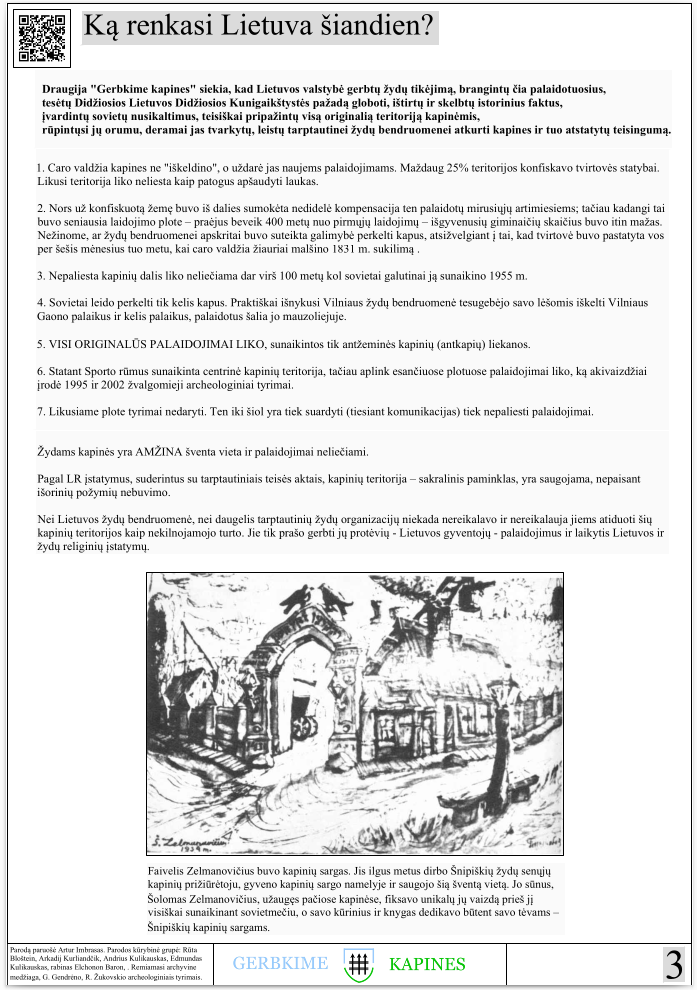
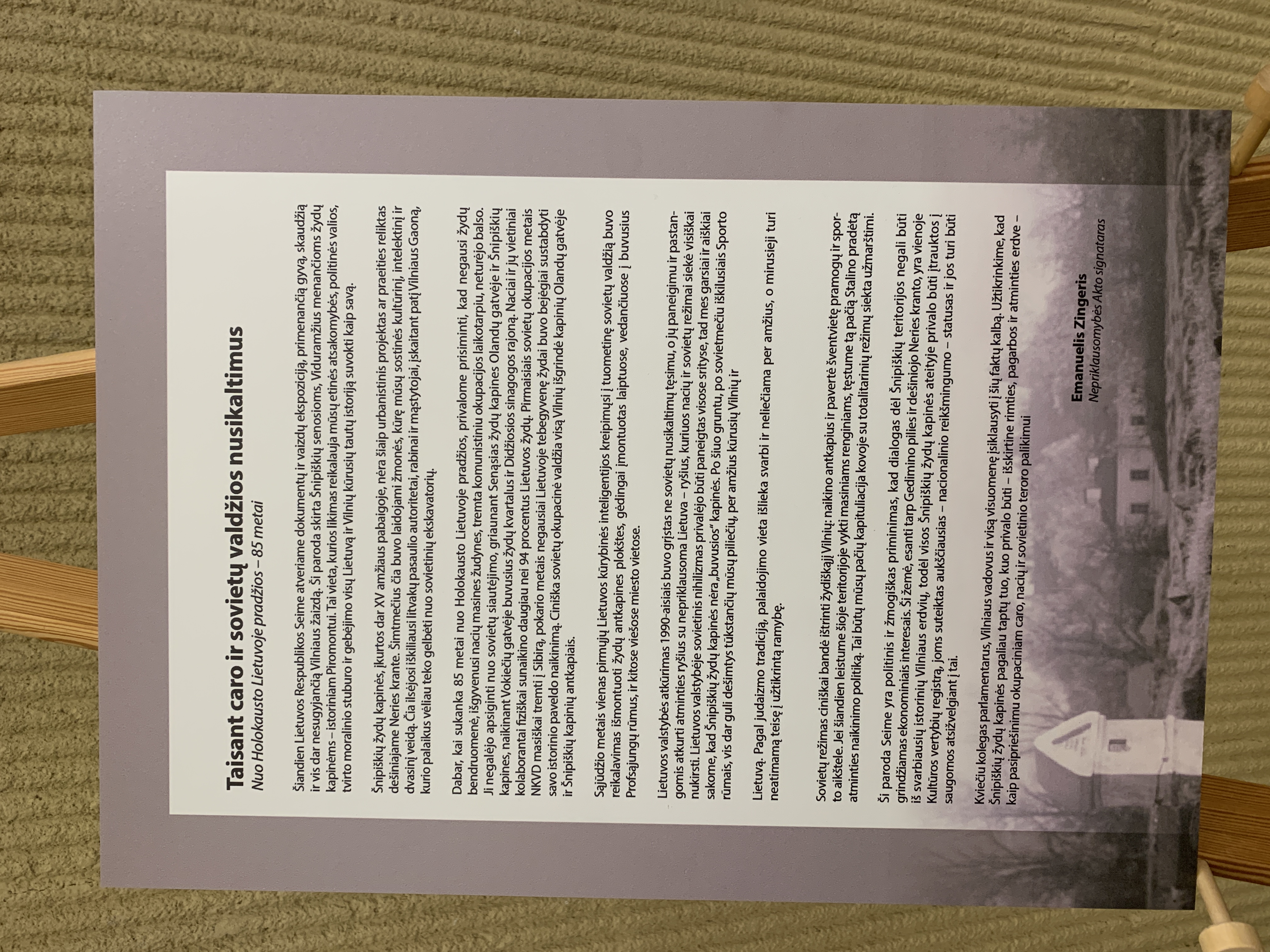
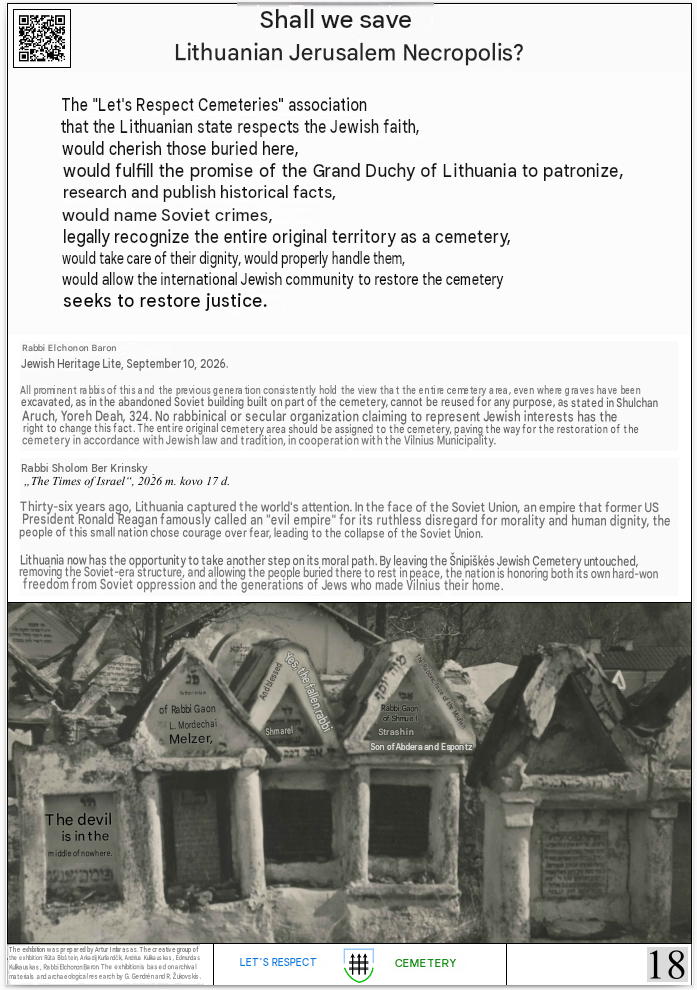
VILNIUS—The Respect Cemeteries group (Gerbkime kapines), based here in the Lithuanian capital, today released its new brochure with members of the Seimas, the Lithuanian parliament, in mind. They will be voting this autumn on whether to (mis)invest substantial state assets in a national convention center or memorial complex in the Old Vilna Jewish Cemetery at Piramónt (in Shnípishok, today’s Šnipiškės in modern Vilnius) or, as Respect Cemeteries (and the Defending History community) hope, discard both plans in favor of the ethical solution (supported by tens of thousands internationally who have signed petitions) — restoration of the major Jewish cemetery in the historic Lithuanian lands. Thousands still lie buried there.
Indeed it was the recent letter-writing campaign initiated by Respect Cemeteries that persuaded the relevant parliamentary committee to postpone its decision until the autumn. That campaign was launched by an article on these pages by one of the group’s founders, Dr. Andrius Kulikauskas, and by an appeal by another, Ms. Ruta Bloshtein, to the nearly 54,000 people who have signed her Change.org petition over the years. Selected letters are published on the Respect Cemeteries website.
In addition to a detailed map showing the historic cemetery (or mapping) boundaries of 1830, 1831, and 1935 (significant given the campaigns of social and mass media misinformation apparently coming from contractors and building industry figures), the brochure provides powerful quotes from both Kulikauskas and Bloshtein. In English translation:
◊
VILNIUS—On June 10, 2026, in Vilnius, Lithuania, the Seimas Committee on Culture voted unanimously to postpone until the autumn session further deliberation of the bill “On the Further Utilization of the Vilnius Concert and Sports Palace”. The Soviets built this palace in the middle of Vilnius’s oldest Jewish cemetery.

Screenshot from Seimas video. Upper left: LJC chair Faina Kukliansky, and then clockwise: committee Chair Kęstutis Vilkauskas; committee member Vytautas Grubliauskas; committee deputy chair Vytautas Juozapaitis; folk art curator Virginijus Jocys; Respect Cemeteries representative Edmundas Kulikauska; committee member Petras Dargis. Center: committee member Rima Baškienė
Committee Chairman Kęstutis Vilkauskas acknowledged the “truly many letters” (“tikrai … daug labai”) which they received from all around the world. “Gerbkime kapines” (Respect Cemeteries) received 37 copies of letters — impactful, rational, emotional, personal — from Lithuania, United States (New York, Idaho, Florida, New Jersey, Minnesota, California), Netherlands, Belgium, Israel, United Kingdom, Australia, from Jews and Christians, Litvaks and Lithuanians and friends.
The Chairman invited Edmundas Kulikauskas to speak on behalf of “Gerbkime kapines”. Edmundas distilled our message into two words: Restore justice (Atstatykime teisingumą).
◊
◊
VILNIUS—The Double Genocide movement’s long-held wish of major legitimization at or near the European Parliament in Brussels via a huge monument effectively equalizing Nazi and Soviet crimes has come a step closer. This journal’s opinion has been consistent for some eighteen years, since these issues were forced on to the European Parliament’s agenda by some eastern member states (normally, in democratic alliances of sovereign states, it is understood that freedom of speech and thought includes healthy debates on history within each state). Our take: 1. Brussels needs a major new monument to the victims of Communism and its brutality, including mass murder and horrendous crimes against humanity. 2. Brussels does not need a mix-and-match monument for victims of Nazism and Communism together which is a ruse of the red-equals-brown (Double Genocide) revisionism movement, emanating from the East European far right, and seeking to downgrade (and relativize) the Holocaust, criminalize those who joined the anti-Nazi resistance, and glorify local killers in the east as freedom fighters (they were after all “anti-Communist”). The effects of “Double Genocide” pressure on various European museums has been manifest for years.VILNIUS—A deeply ethical and conscientious Vilnius scholar, flabbergasted by the local “mainstream” media’s rehashing of the mantra (and sheer antisemitic nonsense) that “the Jews sold the Old Vilna Jewish Cemetery to the czar in 1830” decided to look in the archives. When he succeeded to find the document, issued by Stalin’s USSR on 22 October 1940 ordering the confiscation (i.e. theft) of the Jewish cemeteries under the aegis of the Vilnius Jewish Community, he just did the right thing and released it to the public domain. That Stalinist order came very soon after the summer 1940 forcible annexation of Lithuania and its two Baltic state neighbors, into the Soviet Union.
The document assumes special significance in the midst of current debates over the past and future of the Old Vilna Jewish Cemetery at Piramónt (in Shnípishok, today’s Šnipiškės), referred to (accurately) as the “Old Jewish Cemetery” in item no. 2 (colored below in red for rapid locating) in the document of “transfer” of ownership. There is explicit reference to “historical monuments and remnants”. The document orders that cemeteries belonging to the Vilnius Jewish Community (administering the property of the thousands of Vilna citizens who purchased their plots freehold over the centuries) were being nationalized (i.e. pilfered) by Soviet occupation authorities. Defending History’s translation (with translator’s explanatory notes) is followed by an image of the document (also available as PDF; PDF of the copy with Soviet handwritten archival notation at bottom).
VILNIUS—The following is a draft English translation of the official Lithuanian transcript (which follows the English text) of the debate held on 12 May in the Seimas, Lithuania’s parliament, on the question of plans to refurbish with state funding the Soviet-era “Sports Palace” (Sporto rumai) ruin that sits in the middle of the Old Vilna Jewish Cemetery of Piramónt (Shnípishok, Šnipiškės), and turn it into a national convention center that would be surrounded by thousands of extant Jewish graves going back to the cemetery’s founding in the fifteenth century.
Fania Yocheles Brantsovsky showing us around the Jewish partisan fort, in her Vilna Yiddish, in 2007 (video). Her last request to future generations. DH’s section on the Jewish partisan fort (also in ascending chronological order).
“This ground was sacred to the last Holocaust survivors of Lithuania and far beyond. Will it now be honored by modern democratic Germany?”
◊

Fania Yocheles Brantsovsky at one of the underground bunkers at the Jewish partisan fort outside Vilna in the forest where she resided from the day after her escape from the Vilna Ghetto on the morning of its liquidation (23 Sept. 1943) until the defeat of the Nazi occupiers in July 1944. Photo: DefendingHistory.com.

Ireland’s Ambassador Dónal Denham (left) and UK Ambassador Simon Butt visit the Jewish partisan fort in the forests of Lithuania, learning of its remarkable history in the annals of anti-Nazi resistance from survivor and veteran of the Jewish partisans Fania Yocheles Brantsovsky (c. 2009). Photo: DefendingHistory.com

Germany’s Ambassador Hans-Peter Annan awarding Jewish partisan veteran Fania Yocheles Brantsovsky the president’s federal cross of merit at the German Embassy in Vilnius in 2009. Left to right: Dr. Shimon Alperovich (head of the Lithuanian Jewish Community), Ambassador Annan, Fania Yocheles Brantsovsky and Dovid Katz, then professor of Yiddish at Vilnius University and editor of DefendingHistory.com.
◊

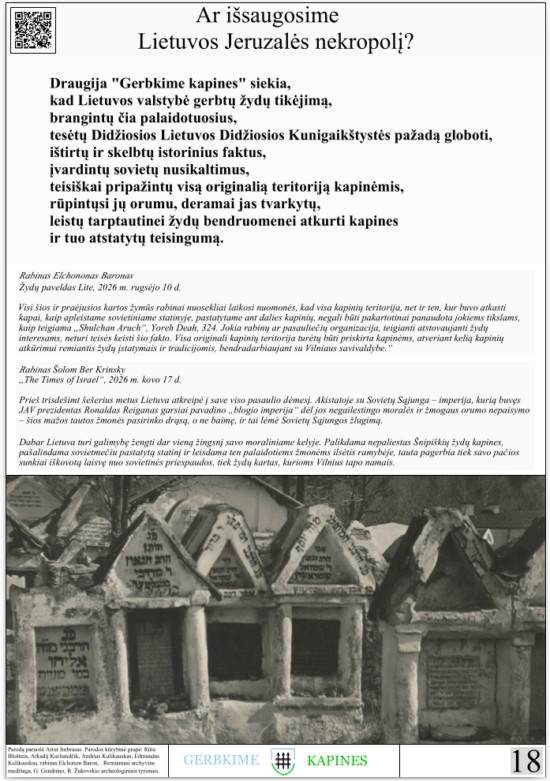
The poster for the June 3rd 2026 demonstration at the Old Vilna Jewish Cemetery calling for the building the Soviets plonked in its center to become the new national conference center
◊
VILNIUS—The poster in question invites people to a protest action on June 3 at the Vilnius Palace of Concerts and Sports. Three prominent public figures and their quotes are depicted:
◊
On March 18, 2026, twenty-three members of Lithuania’s parliament, Seimas, sponsored a bill to Promptly Renovate the Vilnius Concert and Sports Palace. On April 21, twenty-five members, representing all of Lithuania’s political parties, with the support of President Gitanas Nausėda, sponsored a revised bill On the Further Utilization of the Vilnius Concert and Sports Palace, cherishing it as a masterpiece of 20th century brutalist architecture which must be revived and exploited as a conference center and tourist site.
◊

Which of these two visions for Piramónt (Shnípishok, today’s Snipiskes on modern, beautiful Vilnius) reflects true love of modern Lithuania? The historic cemetery restored or a convention center that would haunt the capital for centuries to come? DH images by Vulovakas of Kaunas (not to scale).
◊