Tag Archives: LAF (Lithuanian Activist Front)
Berliner Zeitung’s Maritta Tkalec Breaks (Weird) German Media Taboo on the Sinking Jewish Partisan Fort in Lithuania
Prof. Girnius Tries Again to Glorify the LAF that in 1941 Killed Thousands of Jewish Neighbors, Unleashing the Lithuanian Holocaust
OPINION | LEGACY OF 23 JUNE 1941 | 2011 ATTEMPTS TO SANITIZE THE LAF | LAF’S INTENTIONS IN WRITING | ŠKIRPA’S PLANS | COLLABORATORS GLORIFIED | LITHUANIAN JEWISH AFFAIRS | CHRISTIAN-JEWISH RELATIONS
◊
OPINION
◊
The eminent Harvard and Univ. of Chicago educated American-Lithuanian professor and public affairs analyst, Kęstutis Girnius, tried a decade and a half ago to mobilize support for a far-right inspired dry-clean of the “Lithuanian Activist Front” (LAF, Lietuvių aktyvistų frontas, “white armbanders”) which was the 1941 organization that did not shoot a rabbit when the Soviets were in power (1940-1941) but began to murder thousands of innocent Jewish neighbors the moment the Soviet army started its panicked flight eastward, and there was no authority to stop them. Hitler’s local henchmen declared an “independence” that included the oath of loyalty to Adolf Hitler, the commitment to rid Lithuania of all its Jews, and the unleashing of barbaric murder before the Germans even arrived or set up their control. Any true friend of Lithuania will understand that this is the kind of pro-fascist revisionism that beautiful, modern, tolerant, democratic Lithuania needs like a hole in the head.
Girnius’s gushing public announcement of the new initiative to whitewash the LAF was announced in an article in Delfi.lt this week, heralding the formation of a group of Conservative (Homeland Union party) members of parliament who are forming a “collegium” for this task. If that’s correct, it would, in one fell swoop, undermine the magnificent contributions of so many great truth-telling Lithuanian ethicists of the past three and a half decades, including Vytenis Povilas Andriukaitis, Evaldas Balčiūnas, Saulius Beržinis, Aleksandras Bosas, Valentinas Brandišauskas, Algirdas Brazauskas, Leonidas Donskis, Silvia Foti, Andrius Kulikauskas, Liudas Truska, Rūta Vanagaitė, Nida Vasiliauskaitė, Tomas Venclova, Linas Vildžiūnas, and numerous others.
First Impressions of Vilnius’s New ‘Museum of Culture and Identity of Lithuanian Jews’
OPINION | MUSEUMS | ARTS | LITVAK AFFAIRS
◊
◊
by Dovid Katz
The creators of Vilnius’s new Museum of Culture and Identity of Lithuanian Jews (MCILJ or for short — “Litvak Culture Museum”), which opened its doors last January, have rapidly earned their place of honor in the 700 or so years of Lithuanian Jewish history. They have achieved a notable advance in encapsulating — in broad outline — the scope, the breadth, and many of the contours of internal diversity of one of the world’s more intriguing and complex stateless cultures, right in the city that had for centuries been its symbolic capital. That heritage is part of the larger Ashkenazic heritage that is itself often undercredited and understudied internationally, particularly among modern Jews themselves, for whom the twin pillars of modern Israel and of modern forms of religion occasionally leave no room for the civilization of their own forebears. That it was largely annihilated in its homelands during the Holocaust makes such a task more daunting still.
New Plaque Glorifying ‘Chief Spokesman for Ethnic Cleansing’ in Lithuanian Holocaust Goes Up in Central Vilnius
OPINION | COLLABORATORS GLORIFIED | KAZYS ŠKIRPA | GENOCIDE CENTER IN VILNIUS | GENOCIDE MUSEUM | SHRINES TO HOLOCAUST COLLABORATORS IN VILNIUS | VILNIUS
◊

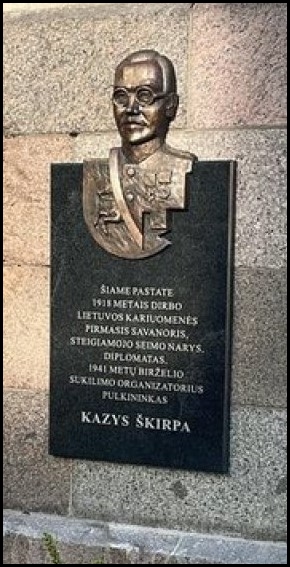
Brand new plaque in central Vilnius for the man who set the formal goal of eliminating Jews from Lithuania in the run-up to the onset of the Lithuanian Holocaust. Photo: DefendingHistory.com
◊
by Dovid Katz
VILNIUS—A crowd of ultranationalist glorifiers of Hitler’s invasion of Lithuania in June 1941 today affixed a handsome new plaque (with bas relief) on the corner of Vilnius’s central boulevard, glorifying Kazys Škirpa, who wrote pamphlets, in Berlin, calling for the elimination of Jews from Lithuania. His writings and radio broadcasts help incite the onset of the Lithuanian Holocaust on 23 June 1941, when his followers began butchering Jewish neighbors in Kaunas, and across Lithuania, before the Germans even arrived.
Time for France’s Embassy in Vilnius to Just Say ‘Non!’ to French Bookstore that Features Books Glorifying Lithuanian Holocaust Collaborators
[UPDATED 29 MAY]
OPINION | GLORIFICATION OF COLLABORATORS | FRANCE | THE ‘FRENCH BOOKSTORE’ IN VILNIUS
◊
by Dovid Katz
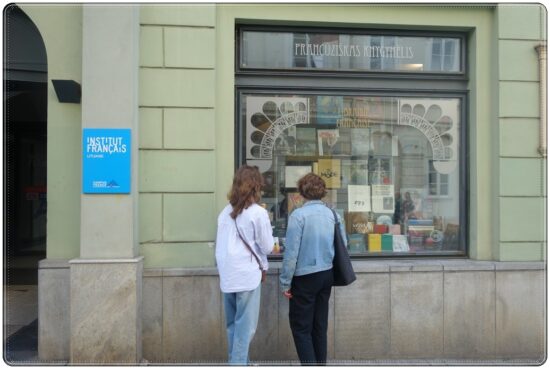
VILNIUS—The French bookstore located in the building housing the Institut français / French Cultural Center, all part of the French Embassy compound here in Lithuania’s capital, has for many years been featuring smack in the middle of its prominent show window at Didžioji St. No. 1 in Vilnius Old Town, in the row of books closest to the viewer outside, books in English or Lithuanian (nothing to do with France or French) that are dedicated to glorifying Holocaust collaborators who supported and enabled the genocide of 96.4% of Lithuanian Jewry.
Jump to author’s memoir
Whenever, over the years, this issue has been brought up to French Embassy diplomats, French Institute leadership, the answer has been the same, along the lines of “It is not our bookshop, it is a private French-themed bookshop that simply rents the space from us. We are not responsible. The French Embassy is not responsible, the French Institute is not responsible, the French Ministry for Europe and Foreign Affairs is not responsible.” Nevertheless, we would like to pay tribute to French diplomats who did make an effort over the years. On 7 May 2020, for example, the then ambassador, HE Claire Lignières-Counathe took action. She reported back: “The French book shop on Didžioji gatvė is not part of the French Institute. But we pointed out to the owner that to present this book in the shop window could hurt people. He agreed and removed the book from the shop window.”
One week later, the book was back. And that goes to the heart of how a far-right, Holocaust-revisionist, Hitler collaborator glorifying (hence ipso facto antisemitic) enterprise has been, as one midlevel French diplomat put it to us off the record, “making a monkey out of our embassy in the third decade of the twenty-first century.”
In the city’s everyday life, and all the more so for thousands of tourists from around the world, the details of ownership are unknown and of little interest. It is the universal public perception that comes into play when a French themed bookshop is housed in the building of the French Embassy compound in Vilnius, just to the right of the French Institute’s handsome blue sign.
Why The First Week of the Lithuanian Holocaust is Historically Unique. Whom to Honor on the 80th Anniversary?
◊
by Dovid Katz
◊
For years now, Defending History has, on the first of January each year, named the newborn year in honor of Lithuanian Holocaust-era Rescuers, or Righteous of the Nations as they are also known (tsadíkey úmes ho-óylem in Yiddish). In 2020 — Antanas Zubrys and Dr. Matilda Zubrienė; in 2019 — Jonas Paulavičius; in 2018 — Malvina Šokelytė Valeikienė. That is a tradition we hope to resume next year. But 2021, the eightieth anniversary of 1941, calls for something more focused, not least when some governmental bodies have chosen, shockingly, to use the anniversary to glorify the perpetrators rather than commemorate the victims and honor those who helped a neighbor to escape the rapidly closing death vise in the last week of June 1941.
By and large, the 916 Rescuers recognized by Yad Vashem (and a somewhat larger number if those recognized by Lithuanian institutions and assorted survivor families are added) are people who risked their own and their families’ lives to hide (and feed, sustain, care for and guard) a Jew or Jews for an extended period, risking it all for weeks, months or years, until the fall of the Nazi regime at the hands of the USSR — then in alliance with the United States, Great Britain and the other Allies — in July of 1944 (there were no American or British forces in Eastern Europe…). As an old adage, variously attributed, goes: One fascist with an automatic weapon could murder hundreds of trapped innocent civilians in some moments, but to save one person took years of heart-wrenching, inspirationally courageous effort by entire families and networks of incredibly good people. In the Baltics, the courage had to be greater than most other places, because they were regarded as traitors to their own nationalist leaders, not only to the occupying Nazi forces. And frankly, because things are different when much or most of the actual killing is done by willing locals idolized by the nationalists of the day.
On the Seimas Declaring 2021 to be Year in Honor of Alleged Participant in Lietukis Garage Massacre of 1941
OPINION | GLORIFICATION OF COLLABORATORS | POLITICS OF MEMORY
◊
by Evaldas Balčiūnas
◊
The resolution of the Seimas (Lithuanian parliament) to declare 2021 the “Year of Juozas Lukša” has resulted in heated discussions. They are attentively chronicled by Defending History.
Those who remember the Holocaust and its lessons for history and for life discuss the name Juozas Lukša in conjunction with the LAF (Lithuanian Activist Front) of June and July 1941, including the versions that link him to a barbaric massacre of Jews at the Lietukis Garage in central Kaunas where some seventy innocent Jewish people, caught in the streets, were brutally killed before cheering crowds.
Juozas Lukša looks very similar to one of the murderers in one of the photos (and he was identified by some from a photo of himself after the war). It links him to one of the versions noting that the Garage Massacre was committed largely by prisoners who had been released from a Kaunas jail (we know that Lukša was released from a Kaunas jail). Opponents to those versions claim that Juozas Lukša is innocent and level accusations of slander against those who implicate him. This discussion is not new and there have not really been any new proofs offered on either side since the flare-up of the argument over the last month.
On the Seimas Declaring 2021 to be Year in Honor of Alleged Participant in Lietukis Garage Massacre of 1941
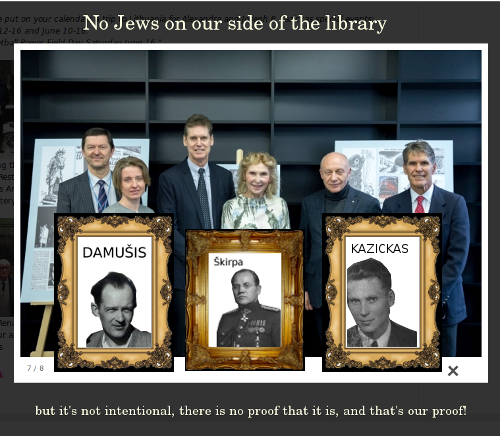
Mažvydas National Library Wants Us to Listen to Valiušaitis, a Denier of Škirpa’s Atrocities
OPINION | HISTORY | COLLABORATORS GLORIFIED | CHRISTIAN-JEWISH RELATIONS | LITVAK AFFAIRS
◊
by Andrius Kulikauskas
◊
Lithuania’s Mažvydas National Library is curiously fostering two parallel cultures which have yet to engage each other. Up on the fifth floor, on the West side, an eminent Judaic studies scholar leads the Judaica Research Center (cosponsored by the Yivo institute in New York), and on the East side, journalist Vidmantas Valiušaitis leads the Adolfas Damušis Democracy Studies Center.
More on Mažvydas National Library; on Yivo’s history in Vilnius since 2011
The World Celebrates Professor Greimas With No Regard for His Victims
OPINION | HISTORY | COLLABORATORS GLORIFIED | CHRISTIAN-JEWISH RELATIONS | LITVAK AFFAIRS
◊
by Andrius Kulikauskas
◊
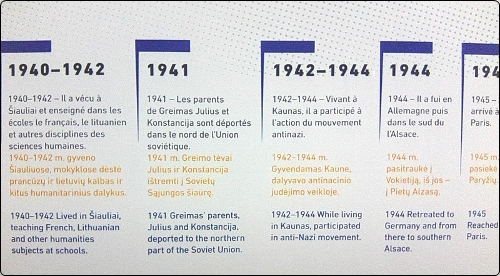
Renowned Lithuanian-French thinker Algirdas Julius Greimas (1917-1992) was more forthcoming than most about his dubious, or frankly, criminal behavior as a young man.
From his interviews we know that in 1940, he gave public speeches in support of Soviet annexation of Lithuania. And in 1941, he served as an editor for the newspaper Tėvynė in Šiauliai, which repeatedly called for ethnic cleansing of Jews from Lithuania.
Celebrating (!) 75th Anniversary of Start of the Lithuanian Holocaust (23 June 2016)?
◊
VILNIUS—For the tiny and dwindling group of Holocaust survivors in this part of the world, the indelibly cursed day the genocide began was June 23rd 1941, when hordes of young local “nationalists,” some affiliated with the fascist Lithuanian Activist Front (LAF) — which had put in writing its intentions for Jewish fellow-citizens beforehand — began to murder, plunder and rape their neighbors in at least forty locations before the first German soldiers even got there, as confirmed by numerous historians and eyewitnesses. Within a few days, most would don white-armbands.
In English Translation: V. Brandišauskas’s Classic Review of A. Liekis
D O C U M E N T S / B O O K S / H I S T O R Y
◊
The following is an English translation of a book review by Valentinas Brandišauskas of Algimantas Liekis’s Lietuvos laikinoji vyriausybė (1941 06 22–08 05) that appeared in the Lithuanian publication Genocidas ir Rezistencija No. 8, 2000, and is posted online.
◊
Review: A Doubtful Selection of “Frontists,” or, about One More in a Series of A. Liekis’s “Monographs”: Lietuvos laikinoji vyriausybë (1941 06 22–08 05) [Provisional Government of Lithuania, June 22—August 5, 1941], Vilnius, 2000, 428 pp.
◊
The negative predictions have been fulfilled, unfortunately, even beyond expectations. That’s what can be said about a news item that appeared in the Lithuanian exile community’s monthly Akiračiai regarding preparations by Lithuanian historian Algimatas Liekis, who did some work at the Lithuanian Studies Research and Studies Center in Chicago, to write a book about the June Uprising of 1941 and the Provisional Government (PG). Recalling the historian’s past (“during the Soviet era […] he was the komsorg [Communist Youth Party minder] in the Soviet navy, Party secretary of the History Institute of the Lithuanian Soviet Socialist Republic…”) and doubting his reputation as an academic, it was said that “Frontist successors” to the Lithuanian Activist Front (LAF) had invited Liekis
“to write a book that would help the Lithuanian parliament push through the legislation needed to ‘legalize’ the Provisional Government and to proclaim the day of the uprising a national holiday.”
Lithuanian-Jewish Affairs: Three Events
(Reposted from today’s Jerusalem Post)
O P I N I O N
by Efraim Zuroff
Three events took place this weekend which reflect the ambiguities of contemporary Jewish life in the Baltics and particularly in Lithuania, the largest of the three new democracies. In reverse order, on Sunday, ultra-nationalist groups staged an Independence Day march, which included anti-Semitic themes, in Kaunas (Kovno), Lithuania’s interwar capital and the country’s second largest city.Continue reading
Milan Chersonski Reports on the Antifa Lietuva Event in Kaunas on 23 June 2013
МНЕНИЕ
Милан Херсонский
Шествие под лозунгом
«ФАЛЬСИФИКАЦИИ ИСТОРИИ – НЕТ!»
В соответствии с законом о памятных днях Литовской Республики, 23-е июня провозглашено национальной памятной датой – днём Июньского восстания 1941-го года. Как известно, уничтожение Еврейской общины Литвы началось в тот же день, что и восстание. Continue reading
Yitzhak Arad’s Paper
The Holocaust in Lithuania, and Its Obfuscation, in Lithuanian Sources
by Yitzhak Arad
◊
Editor’s note: Yitzhak Arad explained that Yad Vashem had refused to publish this paper, and that he did not accept the reasons given, believing that in fact politics were at work. The Defending History community is honored to be able to pubish Dr. Arad’s paper.
◊
C O N T E N T S:
Introduction
Lithuanian Nationalism and Antisemitism Prior to the Holocaust
The First Soviet Occupation of Lithuania, 15 June 1940 – 22 June 1941
The Lithuanian Activist Front: Antisemitic Incitement
The German Invasion and the Organization of an “Independent” Lithuanian Government
The Period of Pogroms: Late June to Mid July 1941
The Lithuanian Press at the Time of the Pogroms: A Source of Incitement
The Lithuanian Provisional Government: Anti-Jewish Legislation
Systematic Mass Murder: German Design and Command, Lithuanian Perpetration (late July–November 1941)
Lithuanian Police Battalions and Their Role in the Murder of the Jews
The Lithuanian Catholic Church and the Holocaust
The Rewriting of Holocaust History and the Double Genocide Thesis — “The Jewish Holocaust and the Lithuanian Holocaust”
Anti-Soviet Guerilla Warfare in Lithuania
The Prague Declaration of June 2008 and the European Parliament Resolution of April 2009
Conclusion
Notes
Introduction
In Lithuania, as in other places in Europe conquered by Nazi Germany, a thorough and comprehensive inquiry into the tragic events that occurred compels consideration of three factors:
March 11th: A Grand Opportunity for the Lithuanian Human Rights Community — and the People of Vilnius
O P I N I O N
by Dovid Katz
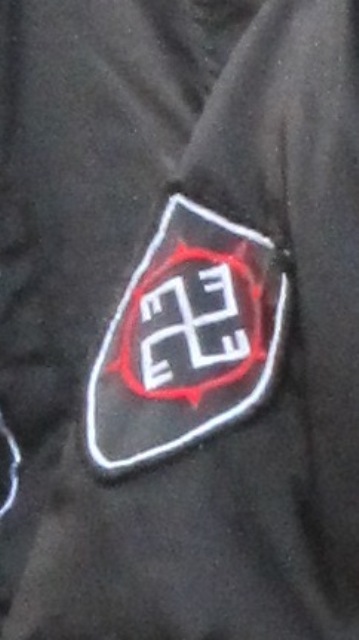
When three of us from the DefendingHistory.com community headed out from Vilnius on February 16th to confront the neo-Nazi march in central Kaunas, we were sure we would be joined by dozens, or more, true lovers of Lithuania — folks who cannot remain silent that perverted political leadership allows today’s neo-Nazis to achieve free reign in the center of a great city in the middle of the nation’s cherished independence day. Folks who cannot let the glorification of stylized swastikas (including the “Lithuanian swastika“), and white armbands (celebrating the LAF Holocaust perpetrators of 1941) go unchallenged in the country with the largest rate of murder of its civilian Jewish population in all Holocaust-era Europe. Folks who want to send at least some modicum of support to today’s minorities. And a message to the world that the neo-Nazis do not represent Lithuanian society.
It was a shock to find in Kaunas on February 16th, that the somewhat quixotic DefendingHistory.com threesome would find itself the only visible anti-Nazi presence during the march and the rally that followed.