DOUBLE GENOCIDE | EU | PRAGUE PLATFORM | PRAGUE DECLARATION | THE SEVENTY YEARS DECLARATION
◊
OPINION
◊
◊
◊
VILNIUS—The Double Genocide movement’s long-held wish of major legitimization at or near the European Parliament in Brussels via a huge monument effectively equalizing Nazi and Soviet crimes has come a step closer. This journal’s opinion has been consistent for some eighteen years, since these issues were forced on to the European Parliament’s agenda by some eastern member states (normally, in democratic alliances of sovereign states, it is understood that freedom of speech and thought includes healthy debates on history within each state). Our take: 1. Brussels needs a major new monument to the victims of Communism and its brutality, including mass murder and horrendous crimes against humanity. 2. Brussels does not need a mix-and-match monument for victims of Nazism and Communism together which is a ruse of the red-equals-brown (Double Genocide) revisionism movement, emanating from the East European far right, and seeking to downgrade (and relativize) the Holocaust, criminalize those who joined the anti-Nazi resistance, and glorify local killers in the east as freedom fighters (they were after all “anti-Communist”). The effects of “Double Genocide” pressure on various European museums has been manifest for years.A few weeks ago my wife and I visited a number of British Commonwealth military cemeteries from World War I in Belgium’s Ypres area, which is in western Flanders, the Dutch-speaking region in the north of Belgium. Starting in October 1914, Ypres had been attacked by considerable German forces but held its ground and remained part of the Allies’ front line until November 1917 when the line was joined by Anzac and Canadian soldiers, going on to reach Passendale, thus breaching the German army’s hold on the Ypres Salient in the west of Belgium.
I always feel a deep admiration for all those young men, the young privates as well as their officers who were sometimes much older. I come to see there graves in these Commonwealth military cemeteries. They were young men who came from New Zealand, Canada, Australia, South Africa, Wales, Ireland and Northern Ireland, England, and Scotland. They also came from India and Nepal and fought here in Belgium as volunteers, career soldiers or conscripted troops, to defend “brave little Belgium.” In Western Flanders, there are hundreds of such cemeteries where courageous men were laid to rest in what has been poetically termed “Flanders’ Fields,” a place that is forever British, with places of worship and by way of a common memory.
THE LATEST
Reviews of Bloodlands
Reviews of Black Earth
Instrumentalization?
2012 2013 2014 2015 2016
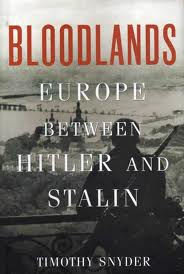
This journal holds leading historian Professor Timothy Snyder (Yale University) in the highest esteem, and trusts that this select list of reviews taking issue with aspects of Bloodlands of direct concern to DefendingHistory.com will not be taken amiss. It does not include reviews which have engaged in personal attack or pursued grudges, or which focus on other issues.◊
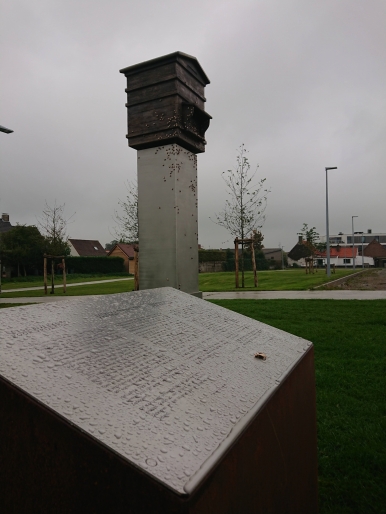
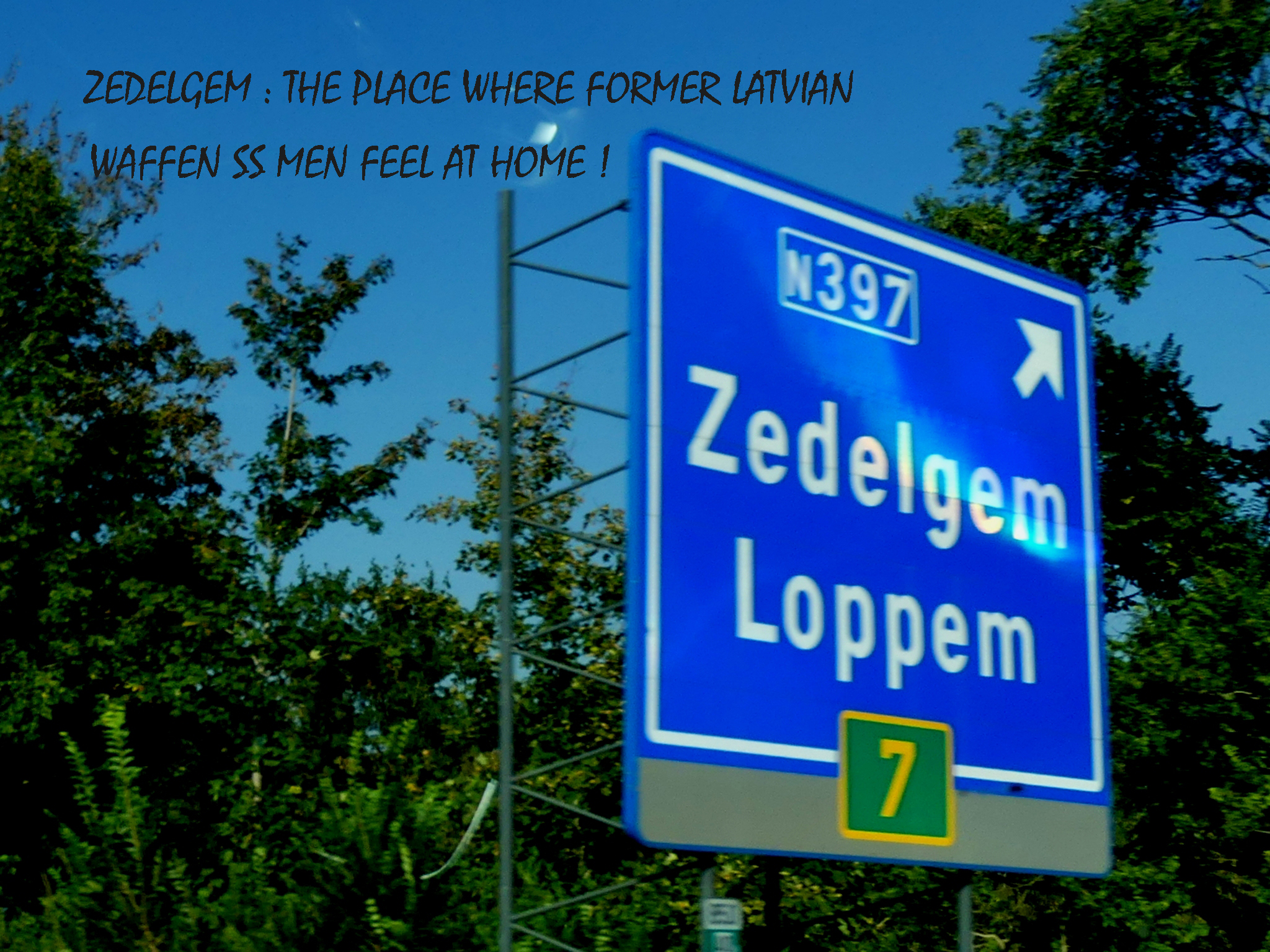
The city council of Zedelgem, Belgium decided on December 3rd that the pro-Nazi Latvian “Beehive” monument, commemorating Latvia’s Hitlerist Waffen SS, will be removed. Three years ago, in a somewhat insidious and perverse manner, PR savvy reps of Riga’s “Occupation Museum” convinced the municipal council of Zedelgem in West-Flanders, Belgium, to allow them to unveil a monument honoring their wish for de facto whitewashing and heroizing of the 12,000 Latvian Waffen SS Legionnaires who had been detained in in a British detention camp in that town in 1945/1946. Indeed, the president of the board of directors of the Occupation Museum of Riga – a well-known Holocaust revisionist institution – and members of Dagavas Vanagi (an organization of former Latvian Waffen SS) were present for the monument’s festive launch. That event was primarily covered by the Flemish speaking press without any mention of possible issues, without in fact anybody asking any question of how it might have been possible that a Flemish town had allowed the construction of a monument in honor of former members of the Waffen SS, a Nazist organization whose members swore loyalty to Adolf Hitler, and who fought against the freedom of Belgium, and, in effect, all of Europe.
◊
Zedelgem, a quiet Flemish town in West Flanders, was occupied by the Nazis between May 1940 and September 1944. During World War I it had also been under German yoke for over four years.
Now, 74 years after the end of the the Second World War, former Latvian Waffen SS men, who wore the same barbarians’ uniform as the occupiers of Zedelgem during the occupation, who fought for the same ideals and were condemned by the same Nuremberg Trials of 1945/1946 as members of a criminal organization, now, more than seven decades after Waffen SS men being freed from an Allied POW camp situated in Zedelgem, these former Latvian SS men and their current far-right, neo-Nazi and Hitler-sympathetic admirers have convinced Flemish officials — many report more than a little impetus to call them morons, plain and simple — in and in the region of modern Zedelgem to enable them to erect a monument to “Liberty” in their memory. A monument to Liberty! The very Liberty they had denied the 100,000 Jews killed in their native country and the dozens of thousands of innocent Soviet citizens of an array of nationalities and religious they killed while fighting in the USSR, near Leningrad and at other fierce, lethal battles. They wore the same barbarians’ uniforms as the Nazi occupiers of Belgium and Zedelgem. They all fought for the Führer to whom they had sworn a common oath of loyalty. They too fought for the same ideals as the Führer.
JUMP TO:
Latvia → Belgium
Lithuania → USA
Ukraine → Canada
Ukraine → USA
◊
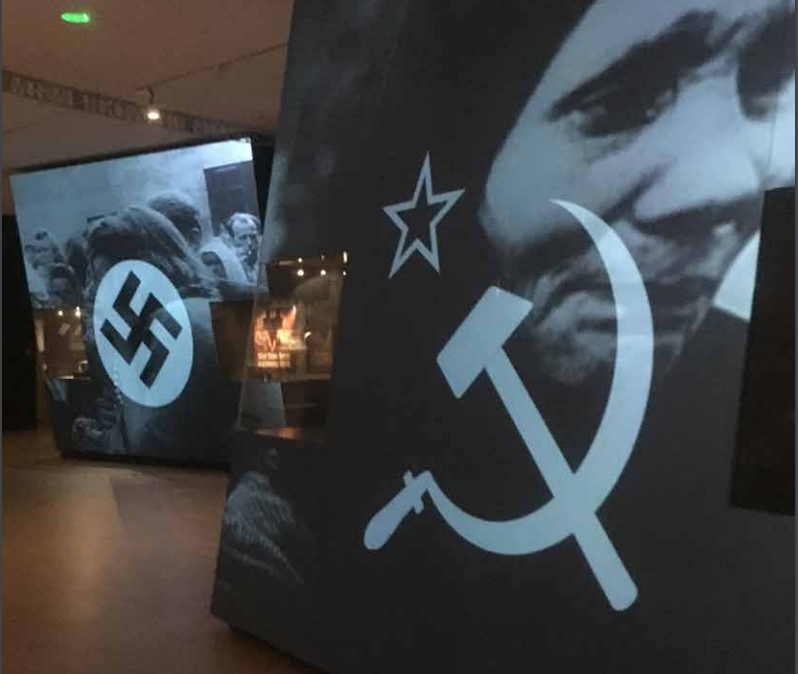
The Nazis wanted to exterminate a race and Karl Marx wanted to exterminate a social class. Our guide at the House of European History museum (HEH) in Brussels is twisting her tongue as she tries to solve the task of simultaneously explaining that Communism and Nazism are the same thing, and yet, somehow not. Visually, the impression of the museum’s exhibition is overwhelmingly slanted toward the notion that they are fully, inexorably and inherently equivalent.
Towering above us in the ideologically most intense part of the museum are huge video screens tilted towards the visitor. These screens, on four islands in the room, are so large that in spite of the hall being generously spacious, they fill up the room. The spectator can feel small in their shadow. On the screens the masses march in honor of the dictator, people are violently oppressed and the imagery makes this museum’s point very clearly: the interwar period was marked by the very same conflict as that after the war until the Soviet Union collapsed and the Berlin wall fell. That single conflict that is posited as God’s-honest-truth-fact is between Western democracy and (any kind of) totalitarianism. The technically impressive format is meticulously balanced: two huge screens each for the horrific methods of Communism and Nazism. The similarity is indeed visually striking. Stalin and Hitler—in that order— are omnipresent in the midst of terror. As a climax, the hammer and the sickle are projected at the same time as the swastika in meticulously equal format.
◊
VILNIUS—Coronavirus or not, Vilnius’s Supreme Administrative Court yesterday issued its dismissal of the appeal against an earlier court ruling that effectively codified in Lithuanian law the conclusion that Holocaust collaborator Jonas Noreika is indeed a national hero. The Noreika saga reached the English speaking world in 2012, when Evaldas Balčiūnas’s article appeared in Defending History. Mr. Balčiūnas followed up with articles on other perpetrators glorified by the state, and was harassed by years of kangaroo prosecutions (scroll down to May 2014, further articles following). Thereafter, challenges were mounted both here and abroad to state-sponsored glorification, in a NATO/EU state, of a proven Holocaust collaborator. These have included Californian-resident wealth adviser Grant Gochin, Vilnius-resident Lithuanian-American scholar Dr. Andrius Kulikauskas, who curates a website on the subject, and, most sensationally, Noreika’s own American-born grandsaughter, the Chicago-based author and educator Silvia Foti, whose 2018 article in Salon led to international media coverage and work on a feature film project.
◊
◊
Last month, on February 23, 2020, hundreds of individuals, associations and decorated wagons marched or rolled through the streets of the center of Aalst in what is known as their unique form of celebrating “Carnival,” mainly as a moment of self and free expression where and when king, royalties, clergy, politicians, film stars, VIPs, world events, are objects of satire, fun, criticism, be it with effigies, people dressed up or with placards of panels written in their nearly cryptic local dialect.
Aalst is a small, drab city in the Province of Eastern Flanders. The first time Aalst made world news was on the evening of November 9, 1985 when a mass killing by unknown semi-military killers ( “the Brabant Killers” in French and “de Bende van Nijvel” in Dutch) left eight people dead in the supermarket Delhaize, at the periphery of the city. It is a mass killing still under investigation nowadays by the Belgian Police authorities.
DH coverage of past Vilnius marches; Kaunas marches; Riga marches. See also marches section. For the 13th year running, Defending History will monitor the event. Hopefully, some human rights and international organizations will also send observers.
❋
◊
This comment appeared in Mémoires en Jeu (Memory at Stake), no. 9, (2010).
◊
In recent years, a number of eastern EU and NATO member states (plus Ukraine) have been constructing components of their official(and protected-by-law) national narratives on heroes who were collaborators, or even perpetrators in the Holocaust on the grounds that they were “anti-Soviet heroes.”1 These countries indeed had to face two Soviet occupations (1939/1940–41 and 1944/45–1991), and the occupation by Nazi Germany (1941-1944/5). The “liberating” state was also the author of major crimes such as repressions, deportations, forced labor and executions, and the statutes of post-Soviet Europe lacked a text on the crimes of communism. The ensuing moral problem is as follows: while these States would have legitimate heroes who struggled for freedom against dictatorial Soviet domination, they also honor those who participated in the Holocaust and even criminalize criticism against them.
UPDATE OF 20 MARCH: CANADA CONDEMNS EVENT
◊
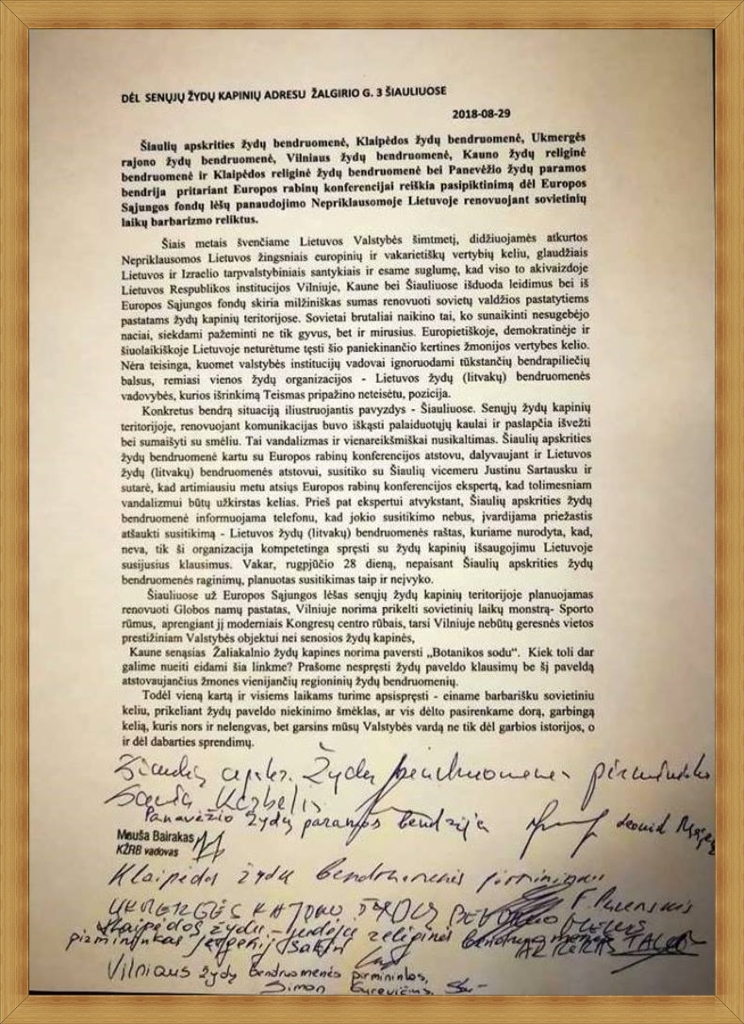
VILNIUS—The 21 person democratically elected board of the Vilnius Jewish Community, representing the approximately 2,200 Jews resident in the Lithuanian capital, today released an approved English translation of its 29 August 2018 statement on Jewish heritage in partnership with a number of smaller regional Jewish communities throughout the country. The original Lithuanian text is available here, and appears at the end of this report below.
Those following the saga of attempts to humiliate the Old Vilna Jewish Cemetery by situating a national convention center in its heart, will be encouraged by the explicit language concerning the project contained in the statement:
◊
This past winter here in Vilnius, the charming capital of Lithuania, was much like any other. During long solid weeks of subzero temperatures, as the flow of tourists and roots-seekers slowed to a trickle, I adjusted the route of my daily walk to pass by up to a dozen top tourist sights. Day after day, there was one constant: The most popular, winter-defying “must-visit” for foreigners is “The Museum of Genocide Victims.” Perhaps there is something grotesquely sexy about “genocide.” Maybe the promise of (real) former KGB interrogation rooms and isolation chambers in the basement is less run-of-the-mill and more strikingly authentic than much usual museum fare. Estimates obtained from the museum’s administrators suggest about a million visitors total to date.
◊
Today’s edition of The Architects’ Journal (AJ) gracefully announces that Tszwai So, director of Spheron Architects, has been declared the winner of the “international competition to design a pan-European Memorial for the Victims of Totalitarianism.” Mr. So, named a rising star in British Architecture in 2016, is widely acclaimed as one of the most illustrious younger talents of European architecture in our time. Our team feels certain that he would be the first to wish to be apprised of an ulterior political program behind a seemingly neutral architectural project which will now be exploiting his reputation, and his firm’s, as well as his actual design, in promoting a political project that is vastly more controversial than meets the eye at first acquaintance.
Mr. So and Spheron Architects, like the other contestants, were most likely unaware that the sponsor of the competition, the Prague-based Platform of European Memory and Conscience, known for short in Eurocircles as the Prague Platform, is the prime European engine for the far-right movement of World War II history revisionism that is increasingly becoming known as Double Genocide. That phenomenon was recently among the main points of a New York Times article by Pulitzer Prize winning correspondent Rod Nordland concerning the “Genocide Museum” here in Vilnius, which has close ties with the “Prague Platform” in the pursuit of Double Genocide politics in the European Union.
◊
Photos by Julius Norwilla, Ruta Ostrovskaya, and Dovid Katz
VILNIUS—For the 11th year running, the center of Lithuania’s beautiful capital, Vilnius, was gifted in the high afternoon hours this past Sunday, Match 11th, to far-righters and neo-Nazis on the annual holiday cherished by the free world for its historic importance, in 1990, in the series of events that toppled the Soviet Union’s hated misrule. The Defending History community, all resolute admirers of Lithuania who celebrate its success, has monitored this event annually. The international outcry after the 2008 event, which featured “Juden raus” and a throng of swastikas had led to curious “compromises” each year between organizers and the municipality on what will and will not be done. But no sign yet of the mayor’s office, municipality or government finding the moral backbone to just say, “No, not in the center of our capital on our independence day.”
◊
◊
Latvia’s Minister for Foreign Affairs Edgars Rinkēvičs seems to have found a brand new idol and role model — Ludwig Seya, who had been a diplomat in the prewar Latvian Republic for 22 years. For a short time he was a minister, but mostly he held ambassadorships to various countries. After Latvia was annexed to the Soviet Union he taught at the main Latvian university in Riga. In 1944 he was arrested by the Nazis for underground activities in the Latvian Central Council, a union of pre-war politicians and intellectuals who tried to persuade the West to insist on the independence of Latvia after World War II. After being liberated from the concentration camp on the territory of Poland, Seya was arrested by the Soviet military authorities and sent to a Stalinist gulag.
◊
◊
VILNIUS—The following (text below) is a translation from Lithuanian of the 2 March 2017 letter from the state-sponsored Genocide and Resistance Research Center of Lithuania (widely known as the Genocide Center) to a nationalist group that put on this year’s March 11th Independence Day neo-Nazi march, with authorities’ permission, in the center of Vilnius, the Lithuanian capital. The group had complained about Lithuania’s president, Dalia Grybauskaite, having granted an award on February 16th to Lithuania’s oldest Holocaust survivor, Fania Yocheles Brantsovsky, soon to turn 95, for her work in the field of Holocaust education. The president’s office had referred the complaint to the Genocide Center which issued this letter (facsimile of the original below). The correspondence was then read out at a bizarre ceremony that some observers thought bore the hallmarks of a 2017 “Jew-witch hunt” when the Independence day festivities announced a detour to the presidential palace to read out the various letters and condemn Fania Yocheles Brantsovsky, who is the only one of her family to survive the Holocaust precisely because she escaped the Vilna Ghetto in September 1943 and joined up with the anti-Nazi Soviet partisans, the only force seriously challenging Hitler’s rule of Lithuania.
◊
◊
On 16 March 2017, in the Latvian capital of Riga, as in previous years since 1991, after a Lutheran church service, an honorary march and flag-lined rally will take place at the Freedom Monument in the heart of the city to honor Latvian units of the Waffen SS. Latvia, like Estonia, Lithuania, Ukraine and Bulgaria is one of the Eastern European states where locally staffed antisemitic units and death squads under different names who collaborated with the Nazis are celebrated today as national heroes. This is done with tacit consent of the state and varying degrees of tacit or open support from state authorities.
SIGN THE PETITION TODAY