LITHUANIA | POLITICS OF MEMORY | BLAMING VICTIMS | GLORIFYING PERPETRATORS | LAST REMNANT OF JEWISH PARTISAN RESISTANCE IN THE FORESTS OF LITHUANIA | HISTORY
◊
OPINION
◊
by Roland Binet (De Panne, Belgium)
◊
- “Soviet rule has disappeared. The Jews are left behind as fair game.”
- Entry of July 7, 1941. From Surviving the Holocaust: Kovno Ghetto Diary, by Avraham Tory.
◊
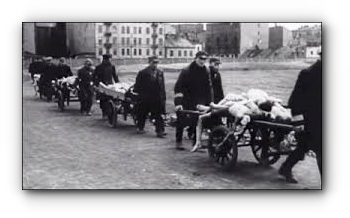
In the late sixties while working in a small company in Brussels my Jewish boss who had been “geschmuggelt’’ out of the ghetto in Lvov (former Lemberg, now Lviv, Ukraine) in a truck, before it was liquidated in 1942, had repeatedly told me that after his escape he had repeatedly tried to join with partisan groups in the area, mostly Polish or Ukrainian. Had they known that he was Jewish, he would have been killed outright. His luck was that he could pass himself off as a Pole as he spoke the language well. He had been fifteen years old at the time. I remembered these words recently on the occasion of the scandal that has erupted these past months regarding the Jewish Partisan Fort in the Rūdninkai Forest (Yiddish; Rudnitsker vald) which is now in danger of being erased due to the presence in that zone of the new German NATO Panzer Brigade (Litauenbrigade).
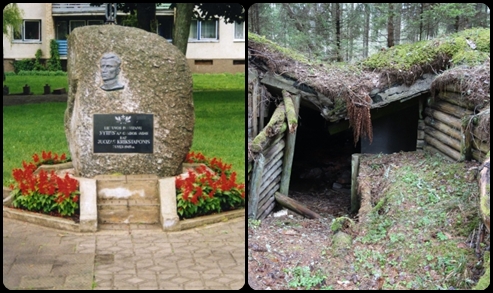
EFFECTS OF THE LITHUANIAN GOVERNMENT’S ‘MAGIC WAND’? Left: Public monument to Holocaust collaborator Juozas Krikštaponis (photo: Seimas). Right: One of the collapsing bunkers at Lithuania’s only relic of the Jewish anti-Nazi resistance that sits next door to Germany’s new Panzer brigade and may soon disappear (photo: DefendingHistory.com).

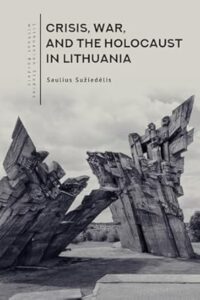

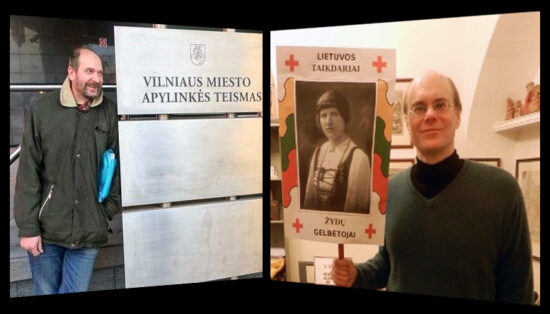 Genuine heroes of this saga—both written out of the film
 There is, however, disturbingly, quite a stupendous missing link in this abridged history of Lithuania in the twentieth century. Where had the quarter million Jews (the figure on the eve of the Holocaust) of the country disappeared to “overnight” (as centuries go), during that fateful century? Had there ever been a Jewish minority in Lithuania at all? When I looked at the author’s pedigree, I understood why the Jews had not played any role of significance in his biased dialectical discourse. Joren Vermeersch is a historian (of sorts) and an accomplished author. He is also a representative (stand-in, as we call it) for the Belgian House of Representatives, for the “N-VA.” This is the nationalist Flemish party that has its historical roots in the collaboration with the Nazis during World War II. The party that has systematically fought for an amnesty for Nazi collaborators. The party in which the grandparents or parents of some of the present actual leaders had been condemned by the Belgian State for collaboration with the enemy. Nobody is guilty of sins of their ancestors, but when there is a pattern of such pedigree being considered a great plus for current leadership, and that pedigree is subtly glorified rather than disowned, we have a current moral problem that merits discussion in the public square.