


OPINION | THE GREAT SYNAGOGUE SAGA | TEXTBOOK CASE OF RESTITUTION GONE AWRY | STOLEN ELECTION SAGA | THE LJC | THE AJC | THE GWF | USCPAHA
◊
OPINION
◊
by Dovid Katz
◊
I have argued that Jewish diaspora history comprises a permanent, central religious spine, a tree trunk if you will, characterized by “secular outbursts” that produce magnificent contributions both to Jewish and to world culture, arts and sciences. The recurring and harmonious patterning includes the great religious treasures remaining precious also to the secularists, be it the Bible, or a wall in Jerusalem or a synagogue in Prague. There has also been bidirectional cross-fertilization of achievements and their use, without either group wanting to usurp the other’s treasures, but rather to benefit from them. One of the outcomes is that great Jewish religious sites around the world, including synagogues and cemeteries, have become invaluable survivals of a rich and varied diaspora history that have a profound meaning for the non religious or not-so-religious — as well as for wider, multiculturalist non-Jewish society.
UPDATE
Please consider signing Ruta Bloshtein’s new petition.
That patterning is only internally ruined on the rare occasions when secularists, instead of taking pride and feeling joy at the continuity of religious life alongside their own, have turned against it with a venom. Grabbed assets and effectively proclaimed “victory” over the ancient religion of their own immediate ancestors. The most notorious case might well be the “Yevsektsiya,” the Soviet Union’s early investment in “good Jewish citizens” who would gleefully help destroy the religious Jewish mainstream of Jewish life that boasts thousands of years of uninterrupted survival in the face of monumental intolerance. They would mock the sanctity of synagogues, yeshivas and cemeteries, and revel in replacing them with artefacts of “Soviet modernity” while relegating the sacred, at best, to the cellars of a museum of a distant, extinct past.
The question before Lithuania, on The Old Vilna Jewish Cemetery and The Great Vilna Synagogue, conjures ghosts, current reincarnations, of a certain spirit of state dismantling of traditional Jewish life (right down to finding, empowering, remunerating and honoring selected “Useful Jews” from at home and abroad). Only this time, the moving forces are vainglory, hubris, greed and a secularist clique’s lust for power, sometimes with clear signs of mohican syndrome (“I am (/we are) the last real Lithuanian Jew(s), the rest are all impostors”). This often comes in a rather macabre partnership with ultranationalist sentiment against there being any “big Jewish-looking thing” in central Vilnius.
All with exquisite cover designed by specialists in PR. Just find some famous foreign personality as needed, be it archaeologist or architect, with “Litvak blood” and dress it all up as “preservation of the Litvak heritage” and it will all cover for the dismantling of Lithuania’s once democratic Jewish community. There will be yet another toy for the same tiny circle empowered by the government to decide on the spending of millions of euros deriving from the valuations, you will remember, of looted prewar religious Jewish properties. Actually, this time around, not just another toy. It will be the new headquarters for that tiny circle’s legitimization via physical, on-site replacement of the Vilna Great Synagogue. The long-term damage to Lithuanian Jewry globally, in all its senses and branches, and to already delicate Lithuanian-Jewish relations, needs to be fathomed and conceptually played out now. Before it is too late.
Turning to the fate of the Great Vilna Synagogue and its excavated remnants now in modern Vilnius’s splendid Old Town, liberated by the recent and long overdue knocking down of the Soviet-eyesore kindergarten on top.
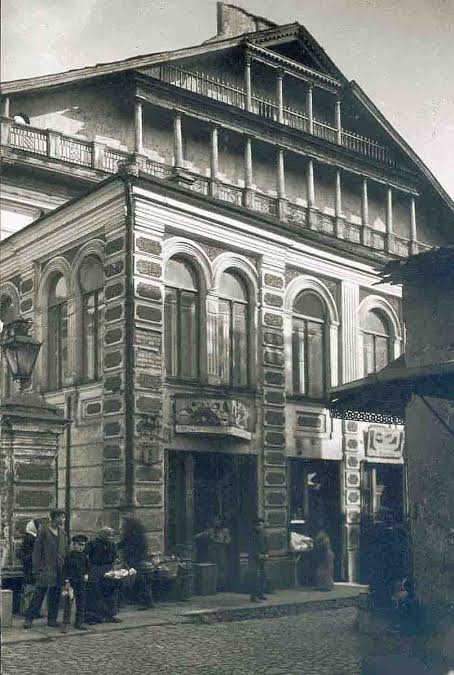 (1) Have the more than one million Orthodox Jews worldwide who consider themselves “Lithuanian” (Litvish) been consulted and respected? Do their future pilgrimages and tourism merit consideration? Those of non-Litvak Orthodox heritage who would love nowadays to add Vilnius to their primary destinations in Ukraine, Poland and other countries? Respect for the tiny remnant on the ground who do consider themselves religious?
(2) Is the sacred site of the Great Vilna Synagogue per se the right place for a new state-sponsored secular community HQ, Yivo, gourmet food projects, and more? What would Yivo’s founders think? What would the synagogue’s centuries of worshippers think? All that was holy and so proudly situated within the main sanctuary would now be in the cellar, a set of ruins to be looked down on by the secularist interests on the swish luxury upper floors. A little like looking at a stuffed animal in its preserved encasement in the cellar.
(3) Is it conceptual, architectural and historic justice to construct (on the Great Synagogue’s still extant — and now archaeologically revealed — main-sanctuary-level ruins that can be permanently displayed or restored) a modernist, secularist edifice? We asked some seasoned architects to characterize the spirit of the proposed building (collage below). Replies included: Nordic modernism. Scandinavian spirit. Barn-inspired structuring. Warmed minimalism. Critical regionalism. The concept of a shul (synagogue) was not among the associations.
(4) Would this be happening to a major sacred Christian shrine of parallel status, recently unearthed and meticulously excavated, one that had flourished for centuries in the hallowed spirit of Old Vilna churches? It will certainly be balm to the souls of those who fear that something substantial beaming with the warmth and glow of bona fide Old Jewish Vilna might be coming back to the Old Town.
Please read the project’s 2022 founding memorandum in English and in Lithuanian. It is quite the document! Were the signed “Jewish representatives” authorized by leaders of Orthodox Litvish Jewry internationally to represent the traditional Jewish view about the future of one of the most sacred religious sites in Lithuania (and all of Eastern Europe)? What do the living Jews of Lithuania think of the solemn memorandum proclaiming as fact that the “Jewish community in Vilnius and Lithuania declined significantly and is now dying out altogether”?
Is this the message to the living Jews of Lithuania, and to the Vilnius Jewish Community (which has received straight zero from restitution), their hopes and dreams for a hundred years hence, and their frequent visitors from every part of the globe? Does this mean that the grand new multimillion euro edifice is actually just a power-and-glory base for the chairperson of an altogether-dying-out community and her (or her successors’) coterie? For the machers of the Good Will Foundation itself? Will it perchance be built in part or in whole with the millions from government restitution for religious properties of the annihilated Jewish communities of Lithuania?
“The Jewish community in Vilnius and Lithuania declined significantly and is now dying out altogether.”
—from the founding memorandum for the new multimillion euro “Jewish community center” on top of (instead of) the Great Synagogue, signed by leaders of the AJC, GWF, LJC, and the mayor of Vilnius.
So who exactly, in their view, needs this new building?
And will the vast majority of Vilnius’s two thousand or so Jews, most of whom consider themselves affiliated with Vilnius Jewish Community, be excluded from this new “community center” as they have been all these years from Pylimo 4? Is this becoming part of the lamentable long-term policy of excluding the actual current Jewish community while constructing a new elephant for the benefit of the handful of “elite restitution payment controllers”?
Indeed, the GWF announced the decision on its website following another so-called “Litvak congress” in Vilnius in 2022 that excluded most genuine Litvak voices, local as well as international. Defending History was on the case from day one. More recently, at a Dec. 2025 reception at the American Embassy in Vilnius celebrating a fait accompli in the absence of any consultation with Orthodox Jewry makes clear that it will house the (utterly secular) official state-restitution-fuelled Lithuanian Jewish Community (which has excluded the majority of Lithuania’s Jews, and the Vilnius Jewish Community which represents them, since the “stolen election saga” of 2017). (And yes, the American Embassy could be perhaps more wary when it comes to being unwittingly instrumentalized in unsavory shenanigans on the say-so of (in alphabetical order) the AJC, the GWF, and the LJC.)
It will also house a prestigious Yivo center. But would Yivo’s ultrasecularist founders and prewar leaders have wanted to arrogantly and triumphantly “muscle in on” and “take over” the Great Synagogue — or even worse, its now-lamented subterranean ruins — for secular endeavors at which administrators, academics and visitors would gaze down at some religious rubble in the basement? Or would they have said: “No, the right place for the new Yivo structure is in a part of Vilna outside the Great Synagogue remnants that are so sacred to religious Jewry?” Indeed the grand tradition of Vilna Yiddish scholarship has its beloved neighborhood in town.
The Good Will Foundation version of the report makes clear that the new building is moreover “expected to become a major attraction for Jews, cultural figures, and gourmets from around the world” (bold type added). Is there going to be a gourmet restaurant there too? Anything to add to the pain and humiliation of traditional Lithuanian Jewry?
Some images from the architectural plans for the new building follow (more online). Do they reflect sympathetic reconstruction of the spirit of the half-millennium old Vilner Shulheyf* (the Great Vilna Synagogue Square)? Is this the same treatment afforded to Vilnius’s other great medieval squares and spaces?
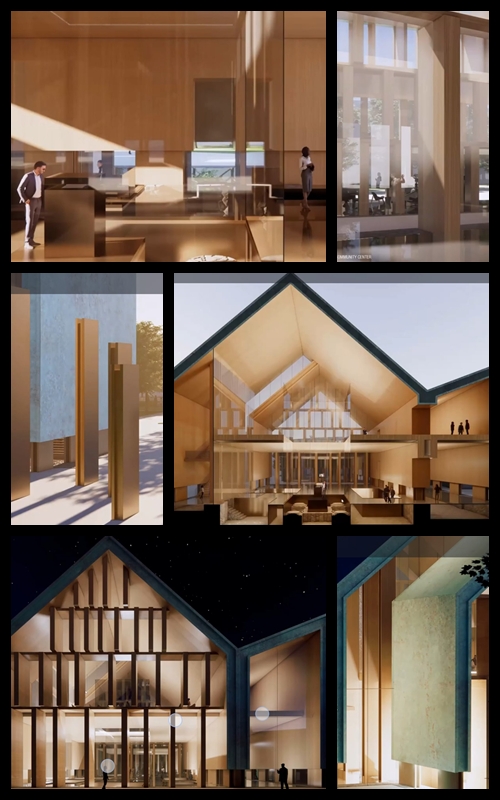
These photos were leaked to the media by conscience-stricken foreign members of the board of the “Good Will Foundation”. The first question: Are they real? Will the GWF now release publicly the full plans and images of what it plans for this most sacred of Old Vilna Jewish sites?
*
There are two ethical solutions here, both rooted in the understanding that the past, present and future of religious Vilna Jewish culture are here paramount. Art, secular Yiddish culture, the current “official” Jewish community and Good Will Foundation quango and gourmet food delicacies all deserve their spots in town, but this ain’t it. The splendid archaeological recoveries are themselves worthy of remaining at the heart of, or even becoming, the permanent public visual treasure here.
The original bimah and other components that were once on the main floor are now well below ground level. They could be on permanent display protected by safety glass, with a designated footpath maximizing the profound spiritual experience of these recovered treasures, so long buried under the unsightly former Soviet kindergarten. Then, next door to the Great Synagogue (not on top of it!), one of the old small kloyzn in the adjacent courtyard can be reconstructed for the use of the many thousands of pilgrims who would be coming each year to pray at the site (and add to Lithuania’s successful tourism). If that is too much for now, a temporary modern structure nearby could house prayerbooks and the other needs of pilgrims who come to pray at precisely such sacred sites in Eastern Europe.
So who is afraid of a “big Jewish looking thing” in Vilnius’s Old Town?
Incidentally, this solution — preserving the uncovered remains and making them permanently visible to visitors — was the one proposed by the long-term beloved and democratically elected head of the Jewish Community of Lithuania, Dr. Shimen Alperovich (Simonas Alperavičius, 1928-2014) in a 13 September 2013 interview videographed at the convalescent home where he spent the final period of his life. Though physically very frail, he remained mentally sharp and spoke lucidly about the future of the Vilna Great Synagogue. He told us he wanted to leave this message for the future. He died just over six months later, on 27 March 2014. This formula has many parallels in Ukraine and elsewhere.
The second option is to rebuild the Great Synagogue to its original scale while preserving the archaeological remains of the original structure in situ. For decades, Swedish-Israeli (and Litvak) architect Tsila Zak worked on this, starting in 1990 when she and Willy Gordon won an international competition on proposals for the site. Her work over many years integrates recovered remains excavated with reconstruction of key elements of the original, supplemented by symbolism as well as the option to “reconstruct the rest” at a future point in time. Most recently, the site’s chief archaeologist, Jon Seligman, has made a thoughtful and eloquent case that full reconstruction should be seriously considered. His many admirers in town trust he will not remain silent about the travesty unfolding, notwithstanding the funding sources for the archaeology per se and his status as laureate of the Year of the “Vilna Gaon and Litvak History Commemorative Medallion for keeping Litvak traditions, learning and the Litvak cultural legacy alive.” Assuredly, that status empowers him to speak with authority and to refuse to let himself, and archaeology, be abused to deceive American and Israeli religious publications that the Great Synagogue is being “saved” in what amounts to a classic case of orchestrated deception that it is right out of Orwell.
It is in fact being permanently destroyed and conceptually humiliated by plonking a modernist building that will be for the use of historically non- and anti-religious entities and an ersatz community that excludes the actual Jewish people of Vilnius (and, needless to add, none of the rabbis officiating in Vilnius have been consulted, even though this is all about a synagogue). Images of the new building and any revealing of what its uses (or who its occupants) will be are strictly unmentionables in the communications being fed to foreign publications — and Jewish religious communities internationally — about the choke-strings in which this archeaology is in real life entangled. This creates a de facto situation where archaeology is abused for cover-up, as the history of Jewish archaeology in twenty-first century Europe will surely record in all gory detail. But there is still time to prevent this chapter of unethical, instrumentalized and deviously-mobilized archaeology (and architecture) from becoming the main story here. Elementary: the handsome modernist new edifice for the few top brass of the LJC and GWF can be moved to any of hundreds of suitable venues in town.
Not to mention the prospective ruination of the Old Vilna character of this vital part of Vilnius’s splendid Old Town. Yes one hopes that both the archaeologists and the architects will come to understand how they are being instrumentalized (“paid to remain silent” in effect?) before it is too late and their roles in the sad story are built into the wood and glass of an avant garde building so conspicuously and painfully misplaced (where it’s main purpose is to forestall rebuilding of the greatest synagogue in Lithuania). One that will become a landmark of post-Soviet corruption of Jewish history, lore, values and ethics here on ground zero of the East European Holocaust.
To return to either of the intellectually honest solutions, the attraction of davening (praying) where for centuries the famed rabbinic authors of Lithuania (whose works are studied every day around the world) prayed their prayers and drew inspiration would become for world Orthodox Jewry a major stop on pilgrimages to Eastern Europe. Where the Gaon of Vilna prayed on major occasions. There are now between 25o,000 and 400,000 Orthodox Jews coming to Eastern Europe on pilgrimage journeys each year. Lithuania has the smallest share in this growing sector despite its glorious rabbinic past. Hasidim may not come just to Lithuania, the historic bastion of non-Hasidic Misnagdism, but they would love to add Vilna and Lithuania to their itineraries focused at present on Ukraine, Poland, Hungary, Romania, and Slovakia. Their current series of educational books on great sages regularly include the Gaon of Vilna. Of course the powers that be need to ensure that kosher food and other religious facilities are readily available with a choice of venues, just as in Poland, Ukraine and the other countries that are home to sacred Jewish places that attract a multitude of Jewish pilgrims each year. Why would Lithuania want to permanently enrage the bona fide worldwide successors to the specifically Litvish stream of religious Jewish life when it could have thousands of admirers coming every year?
There is a grand opportunity to attract thousands of pilgrims each year and bring untold prestige to Lithuania’s standing. To show that modern Lithuania is proud of reconstructing and preserving the two most sacred Jewish religious sites in the City of Gediminas — the Old Jewish Cemetery and the Great Synagogue Square. That it will not cave into desecrating them for secular power games, mammon, corruption, and ersatz ultranationalist purism.
There is still time to save this sacred site that evokes a half millennium of storied Jewish life, in the unique style and spirit of Old Vilna. It was and can soon again become one of the prides and joys of the heritage of the Grand Duchy of Lithuania.
◊
* Note that shúlheyf (ey as in they) is the Lithuanian Yiddish form of Standard Yiddish shúlhoyf designating a synagogue’s courtyard or a complex of prayerhouses (/studyhouses) and related institutions in a contiguous area that is sometimes tantamount to being a conceptual square. In 2016, the LYVA project interviewed Rabbi Yitskhok Gurvich of Boro Park, Brooklyn (originally Vilna) who shared on video his childhood memories of Vilna’s Great Synagogue Courtyard.
Related:
- Anna Avidan & Julijana Leganovič (eds), How to Commemorate the Great Synagogue of Vilna Site? (Kaip įpaveldinti Vilniaus Didžiosios sinagogos vietą?), Litvak World: Vilnius 2017.
- Rabbi Elchonon Baron’s take in Jewish Heritage in Lita.
- Sergey R. Kravtsov’s paper in How to Commemorate The Great Synagogue of Vilna Site? (details cited).
- Jon Seligman’s paper in Journal of Heritage Management.
- Defending History’s sections on the Great Synagogue and the Old Vilna Jewish Cemetery.
◊20