


[LAST UPDATE]
JEWISH FORT IN THE FOREST | FANIA YOCHELES BRANTSOVSKY | DR. RACHEL MARGOLIS | BLAMING THE VICTIMS
◊
It was known as “the Jewish fort” (or “the Yiddish speaking fort”) within the network of anti-Nazi Soviet partisan forest enclaves (the only de facto resistance to Hitler’s occupation of Lithuania, then in alliance with Great Britain, the United States, and the other Allies). It’s 100 or so occupants were all Vilna Ghetto escapees whose families were murdered and who went on to survive, and to become decorated heroes of the free world in the anti-Nazi resistance.
Then, after the rise of free, democratic Lithuania in 1990/1991, they become major educators whose last wish was that the Jewish fort’s remnants be preserved.
Whether coincidence or by sheer majesty of history (or: Higher Powers), the beloved remnants of the Jewish partisan fort have ended up abutting the massive new training ground of the German Army’s 45th Panzer Brigade arriving in Lithuania in the democratic context of NATO and the free world. It is a magnificent opportunity for Germany, and the thousands of young troops being sent “back east” to be educated and educate others about the Holocaust in Lithuania and beyond. Including — the extraordinary saga of Jewish resistance.
◊
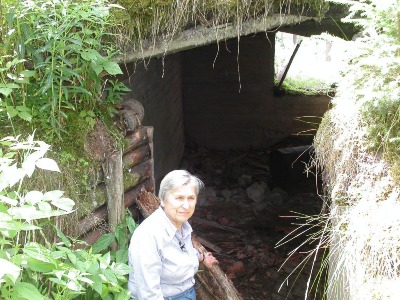
Fania Yocheles Brantsovsky (1922-2024) shows us where she and 99 other Jewish escapees from certain death in the Vilna Ghetto lived and fought the Nazis in this underground fort in the forest now right next door to the German Army’s new Brigade in Lithuania. Click on image for 2007 video. Fania explains that this was known as “the Jewish fort” within the wider partisan movement, and is so known in Holocaust resistance history. Yiddish was the everyday language of its 100 or so occupants.
◊
The new German Army 45th Brigade in Lithuania is right next door to the fort in the Rūdninkai forest (Yiddish: Rudnítsker vald)
Question and answer in the German Bundestag of Dec. 2025 now published online. Bundestag’s subsequent press release displays splendid comprehension of the historic importance of the Jewish partisan fort.
But alarm bells went off when Holocaust survivor families noticed that the issue was being “somehow fixed” in Lithuania itself by the Brigade’s link to the NGO “Maceva” that is dedicated to restoring and documenting old (prewar) Jewish cemeteries — a fine endeavor, but one that has nothing to do with the wartime Jewish partisan resistance relic that lies precisely at the new German training grounds. In some opinions, it is an NGO with political and careerist-fueled agendas, whose leadership has been said to participate in deprecation of Holocaust history dissidents; the failure to accredit the pioneering work of the late and inspirational Joseph Levinson; the dismantling of Lithuanian Jewish community democracy; and, most recently the use of the (excellent) cleaning of old Jewish cemeteries to deflect from the actual, irksome issues at hand, in this case, the lame attemt to “fix” the 45th Brigade saga (“Everyone will talk about the German army cleaning some old Jewish cemetery somewhere, not the disappearing Holocaust-era Jewish resistance fort abutting its own new training ground that the ultranationalists want to destroy”).
Money is no obstacle. The major “gravestone scrubbing spectacle” even included flying in a rabbi from Belgium, so the one resident rabbi in Lithuania could be “cancelled out” entirely. And when the NGO chief duly became head of the state Jewish museum in April 2026, the “first symbolic public act” of the new leadership of the state Jewish museum was — a rooftop photo-op with Panzerbrigade 45 (/archived). But the ghost of the Jewish partisan resistance fort at the Panzerbrigade’s gates will not stop haunting it, or the German Foreign Ministry and army, until it is respected, marked, and restored.
DH’s April 2026 visit revealed extensive tree cutting and detritus of firecracker parties (with recent beer cans etc.) that have already damaged the unique historic ambience of the surrounding forest, as the fort remnants rapidly become a fun place for nearby construction workers, and very soon perhaps for thousands of German troops. Will the 45th Brigade perhaps start by rapidly erecting, on its allocated training grounds, a sign indicating the site’s significance and asking visitors to respect it?
Will Germany now show appropriate sensitivity?
Defending History’s section on the fort
Fania Yocheles Brantsovsky’s last wish
2007 video of Fania showing us the forest fort where she and 99 other Jewish escapees from certain death in the Vilna Ghetto escaped to fight against the Nazis with the partisans.
Does Germany remember the medal it awarded Fania back in 2009? The medal it awarded Rachel Kostanian in 2021?
Does Lithuania remember the Order of the Knight’s Cross for Merits to Lithuania that its then president conferred on Fania in 2017? (even if the far right ultranationalist establishment vehemently protested)
Another Lithuanian Jewish partisan hero who fought valiantly against the Nazis at this fort and wrote a major memoir, Dr. Rachel Margolis, cofounder of Vilnius’s storied Green House, was honored in 2011 by former UK prime minister Gordon Brown as “a Lithuanian war hero” and “one of the most courageous women in her country’s history”
Jewish partisan heroes: saga of ‘blaming the victims’ (while Holocaust perpetrators continued to be honored) led to the 2008 rise of the Defending History community which included a number of Holocaust survivors in Vilnius, and the valiant Western diplomatic fightback, initiated and led by Ireland’s brilliant Ambassador Dónal Denham, and joined by the embassies of Austria, Britain, France, Norway, and the United States, among others. The formulation “Blaming the victims” goes back to the Economist’s Edward Lucas, in 2008 (alternate link; as PDF).
ICONIC PHOTO: Back in 2008-2010, the Irish ambassador to Lithuania, HE Dónal Denham (left), and UK ambassador HE Simon Butt (right) frequently visited the Jewish Partisan Fort with Fania and other survivors and were proud to include distinguished visitors from the Western diplomatic corps in nearby Vilnius. Now, in 2026, one hopes the German Foreign Ministry will step up with moral conviction and clarity, and without fear of the far-right Holocaust revisionists in the region. With a new Brigade next door in the forest, it becomes, in the view of the Defending History community, an ethical imperative of historic proportions, and at the same time a magnificent educational opportunity for today’s German Army and its 45th Panzer Brigade (Panzerbrigade 45, PzBrig 45, Litauenbrigade).
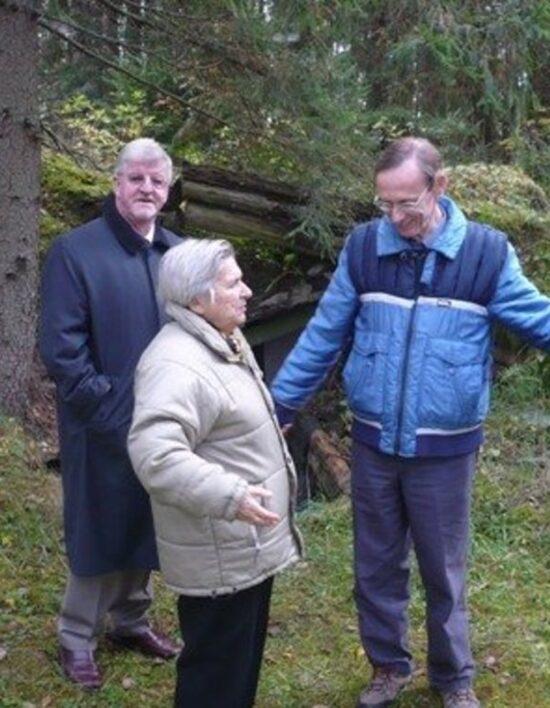
HE Dónal Denham, Ireland’s ambassador to Lithuania (l.) and HE Simon Butt, UK ambassador, on one of multiple visits with Fania Yocheles Brantsovsky (1922-2024) to the remnants of the Jewish Partisan Fort in the forest, not far from Vilnius, 2009. Photo: DefendingHistory.com.
◊
Please contact elected officials asking them to write to the German government & embassies calling for rapid action to preserve the last disappearing remnant of Jewish Holocaust-era resistance against the Nazis in Lithuania, one that ‘the majesty of history herself’ has put right next door to the massive new German Army 45th Brigade training ground in the same Lithuanian forest. . .