DOUBLE GENOCIDE | EU | PRAGUE PLATFORM | PRAGUE DECLARATION | THE SEVENTY YEARS DECLARATION
◊
OPINION
◊


◊
◊
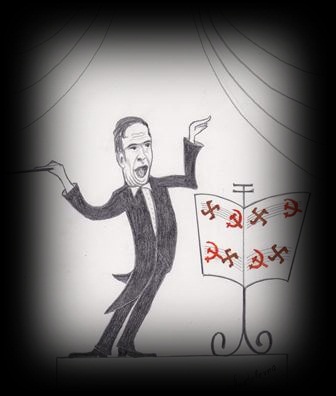 VILNIUS—The Double Genocide movement’s long-held wish of major legitimization at or near the European Parliament in Brussels via a huge monument effectively equalizing Nazi and Soviet crimes has come a step closer. This journal’s opinion has been consistent for some eighteen years, since these issues were forced on to the European Parliament’s agenda by some eastern member states (normally, in democratic alliances of sovereign states, it is understood that freedom of speech and thought includes healthy debates on history within each state). Our take: 1. Brussels needs a major new monument to the victims of Communism and its brutality, including mass murder and horrendous crimes against humanity. 2. Brussels does not need a mix-and-match monument for victims of Nazism and Communism together which is a ruse of the red-equals-brown (Double Genocide) revisionism movement, emanating from the East European far right, and seeking to downgrade (and relativize) the Holocaust, criminalize those who joined the anti-Nazi resistance, and glorify local killers in the east as freedom fighters (they were after all “anti-Communist”). The effects of “Double Genocide” pressure on various European museums has been manifest for years.
In his book Crisis, War and the Holocaust in Lithuania, which I recently reviewed on these pages, historian Saulius Sužiedėlis virulently attacked those who in the past had opposed the Prague Declaration of 2008. When I read the list of signatories to the Prague Declaration signed in 2008, it makes me think of prisoners or detainees becoming free after having spent 45 years between four closed walls.
Getting free in the outside world and knowing next to nothing that has happened in the world at large during their detention. Most of these signatories, people of esteem, some of them heroes in their fight against Communist yoke, have suffered greatly and they yearn for recognition as victims of totalitarian crimes. But the only tangible contemporary phenomenon with some kind of kindred inhuman similitude they want to equate it with is — the Holocaust. So, oblivious to the manifold scourges the twentieth century has known worldwide, they signed on to the conclusion that “both the Nazi and Communist totalitarian regimes should be considered to be the main disasters, which blighted the 20th century” and “recognition of Communism as an integral and common part of Europe’s common history.” The declaration contains the word “same” five times, in support of the declaration’s underlying thesis that Nazi and Soviet crimes are absolutely — the same.
Is it possible to be so self-centered on one’s suffering as to become blind to history?
“Putin’s criminal and barbaric invasion must be countered to the hilt and we must rally unfettered to the cause of Ukraine’s freedom. But for far-right double-genocider revisionists in the Eastern E.U. to take advantage of it for Holocaust obfuscation is just plain wrong.”
Defending History’s statement on the war in Ukraine
☰
When Ottawa Citizen and The New York Times broke taboo on wartime discussion of East European state-sponsored Holocaust obfuscation
☰
But what is the “Prague Platform”?
◊
The Nazis wanted to exterminate a race and Karl Marx wanted to exterminate a social class. Our guide at the House of European History museum (HEH) in Brussels is twisting her tongue as she tries to solve the task of simultaneously explaining that Communism and Nazism are the same thing, and yet, somehow not. Visually, the impression of the museum’s exhibition is overwhelmingly slanted toward the notion that they are fully, inexorably and inherently equivalent.
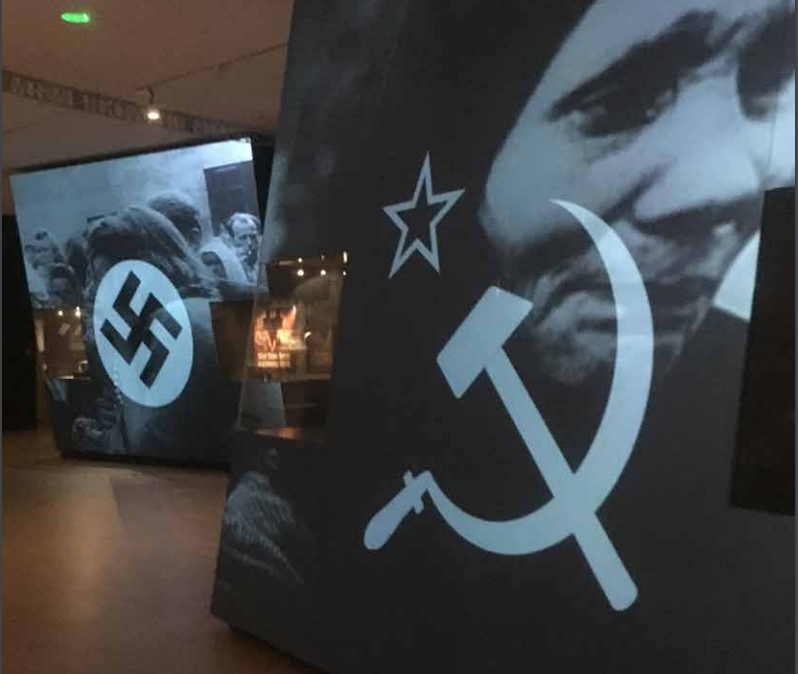
Towering above us in the ideologically most intense part of the museum are huge video screens tilted towards the visitor. These screens, on four islands in the room, are so large that in spite of the hall being generously spacious, they fill up the room. The spectator can feel small in their shadow. On the screens the masses march in honor of the dictator, people are violently oppressed and the imagery makes this museum’s point very clearly: the interwar period was marked by the very same conflict as that after the war until the Soviet Union collapsed and the Berlin wall fell. That single conflict that is posited as God’s-honest-truth-fact is between Western democracy and (any kind of) totalitarianism. The technically impressive format is meticulously balanced: two huge screens each for the horrific methods of Communism and Nazism. The similarity is indeed visually striking. Stalin and Hitler—in that order— are omnipresent in the midst of terror. As a climax, the hammer and the sickle are projected at the same time as the swastika in meticulously equal format.
◊
This comment appeared in Mémoires en Jeu (Memory at Stake), no. 9, (2010).
◊
In recent years, a number of eastern EU and NATO member states (plus Ukraine) have been constructing components of their official(and protected-by-law) national narratives on heroes who were collaborators, or even perpetrators in the Holocaust on the grounds that they were “anti-Soviet heroes.”1 These countries indeed had to face two Soviet occupations (1939/1940–41 and 1944/45–1991), and the occupation by Nazi Germany (1941-1944/5). The “liberating” state was also the author of major crimes such as repressions, deportations, forced labor and executions, and the statutes of post-Soviet Europe lacked a text on the crimes of communism. The ensuing moral problem is as follows: while these States would have legitimate heroes who struggled for freedom against dictatorial Soviet domination, they also honor those who participated in the Holocaust and even criminalize criticism against them.
◊
Today’s edition of The Architects’ Journal (AJ) gracefully announces that Tszwai So, director of Spheron Architects, has been declared the winner of the “international competition to design a pan-European Memorial for the Victims of Totalitarianism.” Mr. So, named a rising star in British Architecture in 2016, is widely acclaimed as one of the most illustrious younger talents of European architecture in our time. Our team feels certain that he would be the first to wish to be apprised of an ulterior political program behind a seemingly neutral architectural project which will now be exploiting his reputation, and his firm’s, as well as his actual design, in promoting a political project that is vastly more controversial than meets the eye at first acquaintance.
Mr. So and Spheron Architects, like the other contestants, were most likely unaware that the sponsor of the competition, the Prague-based Platform of European Memory and Conscience, known for short in Eurocircles as the Prague Platform, is the prime European engine for the far-right movement of World War II history revisionism that is increasingly becoming known as Double Genocide. That phenomenon was recently among the main points of a New York Times article by Pulitzer Prize winning correspondent Rod Nordland concerning the “Genocide Museum” here in Vilnius, which has close ties with the “Prague Platform” in the pursuit of Double Genocide politics in the European Union.
◊
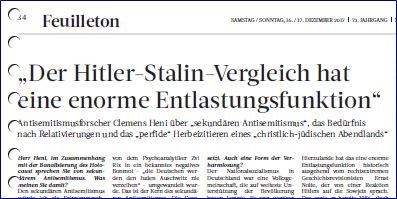
BERLIN—In a groundbreaking interview with Dr. Clemens Heni, director of the Berlin International Center for the Study of Antisemitism (BICSA) in the leading German liberal daily Frankfurter Rundschau, Heni criticizes the ongoing comparison of Hitler and Stalin and the relativization of the Holocaust. He reminds readers, in the interview conducted by journalist Katja Thorwarth, what psychoanalyst Zvi Rix had to say about German reception of the Holocaust: “The Germans will never forgive the Jews for Auschwitz.”
◊
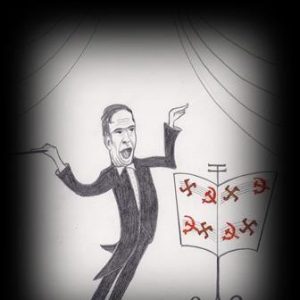
Irina Izhogina / DefendingHistory.com
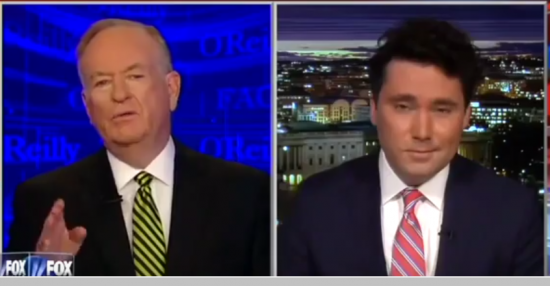
NEW YORK—At least a few viewers of the Fox News Channel’s premier prime time program, “The O’Reilly Factor” were taken aback to hear Bill O’Reilly spurt out last night, in his best high-school teacher by-the-way factual tone, “Stalin was as bad as Hitler! Alright, it’s the same thing!” during a segment presented as uncontested truth. The guest inspiring the “truism” was Mr. Marion Smith, executive director of the Washington DC based “Victims of Communism Memorial Foundation” (sometimes known for short as VOC).
CAMPAIGN TO EXPORT DOUBLE GENOCIDE FROM EAST EUROPEAN NATIONALISTS TO THE WIDER EU?
[updated]
The latest “Double Genocide” conference sponsored (naively?) by the European Union has just ended in Prague. The two-day event (12-13 June 2014) has a convoluted history (see earlier DH reports: 15 Jan. 2014; 24 Jan. 2014; 26 Feb. 2014; 27 Feb. 2014; 7 March 2014; 20 March 2014; 23 March 2014; 20 May 2014).
LONDON—In its just published A Jewish Manifesto: The 2014 European Elections, the British Board of Deputies has included a statement rejecting the attempts of recent years to downgrade the Holocaust. Section 3.3, entitled “Holocaust Revisionism” appears on page 10 of the online version of the Jewish Manifesto.
The Manifesto notes the “alarm among many Jewish communities” caused by the 2008 Prague Declaration, the de-facto central document of the Double Genocide movement, and calls on MEPs to “challenge their European colleagues on these narratives that seek to downplay or minimize the Holocaust.” The Prague Declaration sports the word “same” five times referring to Nazi and Soviet crimes, effectively claiming there were two equal genocide-causing regimes and thereby writing the Holocaust out of history as unique event, without denying a single death.

The 2008 Prague Declaration was followed by the EU’s controversial establishment of the 2011 “Prague Platform” which has been a major disseminator of Double Genocide political and academic products intended to appear neutral rather than of the East European far right (see Double Genocide section for examples over the years). Internally, the movement has been torn by strife between the “witch hunters” who want to exclude from the Double Genocide movement (known by any number of Eurisms, e.g. “equal evaluation of totalitarian regimes”) persons who held communist related posts before the USSR’s collapse, and those who take a more moderate stance toward their own followers’ pasts.
Followers of our Media page have noticed the rapidly moving events in recent days:
This week has seen a further public and, in most assessments, vitriolic attack, from the president of the (Prague-based) “Platform of European Memory and Conscience,” the European Union financed body responsible for “enacting” the 2008 Prague Declaration, against one of its own founding constituent members, the (Prague-based) “Institute for the Study of Totalitarian Regimes.”
At the edge of downtown Vilnius, along the river Neris where the buildings suddenly turn old and worn and bushes, trees and grass take on unmanicured forms, across the bridge whose entree is gated by the Danish and British embassies to Lithuania, there is a strange park nestled in between some very empty Soviet-looking and much older buildings.
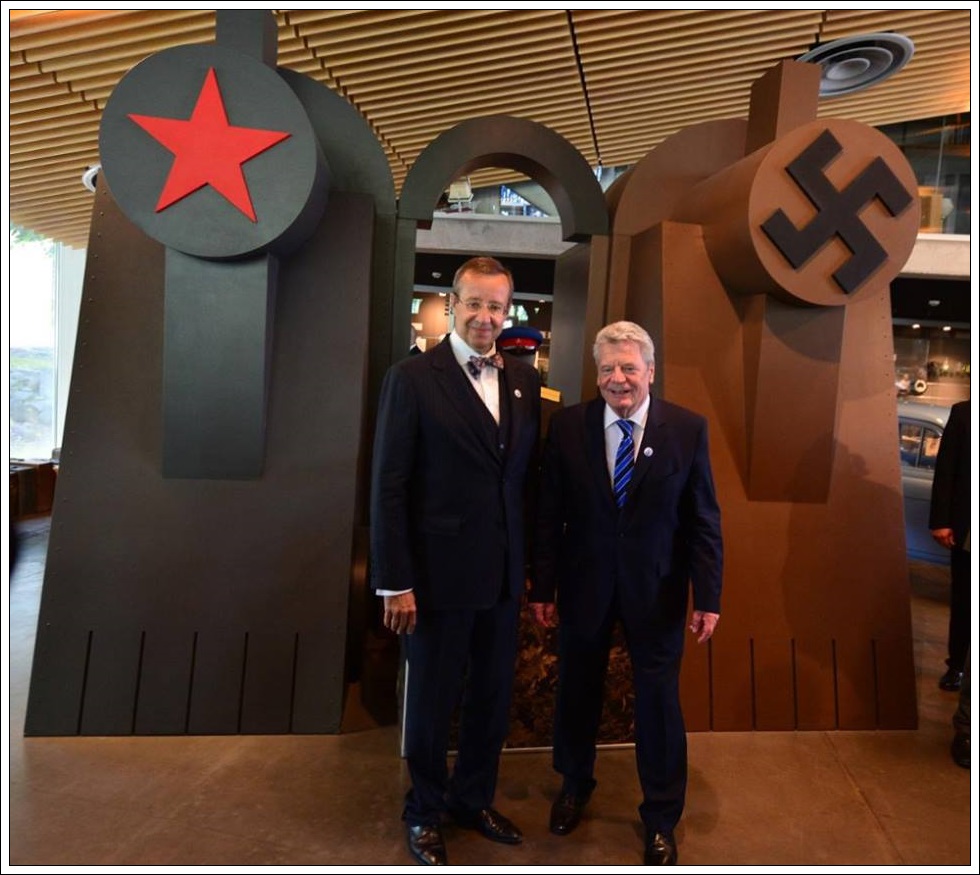
Germany’s president, Joachim Gauck, welcomed intensified cooperation between Estonian and German historians in the cause of continuing the search for Communist crimes in both Soviet Estonia and East Germany. He posed for photographs alongside Estonian president Toomas Hendrik Ilves with a backdrop of the iconic red-equals-brown Hollywoodesque “set” welcoming visitors to the nation’s Museum of the Occupation in Central Tallinn.