


OPINION | MEDIA WATCH | LAST JEWISH PARTISAN FORT IN EUROPE | HISTORY | BLAMING THE VICTIMS | GERMANY | CHRISTIAN-JEWISH RELATIONS | HUMAN RIGHTS
◊
OPINION
◊
VILNIUS—Appreciation is due to the Lithuanian NGO Maceva, and both members of its management team, and the German Army’s new Panzer Brigade in Lithuania (Panzerbrigade 45, Litautenbrigade) for their new joint effort to clean and maintain old Jewish gravestones, as reported, inter alia, on Facebook. This is a noble endeavor.
It is a laudable activity for both Maceva and for the German soldiers. Cleaning pre-Holocaust gravestones of a people of whom none exist anymore in those places is in itself a valuable indirect lesson in the meaning of “genocide” on the ground rather than just in the realm of academic and political debate of the day.
But there is a catch.
And it touches on an essential point of direct commemoration of the Holocaust in Lithuania. The new German army training grounds in the Rūdninkai forest south of Vilnius (a little over a half-hour’s drive from the capital) is right next door to the remnants of the last relic of Jewish partisan resistance against the Nazis in Lithuania, the Jewish Fort where virtually 100% of the fighters were Jewish escapees from the Vilna Ghetto, where the language of life and struggle was Yiddish, and which is described in great detail in Holocaust memoirs emanating from the Vilna area.
For some three decades, the fort’s last survivor, Fania Yocheles Brantsovsky (1922-2024) took thousands of visitors from around the world to see these relics of the indomitable human will to survive against all odds. A sample video. It was her last wish that the fort be preserved for posterity.
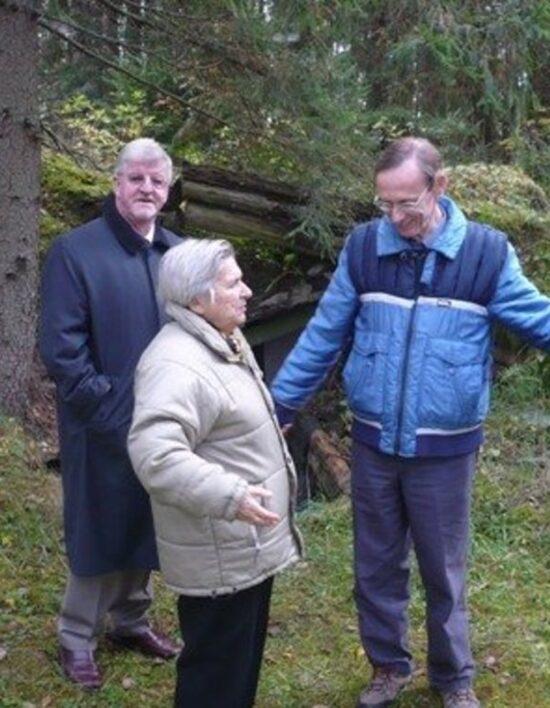
Fania Yocheles Brantsvosky (1922-2024) was frequently asked by the Western diplomatic corps in Vilnius to take diplomats and educators to the Jewish partisans’ forest fort. From 2009: Irish Ambassador Dónal Denham (at left) and UK Ambassador Simon Butt. Photo: DefendingHistory.com
These were people whose entire families were murdered, who were going to be murdered themselves because of the ethnicity they were born with, and who fled the ghetto to join the anti-Nazi partisan resistance, during a period in history where the Soviet war effort, including its partisan movement, were in close alliance with the United States, Great Britain and the Allies. Indeed, nobody else was seriously fighting the Nazis anywhere in Lithuania or the surrounding countries. That has nothing to do with our justified abhorrence of Stalinist crimes, and our uncompromising condemnation of Soviet evils.
Two parts to this saga: Remnants of the Jewish anti-Nazi fort and an unseemly campaign to defame and prosecute veterans of the anti-Nazi resistance
So what is the catch?
That the cleaning of prewar gravestones coordinated by Maceva has come to be instrumentalized as decoy for deflecting questions about the partisan fort with which it has nothing to do. Meanwhile, the partisan fort is deteriorating rapidly. No official historic markings. No fencing. Areas of nearby forest cleared for the Panzerbrigade ruining the unique forest ambience. Leftovers from partying at the fort by building workers constructing the new barracks for the Panzerbrigade. Days when it cannot be approached because the whole area is shut off for shooting practice. Not one public word from the massive German presence in Lithuania honoring this spot in the forest that was so sacred to the last generation of Holocaust survivors, now all gone.
In fact, the whole story of juxtaposition (and deliberate confusion) of an anti-Nazi fort and a prewar cemetery is told rather concisely on the Bundestag’s own website (archived). German official policy is to honor and preserve the Jewish partisan fort and that is confirmed in writing. The uninitiated reader would not know that the rest of the text, about “cleaning gravestones” thanks to “Maceva” has nothing to do with the fort and serves to mask the fact that the Panzerbrigade has publicly done zero to preserve the fort. German military personnel in Lithuania repeatedly report that they have never heard of the place! What is going on? Did someone of authority in Lithuania object to Germany honoring the Jewish anti-Nazi resistance in Holocaust-era Lithuania and suggest this cunning switcheroo to scrubbing old cemeteries instead with an NGO all to happy to serve government Holocaust-rewriting policies?
In recent months, the fort has become a wider issue thanks to articles in Der Spiegel by Solveig Grothe and Berliner Zeitung by Maritta Tkalec. But there has not yet been a public word from the Jewish Labor Bund, Yivo, Yiddishist groups that claim to revere the Jewish partisans, and Holocaust remembrance organizations, including those that honor the Warsaw Ghetto uprising each year on April 19th. Hopefully, the National Yiddish Book Center’s spinoff “Following Fania” that has entailed trips to Lithuania (and to the fort!) and fundraising appeals for a documentary film on Fania will now rapidly speak out in the public square to stop the destruction of the place known to so many Yiddish students from around the world as “Fania’s fort”. “Following Fania” has 180 followers on Facebook. Surely, inspiring half of them to write letters to the German Embassy in Washington, DC would have this matter fixed in a very short time. So would an appeal from the National Yiddish book Center itself. Would dearest Fania expect less from America’s (and the world’s) Yiddishists who benefited so much from her, and her trips with them to the forest fort from which a small group of Vilna Ghetto survivors fought against the Nazis?
We ask them all to speak out now — before the remnants in gone forever — for preservation the last authentic relic of anti-Nazi Jewish resistance in the Baltics. Standing up for something does take rather more dedication than self-satisfying events far out in the West honoring the Jewish partisans. There is no reason to fear speaking out when the last remnants of the Jewish partisans in Lithuania is threatened by those who do not want them to be revered or even preserved. At this juncture, it is crucial. That remnant is in imminent danger of total disappearance precisely due to the appearance of Germany’s Panzerbrigade 45 right next door in the same forest.
We respectfully call upon the Bundestag to follow up on its own commitment, and not allow military or political authorities to pretend to be honoring the last remnant of Jewish anti-Nazi resistance in Lithuania by once again trumpeting the cleaning of old cemeteries while failing to even mention the rapidly sinking partisan fort at its own doorstep.
Have any German soldiers in Lithuania been to the historic site (very near their barracks) that was so sacred to survivors? Told about the Jewish anti-Nazi resistance?
This is especially important in light of the repeated efforts of certain powerful far-right ultranationalist power circles in Lithuania to defame and prosecute survivors of the Holocaust who survived by joining the anti-Nazi partisans and are heroes of the history of the free world.
As for “Maceva” the question is whether they even mention the Jewish partisan fort during their work with the German soldiers. Or are they just cooperating with those in Lithuania who want the fort destroyed as soon as possible, and have found in “Maceva” a swell means of diverting the issue from partisan resistance to Hitler to the need to maintain old Jewish gravestones? Are the supporters and admirers of “Maceva” aware of all this? Incidentally the gravestones in question are not in any danger. They are fenced-in, marked by multilingual official signage, visited by locals and tourists, and protected by law.
As for the German Panzerbrigade 45, has it now lost its German sense of historical perspective and responsibility and been operating in abject fear of the Lithuanian ultranationalist far right for whom Holocaust depreciation and revisionism is a major goal? Will Germany and all its state representatives in Vilnius (military, diplomatic, and others) issue a statement explaining its intentions, and perhaps commenting on the fort’s rapid deterioration since the arrival of the German Panzerbrigade?
To understand the pressures Germany might be feeling from certain elements in Lithuania, see for example the official statement on the topic from the Ministry of Culture that went out to various journalists from abroad who enquired. Will a high German official just say (for example): “We do not feel comfortable deploying here if we are required to participate in the de facto destruction of the last remnant of Jewish anti-Nazi resistance in Lithuania. For us, protection of this astounding historic relic right near our Brigade’s training headquarters is a major responsibility and a welcome opportunity, and we require the needed Lithuanian approvals to enable the site to become a major educational tool in educating our young soldiers coming here to defend our common democratic space. We were not trying to deflect from this vital last relic of Jewish anti-Nazi resistance in Lithuania by cleaning old Jewish cemeteries elsewhere.”
Would the souls of the buried want their peaceful moss-covered, time-aged gravestones to be scrubbed over in conjunction with an effort to erase from the land the last relic of the tiny number of their descendants who by some miracle survived?
Will “Maceva” now issue a public statement calling for preservation of the Jewish partisan fort? Or will this NGO go down in Holocaust commemoration history as a doer of good works for the honor of the prewar dead that also cooperated in efforts to obfuscate the proud history of Jewish partisan resistance and particularly the efforts to erase from Lithuania the last remnant of that resistance?
And will Germany’s Panzerbrigade 45 act to honor or to help erase the inspirational story of Jewish anti-Nazi resistance? Does it hope the fort will soon now disappear and the issue will be forgotten?
If the last remnant of Jewish partisan anti-Nazi resistance in Lithuania disappears because of Germany’s new army in Lithuania, the spot will become one of eternal shame.
And it will not be forgotten.
◊
Yiddish postscript
די נשמות פון די נקברים אין די אַלע בית⸗עלמינס פון דער ליטא שרײַען אויסעט:
„מיר זײַנען מוחל אײַערע מיליטאַרסקע הענט, בעסער לאָזט במנוחה דעם מאָך מיט די איבערוואַקסנדיקע טרויער⸗בלעטלעך אויף אונדזערע אוראַלטע באלכסונדיקע מצבות. בעסער היט אויפעט מיט כבוד, צאַרטקײַט און דרך⸗ארץ די אײַנזינקענדיקע קליינינקע יידישע באַזע אַוואו ס′האָט אַ פּיצינקער שארית הפּליטה פון ווילנער געטאָ העלדיש געקעמפט קעגן היטלערן און קעגן זײַנע רוצחים אין דער ליטא — די חורבות פון דער קליינינקער באַזע פון די יידישע פּאַרטיזאַנער וואָס געפינען זיך אין וואַלד האַרט לעבן אײַער גרויסער נײַער באַזע אין רודניצקער וואַלד.“
◊