


OPINION | OLD VILNA JEWISH CEMETERY AT PIRAMÓNT: SAGA OF 2015-2026 | EARLIER OPPOSITION TO CONVENTION CENTER PROJECT | COMMENT BY ANDRIUS KULIKAUSKAS, SID LEIMAN, JULIUS NORWILLA, DOVID KATZ | 2023-2024 “WORKING GROUP” ON VILNA CEMETERY | LIST OF MEMBERS | MOUNTING OPPOSITION TO “‘COMPROMISE’ MUSEUM PROJECT” | THE USCPAHA | THE CPJCE | THE AJC | THE CER | THE GWF | CEMETERIES & MASS GRAVES | CHRISTIAN-JEWISH RELATIONS | HUMAN RIGHTS
◊
Editor’s note: Eminent philosopher and mathematician Dr. Andrius Kulikauskas, one of the founders of Gerbkime kapines (Respect Cemeteries), and the author of around thirty articles on the subject of Vilnius’s oldest Jewish cemetery, was one of the speakers at the official 17 Sept. 2026 opening of the Seimas exhibition (on video). The exhibition is entitled “The Jewish Cemetery at Šnipiškės in Vilnius — A Choice for Today’s Lithuania.” It runs from 17 to 24 September at the Seimas’s Stained Glass Gallery. He was among the few speakers to speak informally and from the heart rather than deliver a prepared address (his remarks at timecode: 55:53 to 59:22). A (human!) translator has rendered his words into English, supplying clarifying information in square brackets [ ], adding links for further reference (via underline), as well as providing notes for readers who may not be familiar with the scene.
◊
On behalf of the association Gerbkime kapines [‘Respect Cemeteries’], I invite Artūras [Imbrasas] to return [to the stage], along with Ruta [Bloshtein], as well as Edmundas Kulikauskas and Arkady Kurliandchik. We’d like to present a gift, so please, everyone, come.
First of all, we’d like to thank the Seimas Committee on Culture for postponing the debate,[1] giving us a chance to think things through calmly. We’d also like to thank Emanuelis Zingeris,[2] the curator of the exhibition, and his advisor, Auksė Dransard. Let’s give them a round of applause. Thank you, Jovita Morkūnaitė.[3]
You might reasonably assume that these tulips are for Artūras Imbrasas—for all his labors [as principal compiler of the exhibition’s eighteen panels], but he has just said that everything here is in honor of his sister, Ruta Bloshtein, our leader. And indeed, we must not forget Dovid Katz. [He] inspired me ten years ago to take up this cause, just as older people had inspired him even earlier. Pinchos Fridberg[4] saw this cemetery with his own eyes. He couldn’t be here today because he’s taking care of his wife.
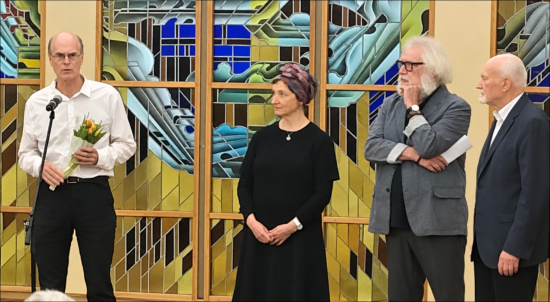
Andrius Kulikauskas thanks Ruta Bloshtein, Artūras Imbrasas, Edmundas Kulikauskas and (not in photo) Arkady Kurliandchik at Seimas opening of exhibition. Photo: William Adan Pahl.
Arkady Kurliandchik is truly the spirit of this exhibition. He said: “There must be three display panels; there must be [photos of] remains.” Ruta said: “As many remains as possible.” “The lies about the tsar’s fortress must be refuted, and there must be documents showing how the Soviets committed crimes and expropriated this cemetery—all of this is documented.” “There must be three [display panels]”—it turned out to be eighteen. To drive home all the points, to expose all the lies spread by the most respected members of Sąjūdis, such as Arvydas Juozaitis[5] and, well, Vilius Kavaliauskas was a correspondent for the Moscow Times[6]—I don’t recall what he thinks about Sąjūdis.
But I want to say that God is at work. One can feel his finger. He cares about this cemetery. He cares about whether apartments would be built there, and that, instead, this place be honored and preserved. He cares that the shadow of corruption would be overcome. He cares that we wrote three sets of forty letters six years ago to stop this nonsense and force a change.
I want to say that we are Lithuanian dissidents. There are two thousand or more Jews in Lithuania who are afraid to speak out because they fear the [official, government financed] Lithuanian Jewish Community, which is a political tool of the Lithuanian state. A tool is lower than the state. Courageous citizens stand above the state. Let’s not hang our heads. Raise your head, Lithuanian.[7] Let’s look up to God’s children, to the Jewish and Lithuanian citizens of Lithuania.
We therefore express our gratitude to Ruta Bloshtein, in whose name 50,000 people—especially Litvaks around the world—said: “Do not build this congress hall. There can be no other activity in a cemetery.”
This is the greatest act of defiance the Litvak diaspora has shown since the Holocaust. The official “Lithuanian Jewish Community” is not here. It did not issue a statement and was opposed to this [exhibition].[8] We, however, are in favor of demolishing the Soviet building, which would cost five million euros.
I dared to speak out. Thank you for this opportunity.
◊
[1] On June 10, 2026, the Seimas Committee on Culture decided to postpone the consideration and voting on the Government‘s decree on the future of Vilnius Palace of Concerts and Sports, as well as the surrounding area. The ruling center-left Social Democratic Party of Lithuania‘s (LSDP) representatives, including the then-Prime Minister Ruginienė, called for “even broader discussions” before a decision is made. The chairwoman of the Lithuanian Jewish Community, attorney Faina Kukliansky, on the other hand, urged the committee to “finish this Šnipiškės story” and start the implementation of the project.
[2] Lithuanian Jewish politician, signatory of the 1990 Act of the Re-Establishment of the State of Lithuania, Member of the Seimas (elected for the 8th time) with the center-right Homeland Union-Lithuanian Christian Democrats (TS-LKD). His own written statement on the cemetery’s fate forms part of the exhibition, all of which is available online at the Gerbkime kapines website.
[3] An advisor to MP Zingeris.
[4] Lithuanian Jewish physicist, professor of physics, currently retired. Writes on Jewish issues in Lithuania to foreign and Lithuanian media (Times of Israel, The Algemeiner, Bernardinai, etc.). His section in Defending History includes his now famous article “Dancing on Jewish graves” that appeared also in The Times of Israel.
[5] Lithuanian politician, philosopher, and former professional swimmer. One of the main activists in the 1988-1992 Reform Movement of Lithuania (Sąjūdis), which led the struggle for Lithuanian independence. Currently one of the most prominent far-right politicians in Lithuania.
[6] From 1984 to 1988, Kavaliauskas was a Moscow News correspondent in New York. The Moscow News (not Times) was the oldest English-language newspaper in the Soviet Union (published between 1930 and, then, in post-Soviet times, until 2012).
[7] Here, Kulikauskas’ choice of words is interesting. He is directly invoking the name of the infamous antisemitic pamphlet Pakelk galvą, Lietuvi!, published by the Nazi collaborator Jonas Noreika (“Generolas Vėtra”) in 1933. Currently, it is also the slogan of the main far-right party in Lithuania, the National Alliance (NS). Dr. Kulikauskas has been among those calling for Lithuania to take down shrines, street names and other memorials to Noreika (see his section in Defending History). In the English-speaking world, the effort was initiated in 2012.
[8] Defending History has criticized Ms. Kukliansky’s role in events that became known in some Jewish circles as “a day of shame” in 2019. See also Defending History’s section on the wider “official community” issues.