


Opinion | The Last Jewish Partisan Fort | History | Blaming the Victims | Germany
◊
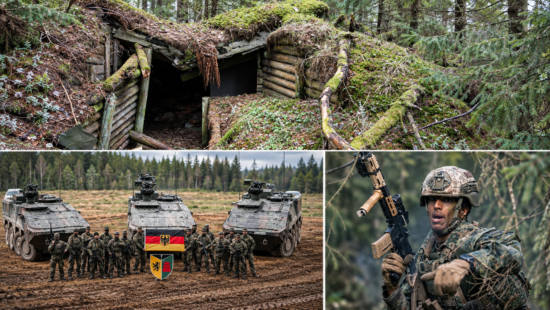
Top: One of the collapsing bunkers at the Vilna Jewish Partisans’ fort in the forest just outside the new German Panzerbrigade 45 training grounds (photo: DefendingHistory.com). Bottom: Panzerbrigade forces just down the road (photos: Panzerbrigade 45).
Editor’s note: The text below is the final English version of a statement by a veteran German public figure. It was approved by the author, then withdrawn on the day scheduled for publication, May 11, 2026. In an accompanying email, the author explained that he had been persuaded to withdraw his statement by an eminent retired Lithuanian parliamentarian who “is ready to ask the Jewish authorities, in what condition the resistance bunker now is actually,” after which he would be “ready to convince the political leaders in Berlin, that the process of renovation could start very soon.”
In light of the fort’s continuing and rapid deterioration, the absence of any such remedy, and Panzerbrigade 45’s failure even to mention the fort in its extensive public relations material, we have decided to publish the statement for the historical record while preserving the distinguished author’s anonymity. Also for the record, Defending History’s first private written communication on the matter to the German Embassy in Vilnius was dated May 6, 2025, more than a year earlier. From June 2026 onward, the issue was taken up by outside media, including JTA, Der Spiegel, and Berliner Zeitung, further disconfirming any suggestion that this could or would be solved if only it does not become a public issue. In any case, it is a wholly public and transparent matter deserving to see the light of day in the public (and global) square. News on the issue continues to appear in Defending History’s section on the subject.
◊
This time it is different. German soldiers are being welcomed today by so many of the Lithuanian people in a unique and inspiring new role: to assist in securing the freedom of the Lithuanian people. That means, to defend Lithuania’s democratically based nationhood. To do so with conviction, the German soldiers now coming to Lithuania to populate the Bundeswehr’s new Forty-Fifth Panzer Brigade (Litautenbrigade) in the framework of NATO, must remain deeply aware, every single day, winter and summer, autumn and spring, what it was that German Nazi forces and their local collaborators destroyed in Lithuania in 1941, and in the years 1941 to 1944.
With a brutality unheard of in human history, they slaughtered hundreds of thousands of defenseless children, men, women. German Nazis opened the doors to the hell of the Holocaust in Lithuania to exterminate the Jewish people. And they did, with a survival rate of a few percent, mostly those who fled eastward in the first days.
Our common responsibility as Germans — and to our Lithuanian partners I say: as Lithuanians and as Germans — is to keep this knowledge in our minds as we together build a better European future of harmony and tolerance. Details can be worked out by the responsible organs in both our governments and their armed forces, but it is vital that we preserve, restore, and honor the remnants of the last Jewish partisan fort in Lithuania, which by the majestic hand of history is to be found in the very Rūdninkai forest abutting the training grounds of the new Panzer Brigade.
The Jewish Partisan Fort is where hundreds of prisoners of the Vilna Ghetto and elsewhere escaped, to join with the resistance, even as their families were trapped and doomed to horrific murder. Now, as German and Lithuanian soldiers together defend democracy and equal rights, it is critical that they honor the hundreds of thousands massacred, and also, the handful who managed to join the armed resistance in the forest, the very same forest where our brigade now comes to defend our common humanity and future.
Indeed, the preservation and restoration of the fort’s remnants, a site in the forest that has attracted thousands of visitors from around the world since Lithuania’s independence, can become a common effort of the Lithuanian and German states, with participation by the European Union and NATO.
For its part, Germany stands committed forever to support and defend the freedom and security of democratic, independent Lithuania. The preservation of the memory of the past plays its role too as we build together that future.
◊