[most recent update]
Israeli Foreign Policy and the Holocaust in Eastern Europe (1990 — 2023)
JUMP TO LATEST
JUMP TO LATEST
◊
◊
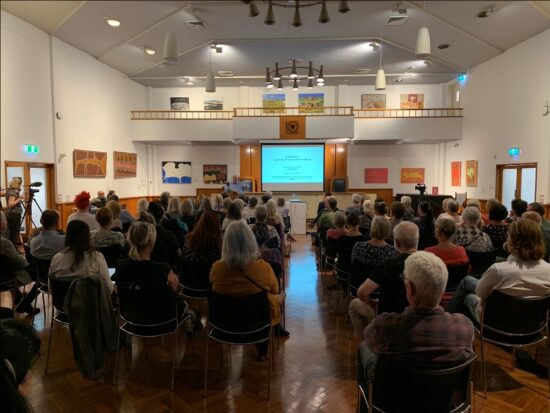
SYDNEY, AUSTRALIA—More than 100 people attended the Wollongong Art Gallery to hear Professor Konrad Kwiet, resident historian at the Sydney Jewish Museum, deliver a public lecture on the Holocaust in Lithuania and the wartime role of Bronius ‘Bob’ Sredersas.
◊
The best way to reach the mass killing site in Garliava (Yiddish Gúdleve, Polish Godlewo), is to take a train from the central train station in Kaunas. It is just one stop. The railway runs south, through a picturesque valley of the languid river Jiesia. Garliava is a township historically in the Suwałki region. It is named after an ancient landlord and noble family Godlewski. It seems that twentieth century ethnic purity zealots renamed the township into Garliava to sever any obvious link to the personage commemorated by the town’s naming, thereby reducing the historical chronicle of the entire region to a narrow and assertively ethnonationalist narrative
When you step out of the old railway station in Garliava, the town itself is still one kilometer away. The train line and the station were built in 1862, and one can wonder, what the point was, with the then cutting-edge train technology of the time, to make a long detour around the town and build the station somewhere in the middle of the fields, or as one might put it, right in the middle of nowhere?
◊
◊
Genuine heroes of this saga—both written out of the film◊
VILNIUS—Michael Kretzmer’s new documentary J’Accuse! provides a terrific extended interview with legendary truth-teller Silvia Foti. The film’s narration provides effective statements on ongoing East European state adulation of Nazi collaborators though focused on just one, Jonas Noreika of Lithuanian Holocaust infamy (who was the Chicago-born Foti’s grandfather).
◊
◊
Editor’s memoir
In 2011, when our small Defending History team headed out (as we did each year) to Kaunas to monitor and document the 2011 neo-nazi city center march, an event that glorified Holocaust collaborators, we went for a coffee after the event. There, our mentor who never missed a march before his final illness, Milan Chersonski (1937–2021), the longtime Vilnius Yiddish theatre director and editor for some dozen years of the Lithuanian Jewish community’s quadrilingual newspaper, Jerusalem of Lithuania, told us (in Yiddish, of course): “Look, there is one young Lithuanian who has more courage than the rest of the country combined. He has been writing articles on the tragedy of his country’s government organs glorifying Holocaust collaborators in the public space. And unlike others, he’ll be happy for Defending History to publish them in English translation. Trust me, his articles are more important that all of ours that come from Jewish pens.”
◊
Congratulations to the city of Kaunas, Lithuania, once known also as Kovno (in Yiddish forever: Kóvne) on its selection as Europe’s “Capital of European Culture” in 2022, sharing the title with Esch-sur-Alzette in Luxembourg. But as the midpoint of the city’s co-reign rapidly approaches, it is necessary, albeit sad, to have to note that not a single public-space glorification of local Holocaust collaborators had been removed. Zero. No city on the planet has as many monuments to local partners in the genocide of that city’s Jews. The 30,000 Litvaks (Lithuanian Jews) of Kaunas were brutally murdered, and the city played the primary role in the launch of the Lithuanian genocide on 23 June 1941, before the arrival of the first German forces. Thousands were murdered before the Germans arrived and/or set up their administration.
See Lev Golinkin’s updated 2022 catalogue in the Forward of public space shrines to Nazi collaborators worldwide
Lithuanian government authorities have reportedly invested large sums to lure “Useful Jewish Idiots” from the UK, US, Israel, and further afield to participate in “cultural events” intended to obfuscate and deflect from the primary issue: Why are the enablers of the slaughter of Kovno Jewry still honored by street names, plaques and university lecture halls and statues in the city? Local Jewish leaders who have dared to speak up have rapidly been smeared as “Putinists” for daring to criticize the far right’s hold over national history policy (and indeed, the need for such a policy to start with).
But in the waning days of 2021, a “waterfall of truth” began to cascade from an unanticipated quarter. Michael Levinas, son of the celebrated Lithuanian-Jewish born French philosopher Emanuel Levinas, forbade authorities to name a fancy new institute after his father. This was kept under wraps until his 21 Dec. Le Figaro opinion piece broke the story, and it was duly reported in Lithuania by LRT.lt. See Defending History’s media tracker page for background and updates.
Compilation of articles, documentaries, videos, and photos. Plus: from the saga of 2008…
See Defending History’s Fania Yocheles Brantsovsky Section
◊
Most Lithuanian government officials in diverse branches of its democratic government, including so many in its Culture and Education ministries, its local museums and libraries, its schools and cultural centers, have a warm and healthy attitude toward both the historic weight and tragic fate of the nation’s Jewish minority. This is important to keep in mind as we come yet again to provide a voice for the voiceless: the manipulation of the fragile Litvak and Yiddish culture, of the last survivors and their families, and of Holocaust history by some small and lavishly financed “Jewish fix-it units” including the Genocide Center, Genocide Museum, Red-Brown Commission, and a scattering of “Jewish, Yiddish and Litvak” centers in central Vilnius, a good part of which exclude from all professional participation people — including top specialists in the relevant field — who dare disagree with state revisionism on the Holocaust. In some cases, this policy brings about the succeeding phase of “Jewish” addresses without a single Jewish member of staff (think African American Cultural Center in Alabama, staffed by pure lily-whites who won’t mess up and peradventure say something contrary to local “patriotic” history-book narratives demanded by nationalists).
Even as the civilized world joins in condemning the barbaric, medieval Putinist invasion of peaceful Ukraine, and unites to embrace its people, and the freedom and simple peace they seek, the Lithuanian Seimas (parliament), is hosting the grand opening of the latest “Litvak Congress” (program here and here), at which none of Lithuania’s great Litvak achievers of recent years, have been invited to speak, or in most cases to even attend. They are being cancelled during their lifetime. The list is long. Just a few examples: Genrich Agranovski, Anna Avidan, Chaim Bargman, Roza Bieliauskienė, Ruta Bloshtein, Fania Yocheles Brantsovsky (Brancovskaja), Dalija Epšteinaitė, Prof. Pinchos Fridberg, Simon Gurevich (Simonas Gurevičius), Irina Guzenberg, Elen Janovskaja, Regina Kopilevich, Arkady Kurliandchik, Polina Pailis, Prof. Josif Parasonis, and (now in retirement in Berlin) Rachel Kostanian. These and others have made empirically demonstrable and durable contributions to the Litvak heritage and its documentation and perpetuation well into the future, and have valiantly and selflessly fought for Litvak causes, a category in which defense of history is a cause as paramount as any.
◊
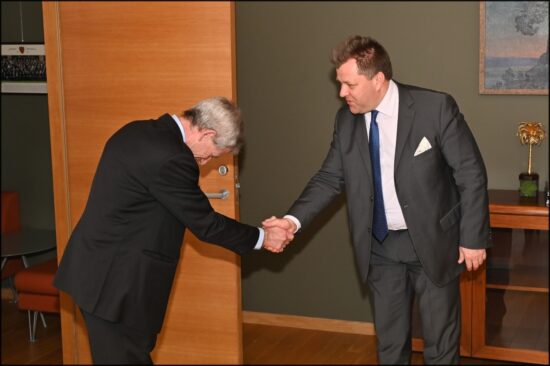
On the 4th of April 2022, the website of our Ministry of Foreign Affairs published a news item titled (in Lithuanian, here translated) “Lithuania will expand cooperation with Yivo Jewish Research Institute, preserving and publicizing Lithuanian Jewish history” (as PDF). The site’s English language section uses the headline wording “Lithuania to expand cooperation with Yivo Institute for Jewish Research to protect and promote the history and heritage of Lithuanian Jews” (as PDF).
The news article contains information about the visit of the esteemed American scholar, Dr. Jonathan Brent, the executive director and CEO of the Yivo Institute for Jewish Research in New York, also a famed educator and academic publisher, with his colleagues, and their meeting with the deputy foreign minister. The news item appears intent on communicating to the world how much our country’s Ministry of Foreign Affairs cares about its Jewish and Yiddish legacy and how sensitive it is to the history of Lithuanian Jewry.
Both the Lithuanian and English versions are illustrated with a three-photo gallery portraying three scenes of the meeting: shaking hands at the welcome, a moment at the meeting table and the final with those at the meeting posing for the official photo-op.
Everything seems to be done according to the usual protocols of such meetings, at which the professional photographer takes numerous photos from start to finish, culminating with the final photo-op. Then the few dozen shots are whittled down to the most informative and appropriate handful for publication. The ones that make the point best. Elementary.
◊
◊
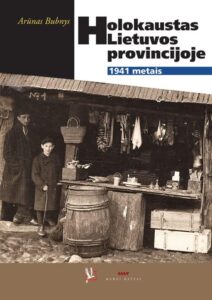
Arūnas Bubnys’s book The Holocaust in the Lithuanian Provinces (Holokaustas Lietuvos provincijoje, Margi
raštai, Vilnius, 2021) is another publication of the International Commission for the Evaluation of the Crimes of the Nazi and Soviet Occupation Regimes in Lithuania (ICECNSORL). Up until now, books published by the Commission were academically written and appreciated by a sophisticated readership. Moreover, they were always published in both Lithuanian and English. This book is different. It is available only in Lithuanian. Previously published monographs would also include Commission-approved conclusions; this book has no such thing. As far as I have been able to ascertain, the Commission’s academics did not discuss the book among themselves before its publication. But let’s start at the beginning.
The book is geographically quite extensive: 23 counties and 140 towns are cited. This is really a lot, but it is also quite obvious that the coverage of towns in different counties is unequal. When it comes to Šilutė county in western Lithuania, for example, several camps and fates of individual Jews are mentioned in passing, but no single town is described. For the Marijampolė county, only the fate of the Jews of Marijampolė itself is presented. Šiauliai xounty (15 towns) and Alytus County (12 towns) are the most extensively covered.
◊
PARIS—The French Jewish journal Actualité Juive published in its print edition a full-page interview (as PDF) with the eminent French composer and pianist Michaël Levinas, concerning his protest at a new center in Lithuania’s second city, Kaunas (once Kovno, Yiddish Kóvne), being named for his late father, the great French philosopher Emmanuel Levinas (1906-1995). An authorized translation is available. Coinciding with the European Union’s naming of Kaunas as “Capital of European Culture” for 2022 and the city’s refusal to remove even one of the many street names, shrines, plaques and monuments to local Nazi collaborators who helped ensure the massacre of nearly all the city’s Jewish residents in 1941, and who participated in the unleashing of the Holocaust in Lithuania even before the arrival of the first German soldiers in late late 1941, the composer’s powerful moral protest represents a singular voice of justice, reason and moral courage to date.
See also op-ed in Le Figaro
&
Levinas Center Media Tracker
The composer’s stance stands in marked contrast with many others, including artists, assorted academics and a wide range of Western wannabees, who are accepting funding, honors, junkets, invites, and photo-ops with “important people” in return for an unspoken assurance of silence in face of the city’s refusal to take down a single shrine to the local perpetrators of the Holocaust.
The following is a PDF of Michaël Levinas’s interview in the print edition of Actualité Juive of 13 January 2022:
Just like each and every other town in Lithuania, Šeduva (Sheduva) has as the most barbarous episode of it history the Lithuanian Holocaust. It is not easy to tell this story. There are many narratives that contradict each other, with many omitted or unclear episodes. The omissions can be partly explained by the current policy of historical memory in Lithuania, as well as by the authority of some organizations that thsemlves took active part in these horrible events. Narratives that are unfavorable to them are denied, downplayed, or classified as “information warfare” (in other words: “Russia”). I have previously written about the difficulty in asssessing assorted narratives here.
The summary version of of the Šeduva Jews’ massacre that I recounted includes these critical dates:
June 25, 1941: The Nazis occupy Šeduva.
July 22, 1941: Šeduva’s Jews are driven into the town’s ghetto established to incarcerate its Jewish citizens.
August 25t, 1941: The city’s 665 Jews are murdered in Liaudiškiai forest. But a few of the Jewish families of volunteers (veterans) of Lithuania’s War of Independence in 1918 are “allowed” to live, under the condition that they abandon their Jewishness and get baptized. The residents of Šeduva and its vicinity observe the public baptism at the church. A couple of weeks later those baptized are driven to Panevėžys and also shot dead, like all their unbaptized brethren who were not “saved by baptism” for having volunteered over two decades earlier to fight in the nation’s War of Independence. The only one who survived was Ms. S. Nolienė, who was hidden by the priest M. Karosas.
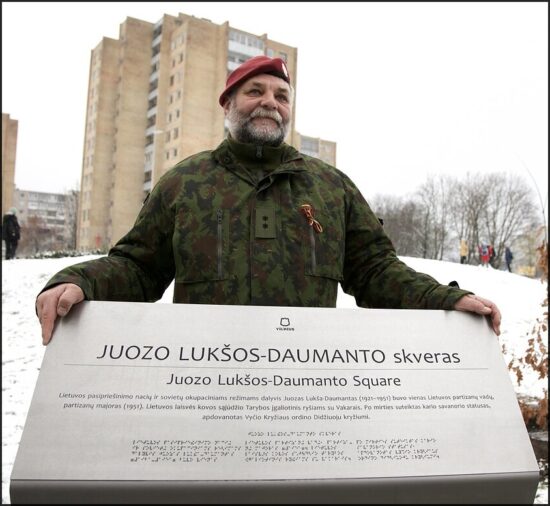
JUMP TO MOST RECENT: On 23 Nov. 2021, Vilnius inaugurated a square named for the alleged 1941 Holocaust perpetrator…
YAKOV FAITELSON; LAURENCE WEINBAUM; FAINA KUKLIANSKY & ANDREW BAKER; DOVID KATZ; BRITISH PARLIAMENT MOTION
◊
◊
VILNIUS—The Lithuanian Yiddish Video Archive (LYVA), a Defending History affiliated project, providing hundreds of Yiddish language video interviews in the “Lithuanian lands” (today’s Belarus, Latvia, Lithuania, eastern Ukraine and northeastern Poland), conducted from 1990 to 2020 has just released a Holocaust-history extract from a longer interview, conducted in May 2000 in Šeduva, northern Lithuania, with the town’s last Yiddish speaker, the Christian Lithuanian native of the town, the late Elena Rimdžiūtė. As is evident from the clip, the interviewer, Dovid Katz, was focused on Elena’s Yiddish folksongs, and the Holocaust arises, at first tangentially, when Elena speaks of her friends who are no more.
See DH’s Šeduva section
The clip on Youtube is accompanied by a draft English translation (in the “Description Box”). This remarkable woman’s honesty, integrity, and desire to Just Tell it Straight, makes for a striking contrast with the current Baltic academic establishment’s claptrap about Prague Declarations, equivalence of totalitarian regimes, tale of two Holocausts, and fairy tales about the “uprising against the Soviets” celebrated in Vilnius’s Genocide Museum (recently renamed), and promoted by the state-sponsored Genocide Center and numerous public shrines to local Holocaust murderers of 1941.
Here is Ms. Rimdžiūtė’s genuine Šeduva Yiddish rendition of the beloved song, where a girl explains that she wants neither new clothes from the tailor nor shoes from the shoemaker but expresses her sadness that all the other girls have boys (altered in the final stanza to ‘get married’). The clip is followed by a draft English translation concluding with a transcription of song in Šeduva Yiddish.
◊
VILNIUS—Two days before tomorrow’s government-sponsored international “academic” conference (on September 10) that glorifies alleged 1941 Holocaust perpetrator Juozas Lukša (without a single paper devoted to the issue of his Kaunas 1941 Holocaust participation), the foreign minister led a high-end Holocaust remembrance ceremony (yesterday, 8 Sept.) bewailing the calamity of the Holocaust and its scale in Lithuania. That ceremony dated the onset of the Lithuanian Holocaust to the first week of September, when the Nazis set up the Vilna Ghetto, and others.