BOOKS
◊
by Yizhak Ahren
◊
Moshe Nathan Rosenfeld: The Rav of Fürth. The Legacy and Legend of Rav Dovid Kahane Spiro. London 2021, 696 pp., £25.00/ $35.00 + postage. Orders directly from: mnrosenfeld@gmail.com
◊
Rabbi Dovid Kahana Spiro (1901-1970) was a very pious and learned man who cofounded the Jewish community in Fürth after the Holocaust. He worked there for twenty-five years as a community rabbi and helped numerous people in need. The Firter Rov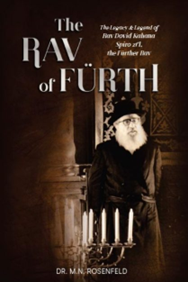 (Fürther Rav) was buried in the Har Hamenuchos Cemetery in Jerusalem. A picture of his tombstone can be found in Moshe Rosenfeld’s recently published book on Rabbi Spiro. The book’s thirteen chapters cover in great detail the origins of the family Spiro, their pre-war life in Poland, the Warsaw Ghetto, survival, rebuilding, dialogue with a bishop, divorce cases and much more.
The author, who now lives in London, grew up in Fürth and practically from birth had a close relationship with Rabbi Spiro, who lived next door. Rosenfeld’s mother was the rabbi’s cousin, and his father became his right-hand man. The author frankly admits that he should have asked a thousand questions at the time, but didn’t. And therefore there are many answers that he honestly does not know today. Nevertheless, with a vast amount of work and love, he managed to collect a wealth of material and to publish this extensive work. The history of the Spiro family, that lived in Poland, is presented in great detail.

 There is, however, disturbingly, quite a stupendous missing link in this abridged history of Lithuania in the twentieth century. Where had the quarter million Jews (the figure on the eve of the Holocaust) of the country disappeared to “overnight” (as centuries go), during that fateful century? Had there ever been a Jewish minority in Lithuania at all? When I looked at the author’s pedigree, I understood why the Jews had not played any role of significance in his biased dialectical discourse. Joren Vermeersch is a historian (of sorts) and an accomplished author. He is also a representative (stand-in, as we call it) for the Belgian House of Representatives, for the “N-VA.” This is the nationalist Flemish party that has its historical roots in the collaboration with the Nazis during World War II. The party that has systematically fought for an amnesty for Nazi collaborators. The party in which the grandparents or parents of some of the present actual leaders had been condemned by the Belgian State for collaboration with the enemy. Nobody is guilty of sins of their ancestors, but when there is a pattern of such pedigree being considered a great plus for current leadership, and that pedigree is subtly glorified rather than disowned, we have a current moral problem that merits discussion in the public square.