


◊
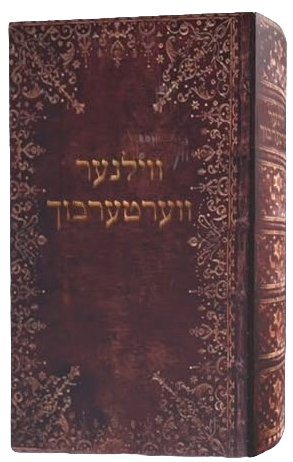
ווילנער ווערטערבוך
„אידיש ויידיש בלשון אחת“
◊
◊
A FREE ONLINE ENGLISH-YIDDISH DICTIONARY (© 2026)
A WORK IN PROGRESS IN VILNIUS, LITHUANIA (50,000 MAIN ENTRIES)
CORRECTIONS & ADDITIONS WELCOME (info@yiddishculturaldictionary.org)
◊
by
Dovid Katz
in memory of my father Menke Katz and to inspire this dictionary’s users to read his poetry in Yiddish, in English, and in translation
◊
compiled with reference to the author’s earlier work in Yiddish stylistics, grammar, linguistics & sociolinguistics, history, dialectology, in-situ expeditions, orthography, editing of journals & academic anthologies, original fiction, Bible translation, and other fields of Yiddish; current and recent projects
◊
Comment on YCD
❛At long last, a bilingual Yiddish dictionary with the explanations, historical notes, stylistic arguments and cultural depth data in Yiddish (and a beautiful Yiddish it is).❜
ALEXANDER ASTRAUKH, author of Yiddish-Belarusian Dictionary (Minsk, 2008)
☰
❛The Yiddish Cultural Dictionary (in Yiddish: Vilner Verterbukh) is much more than a dictionary. It provides a rich and varied range of definitions embedded in a commentary on their use and connotation. It is multidimensional, touching on dialects, levels of religious learning, older and newer usage, Yiddishist-secular preferences and more. No one version is selected as “correct”. The author’s viewpoint is inclusive and independent. It is an online dictionary that is user-friendly and free of charge. It invites you in, and once you are in it, you will happily browse and linger.❜
SOLON BEINFELD, Professor of History (emeritus), Washington University in St. Louis; Co-Editor-in-Chief, Comprehensive Yiddish-English Dictionary (CYED, Indiana University Press, 2013)
☰
❛YCD lavishes on us a wealth of materials on the language, culture and history of Yiddish, as well as on many regional, social-level, historical and stylistic varieties of the language. It lets us participate in the development of this monumental online dictionary. A brief question I posed the other day concerning the Perushim (my own ancestors) in Jerusalem’s Old Yishuv led to a marvelous new entry.❜
DAVID M. BUNIS, Professor of Judezmo and Jewish Languages at the Hebrew University of Jerusalem; many works including A Lexicon of the Hebrew and Aramaic Elements in Modern Judezmo (Magnes Press: Jerusalem, 1993)
☰
❛An encyclopedic lexicon that brings a language back to life. That is what is achieved by this stupendous, new and unfolding Yiddish Cultural Dictionary. Here, in every word and comment, is the real Yiddish with all its Jewish juices and its rich varieties — surviving all attempts to “purify” it from within and liquidate it from without, and here once again in youthful bloom.❜
LEWIS GLINERT, Professor of Hebrew and Linguistics, Dartmouth College, Hanover, New Hampshire; author of The Joys of Hebrew (Oxford University Press, 1992)
☰
❛The Yiddish Cultural Dictionary is a magnificent addition to the arsenal of permanent resources for study and research of authentic Yiddish of our times. It is compiled with deep erudition, and an equal love for all the genuine dialects, styles and incarnations of the modern language, from literary and secular all the way to deeply traditional and religious.❜
MIRIAM HOFFMAN, major Yiddish writer and educator, author of Key to Yiddish (2011)
☰
SID LEIMAN, Distinguished Professor of Jewish History and Literature, Graduate School of Jewish Studies, Touro University
☰
❛This dictionary is a magisterial reference guide to the dynamic tapestry of Yiddish as a living language. Its entries are like little windows into the rich multifaceted world of living Yiddish culture. Its author, a genuine connoisseur of the contemporary Yiddish idiom, has crafted dictionary entries with much attention to the dynamic character of modern Yiddish communication. This forward-thinking approach equips the user with a deeper understanding of modern Yiddish.❜
WOLF MOSKOVICH, Professor of Slavonic Studies, Hebrew University of Jerusalem, editor of Great Dictionary of the Yiddish Language project
☰
❛Thank you dear Dovid, for this colossal contribution, with such generosity — the Yiddish Cultural Dictionary. Wishing you strength to continue work on this vitally important project.❜
YITSKHOK NIBORSKI, major Yiddish educator, co-author of Dictionnaire yiddish-français (Medem: Paris, 2002), founder of modern Yiddish studies in Paris