Vilneans of All Backgrounds Invited to Chanukah Celebration at Choral Synagogue
Letter from the Director of SLS of 13 May 2011
Austrian Volunteer Reflects on Year in Lithuania, Calls for City-Center Holocaust Museum in the Capital
O P I N I O N
by Sebastian Hager
◊
Iwas proud to serve as Austria’s remembrance volunteer (Gedenkdiener) in 2013-2014. Based in Vilnius in the Green House, the country’s only serious Holocaust exhibit, I was able to travel extensively and meet Lithuanian citizens from a wide variety of backgrounds. Despite all the hype, the Jewish heritage is not really in the best of shape. There is a lot of ignorance combined with an ethnocentric nationalist worldview.
A Visit to Ukraine, Where the Holocaust Becomes a Negligible Detail
O P I N I O N / T R A V E L L O G
by Frank Brendle (Berlin)
Editor’s note: The author travelled through Ukraine in autumn 2014 with a team from the Berlin-based Educational Center for Peace Research and Pinima productions. A German version of this report appeared in www.bildungswerk-friedensarbeit.org. This English version has been approved by the author. The photographs were supplied by Frank Brendle and Pinima productions, Berlin. Any re-use should credit each photo appropriately. For background on the Ukrainian Holocaust see a recent US Holocaust museum (USHMM) report, and the Defending History work by Grzegorz Rosslinski-Liebe and Per Anders Rudling; also our Ukraine section and page on 2014 international media.
◊
It’s a late summer night in Lviv and we have our first encounter with Ukrainian civil society: A demonstration of bicyclists. The words “critical mass” are written on their banners, and they are fighting for more space on the roads. Just like in Germany. But something else is different than in Germany: The leader of the demonstration is shouting “Slava Ukraini!” and the crowd shouts back: “Heroiam Slava” (Glory to Ukraine – Glory to the Heroes). Then comes the next organized chant and reply-to-the-chant: “Glory to the Nation – Death to the Enemies.” fun-in-participation factor is multiplied as passers-by shout the chant, eliciting the expected reply from the marchers.
The Holocaust Memoir That Doesn’t Fade Out at the Moment of Liberation
B O O K S
by Ira Gold
◊
Waltzing with the Enemy: A Mother and Daughter Confront the Aftermath of the Holocaust by Rasia Kilot and Helen Mitsios. Urim Publications: Jerusalem 2011, 288 pp. Amazon.com. Kindle.
◊
In Waltzing with the Enemy: A Mother and Daughter Confront the Aftermath of the Holocaust by Rasia Kliot and Helen Mitsios, the authors write a dual memoir of survival and healing. The mother, Rasia, was born into upper class comfort in Vilna (today Vilnius, Lithuania). Her daughter, Helen Mitsios, was born in Montreal, Canada. The dual structure – the first half is titled “Rasia’s Story” and the second half is labeled “Helen’s Story” – works very well.
Vilnius: All Welcome at Public Menorah
Vilnians of all backgrounds warmly invited this Tuesday, 16 December 6PM sharp (1800) for the public lighting in central Vilnius of the first candle of the Hanukah menorah
A Lowpoint in American (and Canadian) Diplomacy?
UN Resolution for “Combating Glorification of Nazism”Passes in General Assembly Committee (115 for, 3 against, with 55 abstentions)
Resolution, offered by Russia, seen as inherently flawed by Putinist machinations, Russia-Ukraine crisis & East-West feuding; EU abstains, asBaltic nationalists gloat (Delfi.lt)
STILL A SHOCK that three member states voted against: Ukraine, USA,Canada. Ukraine’s government recently made “heroes” of Nazi collaborators; catalogue of the last year.
Peter Jukes Tweets on Documentary that Glorifies Alleged Nazi Collaborator
O P I N I O N
LONDON—British author Peter Jukes, best known for his screenplays, literary criticism and political journalism, tweeted last week on the release in the United States of a new documentary film that heroizes certain postwar anti-Soviet “forest brothers” in Lithuania. The film, “The Invisible Front,” that premiered in Greenwich Village’s prestigious Cinema Village theater on 7 November, fails to even mention the view that various of the specific figures it glorifies for their post 1944 activities were in fact alleged recycled Nazi collaborators of 1941. That was the year when, in the days following the Nazi invasion launched on 22 June, the Lithuanian Activist Front (LAF) started butchering local civilian Jews, often elderly rabbis or young women, before the first German forces had arrived. Premeditation becomes evident from perusal of the LAF’s prewar leaflets.
In Europe, a New Public Curtain of Revisionism, Oblivion and Antisemitism
O P I N I O N
by Roland Binet (Braine-l’Alleud, Belgium)
◊
Isee two new important social and political trends now that have a direct bearing, first on the memory of what happened in Europe and the USSR during the Holocaust and other massacres and, secondly, on the life of the Jews presently living in Europe.
UN Resolution Against Glorification of Nazism Opposed on 21 Nov. 2014 by Just Three Countries
D O C U M E N T S / G L O R I F I C A T I O N O F C O L L A B O R A T O R S
◊
The following is the official 21 Nov. 2014 United Nations voting sheet for the resolution (A/C.3/69/L.56/Rev.1) “Combating glorification of Nazism, neo-nazism and other practices that contribute to fuelling contemporary forms of racism, racial discrimination, xenophobia and related intolerance.” The original is posted on the UN website. This copy has three added arrows for rapid identification of the three states that voted “No.”
Media coverage includes: Margaret Besheer in Voice of America; Joseph Brean in Canada’s National Post; Ken Hanly in Digital Journal; Dovid Katz in The Times of Israel; Ryan Maloney in Huffington Post; Jim Miles in CounterPunch; Boruch Shubert in JP Updates; Sam Sokol in the Jerusalem Post.
Glorification of Nazi collaborators (and local perpetrators) by states and their elites is a serious issue in various countries, including Estonia, Hungary, Latvia, Lithuania, and Ukraine.
Tomas Venclova Speaks Out on Banderism and its European Analogues
O P I N I O N
◊

Tomas Venclova
Editor’s note: Our colleague Prof. Pinchos Fridberg drew our attention to a page on Radio Svoboda’s website, by Elena Fanailova, featuring both the audio and transcript of a recent interview conducted by Donata Subbotko for the Polish weekly Gazeta Wyborcza with the famed Lithuanian humanist, poet, essayist and professor Tomas Venclova. Text of the Polish version appears in Gazeta Wyborcza. The Russian text also appeared, at Prof. Fridberg’s initiative, in Obzor.
The following brief excerpt, concerning Banderism in Ukraine and analogous tendencies in Lithuania and elsewhere, has been translated into English (from the Russian) by Ludmila Makedonskaya. See also Defending History’s section dedicated to Tomas Venclova. Our page on bold Lithuanian truth tellers includes some of Prof. Venclova’s writings from the 1970s onward. His famous essay from the period, Jews and Lithuanians, is available in his collection of essays Forms of Hope.
Text of US Rep. John Conyers’ Proposed Amendment Restricting Aid to Pro-Nazi Forces in Ukraine
Defending History has obtained the full text, available to our readers as PDF, and as images (following this text) of US Congressman John Conyers’ proposed amendment that would have restricted US military aid to units that extol Nazi perpetrators or use Nazi, racist or white supremacist symbols. The amendment proposed by Mr. Conyers, who represents Michigan’s 13th congressional district, failed to pass.
The amendment, dated 19 May 2014, contains language that would instruct the Secretary of Defense to restrict aid in cases where he “has credible evidence that the unit or its members have taken public stances or taken actions that are indicative of extremism,” including three categories:
Member of Lithuania’s Jewish Community Speaks Out on Neo-Nazi Parades, and Govt. Flowers at Monument to Hitler’s Soldiers
O P I N I O N
by Jacob Piliansky
◊
Iam proud to be a Litvak, and I am proud to be a citizen of independent and democratic Lithuania. I very much enjoy walking in our city’s delightful Vingis Park, as well as downtown in the beautiful city center area.
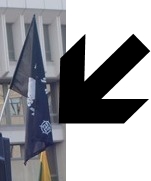
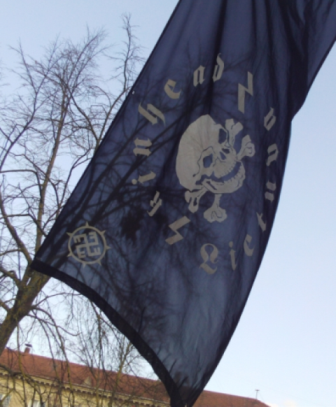
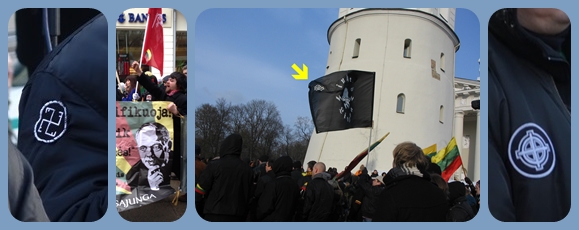
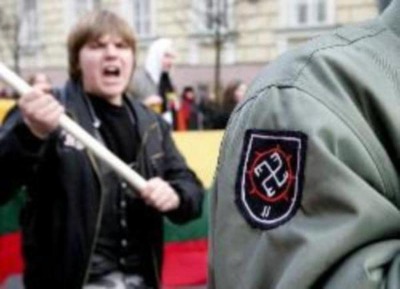
However, I feel suddenly both sad and shocked, when I see neo-Nazi parades with swastikas and other fascist symbols along Gedimino Boulevard on our independence day repeating the yelled chants of “Lithuania for [ethnic] Lithuanians.”

A Historic Ukrainian Low for US (and Canadian) Foreign Policy?
UN Resolution for “Combating Glorification of Nazism”Passes in General Assembly Committee (115 for, 3 against, with 55 abstentions)
Resolution, offered by Russia, seen as inherently flawed by Putinist machinations, Russia-Ukraine crisis & East-West feuding; EU abstains, asBaltic nationalists gloat (Delfi.lt)
STILL A SHOCK that three member states voted against: Ukraine, USA,Canada. Ukraine’s government recently made “heroes” of Nazi collaborators; catalogue of the last year.
Text of the Resolution
Are unchecked Neo-Con politics behind the failure to Just Say No to the adulation of Nazi collaborators?
What is the “Program for Roma Integration” in Lithuania?
H U M A N R I G H T S / R O M A I S S U E S / O P I N I O N
by Vilma Fiokla Kiurė
◊
Here in Lithuania, the words “Roma” and “discrimination” are regarded as inseparable. It seems that even the Roma community is reconciled with that. The situation, however, is worsening and what is currently happening in Kirtimai, a village on the outskirts of Vilnius, the capital city’s home to its most prominent tabor, or Roma settlement, and often referred to just as Kirtimai Tabor. What is happening is something larger than just “discrimination against Roma.”
For starters, the water has been disconnected in upper Kirtimai. There had never been a proper water supply but there was a water “column” used by some three hundred people. But it has been blocked off. Looking at the sight of baby carriages used for carrying urns of water is a sight unbelievable for the beautiful capital city of a European Union member state.
Which Issues Did the Exhibition Neglect to Cover?
M U S E U M S / O P I N I O N
by Milan Chersonski
◊
These observations do not claim to be a review of the traveling exhibition “Lithuanian Jews behind the Iron Curtain,” which was mounted by the Tolerance Center of the Vilna Gaon Jewish State Museum in Vilnius (hereinafter “the state Jewish museum”) from 13 March to 31 July 31 this year. By and large, issues raised refer to the fate of Lithuanian Jewry during World War II and contemporary issues regarding some issues in Lithuanian history.
О ЧЁМ МОЛЧАЛА ВЫСТАВКА
МНЕНИЕ
Милан Херсонский
◊
Эти заметки не претендуют быть рецензией на передвижную выставку «Литовские евреи за железным занавесом», проходившую с 13-го марта до 31-го июля с.г. в Центре толерантности Государственного еврейского музея Литвы им. Вильнюсского Гаона (ГЕМЛ). Это размышления о судьбе литовского еврейства в годы Второй мировой войны и о современных проблемах освещения некоторых вопросов истории Литвы, связанных с этими проблемами.
Max Kaufmann’s Book on the Latvian Holocaust Now Available in English
B O O K S
by Roland Binet (Braine-l’Alleud/Belgium)
◊
“For us, all of Latvia is a huge cemetery – a cemetery without graves or gravestones.”
— Max Kaufmann
◊
The English edition of Max Kaufman’s largely forgotten book, Churbn Lettland: The Destruction of the Jews of Latvia, now available online, is a most welcome, and important, addition to the library of serious works on the Latvian Holocaust.[1]
Meilach Stalevich (1923 — 2014)
O B I T U A R I E S
by Dovid Katz
◊
Vilnius has just lost one of its most powerful and authentic Litvak personalities, and one of the last Vilna-born prewar Jews still resident in the city. Meilach Stalevich, who was born on June 28th 1923 passed away peacefully during the night of 8 t0 9 November this month, in the middle of his ninety-second year, following a heart attack several days earlier.
For some who didn’t know him personally, he will forever be celebrated for his extraordinary soundbite in Wendy Robbins’ BBC radio documentary in 2010, when he was asked what he thought of the idea that the Nazi and Soviet regimes were similar in nature. In a few seconds, in the rich Yiddish tones of a Vilna native, he was able to debunk the current array of Holocaust revisionists rather more effectively than perhaps all of the academic efforts underway taken together.