UPDATED 31 Jan. 2025 (originally published 21 Aug. 2010). See also (older, not updated) Responses page.
2006 2007 2008 2009 2010 2011 2012 2013 2014 2015 2016 2017 2025
__
__
◊
[UPDATE OF 4 FEB. 2025: See now full translation of the text below, and further discussion on Dovid Katz’s Facebook page].
OPINION
◊
JUMP TO ORIGINAL ARTICLE
TO UPDATES; LATEST UPDATE
FOREIGN JOURNALIST’S ARTICLE WITHDRAWN FROM PUBLICATION
DEFENDING HISTORY’S BERŽINIS SECTION
What is it all about?
Reflecting on the current situation in Lithuania, where open antisemites do not hesitate to reveal themselves as such, I am trying to understand the origins of such behavior.
According to some historians, approximately 20,000 people in Lithuania actively participated in the extermination of Jews during World War II. And those who did not personally engage in the killings but considered such extermination to be just and commendable numbered in the hundreds of thousands, if not millions.
Antisemitic propaganda did not originate in Germany, but before the war, it became particularly sophisticated there. Jews were portrayed as insects that needed to be exterminated. And then this initiative was adopted and further developed in Lithuania.
Viewpoint of a Jewish citizen in today’s Vilnius
(by Z. Jabotinsky, following the Berdichev pogrom, from Jabotinsky. A Life by Hillel Halkin, Yale University Press, 2014)
◊
You are from Hashomer Hatsair? Mordecai asked me. Yes, I still remember the Zionists from Vienna.” Surprisingly the man who asked Chaika Grossman the question was an Austrian, officer in the Wehrmacht, stationed in Vilna (now Vilnius, Lithuania), who later was captured and killed by the Nazis because, as Grossman remembered, he was
“a tall officer, Schmidt, who served in the Vilna occupation army (…) He headed a collection station for soldiers who had lost their units. Cars and all kinds of papers were at his disposal. In short, the officer began a rescue operation.”
(from The Underground Army – Fighters of the Bialystok Ghetto, by Chaika Grossman, Holocaust Library, New York, 1987; she survived the war, emigrated to Israel and became a member of the Knesset)
So, one Wehrmacht officer who helped the Jews living underground outside the Vilna Ghetto. Is this enough to redeem the honor of Germany and Austria? Is this even worth mentioning at all when focusing not on individual heroism but on the bigger picture of what it is that happened?
I have long believed in the collective guilt of the German and Austrian nations in the perpetration of the Holocaust. That is my opinion.
◊
VILNIUS—Today’s comprehensive and much-researched article on Saul N. Zarrit’s tenure situation in the Harvard Crimson fails to make any mention of his alleged instrumentalization (or, in more common parlance, “use as Harvard hit man”) by a retired grandee of the field — himself a sibling of the previous long-time, and illustrious, Harvard professor of Yiddish — in the editing (and providing of apparent “Big H legitimacy”) of the online publication “In Geveb” which, it is alleged, pursues the retired grandee’s vendettas against Yiddish scholars who do not meet with his liking.
After years of silence, this journal began to track the disturbing pattern in the section In Geveb Watch. Beyond possible abuse for selective bashing of scholars, there have been questions about alleged distortion (failure to even mention existence of the “other side of the story”) of the late 20th century history of Yiddish Studies at Oxford University. In the spirit of constructive response, this journal has constructed an in-progress online library of full scan-ins (gratis) of both the academic and literary publishing output, in the Yiddish language, of the Oxford Program in Yiddish. Work is underway on a parallel page providing publications in English, starting with Origins of the Yiddish Language and Dialects of the Yiddish Language.
◊

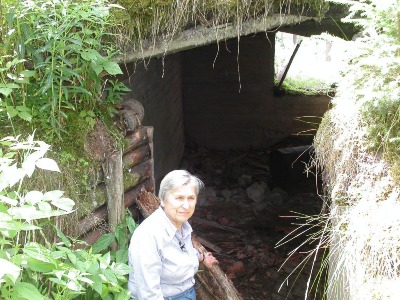
Fania Yocheles Brantsovsky: “My last wish is that the Jewish Partisan Fort, where we lived, and where we fought the Nazis in the forests of Lithuania, be preserved and restored so future generations will know of our resistance against genocide, and so we honor all those who fell fighting for the freedom of all of us.”
See Defending History’s Fania Yocheles Brantsovsky Section: how Vilna’s most beloved Yiddish icon was pursued by authorities hell bent on revising Holocaust history.
Update: See now the Following Fania project
◊
A few days ago I was flabbergasted when I read a news item in the FOCUS website for West-Flanders where I live. On Saturday, August 24, 2024, in Zeebrugge there had been a commemoration ceremony for the crews of two German submarines (U-5 and UC-14) sunk during World War I and just recently identified. This official commemoration ceremony took place in the presence of the German ambassador Martin Kotthaus and the Governor for West-Flanders Carl Decaluwé: “More than one hundred years ago, the crews of these two submarines died in the middle of a horrible war. I am very grateful that today we can grieve for the dead together as friends and partners,” declared the current German ambassador.
It is perhaps interesting to remind readers that in the past Flanders had already made a wrong choice regarding the only illustration for World War I within the ‘Flemish Canon’ (see my article, “Wrong Choice for New “Flemish Canon”). On that occasion, the choice was of a statue of a grieving couple situated in the German military cemetery of Vladslo in Flanders, a couple grieving for their slain son Peter, a German soldier who had died while his regiment attacked Ypres in October 1914, just when the danger of the whole of Belgium being overrun by the German army had been at its highest.
◊
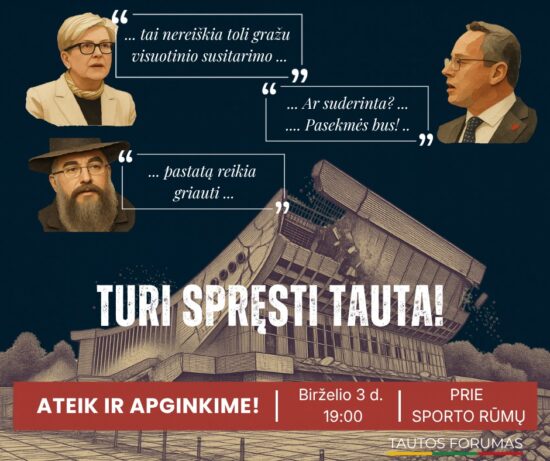
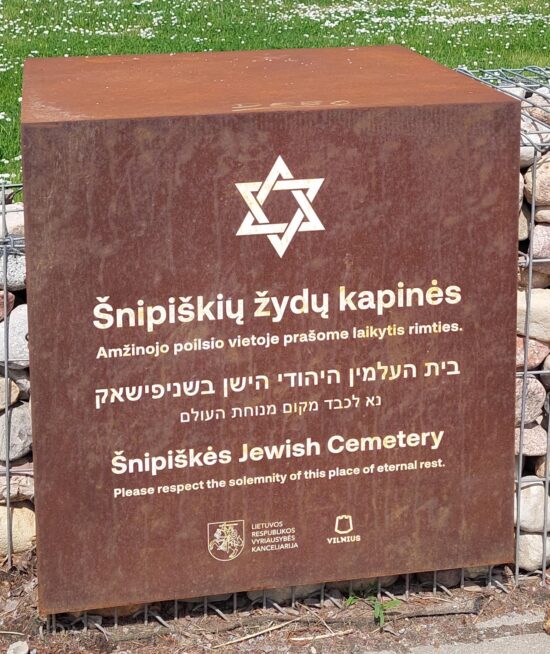
VILNIUS—Last Thursday, 22 August, Defending History distributed the link to an ultranationalist announcement of a demonstration scheduled for the following day at the Old Vina Jewish Cemetery. The demonstration would be against not, directly speaking, the preservation of the Jewish cemetery (though that is the upshot), but against the recent “compromise” that would effectively in any event destroy the cemetery forever: keeping the hated Soviet monstrosity and turning it into a memorial center with exhibits 75% Jewish and 25% Lithuanian. As pointed out by Defending History, this is in any case a (disguised) new events center with seating for thousands who would clap, cheer and flush lavatories surrounded by thousands of extant graves.

Far-right demonstrators stand atop thousands of extant Jewish graves at the Old Vilna Jewish Cemetery. To prevent preservation and restoration of the old cemetery they seem to have just decided that a hated Soviet building is in fact a symbol of Lithuanian independence (!). Defending History photo by William Adan Pahl.
Simon Wiesenthal recounted that he escaped the threat of imminent death seven times as a slave and captive of the Nazis during World War II. Frida Michelson, a Latvian Jew from Riga, escaped an imminent death when on December 8, 1941, moments before she would have been ordered into a grave to be shot in Rumbula, she threw herself on the ground in the snow and pretended to be dead. She was saved by the fact that hundreds of pairs of shoes were piled on her body covering her from the eyes of the murderers, who did not discover her. Otherwise, she would not have told her story to David Silberman.[1]
It says something that the only “Devil Museum” in the world is to be found in Kaunas, Lithuania. This city sometimes also known as Kovno, is the most Lithuanian of cities, the capital of independent Lithuania in the interwar years, and still today, the more fully Lithuanian when contrasted to the more multicultural current capital of Vilnius. The Russian, Polish, and English languages, for instance, which are fairly common in Vilnius, are nary to be heard in Kaunas. This “Devil’s Museum” is a global and learned collection of 3000 figurines from 70 countries made by a prominent Lithuanian professor and is certainly a landmark and a must-see. The devil is the most dominant figure in Lithuanian folklore. This figure apparently has a thousand names in the ancient Sanskrit-related Lithuanian language, with over 400 places names and 5000 legends featuring this character. While surveying the collection, so many features of these legends pop out: the devil is rich, often a thief, one who pours coins, who controls the vodka trade, imparts powers of virtuosity on the violin, and who even, at times, cooks humans.
In the accompanying notes, one learns that the devil is often depicted as a nobleman, sometimes even as a German. Yet nowhere in the entire museum however is even the word Jew, or Jewish, even mentioned. Needless to say, the physiognomy in the overwhelming majority of the figurines closely matches the hallmarks and the stereotype of the antisemitic rendering of “the Jew.” The characteristic markings could not be more clear: facial features such as the long or hooked nose, thick lips, flaring nostrils, the strangely squat or wiry physique, beady eyes and the deep eyebrow ridges. This figure is also well known, inter alia, from the centuries of representations of Jews per se featured during Lithuania’s end-of-winter, Mardi Gras-like Užgavėnės festival.
◊
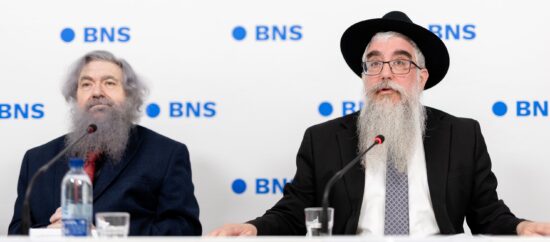
VILNIUS—The following is a full translation of the July 25th Lithuanian television evening news segment, on its flagship Panorama program, of that day’s demonstration led by the Vilnius Jewish Community against plans to permanently erase the Old Vilna Jewish Cemetery by refurbishing (instead of demolishing) a hated Soviet eyesore. Demolition would make way for the respectful restoration of the most important Jewish cemetery in the Lithuanian lands of Northeastern Europe.
JUMP TO TRANSLATION. TO SCREENSHOTS.
OPINION | YIDDISH | GREEN HOUSE | LAST JEWISH PARTISAN FORT
◊
Those of the founders of the Vilnius Summer Program in Yiddish, twenty-six years ago, in July 1998, who are still around and active will today wish to extend the heartiest of welcomes and the best of wishes and godspeed to all the participants of this summer’s mini-revival (two weeks rather than four, no university credit options, but with every perspective of equaling and surpassing the original conception in the years ahead). The new course has issued its program of studies (see the 1998 program for some perspective). The instructors are the well known Yiddish teachers Alec Eliezer Burko, Dov-Ber Boris Kerler, Yuri Vedenyapin, and Anna Verschik (Dr. Burko is a native of the United States, the others were all born and raised in the Soviet Yiddish environment). All were at one time or another students of the original course’s founder, underlying the venerable Vilna tradition of chains of learning over the years. In the case of revived Yiddish studies in Vilnius, an early catalyst was the Oxford-Vilnius agreement of 1991 that enabled Lithuanian students to study Yiddish and Judaic studies at Oxford University from 1991 onwards.
◊
The creators of Vilnius’s new Museum of Culture and Identity of Lithuanian Jews (MCILJ or for short — “Litvak Culture Museum”), which opened its doors last January, have rapidly earned their place of honor in the 700 or so years of Lithuanian Jewish history. They have achieved a notable advance in encapsulating — in broad outline — the scope, the breadth, and many of the contours of internal diversity of one of the world’s more intriguing and complex stateless cultures, right in the city that had for centuries been its symbolic capital. That heritage is part of the larger Ashkenazic heritage that is itself often undercredited and understudied internationally, particularly among modern Jews themselves, for whom the twin pillars of modern Israel and of modern forms of religion occasionally leave no room for the civilization of their own forebears. That it was largely annihilated in its homelands during the Holocaust makes such a task more daunting still.
VILNIUS—The American Jewish Committee (AJC), founded in 1906, is one of the world’s accomplished advocacy groups for Jewish, and more broadly, minority and human rights causes, in addition to other lofty missions. Those who revere and support it now need to ask frank questions about, one is sorry to say, a disturbingly consistent infidelity to Jewish causes in one country, Lithuania. The lamentable record speaks for itself. It has for decades been represented by its director of international Jewish affairs, Rabbi Andrew Baker, a recipient of multiple grand awards from a number of presidents of Lithuania. In the AJC’s name and with its wherewithal, he has consistently let down, first, the living small-c Jewish community of Lithuania; second, the true narrative of the Holocaust when it is under attack by the forces of Holocaust obfuscation, distortion and revisionism; and, finally, the preservation of Jewish cemeteries. We do not ascribe to him any nefarious motives or conscious malice on any of these counts. He is not the first, nor the last American Jewish organization bigwig to be mobilized (and a little intoxicated by a slew of high Lithuanian government medals) as a kind of “useful Jewish functionary” to provide Jewish cover and cred for government policies in countries where, in post-Holocaust Eastern Europe, local Jewish communities can be small, weak, and demographically challenged.