MEMOIRS | GLORIFICATION OF COLLABORATORS | HUMAN RIGHTS | PERSON OF THE YEAR | LITHUANIA | LITVAK AFFAIRS
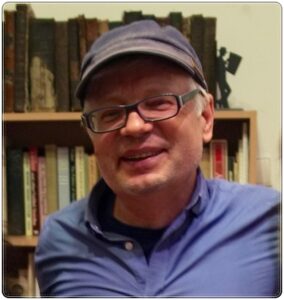
by Evaldas Balčiūnas
◊
Evaldas Balčiūnas is Defending History’s Person of the Year 2023
◊
Evaldas Balčiūnas is Defending History’s Person of the Year 2023
◊
◊
Editor’s memoir
In 2011, when our small Defending History team headed out (as we did each year) to Kaunas to monitor and document the 2011 neo-nazi city center march, an event that glorified Holocaust collaborators, we went for a coffee after the event. There, our mentor who never missed a march before his final illness, Milan Chersonski (1937–2021), the longtime Vilnius Yiddish theatre director and editor for some dozen years of the Lithuanian Jewish community’s quadrilingual newspaper, Jerusalem of Lithuania, told us (in Yiddish, of course): “Look, there is one young Lithuanian who has more courage than the rest of the country combined. He has been writing articles on the tragedy of his country’s government organs glorifying Holocaust collaborators in the public space. And unlike others, he’ll be happy for Defending History to publish them in English translation. Trust me, his articles are more important that all of ours that come from Jewish pens.”
Annelies Beck is a Flemish journalist whom I admire. She is a tough cookie. I have often seen her interviewing politicians and admired her determination, intelligence and open-mindedness. So, I was quite curious to read her opinion piece in the literary supplement of the Flemish language De Standaard dated November 26, 2022, entitled “History is Far From Gone” and relating to a conference in Lithuania she went to on the subject of the role of public television within democracies. She is also a writer. In her opinion piece, she focuses on what the Lithuanians did during the Soviet occupations to protect and preserve their language: “The Lithuanians whom I later questioned declared the importance of resistance through language and literature (…) in different periods of their history.” While visiting, Mrs. Beck was impressed by what she saw “in a cell in the cellar of the Genocide Museum,” imagining all the prisoners during the Soviet occupation, symbolized by the eighteen different layers of color having been necessary to wipe out all the graffiti they had scratched on the walls. She also writes, referring to a conversation she had with a Lithuanian journalist colleague, “that some heroic partisans were also antisemites” (no mention that many of those glorified were in fact recycled 1941 Holocaust perpetrators).
◊
◊
Wollongong, an Australian city located about 80 kilometres south of Sydney, is a long way from Lithuania’s Kaunas, which probably made it attractive to Bronius Sredersas. He arrived in 1950, having fled Lithuania ahead of the Red Army in 1944. For the next 25 years Sredersas, one of more than 100,000 displaced persons to settle in Australia, worked in Wollongong’s steelworks. He led an unobtrusive life and acquired an anglicised nickname, “Bob”. He never married and didn’t waste his money. Instead, he saved his pay, frequented auction houses and with a canny eye built a substantial art collection.
In 1976, Sredersas shocked the citizens of his adopted city by presenting his art collection to them. For an industrial city like Wollongong, which didn’t even have an art gallery, this gift was a sensation. It triggered the establishment of the Wollongong Art Gallery which has since grown into a major regional cultural institution.
Sredersas was widely celebrated in the media and an exhibition space within the new gallery was named in his honor. After his death in 1982, his memory was preserved with eminent persons giving lectures in his memory. The gallery erected a plaque and hosted the Sredersas Dinner as a fundraising social event.
In 2018, the gallery staged a major exhibition celebrating Sredersas. Titled “The Gift”, the exhibition included a recreation of his home, a display of the artworks, a video, and a symposium on his life and benefaction.
Publicity for the exhibition included mention that in Lithuania, Sredersas had been a policeman. While I was aware of Sredersas’ life as a steelworker in Australia, his prior career as a policeman was new to me. I knew though that the Nazis had relied on local collaborators, formed into police battalions, to carry out the Holocaust in Lithuania. I was appalled at the possibility that Wollongong, my home town, might be honoring a Holocaust perpetrator and decided to see if I could find out more.
◊
Rabbi Dovid Kahana Spiro (1901-1970) was a very pious and learned man who cofounded the Jewish community in Fürth after the Holocaust. He worked there for twenty-five years as a community rabbi and helped numerous people in need. The Firter Rov
(Fürther Rav) was buried in the Har Hamenuchos Cemetery in Jerusalem. A picture of his tombstone can be found in Moshe Rosenfeld’s recently published book on Rabbi Spiro. The book’s thirteen chapters cover in great detail the origins of the family Spiro, their pre-war life in Poland, the Warsaw Ghetto, survival, rebuilding, dialogue with a bishop, divorce cases and much more.
The author, who now lives in London, grew up in Fürth and practically from birth had a close relationship with Rabbi Spiro, who lived next door. Rosenfeld’s mother was the rabbi’s cousin, and his father became his right-hand man. The author frankly admits that he should have asked a thousand questions at the time, but didn’t. And therefore there are many answers that he honestly does not know today. Nevertheless, with a vast amount of work and love, he managed to collect a wealth of material and to publish this extensive work. The history of the Spiro family, that lived in Poland, is presented in great detail.
◊
Please send additions and corrections to info@defendinghistory.com. Thank you.
◊
◊
PROFESSOR MICHAEL SHAFIR
(4 January 1944 – 9 November 2022)
Michael Shafir section in DefendingHistory.com
Under construction:
Papers by Michael Shafir
◊
More on history of the Lithuanian gov. financed “Red-Brown Commission” of which the Yale-Fortunoff speakers are long-standing members
◊
KAUNAS—The last Holocaust survivors in this city that gave birth to the Lithuanian Holocaust on 23 June 1941 (before the first German soldiers arrived, later that week) are in pain to learn that their government is now investing in foreigner-rich “Jewish” and “Litvak” and “Yiddish” events as part of gala PR for this year’s Kaunas 2022 “Capital of European Culture” program — without also removing the city’s shrines to the most infamous collaborators and perpetrators of the genocide. The Defending History community congratulates Kaunas on the European year of honor, while urging its foreign participants and honorees to politely and with dignity call (publicly!) for Kaunas to kindly remove its prominent state-sponsored public-space shrines, monuments and memorials to major local Holocaust perpetrators and collaborators. By speaking out, with dignity and publicly, they would be successfully countering the moral taint of ipso facto being used as “Useful Jewish Idiots” (known as “UJIs”) to cover for the ongoing failure to remove even one such shrine and thereby participating actively (and having been forewarned) in the current (East European based) incarnation of Holocaust revisionism and denial (covered up with lavish “Jewish events”). By failing to do so, they would bring moral taint upon themselves for all time, while deeply offending the legacy of the victims and survivors, and more broadly, the rights of minorities everywhere to life without genocide.
The Kaunas region even has a state school named for an alleged killer at the June 1941 Lietukis Garage Massacre, one about which the British Parliament weighed in.
◊
Under the leadership of the visionary founder of modern Jewish studies at Oxford University, Dr. David Patterson (1922–2005), the academic research and teaching institution which he created became for around two decades a major world center of Yiddish studies. That institution was the Oxford Centre for Postgraduate Hebrew Studies (since renamed the Oxford Centre for Hebrew and Jewish Studies). Indeed, it was Yiddish in the last quarter of the twentieth century that catapulted the Centre from just another sleepy Hebrew studies unit to a world-class center in advanced studies, including successful doctoral programs that provided a generation of (today’s) professors, and seminal publications in English and Yiddish that will be there for centuries to come. The kind of thing that the current twenty-first century incarnation of the same institution might well look back on with pride and even some nostalgia.
Among today’s scholars, educators, authors and personalities in the wider arts who were attracted to come and study Yiddish by our team, enabled at each stage by Dr. Patterson (in an array of settings ranging from weekly classes through summer courses to doctoral programs) at the Centre between the 1970s and 1990s are Prof. Marion Aptroot, Dr. Helen Beer, Prof. James Dingley, Prof. Jennifer Dowling, Prof. Gennady Estraikh, Mr. Elliot Gertel, Prof. Christopher Hutton, Dr. Devra Kay, Prof. Dov-Ber Kerler, Ms. Miri Koral, Dr. Holger Nath, Prof. Ritchie Robertson, Ms. Elinor Robinson, Mr. David Schneider, Prof. Robert Moses Shapiro, Prof. Astrid Starck, Dr. Heather Valencia, Prof. Nina Warnke, Mr. Tim Whewell, among many others. The first BA option in Yiddish was introduced at Oxford University (Faculty of Modern Languages) in 1982, and the doctoral program was inaugurated in 1984. After some years it was awarded a citation of excellence by the Modern Languages Faculty, signed by its then head. These were all achievements of historic order for the small, fragile and frankly still struggling academic field of Yiddish.
OPINION | RED-BROWN COMMISSION | MR. RAČINSKAS ON THE HOLOCAUST | LITHUANIA | DOUBLE GENOCIDE
◊
VILNIUS—With nearly all local Holocaust Survivors now gone, or effectively out of public circulation, Lithuania’s “Red-Brown Commission,” a major European engine for the downgrade of the Holocaust via far-right “Double Genocide” history revisionism is again in the forefront of PR efforts to bowl over naive foreign visitors and delegations to this city, particularly on September 23rd each year, with “moving Holocaust elegies.” For Lithuanian Holocaust survivors, the very choice of Sept. 23 (day of the 1943 liquidation of the Vilna Ghetto by the Germans, two years after the murder of the majority of Lithuanian Jews in hundreds of towns across the land) was seen as a decoy. The day each of them had etched in the heart in perpetuity was June 23rd, when in 1941, violence against Jews broke out in hundreds of locations, with murder documented in around forty — before the first German forces arrived or managed to set up their authority. It was the day when six hundred years of peaceful, harmonious coexistence turned overnight, under Hitlerist propaganda, to dehumanization, humiliation, plunder, rape, injury and murder. To this day, an industrial grade revisionist industry continues to obfuscate or outright deny the history of the First Week (i.e. the last week of June 1941). Indeed, June 23rd is celebrated by far-right government historians each year as the date of a supposed “uprising” against the Soviets by the white-armbanded Jew killers who did not “rebel” until the Soviets fled in disarray from Hitler’s invasion, when they began to murder Jewish neighbors across the land unleashing the Lithuanian Holocaust, in which 96.4% of Lithuanian Jewry perished. In 2020, Dr. Arunas Bubnys, the chief historian of the second “Holocaust entity financed by the state,” the Genocide Center, celebrated the “holiday ” alongside banners of two major Holocaust collaborators. He was rewarded a year later with directorship of the Center.
◊
◊

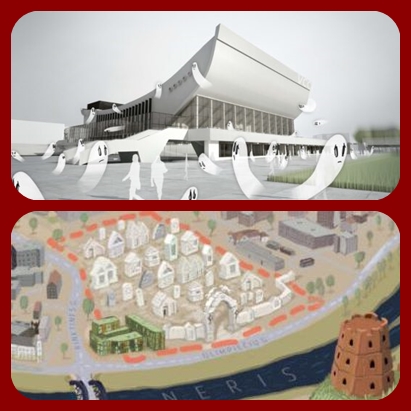
Look what you can see standing right by Vilnius’s Cathedral Square: The Soviet “Sports Palace” ruin that symbolizes not only antisemitism but also: Soviet/Russian Empire spiritual and political domination of Lithuania’s free spirit. High time to be rid of this carbuncle on the beautiful face of modern Vilnius?
The first phase of the eradication of the Old Vilna Jewish Cemetery at Piramónt in Shnípishok — modern Šnipiškės — and of the people buried there, started back in 1830, contemporaneous with an uprising against the Russian Empire. The November Uprising, as it is now known, started with the will to resist the czarist government’s plans to send the army of Poland — at the time an autonomous kingdom within the Russian Empire — to Belgium and France, as well as with the dreams of restoring Polish independence. In 1831, seeing that the uprising for independence would soon take over Vilna, the Russian Imperial government expropriated a section of the Jewish cemetery by the bank of the Viliya (now Neris), and established an artillery citadel to keep the freedom-loving city at all times in the crosshairs of its cannon barrels. But even after the establishment of the citadel, more than three quarters of the actual graves (and their stoness or mini-mausoleums, oyhólim) remained untouched. This legendary cemetery is a Litvak pantheon, a monument to the civilization of Lithuanian Jewry. So it is meaningful that its first phase of destruction got underway just as the Russian imperial government’s project to enhance its military presence in Vilna, by making sure that the city’s inhabitants live in constant fear.

A small section of the Old Vilna Jewish Cemetery at Piramónt. The Soviet Sport Palace was built in its heart. All stones and inscriptions were trashed but thousands of graves survive on all four sides of the building, now an eyesore in the heart of modern Vilnius.
◊
My attention was recently caught by an article in a Flemish-language newspaper here in Belgium (“Living in fear of the Russian bear” in De Standaard of 5 September 2022), where the author writes that he had studied in 2005 at the University of Vilnius. The article speaks eloquently — and accurately — about the loss of freedom that came upon the people of Lithuania when the USSR invaded and occupied (for the long haul) Lithuania in 1940. It speaks of the many people deported to Siberia by the NKVD, it speaks warmly of the postwar fight of the Forest Brothers, and it speaks openly about the current fear that Putin’s Russian Federation might try again to incorporate their country into their revanchist program, a fear the author calls “Potsdam II.”
There is, however, disturbingly, quite a stupendous missing link in this abridged history of Lithuania in the twentieth century. Where had the quarter million Jews (the figure on the eve of the Holocaust) of the country disappeared to “overnight” (as centuries go), during that fateful century? Had there ever been a Jewish minority in Lithuania at all? When I looked at the author’s pedigree, I understood why the Jews had not played any role of significance in his biased dialectical discourse. Joren Vermeersch is a historian (of sorts) and an accomplished author. He is also a representative (stand-in, as we call it) for the Belgian House of Representatives, for the “N-VA.” This is the nationalist Flemish party that has its historical roots in the collaboration with the Nazis during World War II. The party that has systematically fought for an amnesty for Nazi collaborators. The party in which the grandparents or parents of some of the present actual leaders had been condemned by the Belgian State for collaboration with the enemy. Nobody is guilty of sins of their ancestors, but when there is a pattern of such pedigree being considered a great plus for current leadership, and that pedigree is subtly glorified rather than disowned, we have a current moral problem that merits discussion in the public square.Continue reading
◊
Congratulations to the city of Kaunas, Lithuania, once known also as Kovno (in Yiddish forever: Kóvne) on its selection as Europe’s “Capital of European Culture” in 2022, sharing the title with Esch-sur-Alzette in Luxembourg. But as the midpoint of the city’s co-reign rapidly approaches, it is necessary, albeit sad, to have to note that not a single public-space glorification of local Holocaust collaborators had been removed. Zero. No city on the planet has as many monuments to local partners in the genocide of that city’s Jews. The 30,000 Litvaks (Lithuanian Jews) of Kaunas were brutally murdered, and the city played the primary role in the launch of the Lithuanian genocide on 23 June 1941, before the arrival of the first German forces. Thousands were murdered before the Germans arrived and/or set up their administration.
See Lev Golinkin’s updated 2022 catalogue in the Forward of public space shrines to Nazi collaborators worldwide
Lithuanian government authorities have reportedly invested large sums to lure “Useful Jewish Idiots” from the UK, US, Israel, and further afield to participate in “cultural events” intended to obfuscate and deflect from the primary issue: Why are the enablers of the slaughter of Kovno Jewry still honored by street names, plaques and university lecture halls and statues in the city? Local Jewish leaders who have dared to speak up have rapidly been smeared as “Putinists” for daring to criticize the far right’s hold over national history policy (and indeed, the need for such a policy to start with).
But in the waning days of 2021, a “waterfall of truth” began to cascade from an unanticipated quarter. Michael Levinas, son of the celebrated Lithuanian-Jewish born French philosopher Emanuel Levinas, forbade authorities to name a fancy new institute after his father. This was kept under wraps until his 21 Dec. Le Figaro opinion piece broke the story, and it was duly reported in Lithuania by LRT.lt. See Defending History’s media tracker page for background and updates.
Compilation of articles, documentaries, videos, and photos. Plus: from the saga of 2008…
See Defending History’s Fania Yocheles Brantsovsky Section
“Putin’s criminal and barbaric invasion must be countered to the hilt and we must rally unfettered to the cause of Ukraine’s freedom. But for far-right double-genocider revisionists in the Eastern E.U. to take advantage of it for Holocaust obfuscation is just plain wrong.”
Defending History’s statement on the war in Ukraine
☰
When Ottawa Citizen and The New York Times broke taboo on wartime discussion of East European state-sponsored Holocaust obfuscation
☰
But what is the “Prague Platform”?
◊
My good friend and colleague for two and a half years in Vilnius, Dónal Denham, has written a book with the title Nine Lives: The Reflections of a Dedicated Diplomat
. The book is an interesting, fascinating read about an eventful career in the service of Ireland at home and abroad, enriched by an excellent selection of photos that add life and substance to the text. The author also draws a vivid picture of his early formative years in Ireland and England and student years at Trinity College. He writes warmly about his family, not avoiding the pain of personal losses, exacerbated by separation and distance. Diplomats from all countries would subscribe to his tribute to his wife Siobhan (“without whom nothing worthwhile would have happened to me”) who “as an unpaid ‘trailing spouse’ was a treasure beyond measure, largely unrecognized by officialdom.”
So, which are Dónal Denham’s nine diplomatic lives?
VILNIUS—The New York Times reports today that Ukrainian president Volodymyr Zelensky has dismissed his country’s ambassador to Germany after the ambassador’s worshipful antics glorifying the World War II Hitlerist, fascist figure Stepan Bandera, who was the leader of groups that murdered hundreds of thousands of Polish and Jewish civilians in Ukraine.
See G. Rossolinski-Liebe’s authoritative study of Bandera’s Hitlerist history and the racist, fascist leader’s inspiration of hundreds of thousands of murders of Polish and Jewish civilians. See also Erika Solomon’s update in the New York Times.
Defending History was ahead of the curve. See from earlier years our Bandera section and some of Dr. Rossolinski-Liebe’s earlier writings in Defending History; DH’s Collaborators Glorified section for the wider context of the issue in contemporary Eastern Europe (more details on Sections page).