Opinion
In Reponse to the Media: 9 July 2016
Now We [Who Lie Buried in the Old Vilna Jewish Cemetery], Know…
PAPER TRAIL | REGISTRY OF OPPOSITION TO CONVENTION CENTER | DH SECTION
◊
VILNIUS—The following is a reprint of the article published on 2 July 2016 in Yated Ne’eman, authored by the eminent scholar, Professor Bernard Fryshman. The title refers to the accompanying illustration which considers the views of the many thousands of Jews buried at Piramónt, Vilna’s old Jewish cemetery in the Šnipiškės (Shnípishok) district, in active use from the fifteenth to the nineteenth centuries. See also background to the article, PDF of the original article, the catalogue of international opposition, the paper trail, the DH section, and our editor’s summary of the issue published in December 2015 in The Times of Israel.
Asra Kadisha on Vilna Cemetery: From Proud Powerhouse of Historic Truth to Silent Mouse?
PAPER TRAIL | REGISTRY OF OPPOSITION TO CONVENTION CENTER | DH SECTION
◊
O P I N I O N
◊
VILNIUS—Between October 2014 and October 2015, the international Jewish-cemetery group Asra Kadisha, coordinated by haredim largely affiliated with the “Zalmen” branch of the split Hasidic Satmar group (today the world’s largest Hasidic group) made a number of contributions that will remain permanent. Thanks in whole or in part to Asra Kadisha, eighteen important documents were published opposing the antisemitic decision of some Lithuanian government officials to allow a convention center to rise, surrounded by thousands upon thousands of skeletons on all four sides, skeletons of Jewish citizens of Vilnius buried there between the fifteenth and nineteenth centuries. As a Protestant minister and Catholic philosopher have pointed out, such would not have been the decision were it a Christian cemetery or one housing heroes of Lithuanian culture between the fourteenth and nineteenth centuries. Of course the millions in store for property developers and their many “beneficiaries” (for decades to come) play a prime role; antisemitism enters the picture when the state fails to put in play the same brakes which it applies for majority culture and majority religion sacred sites.
South African Litvak in London Critiques Lithuania’s Citizenship Policies
OPINION | LITHUANIA | SOUTH AFRICA | HUMAN RIGHTS | ANTISEMITISM & BIAS
◊
by Daniel Lutrin
The following opinion piece by Daniel Lutrin appeared in the South African Jewish Report on 1 June 2016 under the headline “Lithuanian Citizenship: Only Successful Applicant is a Dead Jew.” Comments or discussion may be directed to the South African Jewish Report. Defending History is always prepared to consider actual articles in reaction to published articles.
◊
It was gratifying to see a recent article regarding the plight that Jews of Lithuanian origin (Litvaks) are facing when applying to have their Lithuanian citizenship restored. The article, however, does not hone in on the critical matter at hand, namely the extent to which Lithuanian bureaucrats have gone to deny Jews of their ancestral right to citizenship.
Appeal to Conscience of the “Red-Brown Commission”
[updated]
Appeal to the conscience of the members of the renewed state-financed “International Commission for the Evaluation of the Crimes of the Nazi and Soviet Occupation Regimes in Lithuania”
Forward Coverage of Yivo Strife Omits Mention of Instrumentalization by Lithuanian Holocaust Revisionism Industry
YIVO MANIPULATED? | MEDIA WATCH | POLITICS OF MEMORY | DOUBLE GAMES
◊
NEW YORK CITY—A 9 March 2016 Forward article, by Britta Lokting, focused on Martin Peretz’s recent resignation from Yivo’s board, cited a number of current Yivo issues. It did not, however, mention the major issue of instrumentalization by the Lithuanian government’s campaign of Holocaust obfuscation, relativization and revisionism. It did reference the now-famous Vilnius-based digitization project.
In 2011, Yivo honored an antisemitic foreign minister while failing to honor the Yiddish speaking Vilna Holocaust survivors maligned by Lithuanian prosecutors, resulting in a heartfelt plea from the long-time editor of the Jewish community’s quadrilingual newspaper. Then, in 2012, it sent its director to Vilnius to help cover for the reburial with full honors of a Holocaust perpetrator, and saw its director join (and thereby give legitimacy to) the notorious “Red-Brown Commission.” A year ago, the organization was called to task by a Vilna Holocaust survivor in the Yiddish Fórverts (English translation here; unmentioned in the English Forward?). See Defending History’s section on Yivo issues in recent years.
Another Holocaust-Obfuscating PR Bash at “Vilnius Jewish Public Library”
VILNIUS JEWISH PUBLIC LIBRARY | DOUBLE GAMES | RED-BROWN COMMISSION
◊
VILNIUS—Yet again, the “Vilnius Jewish Public Library,” housed in exquisite city-center premises in a courtyard off the capital’s central Gedimino Boulevard, has been the base for a Holocaust-obfuscating event featuring stars of the state’s “Red-Brown Commission” who are dispatched far and wide to deny the existence of the state-sponsored “Double Genocide” campaign, to mitigate the campaign against Holocaust survivors, the efforts to glorify local collaborators, and to obscure entirely the Second Opinion expressed in the Seventy Years Declaration. Incredibly, the roster of invited speakers did not include Ms. Rūta Vanagaitė, author of Mūsiškiai, the new best-selling book on the Holocaust that has in effect revolutionized the country’s coming to terms with its Holocaust-era past. What is the “Jewish” Library afraid of?
Neo-Nazis Given Central Vilnius Again on March 11th Independence Day
Arūnas Degutis, Signatory of Lithuania’s 1990 Declaration of Independence, Voices View on the Holocaust
OPINION
by Andrius Kulikauskas
◊

Arūnas Degutis
O
n February 26, 2016, Arūnas Degutis posted his thoughts on Lithuanian-Litvak relations at the Minciu Sodas discussion forum, one of the longest running public Internet forums in Lithuanian, which I founded in 1999. Degutis writes that Lithuanians as a nation should empathize with Jewish victims of the Holocaust, especially those murdered by Lithuanians, and indeed should make a moral apology. Degutis was one of the signers of the declaration of Lithuania’s independence on March 11, 1990. In 1984, he was thrown out of work for his ties with anti-Soviet dissidents. In the summer of 1988, he became a key organizer of the Lithuanian Reform Movement “Sąjūdis,” especially as an editor of “Sąjūdžio žinios.”
Sugihara Abused? Red-Brown Commission Ropes In Japanese Embassy for 11 Feb. Event
OPINION | EVENTS | JAPAN | RED-BROWN COMMISSION | POLITICS OF MEMORY
◊
VILNIUS—Over the past decade, few foreign embassies in Lithuania have done as much as Japan’s to help ensure that the Holocaust in Lithuania is never forgotten and indeed, that remembrance events and educational programs feed into both national and international efforts to raise awareness and sensitivities in the cause of averting future massacres of innocent civilians.
Japan’s Holocaust remembrance achievements in Lithuania are manifold. From 2008, when state prosecutors connected to the Genocide Center began defaming local Holocaust survivors, Japan’s embassy joined with others in giving honor to the wrongly accused, including the 2009 “Walk in the Rain” organized by then Norwegian ambassador Steinar Gil. More well known are the embassy’s activities in commemoration of Chiune (Sempo) Sugihara, the inspirational Japanese humanist who saved thousands of lives by issuing visas in Kaunas in 1940 (enabling those people to flee Soviet rule directly, and indirectly from what was to come a year later, in 1941, with Hitler’s invasion and the massive local collaboration in genocide). One of the most important goes back to the turn of our century when the embassy participated actively, and generously, in setting up Sugihara House in Kaunas.
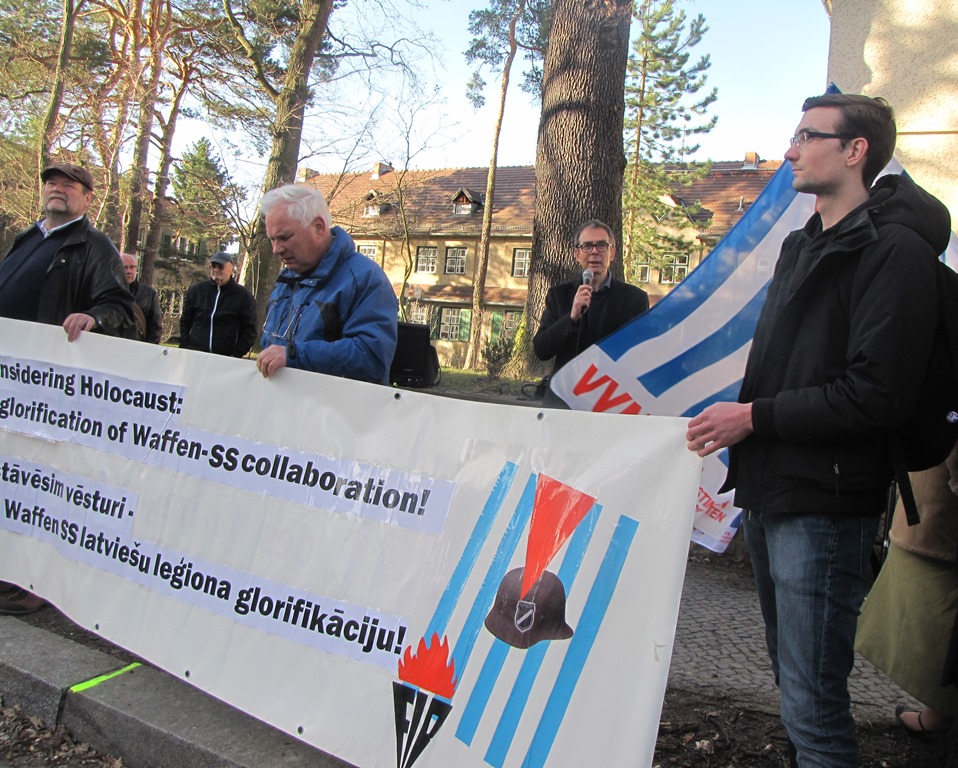
Why Do I Find the So-Called Heroes from the Latvian Waffen SS So Despicable?
OPINION | HISTORY | LATVIA | COLLABORATORS GLORIFIED
by Roland Binet (Braine-l’Alleud/Belgium)
◊
Introduction
Next month, the European Union and NATO will again be faced with the annual city-center march in Riga, the Latvian capital, glorifying the country’s Hitlerist Waffen SS. I had of course for years heard about the infamous March 16th marches in Riga when old members of the Latvian Waffen SS, their sympathizers and those who feel nostalgic about the good old time under Nazi rule proudly parade through the central streets of the beautiful capital of Latvia, ending their solemn march in front of the Freedom Monument, where they – solemnly and hierarchically – lay bundles of flowers at the foot of the monument and sing the national anthem.
An Open Letter to Holocaust Scholars and Educators in the Francophone World
OPINION | FRANCE | RED-BROWN COMMISSION | GENOCIDE CENTER
◊
Dear Colleagues:
Re: Conference on the Lithuanian Holocaust scheduled for this week in Vilnius
The newest Lithuanian “Double Genocide Industry” outreach to the French speaking academic world of Holocaust and World War II studies, this week’s conference in Vilnius, combines a number of truly outstanding scholars and papers with a political agenda of finding Francophone legitimization for Baltic Holocaust revisionism. The French component includes outstanding personalities from Mémorial de la Shoah, from Institut d’Histoire du Temps présent, and from the French Embassy in Lithuania. The strategy has recently evolved following a protracted collapse of US/UK/Israeli confidence in both the “Red-Brown Commission” (page) and the “Genocide Center” (page), both of which have been extensively exposed in recent months. Participants from Lithuania include one of the Double Genocide movement’s main “attack dogs” who makes fine hay of smearing local Lithuanian truth tellers as stooges of Moscow or useful idiots, especially when attempting to discredit honest multi-sided conferences (e.g. last April’s Vilnius conference).
Will the European Commission and the Claims Conference ever see the light on how their generosity is abused by Baltic nationalist Holocaust revisionism?
Let’s Dismantle the Sports Palace and Revoke the “Revocation of Hospitality”
OPINION | PIRAMÓNT | PAPER TRAIL | OPPOSITION | CEMETERIES
by Andrius Kulikauskas
◊
I am inspired by the deep feelings which have been stirred amongst Litvaks regarding the fate of the Vilnius Sports Palace built on top of the Jewish cemetery. I wish for our state of Lithuania to do its utmost on behalf of Lithuanians to restore the Jewish cemetery in Vilnius as a symbol of our aspiration for the closest friendship between Lithuanians and Jews. I realized that it would be most helpful for me to present my thoughts in Lithuanian.
“From the top of Gediminas Castle, do we want to see and cherish, for hundreds of years to come, what the Communist Party Chief saw (the Sports Palace) or what the Grand Duke of Lithuania saw (the Jewish cemetery)?”
When Both Law Enforcement and Politicians Cover Up Racism
HUMAN RIGHTS | RACISM | ROMA | OPINION
by Vilma Fiokla Kiurė
◊

Vilma Fiokla Kiurė
A Nigerian citizen was attacked with a knife and injured in Kaunas, Lithuania, earlier this month. Trying hard to avoid describing the assault as a racially motivated hate crime, law enforcement officials and the mainstream media alike explained that the incident was purely part of a private dispute. Strange to tell, reading through official statistics you would rapidly come to the conclusion that racist and xenopohobic crimes in Lithuania stand at about zero. And, that neo-Nazi minded youth are “just patriotic.”
It is no great secret in this part of the world that law enforcement officials and some politicians like to beautify the statistics, or to terminate or redefine proceedings brought in respect of racial or xenophobic hatred. One example comes to mind from 2011, when MPs J. Narkevičius and E. Zingeris appealed to the General Prosecutor’s Office to do something about the neo-Nazi ideology espoused in the song “Diktatūra” by the group “Šalčininkų rajonas” (Šalčininkai District).
Lithuania’s Liveliest Cemetery
OPINION | PIRAMÓNT | PAPER TRAIL | OPPOSITION | CEMETERIES
by Dovid Katz
Editor’s note: Reprint from The Times of Israel, where this op-ed appeared on 13 December 2015.
◊
Back in 2009, a rancorous dispute over the old Vilna Jewish cemetery was ostensibly solved. Two new buildings, despite worldwide protests, would be allowed to remain, and in return, no more land would be pilfered from the cemetery at Piramónt, in the Šnipiškės district of modern Vilnius, the capital of Lithuania. The burial ground goes back to the late fifteenth century, at least. After the Holocaust, with virtually no descendants left to worry about, Soviet authorities helped themselves to the gravestones for use in building projects, but left many thousands of graves intact. A galaxy of eminent European rabbinic scholars and authors were buried there. But once the 2009 “Peace of Piramónt” was brokered (with help from Western embassies here), emotions cooled as all sides got on with their lives.
Documents Which Argue for Ethnic Cleansing (by Kazys Škirpa, Stasys Raštikis, Stasys Lozoraitis and Petras Klimas in 1940-1941 and by Birutė Teresė Burauskaitė in 2015)
O P I N I O N / H I S T O R Y
◊
2023 update: Readers experiencing difficulty accessing sources linked are referred to the archived version where original links are operative.
◊
by Andrius Kulikauskas
◊
◊
As of October 28, 2015, the home page of the Genocide and Resistance Research Center of Lithuania has a link to an authorative statement by General Director Birutė Teresė Burauskaitė about Kazys Škirpa. She responds to a request for information by the City of Kaunas, which has a street in Škirpa’s name. Škirpa was Lithuania’s representative in Berlin, the leader of the Lithuanian Activist Front, organizer of Lithuania’s anti-Soviet rebellion and Prime Minister of Lithuania’s Provisional Government in 1941. In bold letters she emphasizes:
It’s Not Just About Old Jewish Cemeteries
O P I N I O N / P I R A M Ó N T / P A P E R T R A I L / O P P O S I T I O N / C E M E T E R I E S
by Milan Chersonski
◊
Translated from the Russian by Ludmila Makedonskaya (Grodno); English version approved by the author, Milan Chersonski (Chersonskij), longtime editor (1999-2011) of Jerusalem of Lithuania, quadrilingual (English-Lithuanian-Russian-Yiddish) newspaper of the Jewish Community of Lithuania. He was previously (1979-1999) director of the Yiddish Folk Theater of Lithuania. The views he expresses in Defending History are his own. See also Milan Chersonski section. Photo © Jurgita Kunigiškytė.
◊
There were many festive occasions celebrated once Lithuania declared its independence in 1990. So many hopes and expectations were inspired by the sweet word freedom. Free-ee-dom! Laisvė! Had it ever been possible to even imagine beforehand, taking one example, that Lithuania would hold a celebration to honor Israeli Independence Day, dear to Jews all over the world? The new state organized a large event at the Palace of Culture of the Trade Unions in Vilnius in honor of a faraway state, which in Soviet times was mentioned only as “the aggressive state of Israel.”
Why Would the “Genocide Center” in Vilnius Manipulate History and Glorify Murderers?
O P I N I O N / C O L L A B O R A T O R S G L O R I F I E D / G E N O C I D E C E N T E R
by Kristina Apanavičiūtė Sulikienė
◊
“I am a former Lithuanian soldier myself and have a personal remark to make. Nobody will ever force me to wear the uniform of another country’s armed forces, because I am a Lithuanian patriot. I will not wear the uniform of Russia or of Mozambique.”
◊
One of the main Lithuanian dailies Lietuvos žinios (Lithuanian News) reported in an article on 24 November 2015 that the council of the celebrated Sajūdis organization (famed for its role in resisting the USSR and helping to achieve Lithuanian independence), had now, in 2015, decided to apply to prosecutors to take legal action over an article that had appeared in the 13 October 2015 edition of Laisvas laikraštis (Free Newspaper).
Sajūdis “decided” that the author had violated the law because he mentioned that Lithuanian postwar militants Vytautas Žemaitis, Jonas Noreika (Vėtra), Antanas Baltūsis-Žvejas and others might have been personally involved in Holocaust atrocities. [Editor’s note: See articles by Evaldas Balčiūnas on the alleged Holocaust involvement of Žemaitis, Noreika, and Baltūsis -Žvejas.]
Roma in Lithuania: But What Does the Government Need To Do?
R O M A / H U M A N R I G H T S / O P I N I O N
by Vilma Fiokla Kiurė
◊

Vilma Fiokla Kiurė
“Which social group in the EU is most generally evicted from housing?” This was the question cheerfully posed by the host of the Good Morning Lithuania show on our national television. The viewer who called in said “Roma” and won a prize.
It can be pleasant to drink morning coffee while tuned to a TV quiz, but this time it was quite something else. The program’s entertaining format and the host’s frequent jokes are not very funny at all when such painful social issues are the subject of entertainment. But the episode well illustrates the public attitude towards the Roma here. Many Roma are still deemed to be distant, exotic and mysterious people, an object rather than a living community. Maybe because there is a lack of empathy and understanding in dealing with Roma integration problems and there are various language issues too.
Vilnius Mayor Plays with Fire: Yiddish, Pilfered Jewish Gravestones, and an Olympics of “Barbarism”
O P I N I O N / C E M E T E R I E S / P I R A M Ó N T / P A P E R T R A I L
by Dovid Katz
◊
VILNIUS—This city’s dashing young new mayor, Remigijus Šimašius, elected last spring, has now added Yiddish to the previously bilingual (Lithuanian-English) signs, wrought of expensive metal in rounded-edged casement, in times of austerity for pensioners and others in town. These signs are being placed near Soviet-era edifices made of pilfered Jewish gravestones (matséyves) that are a blot on this charming East European capital. This is the latest model featured on the mayor’s office website: