Litvak Affairs
Film, Video, Radio, Music
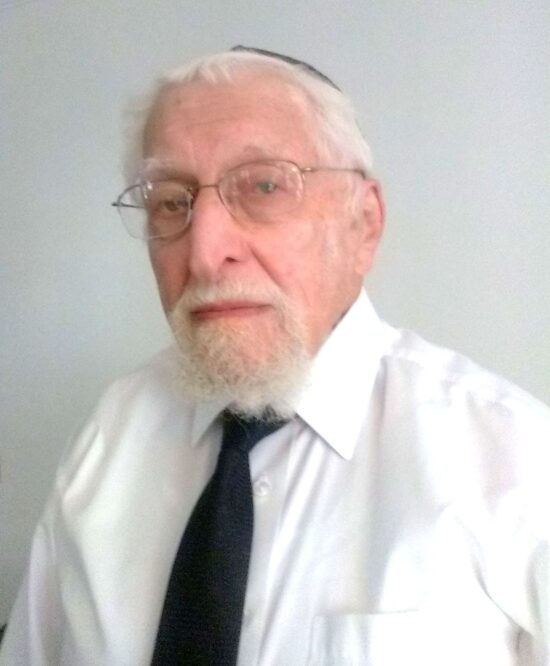
Roza Bieliauskienė (1946 – 2023): Cofounder of Lithuania’s Jewish Museum, Longtime Chief Curator, Educator, Specialist on Litvak Artists
ROZA BIELIAUSKIENE | OBITUARIES | MUSEUMS
◊
The following is a revised text of Dovid Katz’s obituary that appeared on his Facebook page today.
◊
Roza Bieliauskienė (1946-2023)
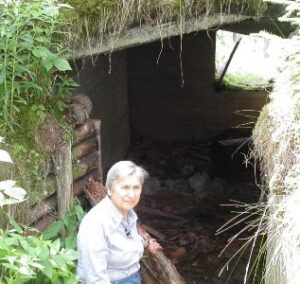
The world of Jewish Vilna and Litvaks everywhere mourn in deep sorrow the untimely sudden death of our dear Roza (Róze, Reyzl) Bieliauskienė, beloved scholar of Lithuanian Jewish art, long time historian, museum curator, educator, guide and a loyal friend unafraid of untoward local politics and its boycotts. Whether for an old friend or a foreigner she’d never seen before, Roza would rush to help anyone research anything if it was in the field of Lithuanian Jewish culture, history. Here is our 2 hour+ interview with her (entirely in Yiddish) from less than a year ago (recorded and posted in the Lithuanian Yiddish Video Archive (LYVA) thanks to the generosity of Remembering Litvaks Inc).
Notes from my Life
MEMOIRS | GLORIFICATION OF COLLABORATORS | HUMAN RIGHTS | PERSON OF THE YEAR | LITHUANIA | LITVAK AFFAIRS
by Evaldas Balčiūnas
◊
Evaldas Balčiūnas is Defending History’s Person of the Year 2023
DH’s 2023 Person of the Year: Evaldas Balčiūnas
PERSON OF THE YEAR | LITHUANIA | EVALDAS BALČIŪNAS | LITVAK AFFAIRS | HUMAN RIGHTS | HISTORY
◊
In the decade since Evaldas Balčiūnas began informing the English-speaking world, in a series of articles in Defending History, of the details, scope, and pain of his own country pursuing a state policy of glorifying Holocaust collaborators and perpetrators, the phenomenon has moved from local shadows to the bright lights of open and free debate across the democratic world. His 2012 exposé of Holocaust perpetrator Jonas Noreika ultimately led to the publication in America of a bold new book, The Nazi’s Granddaughter by Sylvia Foti. But back here in Lithuania, Evaldas was lugged into court for years and years on kangaroo charges and harassed extensively. The Defending History team was there at each hearing to provide moral support. The day will surely come when Evaldas Balčiūnas — journalist, educator, rebel, author, and historian — will be honored by Jewish and Holocaust history and remembrance groups internationally, by humanists everywhere, and last but not least, by his own country, as its fearless grand ethicist of the earlier twenty-first century.
◊
Editor’s memoir
In 2011, when our small Defending History team headed out (as we did each year) to Kaunas to monitor and document the 2011 neo-nazi city center march, an event that glorified Holocaust collaborators, we went for a coffee after the event. There, our mentor who never missed a march before his final illness, Milan Chersonski (1937–2021), the longtime Vilnius Yiddish theatre director and editor for some dozen years of the Lithuanian Jewish community’s quadrilingual newspaper, Jerusalem of Lithuania, told us (in Yiddish, of course): “Look, there is one young Lithuanian who has more courage than the rest of the country combined. He has been writing articles on the tragedy of his country’s government organs glorifying Holocaust collaborators in the public space. And unlike others, he’ll be happy for Defending History to publish them in English translation. Trust me, his articles are more important that all of ours that come from Jewish pens.”
Wollongong, Australia is a Long Way from Kaunas, Lithuania: Discovering a Holocaust Collaborator Among Us
LITHUANIA | HISTORY | KAUNAS | MUSEUMS
◊
by Michael Samaras
◊
◊
Wollongong, an Australian city located about 80 kilometres south of Sydney, is a long way from Lithuania’s Kaunas, which probably made it attractive to Bronius Sredersas. He arrived in 1950, having fled Lithuania ahead of the Red Army in 1944. For the next 25 years Sredersas, one of more than 100,000 displaced persons to settle in Australia, worked in Wollongong’s steelworks. He led an unobtrusive life and acquired an anglicised nickname, “Bob”. He never married and didn’t waste his money. Instead, he saved his pay, frequented auction houses and with a canny eye built a substantial art collection.
In 1976, Sredersas shocked the citizens of his adopted city by presenting his art collection to them. For an industrial city like Wollongong, which didn’t even have an art gallery, this gift was a sensation. It triggered the establishment of the Wollongong Art Gallery which has since grown into a major regional cultural institution.
Sredersas was widely celebrated in the media and an exhibition space within the new gallery was named in his honor. After his death in 1982, his memory was preserved with eminent persons giving lectures in his memory. The gallery erected a plaque and hosted the Sredersas Dinner as a fundraising social event.
In 2018, the gallery staged a major exhibition celebrating Sredersas. Titled “The Gift”, the exhibition included a recreation of his home, a display of the artworks, a video, and a symposium on his life and benefaction.
Publicity for the exhibition included mention that in Lithuania, Sredersas had been a policeman. While I was aware of Sredersas’ life as a steelworker in Australia, his prior career as a policeman was new to me. I knew though that the Nazis had relied on local collaborators, formed into police battalions, to carry out the Holocaust in Lithuania. I was appalled at the possibility that Wollongong, my home town, might be honoring a Holocaust perpetrator and decided to see if I could find out more.
Yet Again, Naive Foreigners in Awe of Annual PR Show by ‘Red-Brown Commission’ (and its Director who Supports ‘War Crime Investigations’ of Holocaust Survivors)
OPINION | RED-BROWN COMMISSION | MR. RAČINSKAS ON THE HOLOCAUST | LITHUANIA | DOUBLE GENOCIDE
◊
VILNIUS—With nearly all local Holocaust Survivors now gone, or effectively out of public circulation, Lithuania’s “Red-Brown Commission,” a major European engine for the downgrade of the Holocaust via far-right “Double Genocide” history revisionism is again in the forefront of PR efforts to bowl over naive foreign visitors and delegations to this city, particularly on September 23rd each year, with “moving Holocaust elegies.” For Lithuanian Holocaust survivors, the very choice of Sept. 23 (day of the 1943 liquidation of the Vilna Ghetto by the Germans, two years after the murder of the majority of Lithuanian Jews in hundreds of towns across the land) was seen as a decoy. The day each of them had etched in the heart in perpetuity was June 23rd, when in 1941, violence against Jews broke out in hundreds of locations, with murder documented in around forty — before the first German forces arrived or managed to set up their authority. It was the day when six hundred years of peaceful, harmonious coexistence turned overnight, under Hitlerist propaganda, to dehumanization, humiliation, plunder, rape, injury and murder. To this day, an industrial grade revisionist industry continues to obfuscate or outright deny the history of the First Week (i.e. the last week of June 1941). Indeed, June 23rd is celebrated by far-right government historians each year as the date of a supposed “uprising” against the Soviets by the white-armbanded Jew killers who did not “rebel” until the Soviets fled in disarray from Hitler’s invasion, when they began to murder Jewish neighbors across the land unleashing the Lithuanian Holocaust, in which 96.4% of Lithuanian Jewry perished. In 2020, Dr. Arunas Bubnys, the chief historian of the second “Holocaust entity financed by the state,” the Genocide Center, celebrated the “holiday ” alongside banners of two major Holocaust collaborators. He was rewarded a year later with directorship of the Center.
Rachel Kostanian’s Inspiring Life Story (and Message) Now on German Wikipedia
RACHEL KOSTANIAN | LITHUANIA | LITVAK AFFAIRS
◊
Vilnius Cinderella Comes to the Ball (belatedly, and in Berlin)
German Wikipedia’s new entry tells the tale of Lituhania’s Rachel (Rokhl, Rochel) Kostanian, who for decades led a one-woman campaign in Vilnius for truth about the Holocaust, standing up to some very powerful forces. She was a co-founder and long time director of The Green House in Vilnius. Photo: Rachel in Berlin with Thomas Pfanne, former German cultural attaché in Lithuania, after she was honored by the president of Germany. See Defending History’s Rachel Kostanian section.
Russian Warship, Go F**k Yourself! (Tale of an Overdue Vilnius Cultural Version)
OPINION | LITVAK AFFAIRS | (AB)USE OF JEWISH STUDIES FOR HISTORICAL REVISIONISM | YIDDISH AFFAIRS | YIVO IN LITHUANIA | MEDIA WATCH | FOREIGN MINISTRIES AND JUDAIC STUDIES | COLLABORATORS GLORIFIED | NOREIKA GLORIFIED
◊
by Julius Norwilla (Vilnius)
◊

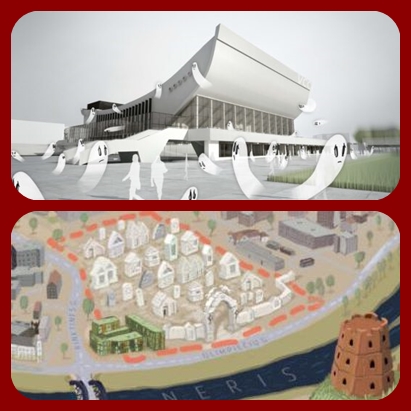
Look what you can see standing right by Vilnius’s Cathedral Square: The Soviet “Sports Palace” ruin that symbolizes not only antisemitism but also: Soviet/Russian Empire spiritual and political domination of Lithuania’s free spirit. High time to be rid of this carbuncle on the beautiful face of modern Vilnius?
◊
The first phase of the eradication of the Old Vilna Jewish Cemetery at Piramónt in Shnípishok — modern Šnipiškės — and of the people buried there, started back in 1830, contemporaneous with an uprising against the Russian Empire. The November Uprising, as it is now known, started with the will to resist the czarist government’s plans to send the army of Poland — at the time an autonomous kingdom within the Russian Empire — to Belgium and France, as well as with the dreams of restoring Polish independence. In 1831, seeing that the uprising for independence would soon take over Vilna, the Russian Imperial government expropriated a section of the Jewish cemetery by the bank of the Viliya (now Neris), and established an artillery citadel to keep the freedom-loving city at all times in the crosshairs of its cannon barrels. But even after the establishment of the citadel, more than three quarters of the actual graves (and their stoness or mini-mausoleums, oyhólim) remained untouched. This legendary cemetery is a Litvak pantheon, a monument to the civilization of Lithuanian Jewry. So it is meaningful that its first phase of destruction got underway just as the Russian imperial government’s project to enhance its military presence in Vilna, by making sure that the city’s inhabitants live in constant fear.

A small section of the Old Vilna Jewish Cemetery at Piramónt. The Soviet Sport Palace was built in its heart. All stones and inscriptions were trashed but thousands of graves survive on all four sides of the building, now an eyesore in the heart of modern Vilnius.
Updates on Kaunas’s ‘Capital of European Culture 2022’ Year Without (So Far) Removing a Single Shrine to Local Holocaust Collaborators
[latest update]
OPINION | LITVAK AFFAIRS | COLLABORATORS GLORIFIED | THE 2022 LEVINAS AFFAIR OF 2022
◊
Congratulations to the city of Kaunas, Lithuania, once known also as Kovno (in Yiddish forever: Kóvne) on its selection as Europe’s “Capital of European Culture” in 2022, sharing the title with Esch-sur-Alzette in Luxembourg. But as the midpoint of the city’s co-reign rapidly approaches, it is necessary, albeit sad, to have to note that not a single public-space glorification of local Holocaust collaborators had been removed. Zero. No city on the planet has as many monuments to local partners in the genocide of that city’s Jews. The 30,000 Litvaks (Lithuanian Jews) of Kaunas were brutally murdered, and the city played the primary role in the launch of the Lithuanian genocide on 23 June 1941, before the arrival of the first German forces. Thousands were murdered before the Germans arrived and/or set up their administration.
See Lev Golinkin’s updated 2022 catalogue in the Forward of public space shrines to Nazi collaborators worldwide
Lithuanian government authorities have reportedly invested large sums to lure “Useful Jewish Idiots” from the UK, US, Israel, and further afield to participate in “cultural events” intended to obfuscate and deflect from the primary issue: Why are the enablers of the slaughter of Kovno Jewry still honored by street names, plaques and university lecture halls and statues in the city? Local Jewish leaders who have dared to speak up have rapidly been smeared as “Putinists” for daring to criticize the far right’s hold over national history policy (and indeed, the need for such a policy to start with).
But in the waning days of 2021, a “waterfall of truth” began to cascade from an unanticipated quarter. Michael Levinas, son of the celebrated Lithuanian-Jewish born French philosopher Emanuel Levinas, forbade authorities to name a fancy new institute after his father. This was kept under wraps until his 21 Dec. Le Figaro opinion piece broke the story, and it was duly reported in Lithuania by LRT.lt. See Defending History’s media tracker page for background and updates.
In Honor of Fania Yocheles Brantsovsky (Brancovskaja) on her 100th Birthday (2022)
[LAST UPDATE]
by Dovid Katz
Compilation of articles, documentaries, videos, and photos. Plus: from the saga of 2008…
See Defending History’s Fania Yocheles Brantsovsky Section
Note: This page is a work in progress. A number of older documents, articles, photographs, and recordings remain to be digitized, catalogued, and posted.
◊
Are Leaders of Estonia, Latvia, Lithuania, Poland, Romania ‘Taking Advantage’ of Ukraine Tragedy? They Call on EU to Support Far-Right Holocaust-Obfuscating ‘Prague Platform’
Reports in Baltic Times and Delfi
For over a decade Defending History has exposed the far-right”Double Genocide” history-revisionist, Holocaust-obfuscating agenda of the “Prague Platform of European Memory and Conscience” which has repeatedly covered for East European efforts to glorify Nazi collaborators and perpetrators
“Putin’s criminal and barbaric invasion must be countered to the hilt and we must rally unfettered to the cause of Ukraine’s freedom. But for far-right double-genocider revisionists in the Eastern E.U. to take advantage of it for Holocaust obfuscation is just plain wrong.”
Simon Wiesenthal Center’s Efraim Zuroff is first to respond (in Times of Israel blogs)
Will Western leaders — and institutions dedicated to the history of the Holocaust and leaders in Holocaust education and commemoration — speak out and subject the “Prague Platform” to some long overdue scrutiny, and warn the European Commission about this “new initiative”? European citizens’ hard-earned euros continue to flow to the revisionists whose “unholy bible” is still the Prague Declaration of 2008… Defending History is proud to have helped provide the European parliamentary response, the Seventy Years Declaration…
Defending History’s statement on the war in Ukraine
☰
When Ottawa Citizen and The New York Times broke taboo on wartime discussion of East European state-sponsored Holocaust obfuscation
☰
But what is the “Prague Platform”?
The Nine Lives of Dónal Denham
BOOKS | IRELAND | NORWAY
◊
by Steinar Gil
My good friend and colleague for two and a half years in Vilnius, Dónal Denham, has written a book with the title Nine Lives: The Reflections of a Dedicated Diplomat
. The book is an interesting, fascinating read about an eventful career in the service of Ireland at home and abroad, enriched by an excellent selection of photos that add life and substance to the text. The author also draws a vivid picture of his early formative years in Ireland and England and student years at Trinity College. He writes warmly about his family, not avoiding the pain of personal losses, exacerbated by separation and distance. Diplomats from all countries would subscribe to his tribute to his wife Siobhan (“without whom nothing worthwhile would have happened to me”) who “as an unpaid ‘trailing spouse’ was a treasure beyond measure, largely unrecognized by officialdom.”
So, which are Dónal Denham’s nine diplomatic lives?
‘Morbid Memorandum’ (of AJC+LJC+GWF+Vilnius Mayor) Says Jews in Lithuania ‘Dying Out Altogether’ — While Allocating Millions for New ‘Community Center’ Building on Sacred ‘Great Synagogue Square’
OPINION | VILNA GREAT SYNAGOGUE | VILNIUS JEWISH LIFE
◊

VILNIUS—In the days following publication by Defending History of a report reacting to press releases about a (secret?) “memorandum” signed by the heads of the official “Lithuanian Jewish community” (LJC), the head of international affairs for the American Jewish Committee (AJC), the “Good Will Foundation” (GWF) and the Mayor of Vilnius, a number of conscience-stricken employees at LJC have been sending around copies of various versions of the memorandum, signed on 25 May, during the recent “Fifth Litvak Congress” here in Vilnius.
Update of 13 June 2022: One day following publication of this report, the “Good Will Foundation” published the signed English memorandum, using the wording “is now dying out altogether” to refer to today’s Jewish community in Lithuania, its hopes, and its dreams.
Uh-Oh, Here We Go Again: Secret Memorandum on Future of Vilna Great Synagogue Courtyard
OPINION | VILNA GREAT SYNAGOGUE
◊
◊
by Dovid Katz
◊
It has not been easy for our embattled team to keep Defending History going for over a dozen years now, based here in Vilnius. But as with other small but committed projects committed to speaking out for historic justice whomever it will please or displease, misconceptions can flourish. For example, this journal has indeed opposed the misuse of millions of Lithuanian citizens’ hard earned tax euros for campaigns to “equalize” for new generations (and today’s West) Nazi and Soviet crimes (the “Red-Brown” Commission); to target Holocaust survivors who joined the anti-Nazi resistance by smearing them as “war criminals” (state prosecutors); to establish as European heroes brutal participants in the Holocaust (the Genocide Center and Museum); efforts by government bodies (foreign ministry under some governments) to insist on European Union cave-in to the revised Baltic far-right historiography (note the Prague Declaration and DH’s response: the Seventy Years Declaration received personally a decade ago by the president of the European Parliament).
Another ‘Fake Litvak Congress’? Litvaks of Lithuania are Excluded on Orders of Election-coup ‘Pylimo 4 Bosses’; Photo-op Foreigners In Town for Gov. Hosted Event
OPINION | LITVAK AFFAIRS | WHAT DO FAKE LITVAK GAMES LOOK LIKE? | VILNIUS JEWISH COMMUNITY’S STRUGGLE FOR JUSTICE | (AB)USE OF JEWISH EVENTS FOR HOLOCAUST REVISIONISM | WHEN GOV. MINISTRIES MEDDLE IN FRAGILE MINORITY CULTURE (& HISTORY DEBATES) | LITHUANIA
◊
by Dovid Katz
◊
Most Lithuanian government officials in diverse branches of its democratic government, including so many in its Culture and Education ministries, its local museums and libraries, its schools and cultural centers, have a warm and healthy attitude toward both the historic weight and tragic fate of the nation’s Jewish minority. This is important to keep in mind as we come yet again to provide a voice for the voiceless: the manipulation of the fragile Litvak and Yiddish culture, of the last survivors and their families, and of Holocaust history by some small and lavishly financed “Jewish fix-it units” including the Genocide Center, Genocide Museum, Red-Brown Commission, and a scattering of “Jewish, Yiddish and Litvak” centers in central Vilnius, a good part of which exclude from all professional participation people — including top specialists in the relevant field — who dare disagree with state revisionism on the Holocaust. In some cases, this policy brings about the succeeding phase of “Jewish” addresses without a single Jewish member of staff (think African American Cultural Center in Alabama, staffed by pure lily-whites who won’t mess up and peradventure say something contrary to local “patriotic” history-book narratives demanded by nationalists).
Even as the civilized world joins in condemning the barbaric, medieval Putinist invasion of peaceful Ukraine, and unites to embrace its people, and the freedom and simple peace they seek, the Lithuanian Seimas (parliament), is hosting the grand opening of the latest “Litvak Congress” (program here and here), at which none of Lithuania’s great Litvak achievers of recent years, have been invited to speak, or in most cases to even attend. They are being cancelled during their lifetime. The list is long. Just a few examples: Genrich Agranovski, Anna Avidan, Chaim Bargman, Roza Bieliauskienė, Ruta Bloshtein, Fania Yocheles Brantsovsky (Brancovskaja), Dalija Epšteinaitė, Prof. Pinchos Fridberg, Simon Gurevich (Simonas Gurevičius), Irina Guzenberg, Elen Janovskaja, Regina Kopilevich, Arkady Kurliandchik, Polina Pailis, Prof. Josif Parasonis, and (now in retirement in Berlin) Rachel Kostanian. These and others have made empirically demonstrable and durable contributions to the Litvak heritage and its documentation and perpetuation well into the future, and have valiantly and selflessly fought for Litvak causes, a category in which defense of history is a cause as paramount as any.
Is Walking Down a Street Named for a Murderer Now Considered ‘Holocaust Remembrance’?
Opinion | Collaborators Glorified | Antanas Baltūsis-Žvejas | Politics of Memory | Lithuania | History
◊
by Evaldas Balčiūnas
◊

Just another street name in a pleasant part of Kaunas, this year’s Capital of European Culture? Author thinks that “Kaunas and its people deserve better”…
◊
Antanas Baltūsis-Žvejas (1915–1948) is remembered by the Republic of Lithuania for his anti-Soviet guerilla activities after the war but without regard for the three separate periods of his activity in service to Nazi activities to exterminate the Jewish people. He did indeed join the anti-Soviet partisan resistance movement in the spring of 1945. And, before his death, he did become the head of its Tauras County unit. Those who heroize this period of his activities emphasize his efforts in establishing military discipline and order in the county. His critics, in turn, are more likely to make reference to his order to the Žalgiris Detachment, subordinate to the Tauras County, to annihilate Russian (Soviet) civilian settlers (“colonists”) in Opšrūtai, who had been transferred to Lithuania according to the Soviet-Nazi repatriation agreement (often with little or no input from these folks themselves). Thirty-one persons perished in Opšrūtai, including fourteen children. In the partisans’ descriptions of the battle, it is easy to notice that their task was to eradicate all colonists, including children. Those who justify the atrocity against civilians, including children, say that it was necessary to thwart the russification of Lithuania.
Lithuania’s policy of historical memory was quite straightforward on this issue: it built a monument to the partisans of the Žalgiris Detachment in Opšrūtai. Ethnic cleansing of Jews, if done by “our own nationalist heroes” in Lithuania, is still seen, it seems, as acceptable.
Subtle Art of State Antisemitism ― East European Style (with ubiquitous nod to glorification of Holocaust collaborators)
OPINION | LITVAK AFFAIRS | (AB)USE OF JEWISH STUDIES FOR HISTORICAL REVISIONISM | YIDDISH AFFAIRS | YIVO IN LITHUANIA | MEDIA WATCH | FOREIGN MINISTRIES AND JUDAIC STUDIES | COLLABORATORS GLORIFIED | NOREIKA GLORIFIED
◊
by Julius Norwilla (Vilnius)
◊
On the 4th of April 2022, the website of our Ministry of Foreign Affairs published a news item titled (in Lithuanian, here translated) “Lithuania will expand cooperation with Yivo Jewish Research Institute, preserving and publicizing Lithuanian Jewish history” (as PDF). The site’s English language section uses the headline wording “Lithuania to expand cooperation with Yivo Institute for Jewish Research to protect and promote the history and heritage of Lithuanian Jews” (as PDF).
The news article contains information about the visit of the esteemed American scholar, Dr. Jonathan Brent, the executive director and CEO of the Yivo Institute for Jewish Research in New York, also a famed educator and academic publisher, with his colleagues, and their meeting with the deputy foreign minister. The news item appears intent on communicating to the world how much our country’s Ministry of Foreign Affairs cares about its Jewish and Yiddish legacy and how sensitive it is to the history of Lithuanian Jewry.
Both the Lithuanian and English versions are illustrated with a three-photo gallery portraying three scenes of the meeting: shaking hands at the welcome, a moment at the meeting table and the final with those at the meeting posing for the official photo-op.
Everything seems to be done according to the usual protocols of such meetings, at which the professional photographer takes numerous photos from start to finish, culminating with the final photo-op. Then the few dozen shots are whittled down to the most informative and appropriate handful for publication. The ones that make the point best. Elementary.
Dr. Bubnys’s New Book on the Lithuanian Holocaust: More Obfuscation and Far-Right History-Spin to Minimize Local Participation?
Opinion | Books | Dr. Bubnys & Official State Holocaust Research in Lithuania | Red-Brown Commission | Genocide Center | Politics of Memory | Lithuania | History
◊
by Evaldas Balčiūnas
◊
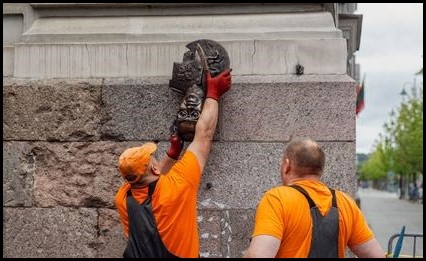
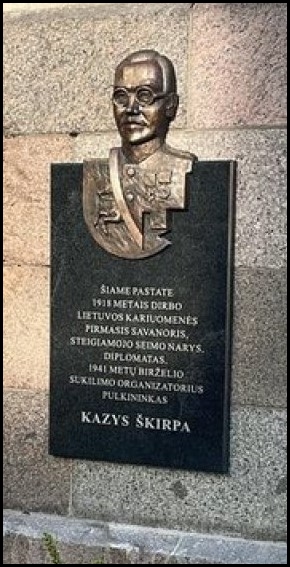
Prolific historian, director of the state’s Genocide Center, and far-right activist. On 23 June 2020, Dr. Arūnas Bubnys addressed an ultranationalist rally celebrating the 79th anniversary of Hitler’s invasion (and onset of the Lithuanian Holocaust), flanked by large posters of Jonas Noreika and Kazys Škirpa, two major collaborators in various phases of the genocide of Lithuanian Jewry (96.4% were killed). In his speech he taunted the (silent) DH observers on hand. See reports here and here, and DH’s section on Dr. Bubnys’s work and positions over the years.
◊
Arūnas Bubnys’s book The Holocaust in the Lithuanian Provinces (Holokaustas Lietuvos provincijoje, Margi
raštai, Vilnius, 2021) is another publication of the International Commission for the Evaluation of the Crimes of the Nazi and Soviet Occupation Regimes in Lithuania (ICECNSORL). Up until now, books published by the Commission were academically written and appreciated by a sophisticated readership. Moreover, they were always published in both Lithuanian and English. This book is different. It is available only in Lithuanian. Previously published monographs would also include Commission-approved conclusions; this book has no such thing. As far as I have been able to ascertain, the Commission’s academics did not discuss the book among themselves before its publication. But let’s start at the beginning.
The book is geographically quite extensive: 23 counties and 140 towns are cited. This is really a lot, but it is also quite obvious that the coverage of towns in different counties is unequal. When it comes to Šilutė county in western Lithuania, for example, several camps and fates of individual Jews are mentioned in passing, but no single town is described. For the Marijampolė county, only the fate of the Jews of Marijampolė itself is presented. Šiauliai xounty (15 towns) and Alytus County (12 towns) are the most extensively covered.
New York Jewish Museum: Latest to be Duped into “Legitimizing” Lithuanian Far-Right Holocaust Revisionism?
MUSEUMS | JEWISH EVENTS ABUSED TO MAKE “KOSHER” HOLOCAUST REVISIONISM | POLITICS OF MEMORY | COLLABORATORS WHITEWASHED
◊