


History
Protected: Let Us Together Restore the Last Jewish Anti-Nazi Partisan Fort in Lithuania
Posted in Germany, Gert Weisskirchen, History, Lithuania, Litvak Affairs, News & Views, Opinion, Politics of Memory, Remnants of Europe's Last Jewish Anti-Nazi Partisan Fort
Tagged Fania Yocheles Brantsovsky, German 45th Brigade in Lithuania, Gert Weisskirchen, Litauenbrigade
Comments Off on Protected: Let Us Together Restore the Last Jewish Anti-Nazi Partisan Fort in Lithuania
The Split Image of the Holocaust
HISTORY
◊
OPINION
◊
by Roland Binet (De Panne, Belgium)
◊
The Holocaust was a unique phenomenon. But its perception is double-faceted, to some degree, in the eyes of some Jews and non-Jews alike, hence my use of the term “split image” to describe the phenomenon.
In July 2010, I was in Paris with David Silberman, Latvian author of И Ты Это Видел, a book of testimony and accounts by Jews mainly from Latvia, originally written in Russian and which we together worked on getting published in French. We met Serge Klarsfeld, the well-known French historian and Holocaust authority in France, also a Nazi-hunter. He succeeded in bringing Klaus Barbie, among others, to trial.
I had noticed he held a copy of a book he had just purchased: The Black Book by Ehrenburg and Grossman. So, I surmised that he wanted to learn about the Holocaust in the Soviet republics. I understood quite well his dilemma because, although I had begun to learn about the Holocaust at the beginning of the 1970s, to me, until September 2009, my only iconic representation of the Holocaust was situated at Auschwitz-Birkenau, which I had already visited twice in 1982 and 2006, its symbols having been the gas chambers and the crematoria.
Posted in History, News & Views, Roland Binet
Tagged Einsatzgruppen: Les commandos de la mor, Emmanuel Ringelblum, Holocaust in the Soviet Union, Roland Binet, Yitzhak Rudashevski
Comments Off on The Split Image of the Holocaust
Books in the Debate (a DefendingHistory.com selection)
[last update]
◊
see also: BOOKS SECTION
◊
Not yet published:
Michael Shafir, Competitive Martyrdom [working title].
Draft manuscript of the book circulated to colleagues (for comments and criticism) before the author’s sudden death in 2022. See Defending History’s Michael Shafir section. It is hoped that Professor Shafir’s heirs will enable rapid publication of this major and indispensable work in the field.
2025
Saulius Sužiedėlis,
Reactions, reviews, and citations:
Roland Binet: Autopsy of the Annihilation of Lithuanian Jewry. Or: How to Subtly Rewrite History
Clemens Heni: Mit Kojak gegen die Rot=Braun-Ideologie
Posted in Books, History, Lithuania, Litvak Affairs, News & Views, Rūta Vanagaitė
Tagged Alexander Gendler (Khurbn), Dan Rabinowitz, Holocaust in Lithuania, Jonas Noreika, Leyb Koniuchowsky & Jonathan Boyarin, Nazi's Grnddaughter, Ruta Vanagaite & Christoph Dieckmann, Ruta Vanagaite + Efraim Zuroff, Saulius Suziedelis, Silvia Foti
Comments Off on Books in the Debate (a DefendingHistory.com selection)
The Prague Declaration and the Double Genocide Theory
PRAGUE DECLARATION | DOUBLE GENOCIDE | HISTORY | LITHUANIA
◊
OPINION
◊
by Roland Binet (De Panne, Belgium)
◊
In his book Crisis, War and the Holocaust in Lithuania, which I recently reviewed on these pages, historian Saulius Sužiedėlis virulently attacked those who in the past had opposed the Prague Declaration of 2008. When I read the list of signatories to the Prague Declaration signed in 2008, it makes me think of prisoners or detainees becoming free after having spent 45 years between four closed walls.
Getting free in the outside world and knowing next to nothing that has happened in the world at large during their detention. Most of these signatories, people of esteem, some of them heroes in their fight against Communist yoke, have suffered greatly and they yearn for recognition as victims of totalitarian crimes. But the only tangible contemporary phenomenon with some kind of kindred inhuman similitude they want to equate it with is — the Holocaust. So, oblivious to the manifold scourges the twentieth century has known worldwide, they signed on to the conclusion that “both the Nazi and Communist totalitarian regimes should be considered to be the main disasters, which blighted the 20th century” and “recognition of Communism as an integral and common part of Europe’s common history.” The declaration contains the word “same” five times, in support of the declaration’s underlying thesis that Nazi and Soviet crimes are absolutely — the same.
Is it possible to be so self-centered on one’s suffering as to become blind to history?
Posted in Double Genocide: The New Form of Holocaust Revisionism & Denial, History, News & Views, Opinion, Politics of Memory, Prague "Platform", Roland Binet
Tagged Double Genocide, Prague Declaration (2008), Roland Binet
Comments Off on The Prague Declaration and the Double Genocide Theory
Autopsy of the Annihilation of Lithuanian Jewry. Or: How to Subtly Rewrite History
BOOKS | BOOKS IN THE DEBATE | LITHUANIA
REVIEW ARTICLE
by Roland Binet (De Panne, Belgium)
◊
◊
Human feelings are now as candles without wick burning from inside.
(from a poem by Avrom Sutzkever, a tribute to Yiddish teacher Yankev Gershtein who perished in the Vilna Ghetto on September 27, 1942 (quote from Rudashevski’s Diary)
◊
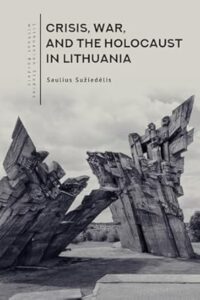 Professor emeritus Saulius Sužiedėlis of Millersville University of Pennsylvania begins this major new book by characterizing its long and productive journey. “This study is the result of years of interaction with historians, journalists, and writers from Lithuania, Latvia, Estonia, the United States, Poland, Germany, the United Kingdom, and Israel. Inspiration and encouragement emerged from discussions among the eleven-member Sub-Commission on Nazi Crimes, part of the Commission for the Evaluation of the Crimes of the Nazi and Soviet Occupation Regimes in Lithuania” (p. vii). Sužiedėlis’s opus on the Jews in Lithuania and their almost complete disappearance during the war years is a meticulously researched, coherently chronicled and impressively documented opus, tackling many themes, issues and problems with a staggering abundance of facts, figures, quotes, opinions, and anecdotes. Chunks of it read almost like an autopsy report on places and massacres rather than on an individual’s remains. I find it overall to be an exceptional, very well written, and significant contribution.
Posted in "Red-Brown Commission", Books, History, Lithuania, Litvak Affairs, News & Views, Roland Binet
Tagged Andrius Kulikauskas, Crisis War and the Holocaust, Efraim Zuroff, Evaldas Balciunas, Holocaust in Lithuania, International Commission for the Evaluation, Milan Chersonski, Omer Bartov, Prague Declaration, Red-Brown Commission, Roland Binet, Saulius Berzinis, Saulius Suziedelis, Seventy Years Declaration, Shimon Alperovich (Simonas Alperavicius), Yitzhak Arad
Comments Off on Autopsy of the Annihilation of Lithuanian Jewry. Or: How to Subtly Rewrite History
The Australian who Warned of the Holocaust and was Executed by Fascists
HISTORY | AUSTRALIA
◊
by Michael Samaras
◊
Ted Dickinson was one of the most remarkable of the International Brigaders, those prescient individuals who fought the fascist forces of Franco, Hitler and Mussolini in the Spanish Civil War. He was born in England and as a child migrated with his family to Australia. At 20, he joined the politically radical Industrial Workers of the World and became one of its leading identities. He was physically impressive, with brown hair, blue eyes, and was described as “strikingly handsome” with a carriage as “straight as a ramrod”.
In 1928, as the economy worsened, Dickinson, with his friend Jim McNeill, campaigned for a better deal for the unemployed and led marches, protests and anti-eviction actions. The pair started a newspaper, Direct Action, and it was because of its radical articles that Dickinson was charged with sedition and imprisoned for six months.
Posted in Australia, History, Michael Samaras, News & Views
Tagged Jim McNeill, Michael Samaras, Spanish Civil War, Ted Dickinson, Tommy Bloomfield
Comments Off on The Australian who Warned of the Holocaust and was Executed by Fascists
Prof. Girnius Tries Again to Glorify the LAF that in 1941 Killed Thousands of Jewish Neighbors, Unleashing the Lithuanian Holocaust
OPINION | LEGACY OF 23 JUNE 1941 | 2011 ATTEMPTS TO SANITIZE THE LAF | LAF’S INTENTIONS IN WRITING | ŠKIRPA’S PLANS | COLLABORATORS GLORIFIED | LITHUANIAN JEWISH AFFAIRS | CHRISTIAN-JEWISH RELATIONS
◊
OPINION
◊
The eminent Harvard and Univ. of Chicago educated American-Lithuanian professor and public affairs analyst, Kęstutis Girnius, tried a decade and a half ago to mobilize support for a far-right inspired dry-clean of the “Lithuanian Activist Front” (LAF, Lietuvių aktyvistų frontas, “white armbanders”) which was the 1941 organization that did not shoot a rabbit when the Soviets were in power (1940-1941) but began to murder thousands of innocent Jewish neighbors the moment the Soviet army started its panicked flight eastward, and there was no authority to stop them. Hitler’s local henchmen declared an “independence” that included the oath of loyalty to Adolf Hitler, the commitment to rid Lithuania of all its Jews, and the unleashing of barbaric murder before the Germans even arrived or set up their control. Any true friend of Lithuania will understand that this is the kind of pro-fascist revisionism that beautiful, modern, tolerant, democratic Lithuania needs like a hole in the head.
Girnius’s gushing public announcement of the new initiative to whitewash the LAF was announced in an article in Delfi.lt this week, heralding the formation of a group of Conservative (Homeland Union party) members of parliament who are forming a “collegium” for this task. If that’s correct, it would, in one fell swoop, undermine the magnificent contributions of so many great truth-telling Lithuanian ethicists of the past three and a half decades, including Vytenis Povilas Andriukaitis, Evaldas Balčiūnas, Saulius Beržinis, Aleksandras Bosas, Valentinas Brandišauskas, Algirdas Brazauskas, Leonidas Donskis, Silvia Foti, Andrius Kulikauskas, Liudas Truska, Rūta Vanagaitė, Nida Vasiliauskaitė, Tomas Venclova, Linas Vildžiūnas, and numerous others.
Posted in Celebrations of Fascism, Christian-Jewish Issues, Collaborators Glorified, Dovid Katz, History, Legacy of 23 June 1941, Lithuania, Litvak Affairs, News & Views, Opinion, Politics of Memory
Tagged Aleksandras Bosas, Algirdas Brazauskas, Andrius Kulikauskas, Dovid Katz, Glorification of Holocaust collaborators (Lithuania), Holocaust in Lithuania, June 1941 Uprising, Kestutis Girnius, LAF (Lithuanian Activist Front), Leonidas Donskis, Linaz Vildziunas, Lithuania's June 1941 uprising, Liudas Truska, Ruta Vanagaite, Silvia Foti, Tomas Venclova, Valentinas Brandisauskas, Vytenis Andriukaitis
Comments Off on Prof. Girnius Tries Again to Glorify the LAF that in 1941 Killed Thousands of Jewish Neighbors, Unleashing the Lithuanian Holocaust
Full Translation of Jan.-Feb. 2025 Email Blast Defaming Fania Yocheles Brantsovsky with Links to Massive Online Defamation
FANIA YOCHELES BRANTSOVSKY | BLAMING THE VICTIMS | ANTISEMITISM | LITHUANIA | LITVAK AFFAIRS
◊
The following is a full translation of the recent email blast published in Defending History in the original Lithuanian on 31 Jan. For background see the English introduction there, as well as reports and discussion on the DH editor’s Facebook page. For a full chronology of the now nineteen year old campaign against Holocaust survivors who survived by joining the anti-Nazi resistance see DH’s Blaming the Victims page. Obersvers have noted that the German teacher recruited to launch the campaign of defamation against Fania Yocheles Brantsovsky (Brancovskaja) and Dr. Rokhl (Rachel) Margolis, I. Tumavičiūtė in a January 2008 article in a far-right antisemitic daily (original; English translation) reappears this week as the campaign, apparently including the Genocide Center (GRRLC) and its director, is duly relaunched. Note the text contains the link to the online clip from a Soviet-era documentary where Fania Brantsovsky’s remarks about regrettable civilian casualties during the partisans’ battles against the Nazis in the forests of Lithuania is maliciously taken out of context to imply targeting of civilians and/or her own participation in the battle described. The youtube video clip, that has been up for seven years is entitled “isgama branvcovskaja” that translates as “The Degenerate Brantsovsky” or “Scum Brantsovsky.” More background of “polite” state support for the defamation of Holocaust Survivors who joined the anti-Nazi resistance includes the public statement for a video documentary by the executive director of the state-sponsored “Red-Brown Commission” (officially “The International Commission for the Evaluation of the Crimes of the Nazi and Soviet Occupational Regimes in Lithuania”). The participation of the state-sponsored Genocide Center in this week’s events is apparently meant to give the new campaign an air of legitimacy, during a time of much-heightened antisemitic sentiment.
◊
https://www.genocid.lt/centras/lt/4535/a/
COMMEMORATION of Kaniūkai Village Residents, Murdered by Soviet Partisans in 1944
February 2, 2025
10:30 AM – Holy Mass at St. Ignatius Church (Vilnius)
11:30 AM – Departure for Kaniūkai village cemetery (Šalčininkai district) after the Holy Mass
2:00 PM – Start of the commemoration event
Participants:
Dr. Arūnas Bubnys, General Director of GRRCL
Posted in A 21st Century Campaign Against Lithuanian Holocaust Survivors?, Documents, Fania Yocheles Brantsovsky (Fania Brancovskaja): 1922-2024, History, Human Rights, Lithuania, Litvak Affairs, Museums, News & Views, Politics of Memory
Tagged Dr. Arunas Bubnys, Fania Brancovskaja, Fania Yocheles Brantsovsky, Kaniukai
Comments Off on Full Translation of Jan.-Feb. 2025 Email Blast Defaming Fania Yocheles Brantsovsky with Links to Massive Online Defamation
The German Army and People During the Holocaust: So What Were They Thinking?
OPINION | HISTORY
◊
by Roland Binet (De Panne, Belgium)
◊
- In that town, I spied in the debris
- The thorn fragment of a parchment scroll
- And gently brushed away the dirt to see
- What tale it told.
- Written on it was “In a strange land” —
- Just a few words from the Bible, but the sum
- Of all one needs to understand
- Of a pogrom.
(by Z. Jabotinsky, following the Berdichev pogrom, from Jabotinsky. A Life by Hillel Halkin, Yale University Press, 2014)
◊
You are from Hashomer Hatsair? Mordecai asked me. Yes, I still remember the Zionists from Vienna.” Surprisingly the man who asked Chaika Grossman the question was an Austrian, officer in the Wehrmacht, stationed in Vilna (now Vilnius, Lithuania), who later was captured and killed by the Nazis because, as Grossman remembered, he was
“a tall officer, Schmidt, who served in the Vilna occupation army (…) He headed a collection station for soldiers who had lost their units. Cars and all kinds of papers were at his disposal. In short, the officer began a rescue operation.”
(from The Underground Army – Fighters of the Bialystok Ghetto, by Chaika Grossman, Holocaust Library, New York, 1987; she survived the war, emigrated to Israel and became a member of the Knesset)
So, one Wehrmacht officer who helped the Jews living underground outside the Vilna Ghetto. Is this enough to redeem the honor of Germany and Austria? Is this even worth mentioning at all when focusing not on individual heroism but on the bigger picture of what it is that happened?
I have long believed in the collective guilt of the German and Austrian nations in the perpetration of the Holocaust. That is my opinion.
Posted in History, News & Views, Roland Binet
Tagged German army and the Holocaust, Raul Hilberg, Roland Binet, Wehrmact and the Holocaust
Comments Off on The German Army and People During the Holocaust: So What Were They Thinking?
Flanders and the Remembrance of the Victims of the German Wars of Aggression Against Belgium
OPINION | HISTORY | BELGIUM | MUSEUMS
◊
by Roland Binet (De Panne, Belgium)
◊
A few days ago I was flabbergasted when I read a news item in the FOCUS website for West-Flanders where I live. On Saturday, August 24, 2024, in Zeebrugge there had been a commemoration ceremony for the crews of two German submarines (U-5 and UC-14) sunk during World War I and just recently identified. This official commemoration ceremony took place in the presence of the German ambassador Martin Kotthaus and the Governor for West-Flanders Carl Decaluwé: “More than one hundred years ago, the crews of these two submarines died in the middle of a horrible war. I am very grateful that today we can grieve for the dead together as friends and partners,” declared the current German ambassador.
It is perhaps interesting to remind readers that in the past Flanders had already made a wrong choice regarding the only illustration for World War I within the ‘Flemish Canon’ (see my article, “Wrong Choice for New “Flemish Canon”). On that occasion, the choice was of a statue of a grieving couple situated in the German military cemetery of Vladslo in Flanders, a couple grieving for their slain son Peter, a German soldier who had died while his regiment attacked Ypres in October 1914, just when the danger of the whole of Belgium being overrun by the German army had been at its highest.
Posted in Belgium, History, Museums, News & Views, Opinion, Roland Binet
Tagged Flanders and Nazism, Flanders and World War II, Memory of both world wars in Belgium, Memory of WWI and WWII in Flanders, politics of remembrance in Flanders, Roland Binet
Comments Off on Flanders and the Remembrance of the Victims of the German Wars of Aggression Against Belgium
Dying a Thousand Deaths: Holocaust Survivors in the Eastern Lands Taken by Hitler in 1941
OPINION | HISTORY | LATVIA
◊
by Roland Binet (De Panne, Belgium)
◊
Simon Wiesenthal recounted that he escaped the threat of imminent death seven times as a slave and captive of the Nazis during World War II. Frida Michelson, a Latvian Jew from Riga, escaped an imminent death when on December 8, 1941, moments before she would have been ordered into a grave to be shot in Rumbula, she threw herself on the ground in the snow and pretended to be dead. She was saved by the fact that hundreds of pairs of shoes were piled on her body covering her from the eyes of the murderers, who did not discover her. Otherwise, she would not have told her story to David Silberman.[1]
Posted in Books, Film, History, Latvia, News & Views, Roland Binet
Tagged David Silberman, Frida Michelson, Holocaust in Latvia, Mitchell Lieber, Mitja Michelson, Rumbula, Rumbula’s Echo, Simon Wiesenthal
Comments Off on Dying a Thousand Deaths: Holocaust Survivors in the Eastern Lands Taken by Hitler in 1941
Ukraine Needs the Vilnius Red-Brown Commission’s ‘Help’ Like a Hole in the Head
OPINION | RED-BROWN COMMISSION: PAGE AND SECTION
◊
by Dovid Katz
The sacred cause of democratic Ukraine’s success and brutal dictator Putin’s failure must not be comprised by attempted hijacks by far-right Holocaust revisionists who have worked for decades to rewrite the history into “two equal Holocausts” (“Double Genocide”), an insidious form of revisionism whose first corollary is glorification of local Holocaust collaborators and perpetrators (whether Noreika in Lithuania or Bandera in Ukraine, among numerous others). It is alarming to read this week (on the website of the Lithuanian Foreign Ministry) that Lithuania’s state-sponsored “Commission for the Evaluation of Crimes of the Nazi and Soviet Occupational Regimes in Lithuania” (for short: “the Red-Brown Commission”), the cause of so much pain to the last Holocaust survivors and the remnants of Lithuanian Jewry, is now interloping in Kyiv, attempting to insinuate Double Genocide Holocaust revisionism right into the current noble struggle of the free states of NATO and the European Union to ensure the future of free and democratic Ukraine. Resignations over the years from the “Red-Brown Commission” (all on matters of principle) include Sir Martin Gilbert, Professor Konrad Kwiet and Professor Dov Levin.
Posted in "Red-Brown Commission", Double Genocide: The New Form of Holocaust Revisionism & Denial, History, Lithuania, News & Views, Opinion, Politics of Memory
Tagged Clemens Heni, Commission on Nazi and Soviet Crimes, International Commission for the Evaluation of the Crimes, Leonidas Donskis, Michael Shafir, Red-Brown Commission, Ronaldas Racinskas, Simon Butt, Sir MartinGilbert, Ukraine & Holocaust history, Vytenis Andriukaitis, Yehuda Bauer
Comments Off on Ukraine Needs the Vilnius Red-Brown Commission’s ‘Help’ Like a Hole in the Head
The European Journey of Belgium’s Roland Binet: Warsaw to Rumbula (near Riga) and Ponár (near Vilnius)
MEMOIRS | OPINION | HISTORY | BELGIUM
◊
by Roland Binet (De Panne, Belgium)
◊
Until the age of seventeen I did not know at all that there were Jews. Following from that, I had moreover never heard anything of what happened to the Jews during World War II. My awakening came one evening in the fall of 1962.
I saw Frédéric Rossif’s documentary on the Warsaw Ghetto, Le Temps du Ghetto (‘The Time of the Ghetto’). I came away devastated, particularly shocked by the scenes of the starving children begging in the streets and by the “morning collection” of nude bodies picked up from the pavements and streets of Warsaw and transported by wheelbarrows and carts to a mass grave where the bodies were dumped without any respect. The images were at once revolting and unforgettable.
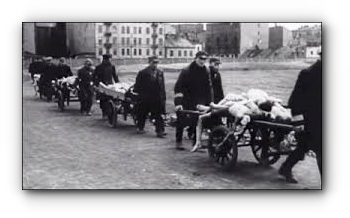
Screenshot from my ‘first shock’: Frédéric Rossif’s documentary on the Warsaw Ghetto, Le Temps du Ghetto (‘The Time of the Ghetto’)
Posted in Belgium, History, Latvia, Lithuania, Memoirs, Music, News & Views, Opinion, Politics of Memory, Roland Binet
Tagged Holocaust in Latvia, Paneriai, Ponár (Ponary, Roland Binet, Rumbula
Comments Off on The European Journey of Belgium’s Roland Binet: Warsaw to Rumbula (near Riga) and Ponár (near Vilnius)
We Honor Fania Yocheles Brantsovsky (Brancovskaja) on her 102nd Birthday in Vilnius
by Dovid Katz
◊
Compilation of articles, documentaries, videos, and photos. Plus: from the saga of 2008…
See Defending History’s Fania Yocheles Brantsovsky Section
Update: See now the Following Fania project
Note: This page is a work in progress. A number of older documents, articles, photographs, and recordings remain to be digitized, catalogued, and posted.
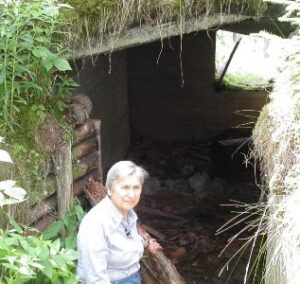
Fania Yocheles Brantsovsky: “My last wish is that the Jewish Partisan Fort, where we lived, loved and fought the Nazis in the forests of Lithuania, be preserved and restored so future generations will know of our resistance against genocide, and so we honor all those who fell fighting for the freedom of all of us.”
Posted in A 21st Century Campaign Against Lithuanian Holocaust Survivors?, Events, Fania Yocheles Brantsovsky (Fania Brancovskaja): 1922-2024, History, Lithuania, Litvak Affairs, News & Views
Tagged Fania Brancovskaja, Fania Yocheles Brantsovsky, Following Fania, Following Fania + Yiddish, Prosecution of Holocaust survivors, Vilna Jewish partisans
Comments Off on We Honor Fania Yocheles Brantsovsky (Brancovskaja) on her 102nd Birthday in Vilnius
B’nai B’rith Australia & New Zealand Issues Press Release on Saulius Beržinis Award
FILM | SAULIUS BERŽINIS | SHEDUVA | BOLD CITIZENS
◊
VILNIUS—B’nai B’rith Australia & New Zealand today issued the following press release accompanying its lifetime achievement award earlier this month to Lithuanian filmmaker Saulius Beržinis (see also DH’s report on the dramatic saga in the background).
Posted in Arts, Australia, Bold Citizens Speak Out, Film, History, Lithuania, Litvak Affairs, News & Views, Politics of Memory, Saulius Beržinis, Šeduva (Sheduva, Shádeve, Shádov) and its "Museum of the Lost Shtetl"
Tagged Holocaust in Lithuania, Petrified Time (Holocaust), Saulius Berzinis, Sheduva (Seduva)
Comments Off on B’nai B’rith Australia & New Zealand Issues Press Release on Saulius Beržinis Award
Wrong Choice for the New “Flemish Canon” in Flanders Region of Belgium
OPINION | HISTORY | BELGIUM | EU
◊
by Roland Binet (De Panne, Belgium)
◊
A few weeks ago my wife and I visited a number of British Commonwealth military cemeteries from World War I in Belgium’s Ypres area, which is in western Flanders, the Dutch-speaking region in the north of Belgium. Starting in October 1914, Ypres had been attacked by considerable German forces but held its ground and remained part of the Allies’ front line until November 1917 when the line was joined by Anzac and Canadian soldiers, going on to reach Passendale, thus breaching the German army’s hold on the Ypres Salient in the west of Belgium.
I always feel a deep admiration for all those young men, the young privates as well as their officers who were sometimes much older. I come to see there graves in these Commonwealth military cemeteries. They were young men who came from New Zealand, Canada, Australia, South Africa, Wales, Ireland and Northern Ireland, England, and Scotland. They also came from India and Nepal and fought here in Belgium as volunteers, career soldiers or conscripted troops, to defend “brave little Belgium.” In Western Flanders, there are hundreds of such cemeteries where courageous men were laid to rest in what has been poetically termed “Flanders’ Fields,” a place that is forever British, with places of worship and by way of a common memory.
Posted in Belgium, EU, History, News & Views, Opinion, Roland Binet
Tagged “Treurend ouderpaar” (Grieving Parents), Emmanuel Gerard, Flemish Canon, Käthe Kollwitz, Roland Binet
Comments Off on Wrong Choice for the New “Flemish Canon” in Flanders Region of Belgium
Notes and Updates on Silvia Foti’s ‘The Nazi’s Granddaughter: How I Discovered My Grandfather was a War Criminal’
[LATEST UPDATES]
Silvia Foti: The Nazi’s Granddaughter: How I Discovered My Grandfather was a War Criminal
UPDATE OF JULY 2023: NOREIKA PLAQUE COMES DOWN FOR NATO CONFERENCE. FOR HOW LONG?
UPDATE OF JULY 2022: Foti’s The Nazi’s Granddaughter is reissued with the new title Storm in the Land of Rain
UPDATE OF MAY 2022:
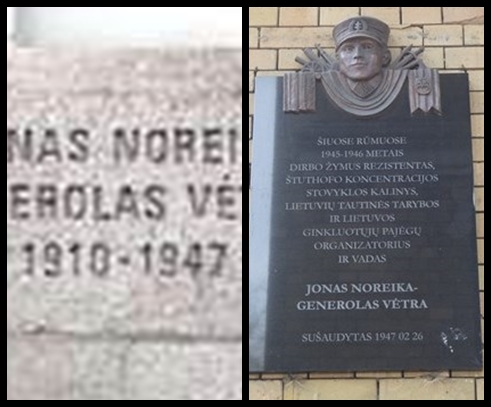 Sylvia Foti’s major new book is widely available in English and Lithuanian, among other languages. QUESTION: Why is the center of Vilnius still blighted by an upgraded plaque & bas-relief (right) and a central boulevard marble slab glorifying Hitler collaborator Jonas Noreika, who masterminded the death of thousands of Jews, and touted his unadulterated hate for Jewish fellow citizens in a prewar book? Why do Western diplomats, and most visiting American, British and Israeli Jewish dignitaries feel obliged to avoid even the most polite critique of these prominent carbuncles on the face of the European Union? Surely, a true friend of Lithuania would want the best for Lithuania and its international stature, even if a small far-right “history rewriting elite” might feel offended.
Posted in Books, Collaborators Glorified, History, Lithuania, News & Views
Tagged Holocaust in Lithuania, Jonas Noreika, Silvia Foti, The Nazi's Granddaughter
Comments Off on Notes and Updates on Silvia Foti’s ‘The Nazi’s Granddaughter: How I Discovered My Grandfather was a War Criminal’
Garliava, Lithuania: On the Town’s Holocaust Mass Grave and its Old Jewish Cemetery
CEMETERIES AND MASS GRAVES | POLITICS OF MEMORY | LITVAK AFFAIRS
◊
by Julius Norwilla
◊
The Holocaust Mass Grave Site
The best way to reach the mass killing site in Garliava (Yiddish Gúdleve, Polish Godlewo), is to take a train from the central train station in Kaunas. It is just one stop. The railway runs south, through a picturesque valley of the languid river Jiesia. Garliava is a township historically in the Suwałki region. It is named after an ancient landlord and noble family Godlewski. It seems that twentieth century ethnic purity zealots renamed the township into Garliava to sever any obvious link to the personage commemorated by the town’s naming, thereby reducing the historical chronicle of the entire region to a narrow and assertively ethnonationalist narrative
When you step out of the old railway station in Garliava, the town itself is still one kilometer away. The train line and the station were built in 1862, and one can wonder, what the point was, with the then cutting-edge train technology of the time, to make a long detour around the town and build the station somewhere in the middle of the fields, or as one might put it, right in the middle of nowhere?
Posted in Defense of Old Jewish Cemeteries and Mass Grave Sites, History, Julius Norwilla, Lithuania, Litvak Affairs, News & Views
Tagged Garliava, Godlewo (Godlevo), Gúdleve (Lithuania), Holocaust in Lithuania, Holocaust mass graves in Lithuania, Julius Norwilla (Norvila)
Comments Off on Garliava, Lithuania: On the Town’s Holocaust Mass Grave and its Old Jewish Cemetery
Review of Michael Kretzmer’s Documentary Film “J’Accuse”
OPINION | FILM | ARTS | MEDIA | COLLABORATOR GLORIFICATION | J. NOREIKA
◊
by Dovid Katz
◊
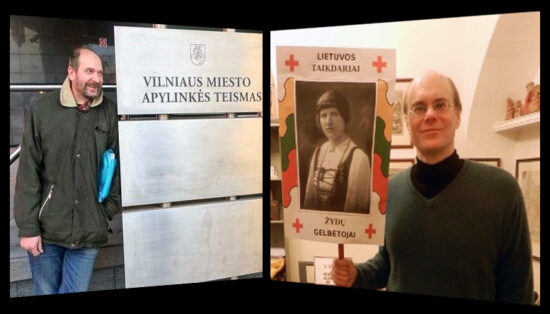 Genuine heroes of this saga—both written out of the film
- At left: Evaldas Balčiūnas (who first called his nation’s attention (in Lithuanian) and the world’s (in English) to state-sponsored adulation of Lithuanian Holocaust perpetrator J. Noreika. That was a year after his classic essay “Why does the state commemorate murderers?” appeared in Defending History in 2011. Here pictured at Vilnius County Court after one of the hearings in the litany of kangaroo cases against him (Defending History was there at each hearing to support him). He is DH’s 2023 Person of the Year.
- ◊
- At right: Dr. Andrius Kulikauskas brought his self-crafted poster to a nationalist event on independence day in central Vilnius, with an image to show his people the kind of national hero Lithuania should be celebrating: the inspirational Holocaust-era rescuer Malvina Šokelytė Valeikienė (DH’s person of the year in 2018). The gentle, teetotaling mathematician and philosopher took this sign right into the heart of an alcohol-fueled ultranationalist demonstration, leaving observers of every persuasion in awe of his courage. Dr. Kulikauskas boldly led the effort to expose Noreika in Lithuania and is the de facto author of the primary documents underpinning the legal petitions to the state’s Genocide Center and its courts. A Lithuanian American born and raised in California, he and his family migrated to newly free Lithuania decades ago.
- See DH’s Evaldas Balčiūnas and Andrius Kulikauskas sections. A future film maker might even find an enchanting angle in the stark differences between the two Lithuanian heroes of this story. One is a devout Catholic, the other an atheist. One is an anarchist, the other a nationalist. One an urban family guy, the other a lone thinker and dreamer in a faraway wooden hut in the depths of the Lithuanian countryside.
◊
VILNIUS—Michael Kretzmer’s new documentary J’Accuse! provides a terrific extended interview with legendary truth-teller Silvia Foti. The film’s narration provides effective statements on ongoing East European state adulation of Nazi collaborators though focused on just one, Jonas Noreika of Lithuanian Holocaust infamy (who was the Chicago-born Foti’s grandfather).
Posted in Arts, Bold Citizens Speak Out, Collaborators Glorified, Dovid Katz, Film, History, Lithuania, Litvak Affairs, Media Watch, Michael Kretzmer's Documentary Film "J'Accuse!" on the Lithuanian Holocaust, News & Views, Opinion, Politics of Memory, State Glorification of Holocaust Collaborator J. Noreika
Tagged Andrius Kulikauskas, Baltic Truth (Dudu Fisher), BBC's How the Holocaust Began, Danny Ben-Moshe, Efraim Zuroff, Evaldas Balciunas, Film J'accuse on Lithuanian Holocaust, Grant Arthur Gochin, Grant Gochin, Holocaust collaborators Glorified, Holocaust in Lithuania, Jonas Noreika, Malvina Šokelytė Valeikienė, Marc Radomsky, Michael Kretzmer, Michael Kretzmer's film J'Accuse, Review of film J'Accuse, Robyn Sassen, Roland Binet, Ruta Vanagaite, Silvia Foti, Simon Wiesenthal Center
Comments Off on Review of Michael Kretzmer’s Documentary Film “J’Accuse”
BBC’s New Documentary Helps Viewers Come to Grips with the Start of the Holocaust’s Genocidal Phase
OPINION | ARTS | FILM | MEDIA WATCH | GLORIFICATION OF COLLABORATORS
◊
by Roland Binet (De Panne, Belgium)
◊
We are accustomed to the frequent excellence of BBC broadcasts, documentaries, and investigative reports. On January 23, 2023, with its documentary How the Holocaust Began featuring historian James Bulgin, BBC 2 struck a welcoming chord, demonstrating powerfully and convincingly that the Holocaust ― in the sense of the genocide per se, unleashed upon Operation Barbarossa in June 1941 ― started in the Baltic States of Lithuania and Latvia.
Through the works of Michaël Prazan (Einsatzgruppen as a book and TV documentary in French), Efraim Zuroff’s untiring crusade against the states in Eastern Europe that still cover up their complicity in the murder of millions of Jews during World War II (see his renowned book Operation Last Chance and the site of the same name at the Wiesenthal Center in Jerusalem), through the vigorous and constant series of articles on in the web journal Defending History (see also the documentary Rewriting History by Danny Ben Moshe), we, the attentive and honest readers know what the reality of the Holocaust had been in the Baltic States when Jews were hunted as animals, slaughtered as animals by the German forces, and in many cases before they even arrived, also by the local populations “activists.”. We are cognoscenti but it is reassuring to see that the BBC broadcasts an image of far-reaching collaboration by the local populations in the Baltic States with the focus primarily on Lithuania.
Posted in Arts, Collaborators Glorified, Film, History, Lithuania, News & Views, Opinion, Roland Binet
Comments Off on BBC’s New Documentary Helps Viewers Come to Grips with the Start of the Holocaust’s Genocidal Phase