MUSEUMS | JEWISH EVENTS ABUSED TO MAKE “KOSHER” HOLOCAUST REVISIONISM | POLITICS OF MEMORY | COLLABORATORS WHITEWASHED
◊
◊
◊
VILNIUS—On our National Independence Day today, the 11th of March, approximately two hundred far-right nationalists and their sympathizers marched in the center of Vilnius, the capital of Lithuania, with permission of the city’s and national authorities. The march, following a route of many years’ standing, started at Cathedral Square and ended up in Lukiškės Square. But this year’s gathering was unusually short, taking up less than one hour. The main outlets of the Lithuanian media covered the event, generally obfuscating its far-right character.
What else makes this year’s march different from the marches of the previous years and from the march on February 16th? First, naturally, support for Ukraine, now under a vicious military campaign by Russian military forces, dominated the event. The rally was opened and closed by playing melodies and singing two national anthems: of Lithuania in Lithuanian and of Ukraine in Ukrainian.
Julius Norwilla’s photos at the event
Second, the provocative far-right slogan “Lietuva Lietuviams!” (Lithuania for Lithuanians!) was today used explicitly, featuring beforehand on the Facebook page banner preceding the event, thereby emphasizing the group’s fear of citizens, residents or refugees who are not pure ethnic Lithuanian (perhaps a contradiction to the professed support of Ukraine?). During the march, it was screamed out repeatedly. Defending History’s monitoring and reporting of the far-right marches starting back in 2008. Sometimes the far-right slogan, implying illegitimacy or no human rights for non-ethnic-Lithuanians in Lithuania, is at times reduced to a single chant word: “Lithuania! Lithuania! Lithuania!”
◊
◊
Antisemitism takes many forms in the twenty-first century. It includes the religion-based, the anti-Israel-based, the globalization-based, the envy-based, and the drunk-violence based — all the way to sophisticated and elegant forms that are so sublimated that it is hard to discern what’s what. In Eastern Europe, some rather exotic forms flourish: hatred of remnant local Jewish communities (who know the truth about the Holocaust-relevant roles played by local nationalists during the Holocaust years of 1941-1944/45) alongside love of rich, distant foreign Jews (who can be charmed right to the high heavens with medals, junkets and photo-ops to help underpin Double Genocide revisionism — and sometimes cover for glorification of local collaborators — as part, naturally, of “Holocaust remembrance” or “commemoration of the victims of equal genocidal regimes”).
Then there is the occasionally encountered East European love of substantial Jewish sacred sites that are suitably far from the center of town (“best place is the forest, you know!”) and provide a fine niche in-season tourism without upsetting the ethnic-purity concocted versions of town-center history that want it to be say pure Ukrainian (Lviv/Lvov/Lemberg), pure Latvian (Riga), or pure Lithuanian (Vilnius/Vilna/Wilno/Vílne).
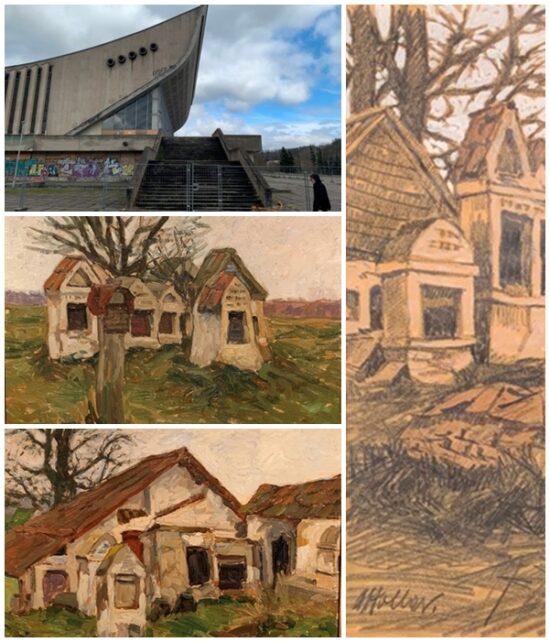
The hard fought battle to keep the convention center out of the old Vilna Jewish cemetery was won last summer (report in the AJ). It will go down in history as a victory for Lithuania and all the country’s true friends. Now comes Part II.
◊
◊
◊
Following the publication on FigaroVox of Salomon Malka’s text entitled “Lithuania celebrates the philosopher Emmanuel Levinas” Michael Levinas asked us to publish his reaction to this information. Michaël Levinas, a pianist, is honorary professor at the National Superior Conservatory of Music and Dance in Paris, as well as a member of the Academy of Fine Arts. He is the son of the philosopher Emmanuel Levinas.
It was through an article signed by Salomon Malka in FigaroVox that I was informed of the inauguration of an Emmanuel Levinas center in Kaunas, which took place on December 6 within the setting of the Lithuanian University of Health Sciences. Thus, it is through the press alone that I, as the exclusive holder of the moral rights, and responsible for the use of my father’s name when it concerns his work, learned of this ceremony which honored a major French personality. A noteworthy fact: it was held only in the presence of the Embassy of Israel, and in the absence of the Embassy of France in Lithuania and the Embassy of Lithuania in France, and this, in defiance of the reservations that I had publicly expressed as a son regarding the use of my father’s name, Emmanuel Levinas, in a historically tragic context.
It all strikes outsiders as a kind of bizarre circus macabre of a celebration of those whose first order of business was the butchering of the city’s 30,000 citizens who were Jewish, a celebration of Nazism and the Holocaust. It is a true friend of Kaunas who would now publicly call for the removal of these shameful street names and monuments. And, when folks accept lavish invites, ego-trips and honors in “Capital of European Culture” programs, we only ask that they speak out publicly, with dignity, calling for the removal of public-space state-sponsored shrines to the local “white-armbander” Hitlerists who launched the Lithuanian Holocaust in Kaunas on 23 June 1941, before the first German soldiers arrived. If they do, they acquit themselves with honor. If they don’t and allow their use as “foreign Jews” to further betray the victims of the Holocaust and the simple historic truth, for a mess of lentils, they shall duly go done in the darkest alleys of Jewish and European history as Useful Jewish Idiots (so-called “UJIs”) — at best.
◊
PARIS—The French Jewish journal Actualité Juive published in its print edition a full-page interview (as PDF) with the eminent French composer and pianist Michaël Levinas, concerning his protest at a new center in Lithuania’s second city, Kaunas (once Kovno, Yiddish Kóvne), being named for his late father, the great French philosopher Emmanuel Levinas (1906-1995). An authorized translation is available. Coinciding with the European Union’s naming of Kaunas as “Capital of European Culture” for 2022 and the city’s refusal to remove even one of the many street names, shrines, plaques and monuments to local Nazi collaborators who helped ensure the massacre of nearly all the city’s Jewish residents in 1941, and who participated in the unleashing of the Holocaust in Lithuania even before the arrival of the first German soldiers in late late 1941, the composer’s powerful moral protest represents a singular voice of justice, reason and moral courage to date.
See also op-ed in Le Figaro
&
Levinas Center Media Tracker
The composer’s stance stands in marked contrast with many others, including artists, assorted academics and a wide range of Western wannabees, who are accepting funding, honors, junkets, invites, and photo-ops with “important people” in return for an unspoken assurance of silence in face of the city’s refusal to take down a single shrine to the local perpetrators of the Holocaust.
The following is a PDF of Michaël Levinas’s interview in the print edition of Actualité Juive of 13 January 2022:
Just like each and every other town in Lithuania, Šeduva (Sheduva) has as the most barbarous episode of its history the Lithuanian Holocaust. It is not easy to tell this story. There are many narratives that contradict each other, with many omitted or unclear episodes. The omissions can be partly explained by the current policy of historical memory in Lithuania, as well as by the authority of some organizations that themselves took active part in these horrible events. Narratives that are unfavorable to them are denied, downplayed, or classified as “information warfare” (in other words: “Russia”). I have preeviously written about the difficulty in assessing assorted narratives here.
The summary version of of the Šeduva Jews’ massacre that I recounted includes these critical dates:
June 25, 1941: The Nazis occupy Šeduva.
July 22, 1941: Šeduva’s Jews are driven into the town’s ghetto established to incarcerate its Jewish citizens.
August 25t, 1941: The city’s 665 Jews are murdered in Liaudiškiai forest. But a few of the Jewish families of volunteers (veterans) of Lithuania’s War of Independence in 1918 are “allowed” to live, under the condition that they abandon their Jewishness and get baptized. The residents of Šeduva and its vicinity observe the public baptism at the church. A couple of weeks later those baptized are driven to Panevėžys and also shot dead, like all their unbaptized brethren who were not “saved by baptism” for having volunteered over two decades earlier to fight in the nation’s War of Independence. The only one who survived was Ms. S. Nolienė, who was hidden by the priest M. Karosas.
JUMP TO MOST RECENT: On 23 Nov. 2021, Vilnius inaugurated a square named for the alleged 1941 Holocaust perpetrator…
YAKOV FAITELSON; LAURENCE WEINBAUM; FAINA KUKLIANSKY & ANDREW BAKER; DOVID KATZ; BRITISH PARLIAMENT MOTION
◊
◊
VILNIUS—The Lithuanian Yiddish Video Archive (LYVA), a Defending History affiliated project, providing hundreds of Yiddish language video interviews in the “Lithuanian lands” (today’s Belarus, Latvia, Lithuania, eastern Ukraine and northeastern Poland), conducted from 1990 to 2020 has just released a Holocaust-history extract from a longer interview, conducted in May 2000 in Šeduva, northern Lithuania, with the town’s last Yiddish speaker, the Christian Lithuanian native of the town, the late Elena Rimdžiūtė. As is evident from the clip, the interviewer, Dovid Katz, was focused on Elena’s Yiddish folksongs, and the Holocaust arises, at first tangentially, when Elena speaks of her friends who are no more.
See DH’s Šeduva section
The clip on Youtube is accompanied by a draft English translation (in the “Description Box”). This remarkable woman’s honesty, integrity, and desire to Just Tell it Straight, makes for a striking contrast with the current Baltic academic establishment’s claptrap about Prague Declarations, equivalence of totalitarian regimes, tale of two Holocausts, and fairy tales about the “uprising against the Soviets” celebrated in Vilnius’s Genocide Museum (recently renamed), and promoted by the state-sponsored Genocide Center and numerous public shrines to local Holocaust murderers of 1941.
Here is Ms. Rimdžiūtė’s genuine Šeduva Yiddish rendition of the beloved song, where a girl explains that she wants neither new clothes from the tailor nor shoes from the shoemaker but expresses her sadness that all the other girls have boys (altered in the final stanza to ‘get married’). The clip is followed by a draft English translation concluding with a transcription of song in Šeduva Yiddish.
◊
Zedelgem, a quiet Flemish town in West Flanders, was occupied by the Nazis between May 1940 and September 1944. During World War I it had also been under German yoke for over four years.
Now, 74 years after the end of the the Second World War, former Latvian Waffen SS men, who wore the same barbarians’ uniform as the occupiers of Zedelgem during the occupation, who fought for the same ideals and were condemned by the same Nuremberg Trials of 1945/1946 as members of a criminal organization, now, more than seven decades after Waffen SS men being freed from an Allied POW camp situated in Zedelgem, these former Latvian SS men and their current far-right, neo-Nazi and Hitler-sympathetic admirers have convinced Flemish officials — many report more than a little impetus to call them morons, plain and simple — in and in the region of modern Zedelgem to enable them to erect a monument to “Liberty” in their memory. A monument to Liberty! The very Liberty they had denied the 100,000 Jews killed in their native country and the dozens of thousands of innocent Soviet citizens of an array of nationalities and religious they killed while fighting in the USSR, near Leningrad and at other fierce, lethal battles. They wore the same barbarians’ uniforms as the Nazi occupiers of Belgium and Zedelgem. They all fought for the Führer to whom they had sworn a common oath of loyalty. They too fought for the same ideals as the Führer.
Congratulations (16 Aug 2021) to Lithuania’s gov on cancelling convention center
Ben Cohen in The Algemeiner
HISTORY OF THE LAST 7 YEARS
◊
◊
VILNIUS—Two days before tomorrow’s government-sponsored international “academic” conference (on September 10) that glorifies alleged 1941 Holocaust perpetrator Juozas Lukša (without a single paper devoted to the issue of his Kaunas 1941 Holocaust participation), the foreign minister led a high-end Holocaust remembrance ceremony (yesterday, 8 Sept.) bewailing the calamity of the Holocaust and its scale in Lithuania. That ceremony dated the onset of the Lithuanian Holocaust to the first week of September, when the Nazis set up the Vilna Ghetto, and others.
◊

Carbuncle in the heart of the EU? Monument in Belgium glorifies Latvian Waffen SS who fought for Hitler
Note: for background on the monument to Latvian SS war criminals in Zeldelgem, Belgium, please see DH’s Zedelgem section, and for Latvia more generally, Roland Binet’s contributions and DH’s Latvia section.
◊
Flemish historian Pieter Lagrou had this to say in an exchange of correspondence pertaining to the quandary of what to do with that monument in Zedelgem glorifying Latvian Hitlerist Waffen SS men. It so happens that he is the one whose official opinion in this matter will be asked on how to further proceed with the “Latvian Beehive” as the pro-Nazi monument on Belgium soil is known: