


Jerusalem of Lithuania
Tribute to Milan Chersonski: a dozen years as editor of Lithuania’s last Jewish newspaper
VIDEO TRIBUTE HERE
Posted in Boxes
Comments Off on Jerusalem of Lithuania
Zeppelinus
Posted in Boxes
Comments Off on Zeppelinus
Revival of Antisemitism in Europe
O P I N I O N
by Roland Binet (Braine-l’Alleud/Belgium)
One would have thought that after the destruction of millions of Jews during the war and the creation of Israel, that antisemitism would have disappeared forever from Europe, the harsh and bloody lessons of the Holocaust having been learned. Yet, now, almost seventy years later, antisemitism is still an important factor to be reckoned with, both in Eastern and Western Europe.
Posted in Antisemitism & Bias, News & Views, Opinion, Roland Binet, Sweden
Comments Off on Revival of Antisemitism in Europe
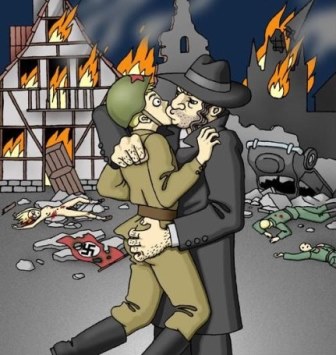
Zeppelinus, Unmasked as Official at Lithuania’s Ministry for the Economy, Posts New Gay-Hate Image to “Welcome” Baltic Pride Week
O P I N I O N
by Dovid Katz
The leading neo-Nazi blogger in Lithuania, “Zeppelinus,” who was unmasked several months ago by a number of publications as a high official at the Ministry for the Economy and chairman of the nation’s Tripartite Commission, did not deny the identification.
Instead, quite incredibly, he complained to the press commission against those who would dare deem to be unacceptable his hateful racist, antisemitic, homophobic and pro-fascist productions.
Posted in Antisemitism & Bias, Events, Human Rights, LGBTQ Equal Rights, Media Watch, News & Views, Opinion, Racism
Tagged Antisemitism in Lithuania, Gay Rights (LGBT) in Lithuania, homophobia, racism, Zeppelinus
Comments Off on Zeppelinus, Unmasked as Official at Lithuania’s Ministry for the Economy, Posts New Gay-Hate Image to “Welcome” Baltic Pride Week
Free Speech and Holocaust Remembrance in the Eastern European Union
O P I N I O N
by Geoff Vasil
NOTE: This was written in response to “Foreign countries use far-right operations to undermine Lithuania’s image” published on June 7, 2013, on the Lithuania Tribune website.
Initially the editor-in-chief of the Lithuania Tribune agreed to publish the following reply in the Lithuania Tribune, but then changed his mind and finally refused, only informing the author a month later…
Posted in Foreign Ministries: Holocaust Politics Abuse?, Free Speech & Democracy, Geoff Vasil, History, Lithuania, Media Watch, News & Views, Opinion, Politics of Memory
Comments Off on Free Speech and Holocaust Remembrance in the Eastern European Union
A Library with an Agenda? Bringing American Naifs On Board the Ultranationalists’ Baltic Holocaust Distortion Train?
SUMMARY COVERAGE OF “VILNIUS JEWISH PUBLIC LIBRARY” EVENTS TO 19 JULY 2013:
Wyman Brent’s prophecy fulfilled?
Posted in "Jewish" Events as Cover?, "Red-Brown Commission", Double Games, Double Genocide: The New Form of Holocaust Revisionism & Denial, Dr. Arūnas Bubnys and State Holocaust Revisionism in Lithuania, Events, Identity Theft of Litvak Heritage, Litvak Affairs, News & Views, Politics of Memory, Vilnius Jewish Public Library, Vilnius's Genocide Center and the Genocide Museum it Manages
Tagged Genocide Center and Vilnius Jewish Library, Genocide Center in Vilnius, Holocaust in Lithuania, Holocaust Obfuscation in Vilnius, International Commission for the Evaluation of the Crimes of the Nazi and Soviet Occupation Regimes in Lithuania, Pinchos Fridberg, Red-Brown Commission, SLS (Summer Literary Seminars) Vilnius, Vilnius Jewish Public Library, Wyman Brent, Zilvinas Bieliauskas
Comments Off on A Library with an Agenda? Bringing American Naifs On Board the Ultranationalists’ Baltic Holocaust Distortion Train?
EHU Center for German Studies: “Colloquium Vilnense 2013” is Short on “The Second Opinion” when it comes to The Holocaust
O P I N I O N
by Dovid Katz
Colleagues at the prestigious European Humanities University in Vilnius (EHU, also known as the Belarusian Humanities University, in exile here in Vilnius) have passed on the public poster for this year’s series of seminars under the title Colloquium vilnense 2013, running from May to November 2013. The A3 size poster is reproduced (much reduced) at the bottom of this page in two halves.
Posted in "Jewish" Events as Cover?, Documents, Double Games, Dovid Katz, EU, Events, Free Speech & Democracy, Germany, Lithuania, News & Views, Opinion, Politics of Memory, Vilnius Yiddish Institute, Yiddish Affairs
Tagged Belarusian Humanities University (Vilnius), Colloquium vilnense, Colloquium vilnense + Jewish issues, Colloquium vilnense + Yiddish, EHU (European Humanities University), EHU Center for German Studies (Vilnius), European Humanities University + Yiddish, Holocaust Denial and Obfuscation, Holocaust in Lithuania, Holocaust Obfuscation, Vilnius Yiddish Institute
Comments Off on EHU Center for German Studies: “Colloquium Vilnense 2013” is Short on “The Second Opinion” when it comes to The Holocaust
Holocaust Survivors from Lithuania Issue Statement on Sutzkever Prize in Vilnius
On the 15 July 2013 centenary of the birth of the illustrious Yiddish poet of Vilna, Abraham Sutzkever (1913–2010), the last active association of Holocaust survivors from Lithuania released the statement below (also available as PDF). It urges organizers, participants, judges and prize winners to avoid being instrumentalized as cover-up props for Holocaust obfuscation. It proposes that they simply issue public statements calling for written public apologies from the Lithuanian government to the defamed Jewish partisans who knew Sutzkever well from the forests of Lithuania and dozens of years of contact in survivor circles. See the related debate on this year’s Sutzkever Prize.
Posted in "Jewish" Events as Cover?, A 21st Century Campaign Against Lithuanian Holocaust Survivors?, Documents, Double Games, Events, Identity Theft of Litvak Heritage, Joseph Melamed, Lithuania, Litvak Affairs, News & Views, Opinion, Politics of Memory, Sutzkever Prize in Lithuania, Yiddish Affairs
Tagged Abraham Sutzkever, Fania Brantsovsky, Joseph Melamed, Rachel Margolis, SLS Jewish Lithuania Sutzkever Prize, Sutzkever Prize in Lithuania, Yitzhak Arad
Comments Off on Holocaust Survivors from Lithuania Issue Statement on Sutzkever Prize in Vilnius
Vexed Revival of “Red-Brown Commission”
State-sponsored Zingeris-Račinskas “red-brown commission” (officially: International Commission for the Evaluation of the Crimes of the Nazi and Soviet Occupational Regimes in Lithuania) in Vilnius posts new list of members.
See also:
Page on the commission
Critiques of the commission and its associated Prague Declaration
DH section on the commission.
Resignations to date from Commission-related bodies include Dr. Yitzhak Arad, Sir Martin Gilbert (London), Prof. Gershon Greenberg (Washington DC), Prof. Konrad Kwiet (Sydney) and Prof. Dov Levin (Jerusalem).
Holocaust survivors themselves have stood up to express disquiet about some aspects of the commission: Yitzhak Arad, Pinchos Fridberg (more), Dov Levin (more), Joseph Melamed (more), Basheva Ran, the Association of Lithuanian Jews in Israel, Jewish Community of Lithuania / Union of Ghetto Survivors. A decade and a half of issues.
Posted in "Red-Brown Commission", Double Games, Double Genocide: The New Form of Holocaust Revisionism & Denial, Dr. Arūnas Bubnys and State Holocaust Revisionism in Lithuania, Foreign Ministries: Holocaust Politics Abuse?, Germany, Holocaust Policies of Mr. Ronaldas Račinskas and the State-Sponsored "International Commission" (ICECNSORL), Lithuania, News & Views, Politics of Memory, Views of Prof. Sarunas Liekis, Vilnius Jewish Public Library
Tagged Arunas Bubnys, Double Genocide, Dov Levin, Emanuelis Zingeris, Holocaust Denial and Obfuscation, Holocaust in Lithuania, Holocaust Obfuscation, International Commission for the Evaluation of the Crimes of the Nazi and Soviet Occupation Regimes in Lithuania, Joseph Melamed, Litvaks, Milan Chersonski, Pinchos Fridberg, Red-Brown Commission, Ronaldas Racinskas, Sarunas Liekis, Yitzhak Arad
Comments Off on Vexed Revival of “Red-Brown Commission”
President of Germany Hails Baltic Double Genocide Revisionism
by Leena Hietanen (Tallinn)
Germany’s president, Joachim Gauck, welcomed intensified cooperation between Estonian and German historians in the cause of continuing the search for Communist crimes in both Soviet Estonia and East Germany. He posed for photographs alongside Estonian president Toomas Hendrik Ilves with a backdrop of the iconic red-equals-brown Hollywoodesque “set” welcoming visitors to the nation’s Museum of the Occupation in Central Tallinn.
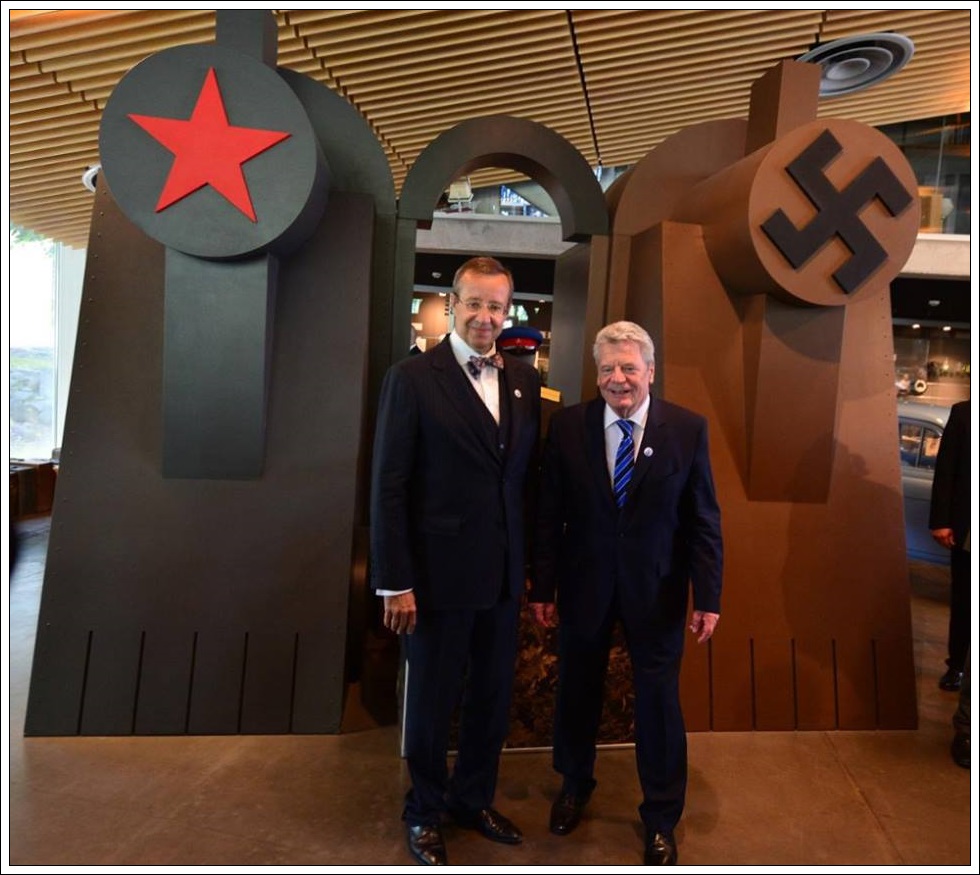
Photo of the two presidents with red-brown-equals-sign backdrop at the Museum of the Occupation in Central Tallinn: Postimees (Erik Peinar). More red-brown iconography here.
Posted in Double Genocide: The New Form of Holocaust Revisionism & Denial, Estonia, EU, Germany, Leena Hietanen, News & Views, Politics of Memory, Prague "Platform"
Tagged Double Genocide in Estonia and Germany, German-Estonian relations, Holocaust Denial, Holocaust in Estonia, Joachim Gauck on Jewish and Holocaust issues, Leena Hietanen, Toomas Hendrik Ilves on Jewish and Holocaust issues
Comments Off on President of Germany Hails Baltic Double Genocide Revisionism
Would a Jewish Museum in Vilnius Graywash the Lithuanian Holocaust?
O P I N I O N
by Dovid Katz
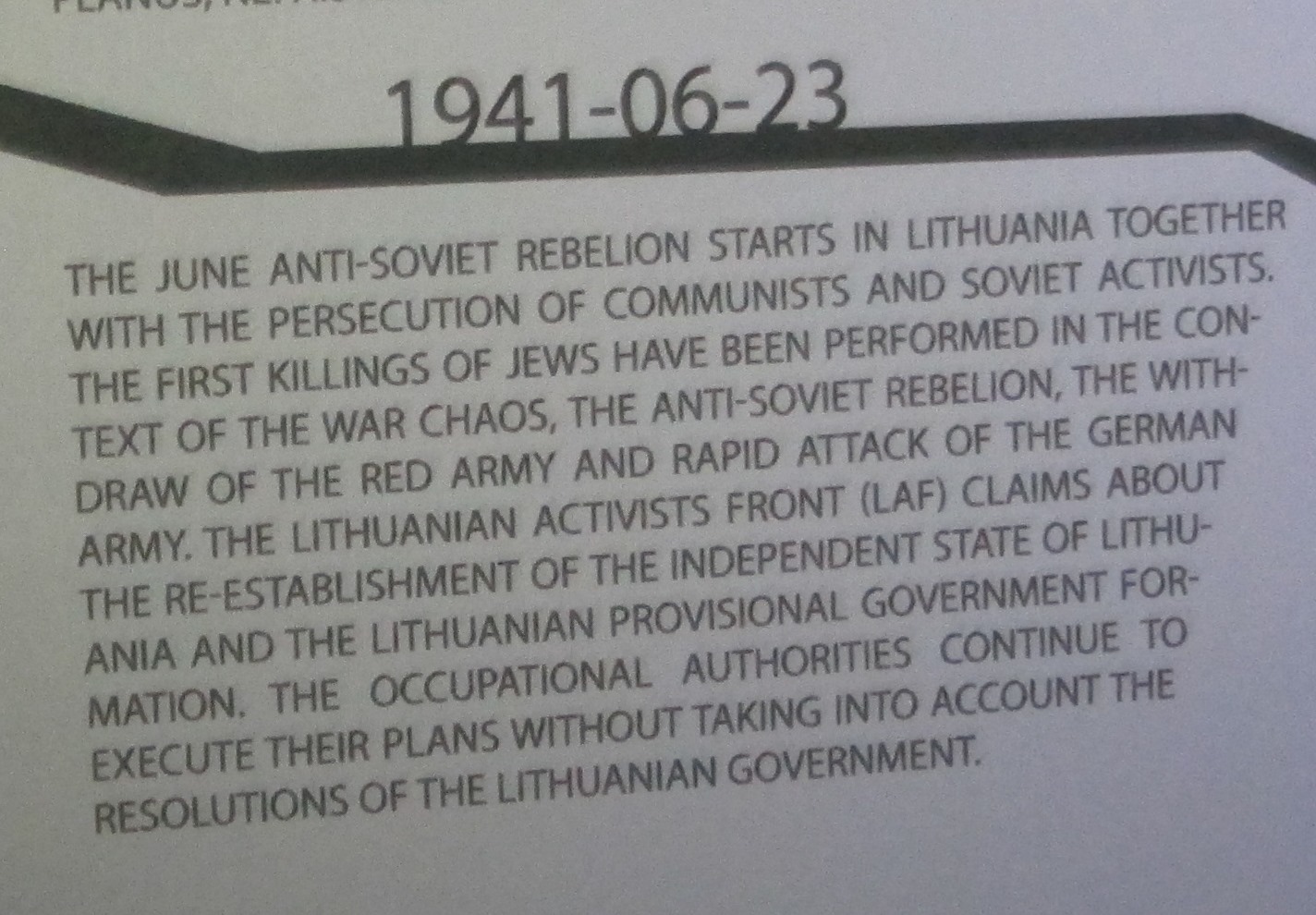
A recent visit to Vilnius’s “Jewish Museum — Tolerance Center” has revealed a shocking panel purporting to convey the “facts” of June 23rd 1941, the darkest date in Lithuanian Jewish history. It is the date on which the Holocaust in Lithuania began. No need, incidentally, to take our word for it. Ask any Lithuanian Jew, of any generation, current abode or political persuasion: When did the Holocaust in your country start?
Posted in "Jewish" Events as Cover?, Collaborators Glorified, Double Games, Exotic Jewish Tourism, Lithuania, Museums, News & Views, Opinion, Politics of Memory
Comments Off on Would a Jewish Museum in Vilnius Graywash the Lithuanian Holocaust?
Wiesenthal Center Blasts Latest Pro-Fascist Commemoration by Latvian Authorities
JERUSALEM—The Simon Wiesenthal Center today denounced the commemoration of the “liberation” of the Latvian city of Limbazi, sponsored by the Visu Latvija political party, a member of the ruling coalition in the nation’s parliament in Riga.
Posted in Celebrations of Fascism, Collaborators Glorified, Efraim Zuroff, Events, Latvia, News & Views
Comments Off on Wiesenthal Center Blasts Latest Pro-Fascist Commemoration by Latvian Authorities
Chief Lithuanian Bureaucrat/Historian Rehabilitates Nation’s Quislings, Again
O P I N I O N
by Geoff Vasil
In an interview posted on the Delfi website on June 21, 2013, Lithuanian government historian Arūnas Bubnys, head of department for the Orwellian- or even Kafkaesque-sounding Center for the Study of the Genocide and Resistance of the Residents of Lithuania, once again lent support to the pro-Nazi Lithuanian Quisling government that seized power on June 23, 1941.
The interview, titled “Lithuanian Historian: June Uprising was Rehabilitation for Shameful Surrender to Soviets,” is available here. An English translation is provided here.
What follows is my commentary on that interview.
Posted in "Jewish" Events as Cover?, "Red-Brown Commission", Collaborators Glorified, Double Genocide: The New Form of Holocaust Revisionism & Denial, Dr. Arūnas Bubnys and State Holocaust Revisionism in Lithuania, Geoff Vasil, Lithuania, News & Views, Opinion, Politics of Memory, Vilnius's Genocide Center and the Genocide Museum it Manages
Tagged Arunas Bubnys, Center for the Study of Genocide and Resistance (Lithuania), Genocide Center Vilnius, Geoff Vasil, Holocaust in Lithuania, International Commission for the Evaluation of the Crimes of the Nazi and Soviet Occupation Regimes, Kazys Škirpa, Lithuanian Activist Front (LAF), Provisional Government of Lithuania in 1941 (PG), Ronaldas Racinskas, World War II
Comments Off on Chief Lithuanian Bureaucrat/Historian Rehabilitates Nation’s Quislings, Again
Statement for London Panel by Michael Pinto-Duschinsky
O P I N I O N
by Michael Pinto-Duschinsky
The following is the author’s prepared statement for a panel discussion this evening on rights and freedoms prior to a performance of Harold Pinter’s “Hothouse” at Trafalgar Studios, London SE1. Panelists are: Shami Chakrabarti, Jonathan Cooper, Nicolas Kent and Michael Pinto-Duschinsky.
In 1970, twelve years after the first performance of “Hothouse”, Harold Pinter chose to accept a valuable award called the “Shakespeare Prize”. The series of Shakespeare Prizes were donated from the 1930s onwards by a Hamburg multi-millionaire with a record for actively supporting the Nazis before, during and after the Second World War.
Posted in News & Views, Opinion, Politics of Memory, United Kingdom
Comments Off on Statement for London Panel by Michael Pinto-Duschinsky
Marching with the Words: “No to Falsification of History!”
O P I N I O N
by Milan Chersonski
Authorized translation from the Russian by Ludmila Makedonskaya (New York)
In accordance with the law of the Republic of Lithuania for days of commemoration, June 23rd has been declared a national memorial day. It is the day of the 1941 June Uprising. As known, the extermination of the Lithuanian Jewish minority began on the same day as this “uprising.”
Posted in Aleksandras Bosas, Bold Citizens Speak Out, Collaborators Glorified, Events, Lithuania, Litvak Affairs, Milan Chersonski (1937-2021), News & Views, Opinion, Politics of Memory
Comments Off on Marching with the Words: “No to Falsification of History!”
Milan Chersonski Reports on the Antifa Lietuva Event in Kaunas on 23 June 2013
МНЕНИЕ
Милан Херсонский
Шествие под лозунгом
«ФАЛЬСИФИКАЦИИ ИСТОРИИ – НЕТ!»
В соответствии с законом о памятных днях Литовской Республики, 23-е июня провозглашено национальной памятной датой – днём Июньского восстания 1941-го года. Как известно, уничтожение Еврейской общины Литвы началось в тот же день, что и восстание. Continue reading
Posted in Events, In Russian, Milan Chersonski (1937-2021), News & Views, Politics of Memory
Tagged Antifa Lietuva, June 23rd, LAF (Lithuanian Activist Front), Milan Chersonski
Comments Off on Milan Chersonski Reports on the Antifa Lietuva Event in Kaunas on 23 June 2013
LGBT Equality Issues Statement after Baltic Pride March is Banned in Central Vilnius
The following statement was issued today by For LGBT Equality:
Vilnius Municipal Authorities Ban Upcoming Baltic Pride 2013 March for Equality
2013 06 27

Posted in Events, Human Rights, LGBTQ Equal Rights, News & Views
Comments Off on LGBT Equality Issues Statement after Baltic Pride March is Banned in Central Vilnius
An Unmarked Holocaust Mass Murder Site in Riga, the Latvian Capital
INTERVIEW WITH RIGA HISTORIAN MEYER MELLER (MELERS)
by Aleksandrs Feigmanis
The great Russian author Lev Tolstoy wrote in his story “From the Notebook of Prince D. Nekhlyudov. Luzern.”
“Seventh July 1857 in Luzern in front of the Schweizerhof Hotel, where most rich people would stay the itinerant beggar-singer sings songs for half an hour and plays his guitar. About a hundred people heard him. Three times the singer asked the crowd to give him some money or food. Nobody gave him anything and many laughed at him.” […] This is the event which the historian of our times should write about with fiery irascible letters. This event is much more important and serious and has much more sense than the facts written in newspapers and history books. […] This is not a fact for the history of human acts, but for the history of progress and civilization.”
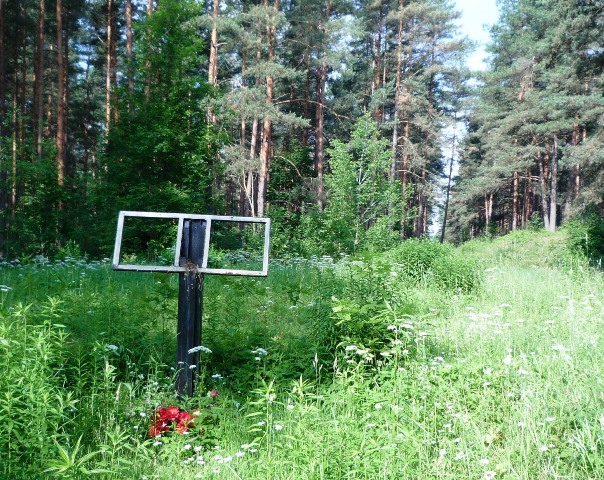
All that marks this major Holocaust mass grave in Riga, the Latvian capital, is a plastic bucket of flowers near the empty frame of a long-destroyed Soviet-era tin sign.
If you wish to see the mass grave take number 13 bus from the central station headed for Plavnieki and get off at the stop called Darzenu baze (roughly a half-hour ride). When you get off, turn from Lubanas street to the right until you come to Darzenu baze (“warehouse for vegetables”). In the pine woods some 300 meters from the warehouse you will see a little hill, without any mark, inscription or tombstone. Just a few primitive buckets of plastic flowers mark the site. They are placed near a wood frame stand that once, in Soviet times, held within it a bilingual tin sign about the site, that has long been destroyed and removed. The site is about 600 meters from the nine-floor apartment houses in Riga’s Plavnieki district.
Posted in Aleksandrs Feigmanis, Defense of Old Jewish Cemeteries and Mass Grave Sites, Latvia, Litvak Affairs, News & Views, Opinion, Politics of Memory
Comments Off on An Unmarked Holocaust Mass Murder Site in Riga, the Latvian Capital
June 23rd: Lithuanian Anti-Fascist Group Mounts Protest in Kaunas Against Glorification of 1941 LAF Killers
Courageous Antifa Lietuva banner reads: “Real heroes rescued people instead of killing them. Remember the victims of the Holocaust”
Milan Chersonski was there. His report on the event. His take: “Let the world know that not everyone in Lithuania tolerates the distortion of history.”
Posted in Collaborators Glorified, Events, Free Speech & Democracy, Kaunas, Legacy of 23 June 1941, Lithuania, News & Views, Politics of Memory
Comments Off on June 23rd: Lithuanian Anti-Fascist Group Mounts Protest in Kaunas Against Glorification of 1941 LAF Killers


