SYMBOLOGY | THE TEN-EURO “GAON COIN” | ABUSE OF JEWISH PROJECTS | THE “FAKE LITVAK” INDUSTRY | HUMAN RIGHTS
◊
◊
A heartfelt thank you for all who responded to our urgent call to write the Budget and Finance Committee of Lithuania’s Seimas (Parliament), which met on November 11, 2020. The Committee acknowledged that it received recommendations from 54 groups and individuals to not finance the reconstruction of the Vilnius Concert and Sports Palace Building Complex, which the Soviets built in the center of the historic Jewish cemetery at Piramónt-Šnipiškės. The Committee neither approved nor rejected this proposal but simply passed it on to the Lithuanian government.
At this stage in the budget process, we urge concerned readers to send a second email to the Seimas leadership, as described below, before the Seimas’s crucial session on November 24, 2020.
◊
Iconic roof of the dereleict Soviet sports palace in the heart of the Old Vilna Jewish Cemetery. Graphic by D. Umbrasas / Lrt.lt. In the original publication.
Vilnius’s historical and literary sources confirm that there are a number of burial sites in the city, mostly near Christian and Orthodox churches. Larger cemeteries, including Rasos, Antakalnis (soldiers), Bernardines, Orthodox (Liepkalnis), Jewish cemeteries (Piramont / Snipiskes and Zarétshe / Olandų), Evangelicals (Kalinauskas) and others. The legal regulation of Vilnius city cemeteries started only in the second half of the eighteenth century, when cemeteries near Christian and Orthodox churches were full to capacity (burials ceased in 1865) and separate parishes began burials outside the city.
As readers of Defending History know from Julius Norwilla’s recent article, this week is the rare and perfect opportunity for our concerns about the fate of the Vilnius Jewish Cemetery at Piramónt to be heard by Lithuania‘s Seimas.
The Seimas (Lithuanian parliament) is approving a package of investments that it will be making in 2021-2023 to pump Lithuania‘s economy as it battles the pandemic. Among the 49 billion euros of expenditures is a line item of 27 million euros for reconstruction of the Vilnius Sports and Congress Building Complex Project. (See page 3 here and page 84 here). In other words, this is money that will fund the endless desecration of the oldest Jewish Cemetery in Vilnius.
◊
◊
VILNIUS—Lithuania’s parliament (the Seimas) has published the provisional state budget for 2021, along with a timetable specifying that the final date for protests, submissions, and comments from outside organizations (non-governmental and presumably including religious and human rights groups) is the 10th of November.
The budget links to the Ministry of Finance page where the project to erect the new national convention center (not mentioned: in the heart of the Old Vilna Jewish Cemetery), is explicitly cited in a list of other projects that do in fact enhance our nation’s economy:
◊
◊
I respectfully call on members of the Lithuanian Parliament (Seimas), to read pp. 33-34 in my father’s book, The Truth and Nothing But the Truth (Gefen Publishing, Jerusalem & New York 2006), and to reconsider the tragically misguided proposal to name 2021 for Juozas Lukša (Luksha), a participant in atrocities committed against the peaceful Jewish citizens of Kaunas (Kovno) in the last week of June 1941, when massive local violence broke out before the invading German army had set up its authority.
I would like to emphasize that in his books, my father Alex (Alter-Henoch) Faitelson (1923–2010) provided a meticulously researched description of those tragic events of the Lithuanian Holocaust. As a professional auditor who worked for a major Israeli bank for over twenty-five years, he adhered to very strict rules also in his studies of the Holocaust. He repeatedly encountered and tested — corroborating or rejecting — details of testimonies of his former comrades in the anti-fascist struggle and Holocaust survivors more generally. In the same book, he included chapters “Forgery, Communist Style” (chapter 20), “The Tricks of Memory” (21), and “Everyone’s a Hero” (22), titles that speak for themselves to anyone in the field. In fact, these are part of a larger five-chapter section called Legends and Fables.
◊
The Nazis wanted to exterminate a race and Karl Marx wanted to exterminate a social class. Our guide at the House of European History museum (HEH) in Brussels is twisting her tongue as she tries to solve the task of simultaneously explaining that Communism and Nazism are the same thing, and yet, somehow not. Visually, the impression of the museum’s exhibition is overwhelmingly slanted toward the notion that they are fully, inexorably and inherently equivalent.
Towering above us in the ideologically most intense part of the museum are huge video screens tilted towards the visitor. These screens, on four islands in the room, are so large that in spite of the hall being generously spacious, they fill up the room. The spectator can feel small in their shadow. On the screens the masses march in honor of the dictator, people are violently oppressed and the imagery makes this museum’s point very clearly: the interwar period was marked by the very same conflict as that after the war until the Soviet Union collapsed and the Berlin wall fell. That single conflict that is posited as God’s-honest-truth-fact is between Western democracy and (any kind of) totalitarianism. The technically impressive format is meticulously balanced: two huge screens each for the horrific methods of Communism and Nazism. The similarity is indeed visually striking. Stalin and Hitler—in that order— are omnipresent in the midst of terror. As a climax, the hammer and the sickle are projected at the same time as the swastika in meticulously equal format.
◊
VILNIUS—There were three observers present at this morning’s Vilnius County Court hearing in the case over the Old Vilna Jewish Cemetery at Piramónt (in the Shnípeshok / Šnipiškės district): Ruta Bloshtein (author of the international petition that has garnered 52,000 signatures), Edmundas Kulikauskas who has appeared at a number of “Gerbkime kapines” (Respect Cemeteries) events supporting the cemetery’s preservation, and Arkady Kurliandchik, elected board member of the Vilnius Jewish Community.
“Defending History was there”
The attorneys for Turto Bankas expressed their impatience and dissatisfaction with the case’s continuation, which they pointed out further postpones the onset of building works on site. The judge, for her part, was concerned about the apostillary status of the affidavits received as well as an original of the classic prewar map of the cemetery appended by scholar Joseph Klausner to his 1935 book on the subject. At last week’s hearing, reported on in DH and the Algemeiner Journal, star witness Prof. Josif Parasonis, one of Lithuania’s major specialists in building sciences and a cofounder of the current Vilnius Jewish Community, pointed out that the Historical Institute in Vilnius had, in its report, carelessly superimposed the Klausner map on modern maps, falsely leaving the Sports Palace building outside the cemetery, and, Prof. Parasonis pointed out to the judge, serving to place many of the historic graves, ridiculously, right in the middle of the nearby river (the Neris, known also as the Viliya).
The judge, who also called for the plaintiffs to present proof of their descendance from persons buried in the cemetery, adjourned the hearing to 24 November.
◊
Seven years ago, this journal’s opinion section cheered the decision to finally, for the first time, honor one of the real Lithuanian heroes of the Holocaust era, the Rescuers, also known as Righteous of the Nations, in Vilnius. While praising the decision to so honor the inspirational Ona Šimaitė (1894–1970), Defending History lamented the decision to do so out in a suburb just north of the city. The name of our editorial in 2013 was “Vilnius Street Name Proposed for Rescuer Out in Boondocks; But Please Remove Nazi Collaborators from City Center!”
As ever, the Defending History community was pleased to play the role of catalyst while much more powerful and wealthy forces eventually came around to taking up the cause. In the end a streetlet was named for Šimaitė at the technical “edge” of the city center, not very traversed, but progress nonetheless.
Naturally, Defending History was there to report on the street name’s unveiling in 2015.
VILNIUS—As Jewish communities worldwide continue to prepare during the pandemic for the Jewish New Year (and roughly three weeks of high holidays) that gets underway on Friday evening, the action on the Old Vilna Jewish Cemetery has been revving up to a high pitch on a number of fronts. The question revolves around the vast pain caused by government plans to site a national convention center and annex in the heart of the old Vilna cemetery at Piramónt (in the Shnipishok / Šnipiškės section of modern Vilnius).
Professor Vladislovas Mikučianis was the master architect of Vilnius who designed Lenin Square. He also led the commission which deemed that the oldest Jewish cemetery in Vilnius had no historical or aesthetic value. And he wrote the review, in 1972, for “Statyba and Architektūra”, of the newly completed Vilnius Sports Palace, which desecrated the cemetery. We should credit him with a devastating but enduring conception of Vilnius that, like a python’s grip, we have yet to appreciate, and so are needing decades to escape. Lithuanian leaders are intent on repurposing the Sports Palace as a National Convention Center, desecrating the cemetery anew. What to do?
In 2015, Ruta Bloshtein first publicly spoke out against the Lithuanian government’s unseemly decision that Lithuania’s premiere convention center should be the Soviet Sports Palace, a monstrosity which desecrates the oldest Jewish cemetery in Vilnius. Her article (that appeared (in Lithuanian and in English translation) in DefendingHistory.com included her plea, “Palikite ramybėje mūsų didžių protėvių Vilniaus žydų kapus” (Leave in Peace the Graves of Our Great Vilnius Jewish Ancestors).
On August 1, 2020, her words became the headline of the main article on the front page of Lithuania’s leading nationalist weekly, “Lietuvos Aidas”. The weekly was founded in 1917 by Antanas Smetona, who in 1918 became Lithuania’s first president. It was revived in 1990, controversially, as the state newspaper of newly independent Lithuania, and privatized a few years later. The weekly has grown in quality under editor Rasa Pilvelytė-Čemeškienė and claims a circulation of 7,000.
◊
◊
The resolution of the Seimas (Lithuanian parliament) to declare 2021 the “Year of Juozas Lukša” has resulted in heated discussions. They are attentively chronicled by Defending History.
Those who remember the Holocaust and its lessons for history and for life discuss the name Juozas Lukša in conjunction with the LAF (Lithuanian Activist Front) of June and July 1941, including the versions that link him to a barbaric massacre of Jews at the Lietukis Garage in central Kaunas where some seventy innocent Jewish people, caught in the streets, were brutally killed before cheering crowds.
Juozas Lukša looks very similar to one of the murderers in one of the photos (and he was identified by some from a photo of himself after the war). It links him to one of the versions noting that the Garage Massacre was committed largely by prisoners who had been released from a Kaunas jail (we know that Lukša was released from a Kaunas jail). Opponents to those versions claim that Juozas Lukša is innocent and level accusations of slander against those who implicate him. This discussion is not new and there have not really been any new proofs offered on either side since the flare-up of the argument over the last month.
◊

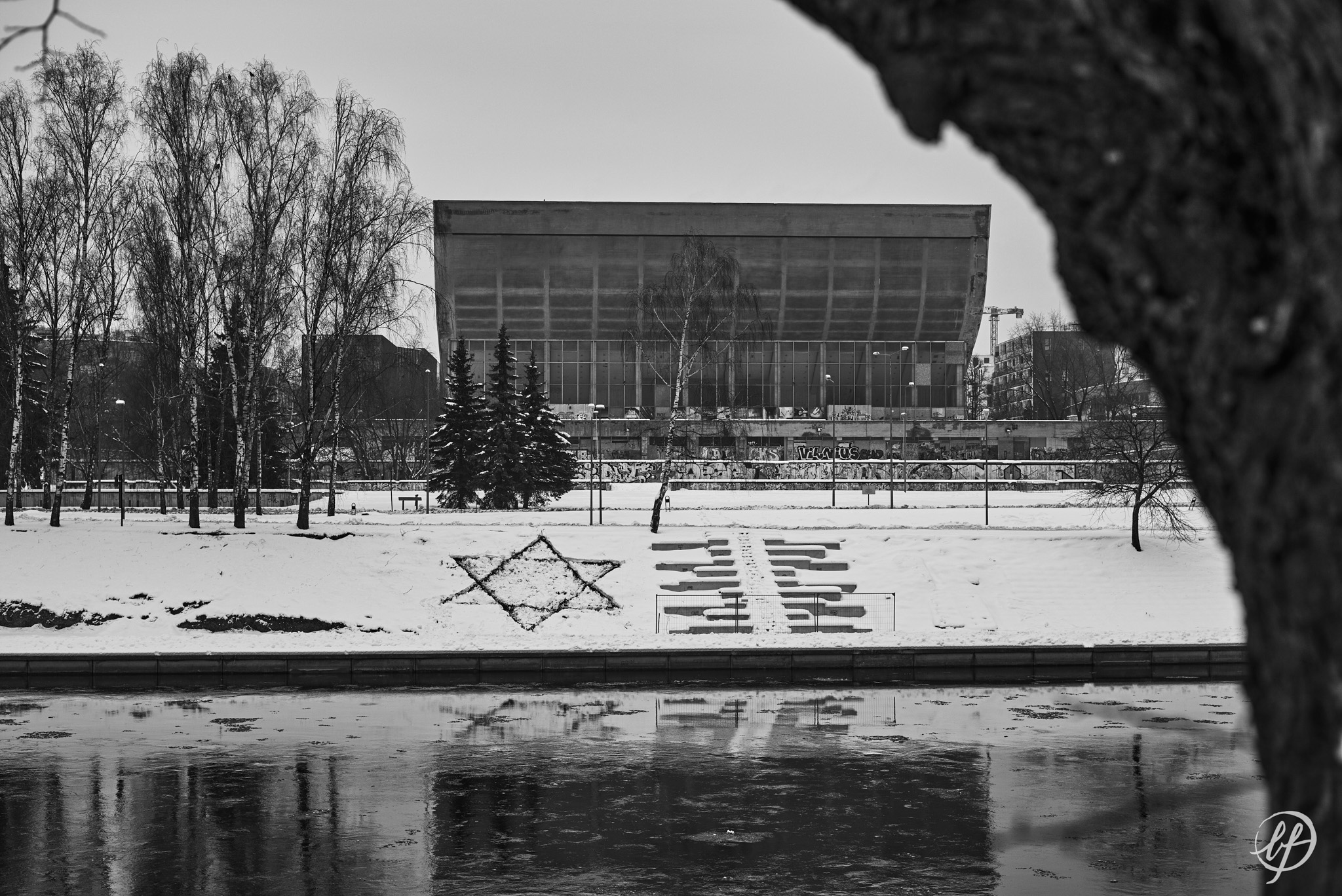
Where the old Soviet Sports Palace stands within the old Cemetery Wall. A group of Lithuanians and Litvaks are working together to ensure that the wall’s historic path will be clearly marked for future generations of visitors to Vilnius.
“Gerbkime kapines” (Respect Cemeteries) at www.kapines.com is our small team of Lithuanians and Litvaks who are working together locally to defend the honor of the oldest Vilnius Jewish Cemetery, known variously as the Piramont or Šnipiškės Cemetery. The Soviets desecrated the site by building a Sports Palace there. The Republic of Lithuania and the City of Vilnius are moving ahead with their plans to open a convention center there in 2023.
Our team is now reaching out internationally with a variety of activities to join or support. We need writers, translators, researcher, web page creators and maintainers, and we also need donations.
◊
◊

The triumphant new visualization of national convention center and “red annex” in the heart of the Old Vilna Jewish Cemetery, produced at last week’s meeting of Vilnius City Council. Omitted at left: the two “green buildings” constructed on the cemetery in 2005-2008. The earth and bones removed have never been made accessible.
◊
On the 8th of July, Vilnius City Council approved the Joint Activity (Partnership) Agreement Between Vilnius City Municipality Administration and State Enterprise Property Bank. The session is available online. The deliberations on the Jewish cemetery are at timecode 19:50 through to 26:43. The new agreement has been heralded, without mention of ongoing opposition, in triumphant mainstream media reports in Lithuanian and English.
The visualizations published show a brand new Caliornia-redoowd colored annex to be built on to the extant Soviet-era derelict former Sports Palace. This comes as a shock to many, as this past January, Lithuania’s ambassador to Israel, HE Lina Antanavičienė, repeatedly promised a group of top Litvak rabbis, on video, that nothing would ever be built outside the confines of the existing building.
One council member, Ms. Evelina Dobrovolska, a lawyer working with the European Foundation for Human Rights, which is (was?) pursuing the preventive case in the courts against restoration of the Sport Palace in the middle of the Old Vilna Jewish Cemetery at Piramónt (in Šnipiškės), left the meeting for that part of the session, as is the custom for those City Council members whose personal commitments may be seen to be a conflict of interest. But that also meant that there was nobody on hand to effectively offer the Second Opinion (including moral and reputational issues, information on the ongoing court case via a European human rights organization, the international petition, and the scope of opposition).
◊
This is a story of seven Jewish women rescued in Telšiai (Yiddish: Telz). They are: Lija Šapiro (Leye Shapiro), Eta Piker, Nija Miselevič (Niye Miselevich), Maša Richman (Masha Richman), Anna Levi, Zlata Chatimlianskaja (Chatimliansky), and Leja Šif (Leye Shif).
But it is first and foremost a story of “the aftermath”: What happened to the Lithuanian rescuers when the war ended?
◊
According to Lithuanian media reports, the nation’s parliament (Seimas) will be declaring the year 2021 to be dedicated to the memory of Juozas Lukša (Daumantas).
Let us assume for the sake of argument that the identification of Mr. Lukša (Luksha) as one of the brutal murderers of defenseless Jewish neighbors in an infamous photo of the Kaunas Garage Massacre of June 1941, best known from Joseph Melamed’s 1999 Crime and Punishment, published by the Association of Lithuanian Jews in Israel, is erroneous. Then, that the reference to Mr. Lukša in the text (p. 38) in a listing of perpetrators (known from a half century of testimonies from the survivor community), and a photo with other alleged collaborators (p. 105), are likewise mistaken. And that the information on the Association’s website, posted during Mr. Melamed’s lifetime, is also in error.
SEE UPDATES
Let us even grant that there is no current courtroom-grade proof for the details of the following text from Holocaust survivor Alex (Alter) Faitelson, in his classic memoir The Truth and Nothing But the Truth: Jewish Resistance in Lithuania (Gefen Publishing House 2006, p. 34). It is a text that includes the author’s recollection from after the war: Lukša’s “photograph was found and shown to witnesses who were interrogated. They all confirmed his participation in the torture of Jews in the garage” (Lithuanian translation). Incidentally, in 1993, Mr. Faitelson was awarded a certificate of honor by Lithuanian president Algirdas Brazauskas. He was not some “enemy of Lithuania” who spent his time making up stories about people. He was a Holocaust survivor, heroic member of the resistance and escape, and renowned memoirist.

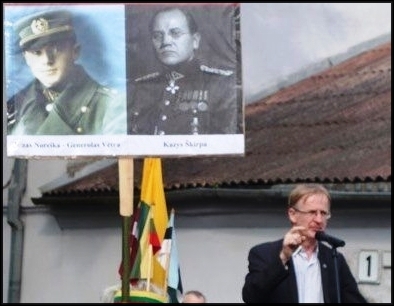
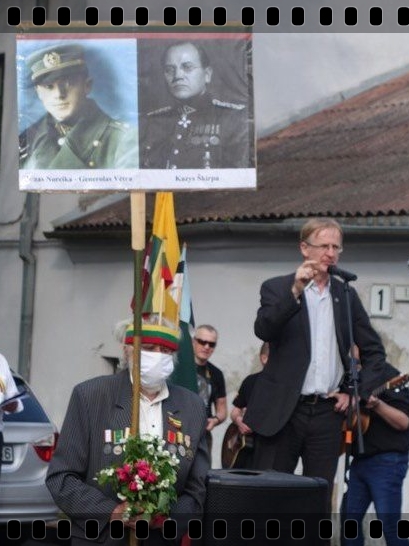
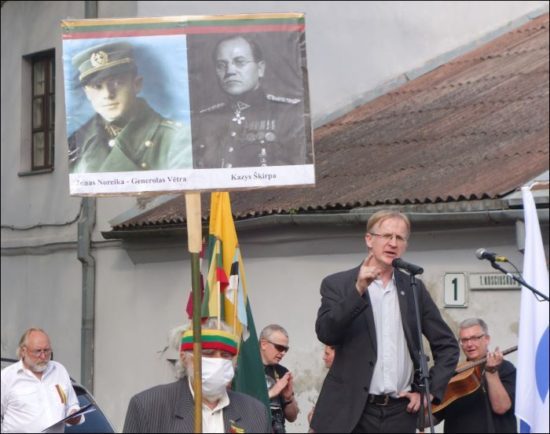
Dr. Arūnas Bubnys, chief historian at the state sponsored “Genocide Center” proudly glorifying June 23rd 1941 under the visages of Holocaust perpetrator J. Noreika (left) and ethnic cleansing advocate K. Škirpa in central Vilnius. Photo: DefendingHistory.com
◊◊
VILNIUS—The good news is that the press conference at the Seimas (Lithuanian parliament) this morning featuring two members of parliament was in the end a small fringe event by the far right, including a renewed attack on Holocaust survivor and resistance hero Dr. Yitzhak Arad, one of the Jewish partisan veterans defamed and harassed by local prosecutors for some years. The evening event in central Vilnius had a dismal turnout of a few dozen people. Both events were dedicated to the glorification of June 23rd, the day the mass murder, injury, plunder and humiliation of Lithuanian Jewry by local Hitler supporters, most prominently the LAF (“Lithuanian Activist Front”) got underway, in a multitude of locations, most lethally Kaunas, before the arrival of the first German forces. Although it is universally accepted by serious historians that the Soviet Army was fleeing Hitler’s onslaught (Operation Barbarossa, the largest invasion in human history), the local far right continues to spew the narrative that this was actually a “rebellion” that “drove out” the Soviet army. (See Defending History’s coverage of previous years’ events and debates, an introductory reading list on the history, and the new English translation of extensive survivor testimonies.)