Politics of Memory
Film, Video, Radio, Music
Respectfully Disagreeing with Professor Timothy Snyder
[last updated]
◊
THE LATEST
Reviews of Bloodlands
Reviews of Black Earth
Instrumentalization?
2012 2013 2014 2015 2016
◊
This journal holds leading historian Professor Timothy Snyder (Yale University) in the highest esteem, and trusts that this select list of reviews taking issue with aspects of Bloodlands of direct concern to DefendingHistory.com will not be taken amiss. It does not include reviews which have engaged in personal attack or pursued grudges, or which focus on other issues.
Continue reading
Wollongong, Australia is a Long Way from Kaunas, Lithuania: Discovering a Holocaust Collaborator Among Us
LITHUANIA | HISTORY | KAUNAS | MUSEUMS
◊
by Michael Samaras
◊
◊
Wollongong, an Australian city located about 80 kilometres south of Sydney, is a long way from Lithuania’s Kaunas, which probably made it attractive to Bronius Sredersas. He arrived in 1950, having fled Lithuania ahead of the Red Army in 1944. For the next 25 years Sredersas, one of more than 100,000 displaced persons to settle in Australia, worked in Wollongong’s steelworks. He led an unobtrusive life and acquired an anglicised nickname, “Bob”. He never married and didn’t waste his money. Instead, he saved his pay, frequented auction houses and with a canny eye built a substantial art collection.
In 1976, Sredersas shocked the citizens of his adopted city by presenting his art collection to them. For an industrial city like Wollongong, which didn’t even have an art gallery, this gift was a sensation. It triggered the establishment of the Wollongong Art Gallery which has since grown into a major regional cultural institution.
Sredersas was widely celebrated in the media and an exhibition space within the new gallery was named in his honor. After his death in 1982, his memory was preserved with eminent persons giving lectures in his memory. The gallery erected a plaque and hosted the Sredersas Dinner as a fundraising social event.
In 2018, the gallery staged a major exhibition celebrating Sredersas. Titled “The Gift”, the exhibition included a recreation of his home, a display of the artworks, a video, and a symposium on his life and benefaction.
Publicity for the exhibition included mention that in Lithuania, Sredersas had been a policeman. While I was aware of Sredersas’ life as a steelworker in Australia, his prior career as a policeman was new to me. I knew though that the Nazis had relied on local collaborators, formed into police battalions, to carry out the Holocaust in Lithuania. I was appalled at the possibility that Wollongong, my home town, might be honoring a Holocaust perpetrator and decided to see if I could find out more.
Will Second Opinions be Heard at Yale-Fortunoff Nov. 9 Event featuring Professors Dieckmann & Snyder?
◊
Will Second Opinions be Heard at Yale-Fortunoff Nov. 9 Event?
Hopefully, families of Connecticut area Holocaust survivors will be included at the event, 5 PM at Luce Hall (room 202)
More on history of the Lithuanian gov. financed “Red-Brown Commission” of which the Yale-Fortunoff speakers are long-standing members
Two truly gifted and prolific scholars are featured on Nov. 9. But both have been extensively instrumentalized by the Lithuanian government for years. Both are veteran members (one for 25 years?) of the state-sponsored “Red-Brown Commission” that has been the engine for Holocaust revisionism in the spirit of Double Genocide and the Prague Declaration in the European Parliament. The commission has caused Holocaust survivors huge pain from day one. The other was brought to Vilnius a decade ago to help cover for (and deflect from) the reburial with full honors of the 1941 Nazi puppet prime minister. Please attend and ask both about the Lithuanian government’s vast “history fixing industry” coming clean on:
(a) the thousands of Jews murdered by Lithuanian Activist Front (LAF) butchers before the first Germans arrived or took over and the state effort to “cancel” this “little fact” from the historical record and narrative;
(b) the state’s current glorification of Holocaust collaborators and perpetrators via street names, plaques, sculptures, and museums;
Yet Again, Naive Foreigners in Awe of Annual PR Show by ‘Red-Brown Commission’ (and its Director who Supports ‘War Crime Investigations’ of Holocaust Survivors)
OPINION | RED-BROWN COMMISSION | MR. RAČINSKAS ON THE HOLOCAUST | LITHUANIA | DOUBLE GENOCIDE
◊
VILNIUS—With nearly all local Holocaust Survivors now gone, or effectively out of public circulation, Lithuania’s “Red-Brown Commission,” a major European engine for the downgrade of the Holocaust via far-right “Double Genocide” history revisionism is again in the forefront of PR efforts to bowl over naive foreign visitors and delegations to this city, particularly on September 23rd each year, with “moving Holocaust elegies.” For Lithuanian Holocaust survivors, the very choice of Sept. 23 (day of the 1943 liquidation of the Vilna Ghetto by the Germans, two years after the murder of the majority of Lithuanian Jews in hundreds of towns across the land) was seen as a decoy. The day each of them had etched in the heart in perpetuity was June 23rd, when in 1941, violence against Jews broke out in hundreds of locations, with murder documented in around forty — before the first German forces arrived or managed to set up their authority. It was the day when six hundred years of peaceful, harmonious coexistence turned overnight, under Hitlerist propaganda, to dehumanization, humiliation, plunder, rape, injury and murder. To this day, an industrial grade revisionist industry continues to obfuscate or outright deny the history of the First Week (i.e. the last week of June 1941). Indeed, June 23rd is celebrated by far-right government historians each year as the date of a supposed “uprising” against the Soviets by the white-armbanded Jew killers who did not “rebel” until the Soviets fled in disarray from Hitler’s invasion, when they began to murder Jewish neighbors across the land unleashing the Lithuanian Holocaust, in which 96.4% of Lithuanian Jewry perished. In 2020, Dr. Arunas Bubnys, the chief historian of the second “Holocaust entity financed by the state,” the Genocide Center, celebrated the “holiday ” alongside banners of two major Holocaust collaborators. He was rewarded a year later with directorship of the Center.
Russian Warship, Go F**k Yourself! (Tale of an Overdue Vilnius Cultural Version)
OPINION | LITVAK AFFAIRS | (AB)USE OF JEWISH STUDIES FOR HISTORICAL REVISIONISM | YIDDISH AFFAIRS | YIVO IN LITHUANIA | MEDIA WATCH | FOREIGN MINISTRIES AND JUDAIC STUDIES | COLLABORATORS GLORIFIED | NOREIKA GLORIFIED
◊
by Julius Norwilla (Vilnius)
◊

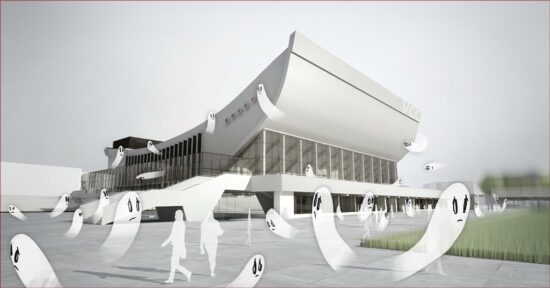
Look what you can see standing right by Vilnius’s Cathedral Square: The Soviet “Sports Palace” ruin that symbolizes not only antisemitism but also: Soviet/Russian Empire spiritual and political domination of Lithuania’s free spirit. High time to be rid of this carbuncle on the beautiful face of modern Vilnius?
◊
The first phase of the eradication of the Old Vilna Jewish Cemetery at Piramónt in Shnípishok — modern Šnipiškės — and of the people buried there, started back in 1830, contemporaneous with an uprising against the Russian Empire. The November Uprising, as it is now known, started with the will to resist the czarist government’s plans to send the army of Poland — at the time an autonomous kingdom within the Russian Empire — to Belgium and France, as well as with the dreams of restoring Polish independence. In 1831, seeing that the uprising for independence would soon take over Vilna, the Russian Imperial government expropriated a section of the Jewish cemetery by the bank of the Viliya (now Neris), and established an artillery citadel to keep the freedom-loving city at all times in the crosshairs of its cannon barrels. But even after the establishment of the citadel, more than three quarters of the actual graves (and their stoness or mini-mausoleums, oyhólim) remained untouched. This legendary cemetery is a Litvak pantheon, a monument to the civilization of Lithuanian Jewry. So it is meaningful that its first phase of destruction got underway just as the Russian imperial government’s project to enhance its military presence in Vilna, by making sure that the city’s inhabitants live in constant fear.

A small section of the Old Vilna Jewish Cemetery at Piramónt. The Soviet Sport Palace was built in its heart. All stones and inscriptions were trashed but thousands of graves survive on all four sides of the building, now an eyesore in the heart of modern Vilnius.
Updates on Kaunas’s ‘Capital of European Culture 2022’ Year Without (So Far) Removing a Single Shrine to Local Holocaust Collaborators
[latest update]
OPINION | LITVAK AFFAIRS | COLLABORATORS GLORIFIED | THE 2022 LEVINAS AFFAIR OF 2022
◊
Congratulations to the city of Kaunas, Lithuania, once known also as Kovno (in Yiddish forever: Kóvne) on its selection as Europe’s “Capital of European Culture” in 2022, sharing the title with Esch-sur-Alzette in Luxembourg. But as the midpoint of the city’s co-reign rapidly approaches, it is necessary, albeit sad, to have to note that not a single public-space glorification of local Holocaust collaborators had been removed. Zero. No city on the planet has as many monuments to local partners in the genocide of that city’s Jews. The 30,000 Litvaks (Lithuanian Jews) of Kaunas were brutally murdered, and the city played the primary role in the launch of the Lithuanian genocide on 23 June 1941, before the arrival of the first German forces. Thousands were murdered before the Germans arrived and/or set up their administration.
See Lev Golinkin’s updated 2022 catalogue in the Forward of public space shrines to Nazi collaborators worldwide
Lithuanian government authorities have reportedly invested large sums to lure “Useful Jewish Idiots” from the UK, US, Israel, and further afield to participate in “cultural events” intended to obfuscate and deflect from the primary issue: Why are the enablers of the slaughter of Kovno Jewry still honored by street names, plaques and university lecture halls and statues in the city? Local Jewish leaders who have dared to speak up have rapidly been smeared as “Putinists” for daring to criticize the far right’s hold over national history policy (and indeed, the need for such a policy to start with).
But in the waning days of 2021, a “waterfall of truth” began to cascade from an unanticipated quarter. Michael Levinas, son of the celebrated Lithuanian-Jewish born French philosopher Emanuel Levinas, forbade authorities to name a fancy new institute after his father. This was kept under wraps until his 21 Dec. Le Figaro opinion piece broke the story, and it was duly reported in Lithuania by LRT.lt. See Defending History’s media tracker page for background and updates.
Are Leaders of Estonia, Latvia, Lithuania, Poland, Romania ‘Taking Advantage’ of Ukraine Tragedy? They Call on EU to Support Far-Right Holocaust-Obfuscating ‘Prague Platform’
Reports in Baltic Times and Delfi
For over a decade Defending History has exposed the far-right”Double Genocide” history-revisionist, Holocaust-obfuscating agenda of the “Prague Platform of European Memory and Conscience” which has repeatedly covered for East European efforts to glorify Nazi collaborators and perpetrators
“Putin’s criminal and barbaric invasion must be countered to the hilt and we must rally unfettered to the cause of Ukraine’s freedom. But for far-right double-genocider revisionists in the Eastern E.U. to take advantage of it for Holocaust obfuscation is just plain wrong.”
Simon Wiesenthal Center’s Efraim Zuroff is first to respond (in Times of Israel blogs)
Will Western leaders — and institutions dedicated to the history of the Holocaust and leaders in Holocaust education and commemoration — speak out and subject the “Prague Platform” to some long overdue scrutiny, and warn the European Commission about this “new initiative”? European citizens’ hard-earned euros continue to flow to the revisionists whose “unholy bible” is still the Prague Declaration of 2008… Defending History is proud to have helped provide the European parliamentary response, the Seventy Years Declaration…
Defending History’s statement on the war in Ukraine
☰
When Ottawa Citizen and The New York Times broke taboo on wartime discussion of East European state-sponsored Holocaust obfuscation
☰
But what is the “Prague Platform”?
Is Walking Down a Street Named for a Murderer Now Considered ‘Holocaust Remembrance’?
Opinion | Collaborators Glorified | Antanas Baltūsis-Žvejas | Politics of Memory | Lithuania | History
◊
by Evaldas Balčiūnas
◊

Just another street name in a pleasant part of Kaunas, this year’s Capital of European Culture? Author thinks that “Kaunas and its people deserve better”…
◊
Antanas Baltūsis-Žvejas (1915–1948) is remembered by the Republic of Lithuania for his anti-Soviet guerilla activities after the war but without regard for the three separate periods of his activity in service to Nazi activities to exterminate the Jewish people. He did indeed join the anti-Soviet partisan resistance movement in the spring of 1945. And, before his death, he did become the head of its Tauras County unit. Those who heroize this period of his activities emphasize his efforts in establishing military discipline and order in the county. His critics, in turn, are more likely to make reference to his order to the Žalgiris Detachment, subordinate to the Tauras County, to annihilate Russian (Soviet) civilian settlers (“colonists”) in Opšrūtai, who had been transferred to Lithuania according to the Soviet-Nazi repatriation agreement (often with little or no input from these folks themselves). Thirty-one persons perished in Opšrūtai, including fourteen children. In the partisans’ descriptions of the battle, it is easy to notice that their task was to eradicate all colonists, including children. Those who justify the atrocity against civilians, including children, say that it was necessary to thwart the russification of Lithuania.
Lithuania’s policy of historical memory was quite straightforward on this issue: it built a monument to the partisans of the Žalgiris Detachment in Opšrūtai. Ethnic cleansing of Jews, if done by “our own nationalist heroes” in Lithuania, is still seen, it seems, as acceptable.
Dr. Bubnys’s New Book on the Lithuanian Holocaust: More Obfuscation and Far-Right History-Spin to Minimize Local Participation?
Opinion | Books | Dr. Bubnys & Official State Holocaust Research in Lithuania | Red-Brown Commission | Genocide Center | Politics of Memory | Lithuania | History
◊
by Evaldas Balčiūnas
◊
Prolific historian, director of the state’s Genocide Center, and far-right activist. On 23 June 2020, Dr. Arūnas Bubnys addressed an ultranationalist rally celebrating the 79th anniversary of Hitler’s invasion (and onset of the Lithuanian Holocaust), flanked by large posters of Jonas Noreika and Kazys Škirpa, two major collaborators in various phases of the genocide of Lithuanian Jewry (96.4% were killed). In his speech he taunted the (silent) DH observers on hand. See reports here and here, and DH’s section on Dr. Bubnys’s work and positions over the years.
◊
Arūnas Bubnys’s book The Holocaust in the Lithuanian Provinces (Holokaustas Lietuvos provincijoje, Margi
raštai, Vilnius, 2021) is another publication of the International Commission for the Evaluation of the Crimes of the Nazi and Soviet Occupation Regimes in Lithuania (ICECNSORL). Up until now, books published by the Commission were academically written and appreciated by a sophisticated readership. Moreover, they were always published in both Lithuanian and English. This book is different. It is available only in Lithuanian. Previously published monographs would also include Commission-approved conclusions; this book has no such thing. As far as I have been able to ascertain, the Commission’s academics did not discuss the book among themselves before its publication. But let’s start at the beginning.
The book is geographically quite extensive: 23 counties and 140 towns are cited. This is really a lot, but it is also quite obvious that the coverage of towns in different counties is unequal. When it comes to Šilutė county in western Lithuania, for example, several camps and fates of individual Jews are mentioned in passing, but no single town is described. For the Marijampolė county, only the fate of the Jews of Marijampolė itself is presented. Šiauliai xounty (15 towns) and Alytus County (12 towns) are the most extensively covered.
New York Jewish Museum: Latest to be Duped into “Legitimizing” Lithuanian Far-Right Holocaust Revisionism?
MUSEUMS | JEWISH EVENTS ABUSED TO MAKE “KOSHER” HOLOCAUST REVISIONISM | POLITICS OF MEMORY | COLLABORATORS WHITEWASHED
◊
Is New York City’s Jewish Museum the Latest Western Jewish Institution to be Duped into “Legitimizing” Lithuanian Nationalists’ Far-Right Holocaust Revisionism?
See Michael Casper’s new exposé in Jewish Currents
Are “useful Jewish idiots” addicted to photo-ops, funding and junkets being duped into joining “Kaunas Capital of European Culture 2022” year? (without Kaunas removing a single public monument to Holocaust perps)
For background see Defending History’s coverage of the revisionists’ “Jewish cover-it-up investments” over more than a dozen years
Andrius Kulikauskas on the Greimas exhibit at Lithuania’s National Mažvydas Library (2017); on the Library’s setting up of the Adolfas Damušis Center glorifying a Nazi collaborator (2017)
Dovid Katz on the (ab)use of East European museums to “legitimize” Double Genocide and far-right Holocaust revisionism; Defending History’s Museums section
Exotic Antisemitism? Declaring a Soviet Ruin to be a National Treasure — to Keep an Old City-Center Jewish Cemetery Verily Underground?
OPINION | ANTISEMITISM | OLD VILNA JEWISH CEMETERY | CEMETERIES | HUMAN RIGHTS | LITVAK AFFAIRS
◊
by Dovid Katz
◊
Antisemitism takes many forms in the twenty-first century. It includes the religion-based, the anti-Israel-based, the globalization-based, the envy-based, and the drunk-violence based — all the way to sophisticated and elegant forms that are so sublimated that it is hard to discern what’s what. In Eastern Europe, some rather exotic forms flourish: hatred of remnant local Jewish communities (who know the truth about the Holocaust-relevant roles played by local nationalists during the Holocaust years of 1941-1944/45) alongside love of rich, distant foreign Jews (who can be charmed right to the high heavens with medals, junkets and photo-ops to help underpin Double Genocide revisionism — and sometimes cover for glorification of local collaborators — as part, naturally, of “Holocaust remembrance” or “commemoration of the victims of equal genocidal regimes”).
Then there is the occasionally encountered East European love of substantial Jewish sacred sites that are suitably far from the center of town (“best place is the forest, you know!”) and provide a fine niche in-season tourism without upsetting the ethnic-purity concocted versions of town-center history that want it to be say pure Ukrainian (Lviv/Lvov/Lemberg), pure Latvian (Riga), or pure Lithuanian (Vilnius/Vilna/Wilno/Vílne).
The hard fought battle to keep the convention center out of the old Vilna Jewish cemetery was won last summer (report in the AJ). It will go down in history as a victory for Lithuania and all the country’s true friends. Now comes Part II.
A Jewish Museum Without a Single Jewish Staff Member? (in a country with 3,000 Jewish citizens)
[UPDATE / original publication 1 Feb. 2022]
Opinion | Sheduva, Lithuania | Museums | Litvak Affairs
◊
2022 is “Can you imagine?” year…
Can you imagine a museum in South Africa dedicated to the history of Apartheid without a single African member of staff on site?
Can you imagine a museum in Mississippi on Confederate state slavery without a single African American member of staff on site?
Can you imagine a museum of Lithuanian shtetl history in Lithuania without a single Jewish member of staff on site?
Yes.
News and Views on a ‘Levinas Center’ in Kaunas that May Serve PR Interests of Deflecting from City’s Shrines to its Holocaust Perpetrators
[UPDATED]
LEVINAS CENTER IN KAUNAS | FRANCE | KAUNAS | GLORIFICATION OF COLLABORATORS | BALTIC JEWISH INVESTMENTS THAT DEFLECT FROM HOLOCAUST REVISIONISM
◊
Tracking media coverage.
Composer and pianist Michael Levinas, the son (and heir and exclusive legal holder of the moral rights to his father’s works) of French philosopher Emmanuel Levinas, has publicly protested Lithuania’s naming an institute in Kaunas for his father. See his op-ed in Le Figaro (21 Dec. 2021) [in English]) and his interview in Actualité Juive (13 Jan. 2022) [in English]). Initial coverage by JTA (19 Jan.) does not mention Michael Levinas’s protest, but unusually, the protest has been covered in some detail by Lithuanian mainstream media’s Lrt.lt (9 Jan., updated 17 Jan. 2022) which reported on the refusal of the French Embassy in Vilnius to send any representation to the center’s opening ceremony in Dec. 2021. A report also appeared on the website of the official Lithuanian Jewish Community (10 Jan.). However, a second local Kaunas community posting on 12 Jan. was alone cited by the European Jewish Congress website as an uncontroversial news item.
“Question on everybody’s mind”:
Will the Levinas Center leaders, staff, sponsors and visitors politely ask, with dignity, that the city of Kaunas now, in its year as “Capital of European Culture” rapidly remove state-sponsored shrines to the local murderers of Levinas’s family and the other 30,000 Jewish citizens of Kaunas? Or will the Levinas Center become one of the “Useful Jewish Idiot (UJI) addresses” that are used to cover for current Kaunas policies of glorification of Nazi perpetrators, while providing handsome photo-ops, lavish hospitality and generous amenities to visiting foreign Jewish dignitaries who maintain studious silence on current policies of honoring Holocaust collaborators in the public space (in some cases, a very short walk from the new “Levinas Center”).
French Composer and Pianist Michael Levinas, Son of Philosopher Emmanuel Levinas, Explains Opposition to Wanton Use of Father’s Name in Kaunas’s New ‘Levinas Center’
OPINION | USE OF ‘JEWISH PROJECTS’ TO DEFLECT FROM HOLOCAUST OBFUSCATION | ‘LEVINAS CENTER’ | LITVAK AFFAIRS | KAUNAS | FRANCE
◊
PARIS—The French Jewish journal Actualité Juive published in its print edition a full-page interview (as PDF) with the eminent French composer and pianist Michaël Levinas, concerning his protest at a new center in Lithuania’s second city, Kaunas (once Kovno, Yiddish Kóvne), being named for his late father, the great French philosopher Emmanuel Levinas (1906-1995). An authorized translation is available. Coinciding with the European Union’s naming of Kaunas as “Capital of European Culture” for 2022 and the city’s refusal to remove even one of the many street names, shrines, plaques and monuments to local Nazi collaborators who helped ensure the massacre of nearly all the city’s Jewish residents in 1941, and who participated in the unleashing of the Holocaust in Lithuania even before the arrival of the first German soldiers in late late 1941, the composer’s powerful moral protest represents a singular voice of justice, reason and moral courage to date.
See also op-ed in Le Figaro
&
Levinas Center Media Tracker
The composer’s stance stands in marked contrast with many others, including artists, assorted academics and a wide range of Western wannabees, who are accepting funding, honors, junkets, invites, and photo-ops with “important people” in return for an unspoken assurance of silence in face of the city’s refusal to take down a single shrine to the local perpetrators of the Holocaust.
The following is a PDF of Michaël Levinas’s interview in the print edition of Actualité Juive of 13 January 2022:
A Simple Victory for Decency and European Values in Zedelgem, Belgium: Waffen SS Monument is Coming Down
ZEDELGEM | BELGIUM | EU | LATVIA | GLORIFICATION OF COLLABORATORS
◊
by Roland Binet (De Panne, Belgium)
The city council of Zedelgem, Belgium decided on December 3rd that the pro-Nazi Latvian “Beehive” monument, commemorating Latvia’s Hitlerist Waffen SS, will be removed. Three years ago, in a somewhat insidious and perverse manner, PR savvy reps of Riga’s “Occupation Museum” convinced the municipal council of Zedelgem in West-Flanders, Belgium, to allow them to unveil a monument honoring their wish for de facto whitewashing and heroizing of the 12,000 Latvian Waffen SS Legionnaires who had been detained in in a British detention camp in that town in 1945/1946. Indeed, the president of the board of directors of the Occupation Museum of Riga – a well-known Holocaust revisionist institution – and members of Dagavas Vanagi (an organization of former Latvian Waffen SS) were present for the monument’s festive launch. That event was primarily covered by the Flemish speaking press without any mention of possible issues, without in fact anybody asking any question of how it might have been possible that a Flemish town had allowed the construction of a monument in honor of former members of the Waffen SS, a Nazist organization whose members swore loyalty to Adolf Hitler, and who fought against the freedom of Belgium, and, in effect, all of Europe.
Over In Zedelgem, Town in Belgium where Latvian Waffen SS Veterans Feel Most at Home
OPINION | ZEDELGEM | BELGIUM | EU | GLORIFICATION OF COLLABORATORS
◊
by Roland Binet (De Panne, Belgium)
Zedelgem, a quiet Flemish town in West Flanders, was occupied by the Nazis between May 1940 and September 1944. During World War I it had also been under German yoke for over four years.
Now, 74 years after the end of the the Second World War, former Latvian Waffen SS men, who wore the same barbarians’ uniform as the occupiers of Zedelgem during the occupation, who fought for the same ideals and were condemned by the same Nuremberg Trials of 1945/1946 as members of a criminal organization, now, more than seven decades after Waffen SS men being freed from an Allied POW camp situated in Zedelgem, these former Latvian SS men and their current far-right, neo-Nazi and Hitler-sympathetic admirers have convinced Flemish officials — many report more than a little impetus to call them morons, plain and simple — in and in the region of modern Zedelgem to enable them to erect a monument to “Liberty” in their memory. A monument to Liberty! The very Liberty they had denied the 100,000 Jews killed in their native country and the dozens of thousands of innocent Soviet citizens of an array of nationalities and religious they killed while fighting in the USSR, near Leningrad and at other fierce, lethal battles. They wore the same barbarians’ uniforms as the Nazi occupiers of Belgium and Zedelgem. They all fought for the Führer to whom they had sworn a common oath of loyalty. They too fought for the same ideals as the Führer.