MUSEUMS | JEWISH EVENTS ABUSED TO MAKE “KOSHER” HOLOCAUST REVISIONISM | POLITICS OF MEMORY | COLLABORATORS WHITEWASHED
◊
◊
◊
◊
Antisemitism takes many forms in the twenty-first century. It includes the religion-based, the anti-Israel-based, the globalization-based, the envy-based, and the drunk-violence based — all the way to sophisticated and elegant forms that are so sublimated that it is hard to discern what’s what. In Eastern Europe, some rather exotic forms flourish: hatred of remnant local Jewish communities (who know the truth about the Holocaust-relevant roles played by local nationalists during the Holocaust years of 1941-1944/45) alongside love of rich, distant foreign Jews (who can be charmed right to the high heavens with medals, junkets and photo-ops to help underpin Double Genocide revisionism — and sometimes cover for glorification of local collaborators — as part, naturally, of “Holocaust remembrance” or “commemoration of the victims of equal genocidal regimes”).
Then there is the occasionally encountered East European love of substantial Jewish sacred sites that are suitably far from the center of town (“best place is the forest, you know!”) and provide a fine niche in-season tourism without upsetting the ethnic-purity concocted versions of town-center history that want it to be say pure Ukrainian (Lviv/Lvov/Lemberg), pure Latvian (Riga), or pure Lithuanian (Vilnius/Vilna/Wilno/Vílne).
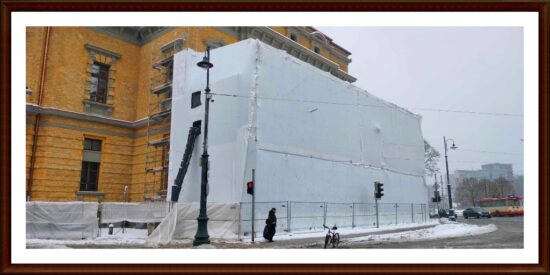
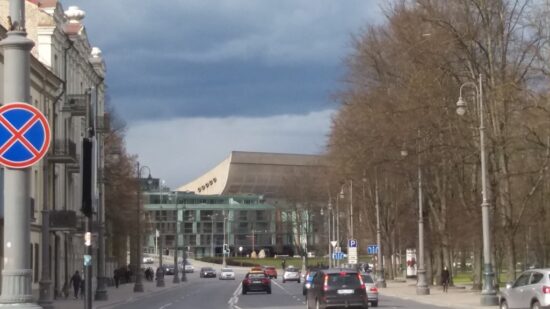
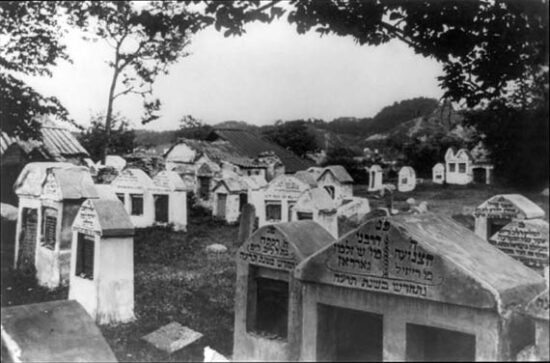
The hard fought battle to keep the convention center out of the old Vilna Jewish cemetery was won last summer (report in the AJ). It will go down in history as a victory for Lithuania and all the country’s true friends. Now comes Part II.
◊
◊
Tracking media coverage.
Composer and pianist Michael Levinas, the son (and heir and exclusive legal holder of the moral rights to his father’s works) of French philosopher Emmanuel Levinas, has publicly protested Lithuania’s naming an institute in Kaunas for his father. See his op-ed in Le Figaro (21 Dec. 2021) [in English]) and his interview in Actualité Juive (13 Jan. 2022) [in English]). Initial coverage by JTA (19 Jan.) does not mention Michael Levinas’s protest, but unusually, the protest has been covered in some detail by Lithuanian mainstream media’s Lrt.lt (9 Jan., updated 17 Jan. 2022) which reported on the refusal of the French Embassy in Vilnius to send any representation to the center’s opening ceremony in Dec. 2021. A report also appeared on the website of the official Lithuanian Jewish Community (10 Jan.). However, a second local Kaunas community posting on 12 Jan. was alone cited by the European Jewish Congress website as an uncontroversial news item.
“Question on everybody’s mind”:
Will the Levinas Center leaders, staff, sponsors and visitors politely ask, with dignity, that the city of Kaunas now, in its year as “Capital of European Culture” rapidly remove state-sponsored shrines to the local murderers of Levinas’s family and the other 30,000 Jewish citizens of Kaunas? Or will the Levinas Center become one of the “Useful Jewish Idiot (UJI) addresses” that are used to cover for current Kaunas policies of glorification of Nazi perpetrators, while providing handsome photo-ops, lavish hospitality and generous amenities to visiting foreign Jewish dignitaries who maintain studious silence on current policies of honoring Holocaust collaborators in the public space (in some cases, a very short walk from the new “Levinas Center”).
◊
PARIS—The French Jewish journal Actualité Juive published in its print edition a full-page interview (as PDF) with the eminent French composer and pianist Michaël Levinas, concerning his protest at a new center in Lithuania’s second city, Kaunas (once Kovno, Yiddish Kóvne), being named for his late father, the great French philosopher Emmanuel Levinas (1906-1995). An authorized translation is available. Coinciding with the European Union’s naming of Kaunas as “Capital of European Culture” for 2022 and the city’s refusal to remove even one of the many street names, shrines, plaques and monuments to local Nazi collaborators who helped ensure the massacre of nearly all the city’s Jewish residents in 1941, and who participated in the unleashing of the Holocaust in Lithuania even before the arrival of the first German soldiers in late late 1941, the composer’s powerful moral protest represents a singular voice of justice, reason and moral courage to date.
See also op-ed in Le Figaro
&
Levinas Center Media Tracker
The composer’s stance stands in marked contrast with many others, including artists, assorted academics and a wide range of Western wannabees, who are accepting funding, honors, junkets, invites, and photo-ops with “important people” in return for an unspoken assurance of silence in face of the city’s refusal to take down a single shrine to the local perpetrators of the Holocaust.
The following is a PDF of Michaël Levinas’s interview in the print edition of Actualité Juive of 13 January 2022:
◊
The city council of Zedelgem, Belgium decided on December 3rd that the pro-Nazi Latvian “Beehive” monument, commemorating Latvia’s Hitlerist Waffen SS, will be removed. Three years ago, in a somewhat insidious and perverse manner, PR savvy reps of Riga’s “Occupation Museum” convinced the municipal council of Zedelgem in West-Flanders, Belgium, to allow them to unveil a monument honoring their wish for de facto whitewashing and heroizing of the 12,000 Latvian Waffen SS Legionnaires who had been detained in in a British detention camp in that town in 1945/1946. Indeed, the president of the board of directors of the Occupation Museum of Riga – a well-known Holocaust revisionist institution – and members of Dagavas Vanagi (an organization of former Latvian Waffen SS) were present for the monument’s festive launch. That event was primarily covered by the Flemish speaking press without any mention of possible issues, without in fact anybody asking any question of how it might have been possible that a Flemish town had allowed the construction of a monument in honor of former members of the Waffen SS, a Nazist organization whose members swore loyalty to Adolf Hitler, and who fought against the freedom of Belgium, and, in effect, all of Europe.
◊
Zedelgem, a quiet Flemish town in West Flanders, was occupied by the Nazis between May 1940 and September 1944. During World War I it had also been under German yoke for over four years.
Now, 74 years after the end of the the Second World War, former Latvian Waffen SS men, who wore the same barbarians’ uniform as the occupiers of Zedelgem during the occupation, who fought for the same ideals and were condemned by the same Nuremberg Trials of 1945/1946 as members of a criminal organization, now, more than seven decades after Waffen SS men being freed from an Allied POW camp situated in Zedelgem, these former Latvian SS men and their current far-right, neo-Nazi and Hitler-sympathetic admirers have convinced Flemish officials — many report more than a little impetus to call them morons, plain and simple — in and in the region of modern Zedelgem to enable them to erect a monument to “Liberty” in their memory. A monument to Liberty! The very Liberty they had denied the 100,000 Jews killed in their native country and the dozens of thousands of innocent Soviet citizens of an array of nationalities and religious they killed while fighting in the USSR, near Leningrad and at other fierce, lethal battles. They wore the same barbarians’ uniforms as the Nazi occupiers of Belgium and Zedelgem. They all fought for the Führer to whom they had sworn a common oath of loyalty. They too fought for the same ideals as the Führer.
◊
VILNIUS—Two days before tomorrow’s government-sponsored international “academic” conference (on September 10) that glorifies alleged 1941 Holocaust perpetrator Juozas Lukša (without a single paper devoted to the issue of his Kaunas 1941 Holocaust participation), the foreign minister led a high-end Holocaust remembrance ceremony (yesterday, 8 Sept.) bewailing the calamity of the Holocaust and its scale in Lithuania. That ceremony dated the onset of the Lithuanian Holocaust to the first week of September, when the Nazis set up the Vilna Ghetto, and others.
◊

Carbuncle in the heart of the EU? Monument in Belgium glorifies Latvian Waffen SS who fought for Hitler
Note: for background on the monument to Latvian SS war criminals in Zeldelgem, Belgium, please see DH’s Zedelgem section, and for Latvia more generally, Roland Binet’s contributions and DH’s Latvia section.
◊
Flemish historian Pieter Lagrou had this to say in an exchange of correspondence pertaining to the quandary of what to do with that monument in Zedelgem glorifying Latvian Hitlerist Waffen SS men. It so happens that he is the one whose official opinion in this matter will be asked on how to further proceed with the “Latvian Beehive” as the pro-Nazi monument on Belgium soil is known:
◊
VILNIUS—Not for the first time, the annual Jewish High Holiday period encompassing Rosh Hashonna and Yom Kippur have provided “optimal timing” for state-sponsored activities glorifying Holocaust collaborators and perpetrators. Lithuania’s Seimas (parliament) had declared that the year per se, 2021, would be dedicated to the memory of Juozas Lukša, identified by eyewitnesses as one of the barbaric butchers of Jews in the Lietukis Garage Massacre in Kaunas in June 1941, during the week when fascist “LAF” (Lithuanian Activist Front) Hitlerist thugs murdered thousands of Jewish neighbors before the Nazis had even taken control. In 2011 a motion in the British Parliament referred to testimony that Lukša was also involved in the beheading of Rabbi Zalmen Osovsky the same week.
“The hard-working people of Lithuania deserve much better than for their tax euros to be squandered by ultranationalist leaders on state glorification of Hitler accomplices.”
This week’s festivities included, on 4 September 2021, a speech by the president of Lithuania to honor Lukša, a brand new Lukša monument unveiled to in a village where he operated, with participation by the director general of the Genocide Center, Dr. Arūnas Bubnys. The monument was “consecrated” by a major bishop who holds the title “president of the Commission on the External Relations of the EU”.
◊
VILNIUS—Deans (rosh-yeshivas, Heb. roshei-yeshiva) of three of the world’s greatest Lithuanian tradition (Litvak) yeshivas, located in the United States and Israel, all proud to bear the Yiddish names of the Lithuanian cities from which they hail, today released a letter to Ingrida Šimonytė, prime minister of Lithuania, expressing admiration and gratitude for her recent suspension of the project to situate a national convention center in the heart of the Old Vilna Jewish Cemetery at Piramónt (in the Shnípishok/Šnipiškės district of modern Vilnius), where thousands would cheer, sing and revel surrounded by multitudes of graves going back over half a millennium.
The project has, in some eyes, tarnished Lithuania’s image over the last seven years, eliciting considerable local and international opposition. Today’s public congratulations from three of the top Lithuanian yeshiva deans, who carry on the traditions of the Gaon of Vilna and numerous other Lithuanian rabbinic luminaries, is widely seen, in the broader context, to help Lithuania rapidly surmount recent setbacks and embark on a new era of Lithuanian-Jewish (and more generally, crosscultural) harmony in the run-up to international celebration of the 700th birthday of the founding of Vilnius (Vilna, Vílne, Wilno) coming up in 2023.
The following English text is a translation from the Hebrew original.
◊
VILNIUS—The following is Defending History’s translation of the text of today’s Vilnius City Council resolution posted on its website. See our report, and the earlier news of the prime minister’s widely heralded cancellation of CCC (“convention center in the cemetery”) to which this resolution is a direct response. See esp. the paragraph colored red below for rapid reference, where the resolution condemns the government’s “abandonment” of the CCC.
◊
VILNIUS CITY COUNCIL
RESOLUTION
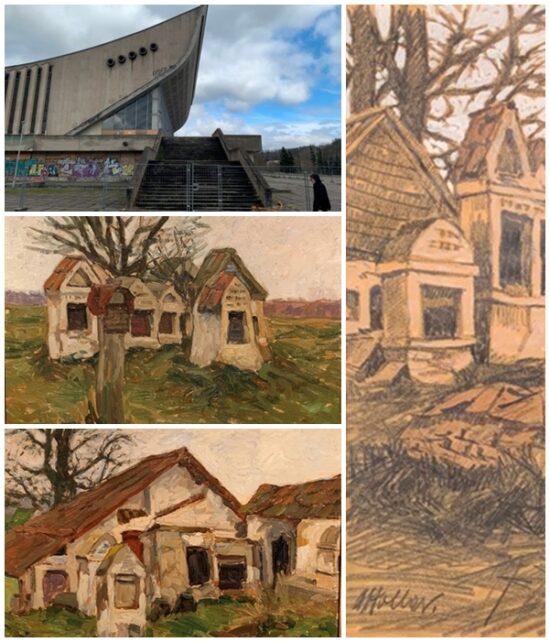
ON VILNIUS PALACE OF CONCERTS AND SPORTS
August 25, 2021, No. 41
22 April 2006. Article in Respublika accuses Dr. Yitzhak Arad, Holocaust survivor, resistance hero, veteran of the Israeli war of independence and long-time director of Yad Vashem, of being a war criminal on the basis of misquoted, decontextualized passages in his own 1979 book, The Partisan. [ADDENDUM of April 2014: One of the chief stone-throwers (final section) is A. Anušauskas, who is today a member of the state’s commission on Nazi and Soviet crimes. In 2006 he was “scientific editor” at the Genocide Center. Since 2008 he has been a member of parliament where he was for some years chair of the Committee on National Security and Defense.]
♦
10 September 2007. Prosecutors in Lithuania confirm that their investigation of Holocaust survivor, anti-Nazi resistance hero and former director of Yad Vashem Dr. Yitzhak Arad, on suspicion of “crimes against humanity” had been initiated in May 2006. The “investigation” was based on an article in the antisemitic daily Respublika (22 April 2006), in which the special prosecutor and head of the Genocide Center are extensively quoted. In June 2006 the daily triumphantly proclaimed that prosecutors were acting on its earlier article. English summary. See below at 25 September 2008 for “conclusion” of the investigation and the 2010 report of the “Lithuanian Human Rights Association” . . . In 2014, ongoing defamation evident from Wikipedia entry.
♦
29 January 2008. Article in the daily Lietuvos aidas that called on prosecutors to investigate Fania Yocheles Brantsovsky and Dr Rachel Margolis. English translation.
6 April 2008. Professor Dov Levin of Jerusalem protests, returning his own earlier award to the president of Lithuania.
30 April 2008. The Embassy of the United States in Lithuania issues a certificate of appreciation, signed by Ambassador John A. Cloud, to Fania Yocheles Brantsovsky; presented by political officer Joseph Boski at a luncheon organized by the Vilnius Yiddish Institute.
◊
VILNIUS—Famed Lithuanian playwright Marius Ivaškevičius interviewed Dovid Katz as his Vilnius apartment on 20 March 2017 as part of the filming for Tzvi Kritzer’s documtentary “The Last Sunday in August” about the slaughter of the Jews of Malát (today: Molėtai) Lithuania. The much more general interview offers sweeping discourse on the Lithuanian Holocaust and its legacies, and sundry difficult related issues. There was a cameo appearance by the film’s producer Tzvi Kritzer. The footage released is unedited but not complete. Unfortunately, the beginning, with Marius’s detailed opening statement and set of questions, is missing from this footage. The documentary, released in 2018, is on youtube.
◊
VILNIUS—Alan Dershowitz, often deemed to be America’s leading constitutional lawyer, confirmed to Defending History this morning that the following statement, that has been circulating in emails and social media, is wholly accurate. This is the precise text sent to DH by Professor Dershowitz:
“The 2015 Seimas resolution green-lighting the conference center on the Shnipishok cemetery in Vilna, Lithuania, undermines the provisions of the Lithuanian Constitution, Articles 22 and 26. These respective provisions in the Constitution protect religious freedom and religious institutions.
“Beyond raising a compelling constitutional issue, this resolution is wrong as a matter of justice, historical preservation, basic decency and the dignity of the dead.”