SYMBOLOGY | THE TEN-EURO “GAON COIN” | ABUSE OF JEWISH PROJECTS | THE “FAKE LITVAK” INDUSTRY | HUMAN RIGHTS
◊
◊
◊
◊
Here is a list of 259 shtetls, large and small Lithuanian Jewish communities, which were located within what are now the boundaries of modern day Lithuania (many Litvaks hail from classical Lithuanian lands now in neighboring states, see map). Each row provides the Lithuanian name of the city or town, the Yiddish name in Latin letters and Hebrew letters, possibly with variant spellings, following Dovid Katz’s provisional online list (linked to a map), and also the name of the current representative in Seimas, Lithuania’s parliament, a link to their web page, and finally, their official email address.
Seimas is the Lithuanian parliament. Its members serve four year terms. Half of them are elected through nationwide party slates and the other half represent electoral districts. The district boundaries can change with each election. The list below shows the representatives elected in the October 2020 election. See Seimas’s own English language page for photos of each, and each member’s political affiliation.
Lithuanians and Litvaks from around the world have many good reasons to write to the members in Seimas representing their ancestral homelands. These members can act on issues of local heritage and also speak out on matters of national policy. Indeed, many national issues are well pursued by building relationships with members of Seimas in districts throughout Lithuania. This is certainly the case with defending the old Vilnius Jewish Cemetery in Piramónt-Šnipiškės.
Members of Seimas or their assistants can also be helpful in making contacts with local authorities such as mayors and aldermen.
A heartfelt thank you for all who responded to our urgent call to write the Budget and Finance Committee of Lithuania’s Seimas (Parliament), which met on November 11, 2020. The Committee acknowledged that it received recommendations from 54 groups and individuals to not finance the reconstruction of the Vilnius Concert and Sports Palace Building Complex, which the Soviets built in the center of the historic Jewish cemetery at Piramónt-Šnipiškės. The Committee neither approved nor rejected this proposal but simply passed it on to the Lithuanian government.
At this stage in the budget process, we urge concerned readers to send a second email to the Seimas leadership, as described below, before the Seimas’s crucial session on November 24, 2020.
◊
Iconic roof of the dereleict Soviet sports palace in the heart of the Old Vilna Jewish Cemetery. Graphic by D. Umbrasas / Lrt.lt. In the original publication.
Vilnius’s historical and literary sources confirm that there are a number of burial sites in the city, mostly near Christian and Orthodox churches. Larger cemeteries, including Rasos, Antakalnis (soldiers), Bernardines, Orthodox (Liepkalnis), Jewish cemeteries (Piramont / Snipiskes and Zarétshe / Olandų), Evangelicals (Kalinauskas) and others. The legal regulation of Vilnius city cemeteries started only in the second half of the eighteenth century, when cemeteries near Christian and Orthodox churches were full to capacity (burials ceased in 1865) and separate parishes began burials outside the city.
As readers of Defending History know from Julius Norwilla’s recent article, this week is the rare and perfect opportunity for our concerns about the fate of the Vilnius Jewish Cemetery at Piramónt to be heard by Lithuania‘s Seimas.
The Seimas (Lithuanian parliament) is approving a package of investments that it will be making in 2021-2023 to pump Lithuania‘s economy as it battles the pandemic. Among the 49 billion euros of expenditures is a line item of 27 million euros for reconstruction of the Vilnius Sports and Congress Building Complex Project. (See page 3 here and page 84 here). In other words, this is money that will fund the endless desecration of the oldest Jewish Cemetery in Vilnius.
◊
◊
VILNIUS—Lithuania’s parliament (the Seimas) has published the provisional state budget for 2021, along with a timetable specifying that the final date for protests, submissions, and comments from outside organizations (non-governmental and presumably including religious and human rights groups) is the 10th of November.
The budget links to the Ministry of Finance page where the project to erect the new national convention center (not mentioned: in the heart of the Old Vilna Jewish Cemetery), is explicitly cited in a list of other projects that do in fact enhance our nation’s economy:
◊
◊
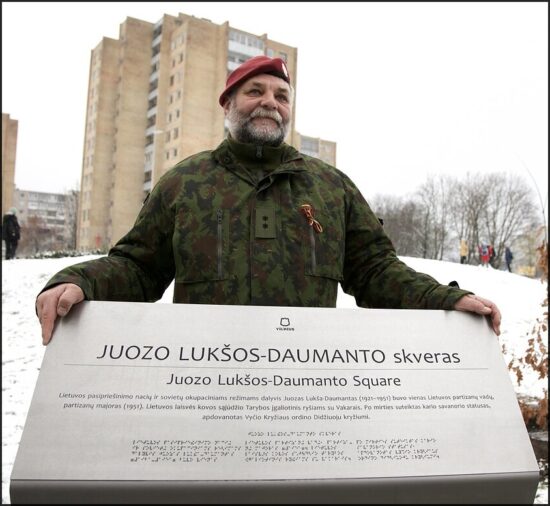
I respectfully call on members of the Lithuanian Parliament (Seimas), to read pp. 33-34 in my father’s book, The Truth and Nothing But the Truth (Gefen Publishing, Jerusalem & New York 2006), and to reconsider the tragically misguided proposal to name 2021 for Juozas Lukša (Luksha), a participant in atrocities committed against the peaceful Jewish citizens of Kaunas (Kovno) in the last week of June 1941, when massive local violence broke out before the invading German army had set up its authority.
I would like to emphasize that in his books, my father Alex (Alter-Henoch) Faitelson (1923–2010) provided a meticulously researched description of those tragic events of the Lithuanian Holocaust. As a professional auditor who worked for a major Israeli bank for over twenty-five years, he adhered to very strict rules also in his studies of the Holocaust. He repeatedly encountered and tested — corroborating or rejecting — details of testimonies of his former comrades in the anti-fascist struggle and Holocaust survivors more generally. In the same book, he included chapters “Forgery, Communist Style” (chapter 20), “The Tricks of Memory” (21), and “Everyone’s a Hero” (22), titles that speak for themselves to anyone in the field. In fact, these are part of a larger five-chapter section called Legends and Fables.
◊
The Nazis wanted to exterminate a race and Karl Marx wanted to exterminate a social class. Our guide at the House of European History museum (HEH) in Brussels is twisting her tongue as she tries to solve the task of simultaneously explaining that Communism and Nazism are the same thing, and yet, somehow not. Visually, the impression of the museum’s exhibition is overwhelmingly slanted toward the notion that they are fully, inexorably and inherently equivalent.
Towering above us in the ideologically most intense part of the museum are huge video screens tilted towards the visitor. These screens, on four islands in the room, are so large that in spite of the hall being generously spacious, they fill up the room. The spectator can feel small in their shadow. On the screens the masses march in honor of the dictator, people are violently oppressed and the imagery makes this museum’s point very clearly: the interwar period was marked by the very same conflict as that after the war until the Soviet Union collapsed and the Berlin wall fell. That single conflict that is posited as God’s-honest-truth-fact is between Western democracy and (any kind of) totalitarianism. The technically impressive format is meticulously balanced: two huge screens each for the horrific methods of Communism and Nazism. The similarity is indeed visually striking. Stalin and Hitler—in that order— are omnipresent in the midst of terror. As a climax, the hammer and the sickle are projected at the same time as the swastika in meticulously equal format.
◊
VILNIUS—There were three observers present at this morning’s Vilnius County Court hearing in the case over the Old Vilna Jewish Cemetery at Piramónt (in the Shnípeshok / Šnipiškės district): Ruta Bloshtein (author of the international petition that has garnered 52,000 signatures), Edmundas Kulikauskas who has appeared at a number of “Gerbkime kapines” (Respect Cemeteries) events supporting the cemetery’s preservation, and Arkady Kurliandchik, elected board member of the Vilnius Jewish Community.
“Defending History was there”
The attorneys for Turto Bankas expressed their impatience and dissatisfaction with the case’s continuation, which they pointed out further postpones the onset of building works on site. The judge, for her part, was concerned about the apostillary status of the affidavits received as well as an original of the classic prewar map of the cemetery appended by scholar Joseph Klausner to his 1935 book on the subject. At last week’s hearing, reported on in DH and the Algemeiner Journal, star witness Prof. Josif Parasonis, one of Lithuania’s major specialists in building sciences and a cofounder of the current Vilnius Jewish Community, pointed out that the Historical Institute in Vilnius had, in its report, carelessly superimposed the Klausner map on modern maps, falsely leaving the Sports Palace building outside the cemetery, and, Prof. Parasonis pointed out to the judge, serving to place many of the historic graves, ridiculously, right in the middle of the nearby river (the Neris, known also as the Viliya).
The judge, who also called for the plaintiffs to present proof of their descendance from persons buried in the cemetery, adjourned the hearing to 24 November.
◊
Seven years ago, this journal’s opinion section cheered the decision to finally, for the first time, honor one of the real Lithuanian heroes of the Holocaust era, the Rescuers, also known as Righteous of the Nations, in Vilnius. While praising the decision to so honor the inspirational Ona Šimaitė (1894–1970), Defending History lamented the decision to do so out in a suburb just north of the city. The name of our editorial in 2013 was “Vilnius Street Name Proposed for Rescuer Out in Boondocks; But Please Remove Nazi Collaborators from City Center!”
As ever, the Defending History community was pleased to play the role of catalyst while much more powerful and wealthy forces eventually came around to taking up the cause. In the end a streetlet was named for Šimaitė at the technical “edge” of the city center, not very traversed, but progress nonetheless.
Naturally, Defending History was there to report on the street name’s unveiling in 2015.
◊
The head of the Conference of European Rabbis (CER), chief rabbi Pinchas Goldschmidt, wrote today to Lithuania’s culture minister, Mindaugas Kvietkauskas, who is often deployed by Lithuanian government agencies to placate Jewish groups with his “love of Yiddish”. The letter forcefully strips the London-based “CPJCE” of any further involvement in the Vilna cemetery saga.
The issue at hand is the fate of the old Vilna Jewish Cemetery, that Lithuania’s state-owned Property Bank (Turto bankas) is determined, in alliance with politicians, builders and other partners for profit, to use for a new national convention center, where thousands would each night cheer and clap, drink at bars and flush toilets, surrounded by a multitude of graves of Vilna Jewish citizens going back to the fifteenth century, if not earlier, including many famous rabbinic scholars and close family of the Gaon of Vilna. There has been massive international opposition to the project.
Hopefully, the Yiddish-loving culture minister will raise his voice for the cultural preservation of Vilna’s holiest Jewish site, where so many generations of Yiddish speaking Vilna Jews lie buried. The cemetery lovingly known to generations of Jews in the Lithuanian capital as Der alter feld (‘the old [burial] field’), or simply as Piramónt.
Besides its being addressed to the culture minister, the text of Rabbi Goldschmidt’s letter is especially significant for its issuing an actual edict concerning the “permission” for the “convention center in the cemetery” by the allegedly corrupt London-based CPJCE (“Committee for the Preservation of Jewish Cemeteries in Europe“) who were caught years ago on Wikileaks cables demanding secret payments for their “supervision” of works at the same cemetery.
In his letter, the chief rabbi makes clear the stance of the Conference of European rabbis:
“The Committee for the Preservation of Jewish Cemeteries in Europe does not have the authority to, God forbid, approve the continued desecration of the cemetery […]. On behalf of the Conference of European Rabbis, I want to clarify that the CPJCE lost the authority to liaise with the Lithuanian government on this vital issue, because they did not respond to a summons of the Rabbinical Court, and subsequently do not represent the voice of European Jewry. Let me also be clear that the Conference of European Rabbis no longer maintains an official affiliation with the group. We therefore urge the Lithuanian government to cease all communications with the CPJCE […].”
A facsimile of Rabbi Goldsmith’s letter follows (also available as PDF). Observers eagerly look forward to the response of Minister Kvietkauskas.
CONFERENCE OF EUROPEAN RABBIS◊
VILNIUS—The official website of the President of Lithuania, Gitanas Nausėda, features a report and picture gallery of his speech on 20 September at the unveiling of a major monument, in the northwestern Lithuanian village Kryžkalnis, to postwar Lithuanian partisans who fought against the Soviet occupation of the country after World War II. As with other such events, the inclusion in the proceedings of honors for those who were recycled 1941 Holocaust collaborators turns what would be a uniting event celebrating freedom into an event that doubles as glorification also of the perpetrators and collaborators in the Lithuanian Holocaust, all of whom were in some sense ipso facto “anti-Soviet” (working for a Nazi victory).

Added arrows show the Noreika-Škirpa banner and the president speaking to the crowd at the inauguration of a new monument in northwestern Lithuania on 20 Sept. 2020. Original photo, by Robertas Dačkus is from Office of the President of Lithuania. Source.
VILNIUS—As Jewish communities worldwide continue to prepare during the pandemic for the Jewish New Year (and roughly three weeks of high holidays) that gets underway on Friday evening, the action on the Old Vilna Jewish Cemetery has been revving up to a high pitch on a number of fronts. The question revolves around the vast pain caused by government plans to site a national convention center and annex in the heart of the old Vilna cemetery at Piramónt (in the Shnipishok / Šnipiškės section of modern Vilnius).
Lithuanian journalists are raising questions that the Lithuanian government has yet to answer regarding its plans to repurpose as a modern convention center the Vilnius Sports Palace which the Soviets built on the oldest Jewish cemetery in Šnipiškės. These journalists are informing the Lithuanian public about spectacular increases in projected costs, the rabbinical court’s ruling which prohibits use of the building, the architects who propose reconsidering the future of the building, and the historical documents which show that the Soviets seized the Cemetery in 1940 from the Vilnius Jewish Community, whose rights have yet to be restored.
◊
Skirmantas Malinauskas Publishes Expected Construction Costs of 64 Million Euros
Most dramatically, on September 12, 2020, independent journalist Skirmantas Malinauskas uploaded an hour-long You Tube video. “For the sake of the public interest”, he presented portions of a document leaked to him, namely the technical project submitted in March, 2020 by Karolis Maciulevičius of UAB “ArchiMenai” to Turto Bankas (the State Property Bank). Malinauskas’s investigative videos are supported by 4,000 Patreon subscribers (at about 3 euros per month) and typically viewed by more than 100,000 viewers, and this bombshell may reverberate across Lithuanian media. Skirmantas Malinauskas was until March, 2020 an advisor to Prime Minister Saulius Skvernelis. Prior to that he worked as a journalist for 15min.lt, where he wrote detailed articles on September 20, 2016 and June 7, 2016 about problems in the bidding process for reconstruction of the Vilnius Sports Palace.

Rabbi Avrohom Pinter (1949-2020), at left, was widely loved for his wisdom, energy, good will and work toward friendship between all the many peoples of his native London
◊
VILNIUS—The sad news of the death last April in London (from the coronavirus) of Rabbi Avrohom (Abraham) Pinter, the beloved principal of Yesodei Hatorah school in Stamford Hill, did not reach his friends and admirers in Vilnius until this week. Readers are referred to Cnaan Lifshiz’s JTA obituary, the piece in Yeshiva World, as well as articles in local papers including the Hackney Citizen and the London Jewish Chronicle. The prestigious school he led was founded after the war by his father, the late Rabbi Shmuel-Shmelke Pinter, a native of Vienna, himself son of Rabbi Chaim Pinter, the head of the rabbinical court of Bukovsk (today in Poland).
◊
◊
◊
We come from Dublin, Ireland and were born into the Christian community. Our great-grandmother gave birth to our grandmother in Manchester in 1895. Our grandmother was born out of wedlock and we never knew who the father was despite searching the records but always assumed he was British. When we submitted our DNA for analysis on a well-known website we were surprised and delighted to learn we were related closely to Eastern European Jews through our mother’s lineage and through the DNA links we discovered we are related genetically to families who were centred in the Plungė (Yiddish: Plungyán) region. For confidentiality and sensitivity reasons I will not mention their names as they probably don’t know of this branch of the family.
Our journey to the Kausenai massacre site near Plungė was a pilgrimage to honour our murdered Jewish ancestors and to pray for peace and forgiveness for all people who have been subjected to hatred and racism.
◊
The following is the text of the public letter from three elected board members of the Vilnius Jewish Community, posted earlier this week, on 12 August, on Facebook (as PDF), and the reply received today, on behalf of the Good Will Foundation, by the American Jewish Committee’s Rabbi Andrew Baker, who is also a medal awardee of the Lithuanian government and a long-time member of its Holocaust-revisionist “red-brown commission” that has caused decades of pain to Holocaust survivors and their families.
Related:
State medals for ambitious Westerners who cover for Holocaust revisionism
Destruction of Jewish community democracy in Vilnius
Rabbi S. B. Krinsky was first to expose the moral issues at stake
Abusing the identity of the fragile, struggling Litvak heritage
Battle to save Old Vilna Jewish Cemetery from humiliation of convention center