◊
All Welcome!
Sunday 29 August 2021
Eighty years ago to the day, 29 Aug. 1941, all the town’s Jewish residents were massacred in the Holocaust, mostly by local white-armbander (“LAF”) fascists in partnership with occupying Nazi forces


◊
Eighty years ago to the day, 29 Aug. 1941, all the town’s Jewish residents were massacred in the Holocaust, mostly by local white-armbander (“LAF”) fascists in partnership with occupying Nazi forces
◊
VILNIUS—Congratulations were pouring in this morning as soon as Lithuania’s media, led by Alfa.lt’s ace reporter, Arvydas Jockus, one of the few to have provided balanced reports throughout the saga, reported on the Lithuanian government’s decision, led by Prime Minister Ingrida Simonyte, to abandon the project to cite a national convention center in the heart of the old Vilna Jewish cemetery at Piramónt, in the Shnípishok section of Vilna (today’s Šnipiškės in modern Vilnius). The Alfa.lt report was followed by BNS (Baltic News Service) confirmation, carried by Lrytas.lt, the business news portal Verslo zinios (vz.lt), as well as 15min.lt, Diena.lt, Kauno diena, and visosnaujienos.e2.lt, among others. JTA has reported the new development (and its report carried, inter alia, by Times of Israel, the Jerusalem Post, Enlace Judío, and the Forward). Ben Cohen’s originally researched article followed in New York’s Algemeiner Journal.
Ben Cohen in The Algemeiner
22 April 2006. Article in Respublika accuses Dr. Yitzhak Arad, Holocaust survivor, resistance hero, veteran of the Israeli war of independence and long-time director of Yad Vashem, of being a war criminal on the basis of misquoted, decontextualized passages in his own 1979 book, The Partisan. [ADDENDUM of April 2014: One of the chief stone-throwers (final section) is A. Anušauskas, who is today a member of the state’s commission on Nazi and Soviet crimes. In 2006 he was “scientific editor” at the Genocide Center. Since 2008 he has been a member of parliament where he was for some years chair of the Committee on National Security and Defense.]
♦
10 September 2007. Prosecutors in Lithuania confirm that their investigation of Holocaust survivor, anti-Nazi resistance hero and former director of Yad Vashem Dr. Yitzhak Arad, on suspicion of “crimes against humanity” had been initiated in May 2006. The “investigation” was based on an article in the antisemitic daily Respublika (22 April 2006), in which the special prosecutor and head of the Genocide Center are extensively quoted. In June 2006 the daily triumphantly proclaimed that prosecutors were acting on its earlier article. English summary. See below at 25 September 2008 for “conclusion” of the investigation and the 2010 report of the “Lithuanian Human Rights Association” . . . In 2014, ongoing defamation evident from Wikipedia entry.
♦
29 January 2008. Article in the daily Lietuvos aidas that called on prosecutors to investigate Fania Yocheles Brantsovsky and Dr Rachel Margolis. English translation.
6 April 2008. Professor Dov Levin of Jerusalem protests, returning his own earlier award to the president of Lithuania.
30 April 2008. The Embassy of the United States in Lithuania issues a certificate of appreciation, signed by Ambassador John A. Cloud, to Fania Yocheles Brantsovsky; presented by political officer Joseph Boski at a luncheon organized by the Vilnius Yiddish Institute.
◊

◊
VILNIUS—Famed Lithuanian playwright Marius Ivaškevičius interviewed Dovid Katz as his Vilnius apartment on 20 March 2017 as part of the filming for Tzvi Kritzer’s documtentary “The Last Sunday in August” about the slaughter of the Jews of Malát (today: Molėtai) Lithuania. The much more general interview offers sweeping discourse on the Lithuanian Holocaust and its legacies, and sundry difficult related issues. There was a cameo appearance by the film’s producer Tzvi Kritzer. The footage released is unedited but not complete. Unfortunately, the beginning, with Marius’s detailed opening statement and set of questions, is missing from this footage. The documentary, released in 2018, is on youtube.
◊
◊
VILNIUS—Alan Dershowitz, often deemed to be America’s leading constitutional lawyer, confirmed to Defending History this morning that the following statement, that has been circulating in emails and social media, is wholly accurate. This is the precise text sent to DH by Professor Dershowitz:
“The 2015 Seimas resolution green-lighting the conference center on the Shnipishok cemetery in Vilna, Lithuania, undermines the provisions of the Lithuanian Constitution, Articles 22 and 26. These respective provisions in the Constitution protect religious freedom and religious institutions.
“Beyond raising a compelling constitutional issue, this resolution is wrong as a matter of justice, historical preservation, basic decency and the dignity of the dead.”
◊
Just close your eyes and imagine. It is a warm June summer day, you have suffered more than a year of tyranny under the Soviet regime and now the Germans have invaded your country of birth. You are being led with some sixty other fellow Jews into a large garage courtyard. Around, a row of spectators, Lithuanians, even children, and German soldiers of all uniform colors. And, in front of you, thugs armed with batons, cudgels, bludgeons, and metal bars. Then, you can see it clearly: by small groups of around 10 men, your fellow Jews are led to the center and bludgeoned to death, slowly or savagely. They are the luckier ones. Others have high-pressure hoses inserted into their bodies to cause them to explode, to the delight of the adoring audience. This happened in the Lietukis garage in Kaunas on June 27, 1941. And 100% of those who carried out the actual violence, with unfettered enthusiasm, were local Lithuanian nationalists (now glorified in some museums and history books as “anti-Soviet freedom figfhters”).
NEW MUSICAL COMPOSITION ON 80TH ANNIVERSARY OF SUMMER 1941 IS ON YOU TUBE
VILNIUS—The following are excerpts in English translation (from the original Lithuanian text) of the 9 June 2021 Appeal filed by 83 plaintiffs still recognized by the court as having proper standing, out of the original 157 claimants, all descendants of persons buried in the Old Vilna Jewish Cemetery at Piramónt (Shnípishok, in today’s Šnipiškės district). These people, whose ancestors paid for their burial plots in freehold perpetuity, do not understand how an EU/NATO member country could plan to cite a national convention center on land surrounded by these graves on all four sides. These excerpts from the translation are limited to paragraphs explicitly citing the London-based “Committee for the Preservation of Jewish Cemeteries in Europe” (CPJCE) which is alleged to accept secret large payments in return for their “permissions and supervisions” of the wanton business-and-profit-led destruction of major Jewish cemeteries in Eastern Europe.
◊
Before my initial Defending History article last March on the monument to the Latvian Hitlerist Waffen SS on Belgian soil, there had only been one Belgian trying, from December 2020 onward, to get attention to what he deemed an infamy. Wilfred Burie, president and founder of the “Belgians Remember Them” association, alone compiled a list of names of more than 4,000 personnel of Britain’s Royal Air Force, whose planes were shot down in Belgium and, for each person, what became of them. There had been a parliamentary question to the Federal Belgian Minister of Justice to no avail, and, also, some articles published in minor French-speaking newspapers as well as outcries from Belgian Jewish organizations, also without consequences. On April 28, an article of mine was published in the French-speaking newspaper “La Libre Belgique” under the title “Why This Monument in Honor of the Waffen SS in Zedelgem?” with quotes from Lev Golinkin’s pioneering study on Nazi monuments around the world, published in New York’s Forward.
Then, on May 20 of this year, Michel Bouffioux from the weekly Paris Match Belgium, published his well-documented “Latvian Waffen SS celebrated in Flanders” including interviews with Dr. Efraim Zuroff (Simon Wiesenthal Center) and Dr. Leanid Kazyrytski (University of Gerona in Spain). He subsequently published sequels to his initial article with among other international reactions comments from Lev Golinkin.
Unfortunately, all reactions to that point had been only in the French-speaking part of Belgium. Then, on May 31, the website Apache.be, a Dutch-speaking media outlet, published a well-informed article with the flamboyant title “Great Damage for Zedelgem’s Image from the Latvian Waffen SS Monument,” with interviews of established Flemish historians. And finally, Jan Vanriet, a well-known Flemish painter, son of a Resistance fighter, who had previously been featured in a film about the resistance in Belgium, whom I had contacted on that matter, alerted Flemish-speaking media, and two articles were simultaneously published in Flanders on June 25, in Het Nieuwsblad (“A Sudden Realization: This is a Nazi Monument!”) and De Standaard (“Zedelgem Hhonors 12,000 Latvian Collaborators”).
But the town council of Zedelgem refuses to demolish or remove the monument, saying repeatedly that it is a monument to peace and assuring that a plaque will be added to it, explaining that “there shall be added an extended text in accordance with historical specialists, in order to avoid all susceptibilities” (Het Nieuwsblad, 25 June, 2021).
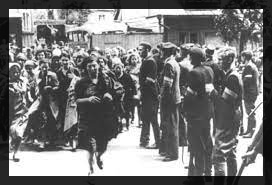
A freedom fighters’ revolt? Hitlerist white-armbanders surround Jewish women being marched to their death. These militias, responsible for deaths of Jewish civilians in forty locations in Lithuania prior to German arrival, are honored by the state as “freedom fighters”….
The 23rd of June 1941 is the date remembered by Lithuanian Jewry as the outbreak of the Holocaust with onset of widespread murder, dehumanizing degradation and humiliation of civilian Jewish neighbors by the “white armbanders” and “LAF” forces (whose pamphlets declared explicitly their plans for their nation’s Jewish citizens). But instead of honoring the victims, the state’s far-right historians-in-tow glorify the perpetrators as “anti-Soviet rebels,” a well known historic nonsense: the Soviet army was fleeing Operation Barbarossa, Hitler’s invasion of the USSR, the largest invasion of human history, not the local Jew-killers with their white armbands. More on the historic background of the Double Genocide revisionism that has evolved into 21 Century Holocaust Denial.
And who will honor the real Lithuanian heroes of 1941 — the amazing, inspirational folks who risked everything to just save a neighbor from the LAF and Hitlerist hordes of the hour?
◊
VILNIUS—In the interest of public information, Defending History has posted the original Lithuanian text of the verdict of the District Court of Vilnius City of 10 May 2021 For the benefit of English readers interested in the main points of the verdict, DH has commissioned an English language summary of the decision, that went against the petition filed by 157 plaintiffs, all of whom are descendants of persons buried in the Old Vilna Jewish Cemetery at Piramónt in the Šnipiškės district of the modern city. The state property bank (Turto bankas) and its partners plan to situate a national convention center in the heart of the site, based on the ruin of the old Soviet sports palace, At the new convention center, thousands would revel each night surrounded by many more thousands of Jewish graves on all four sides. Human rights advocates have pointed out that this would never be the fate of a medieval Christian Lithuanian cemetery,, nor would authorities accept “permissions” from groups proven to take secret payments. For background see, DH’s section chronicling events from 2015 onward, its summary of recent years’ events, and its page slinking to the opposition to the cemetery’s desecration from around the world. Note that the verdict gives the plaintiffs thirty days to appeal. An appeal was duly filed by the plaintiffs within the time allotted
The English summary prepared by Lithuanian legal language experts follows. Note that the reference to the “Committee for the Preservation of Jewish Cemeteries in Europe” (CPJCE) is to the discredited group of Aaronite-Satmar rabbis in London who have accepted large secret payments coinciding with their “permissions” to desecrate cemeteries on the Eastern European ground zero of the Holocaust. Follow the sad history here. Their profitable involvement has been condemned by genuine rabbinic authorities, including the Conference of European Rabbis, as well by virtually all major Litvak (Lithuanian tradition) rabbis internationally.
(More for good measure. And more and more…)
The plaintiffs in the court case, descendants of people buried in the old Vilna Jewish cemetery, employ a new law firm in Vilnius which files the appeal in June 2021 in accordance with the thirty-day deadline imposed by the court that handed down the May 2021 decision. Meanwhile, on 16 June, officials of the US taxpayer funded “USCPAHA” revel in tweets of lavish photo-ops with high officials in Vilnius, without even meeting Ruta Bloshtein, author of the petition whose number of signatories on this date was 53,486. DH reports.
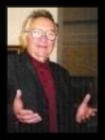
Yitzhak Arad (1926-2021)
Yitzhak Arad (originally Rudnitzky), a native of Svintsyán (Švenčionys, Lithuania, some 90 km north of Vilnius) passed away peacefully in Tel Aviv on Thursday. He was laid to rest Friday at Kibbutz Einat near Tel Aviv. His dramatic career included fighting the Nazis as a bold partisan in the forests of Lithuania, fighting with equal heroism in the air and ground forces that won Israel’s war of independence, rising to brigadier general, becoming a major Holocaust scholar and author, serving as director general of Yad Vashem for two decades (1972-1993), and, in the twenty-first century, becoming the first of a series of Holocaust survivors who joined the anti-Nazi resistance to be publicly accused by Lithuanian prosecutors of “war crimes” (with not a shred of evidence) as part of a massive campaign of Holocaust revisionism and inversion emanating from the state and its lavishly sponsored “genocide center” and “red-brown” commission as well and numerous elite operatives in the media, academia and literature.
The Holocaust revisionist who started the campaign against Arad in 2006 (in an infamous interview in the antisemitic Respublika representing the state’s “Genocide Center“) is today the nation’s Minister of Defense (!). It was, it turned out, the opening salvo in a years’ long saga that came to include Dr. Rachel Margolis (1921-2015), Ms. Fania Brantsovsky (1922- ), and other heroes of the anti-Nazi resistance regarded as “war criminals” by the far-right revisionist history units financed by East European states and their centers, professors, press maestros and operatives on an industrial scale.
Arad was the first Jewish partisan veteran to be libeled (in 2006) by kangaroo prosecutions of Lithuania’s “history fixing” units in the effort to revise Holocaust history. One major component of the multilayered effort, epitomized by Lithuania’s state-sponsored “Red-Brown Commission” and its Genocide Research Center, has entailed painting Holocaust victims who survived by joining the resistance as perpetrators and perpetrators (particularly of the atrocities of 1941) as victims. Follow the ins-and-outs in Defending History.
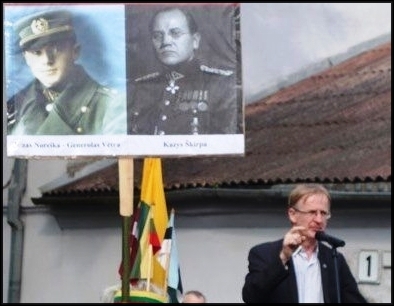
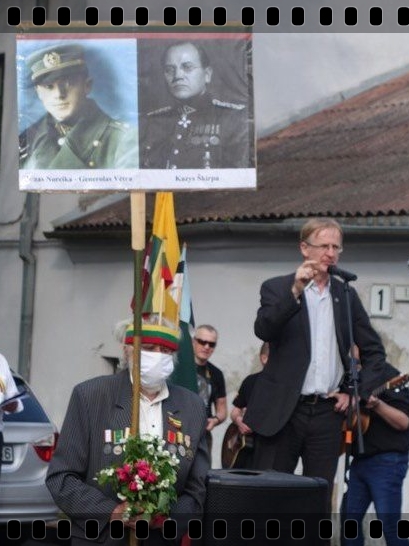
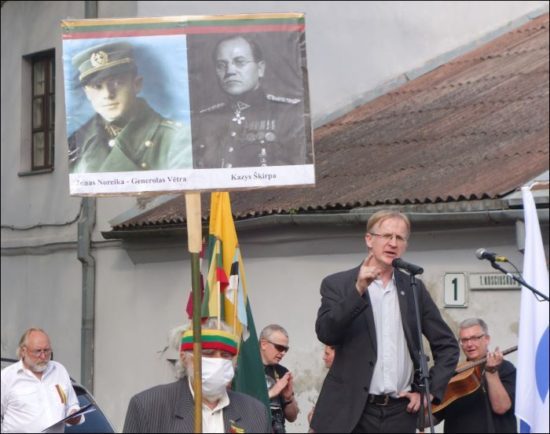
VILNIUS—Shortly after Defending History published the news yesterday that Dr. Arūnas Bubnys, longtime chief historian at Lithuania’s state sponsored far-right Genocide Center had been nominated by the speaker of parliament as the center’s new director, news published also by New York’s Algemeiner Journal, a social media campaign began to try to spread a rumor that the DH photo of Dr. Bubnys proudly speaking less than a year ago under banner images of Holocaust collaborators Jonas Noreika and Kazys Škirpa was “photoshopped.” Two of DH’s Vilnius-based team, Julius Norwilla and Dovid Katz, monitored the event from start to finish. Their report appeared the same day, 23 June 2020, the 79th anniversary of the outbreak of the Lithuanian Holocaust. Instead of honoring the victims — defenseless Jewish citizens, often older rabbis and younger women brutalized and murdered by the “White Armbander” fascists — the event, like many legitimized by Lithuanian government institutions, glorified the killers, who are invariably described as “heroic anti-Soviet rebels.” This is of course a patent historic nonsense. The USSR’s forces were fleeing Hitler’s invasion, Operation Barbarossa, the largest invasion in human history, not the local white-armbanded Jew-killers. While the Soviets were in power, the Hitler-backers and murderers of civilian neighbors now adulated as “anti-Soviet rebels” did not fire a single shot. Not even at a local rabbit.
See DH’s sections on Dr. Bubnys, the Genocide Center, and commemorations of 23 June 1941, as well as reviews of his books on the Vilna Ghetto and on the Kovno (Kaunas) Ghetto.
UPDATES
22 APRIL: BUBNYS NOMINATION CONFIRMED BY SEIMAS
Secret ballot: 76 for, 34 against,8 abstentions, 2 spoiled ballots
Update of 21 April 2021: “No, Sir. This is No Photoshop”
Algemeiner Journal reports of 15 April and of 22 April
Background:
SEE DH SECTION ON DR. BUBNYS AND STATE HOLOCAUST REVISIONISM IN LITHUANIA
EYEWITNESS REPORT: DR. BYBNYS’S PUBLIC 2020 ADULATION OF COLLABORATORS
SECTION ON THE GENOCIDE CENTER