


Friends in TORONTO and CANADA: Some links relating to the recent “Holocaust in Lithuania” symposium at the University of Toronto: https://defendinghistory.com/summary-coverage-of-toronto-24-nov-2013-symposium-on-the-holocaust-in-lithuania/61406 Toronto | DefendingHistory.com defendinghistory.com
Opinion
Facebook Discussion (3 to 11 Dec. 2013) on a Nov. 2013 University of Toronto Event
Posted in "Jewish" Events as Cover?, "Red-Brown Commission", Canada, Lithuania, Litvak Affairs, News & Views, Opinion, Politics of Memory
Tagged Christoph Dieckmann, Christoph Dieckmann + Holocaust in Lithuania, Fern Smiley, Holocaust Studies in Toronto, International Commission for the Evaluation of the Crimes of the Nazi and Soviet Occupation Regimes in Lithuania, Sara Ginaite
Comments Off on Facebook Discussion (3 to 11 Dec. 2013) on a Nov. 2013 University of Toronto Event
Yiddish Roulette? One Resigns in Bloomington, Another Rides In from Buffalo
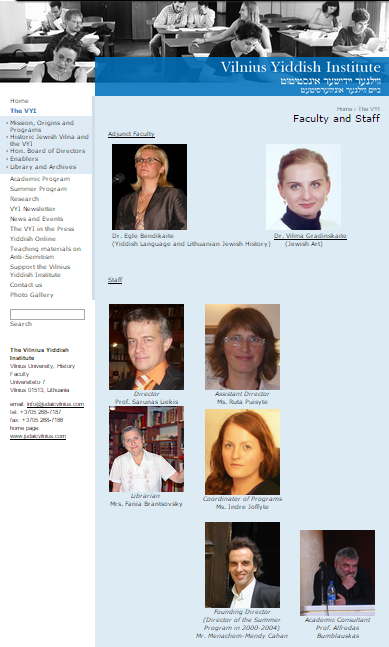
Sources in Bloomington, Indiana and Vilnius, Lithuania, confirmed this week that Dr. Daniel R. Berg, an eminent physician in the greater Bloomington area, has resigned from the rump “Board of Friends” of Sarunas Liekis’s “Vilnius Yiddish Institute” (VYI). The institute’s website abruptly removed Dr. Berg’s name and photograph from the board. No letter of resignation was released to the media, but a source close to the doctor said he was dismayed to see the institute’s resources being dedicated to a campaign of defamation against its own former Yiddish professor and founder, whose name and contributions have been deleted from the historic faculty page, in the classic Soviet style of revising history.
Posted in "Jewish" Events as Cover?, Bloomington-Borns Program Manipulated?, Double Games, Lithuania, Litvak Affairs, News & Views, Opinion, Politics of Memory, Richard Maullin, United States, Vilnius Yiddish Institute, Yiddish Affairs
Tagged AHEYM, Bloomington, Borns Jewish Studies Program at Bloomington, collector's item Yiddish t-shirt, Dan Opatoshu, Dov-Ber Kerler (Boris Karloff), Dr. Daniel Berg (Bloomington, Indiana University, Jerold Frakes + Jerusalem of Lithuania (Vilna), Jerold Frakes + Vilnius Yiddish Institute, Liekis + Yiddish institute, Richard Maullin, Sarunas Liekis, Sarunas Liekis + Yiddish institute, Steven Spielberg + Holocaust, Vilnius Yiddish Institute, Vilnius Yiddish Summer Program, Yiddish at Borns Jewish Studies Program, Yiddish at Buffalo
Comments Off on Yiddish Roulette? One Resigns in Bloomington, Another Rides In from Buffalo
Wiesenthal Center’s Israel Office Releases 2007 Correspondence with LA Board Chief of Vilnius Yiddish Institute
Editor’s note: The Simon Wiesenthal Center’s Israel office today released for the record the following September 2007 email exchange with the director of the Los Angeles based “Friends of the Vilnius Yiddish Institute” (VYI).
Posted in Documents, Efraim Zuroff, News & Views, Opinion, Richard Maullin, United States, Vilnius Yiddish Institute, Yiddish Affairs
Tagged Darius Udrys, Efraim Zuroff, Grant Gochin, Holocaust in Lithuania, Richard Maullin, Simon Wiesenthal Center, Steven Spielberg + Hoocaust in Lithuania, Vilnius Yiddish Institute
Comments Off on Wiesenthal Center’s Israel Office Releases 2007 Correspondence with LA Board Chief of Vilnius Yiddish Institute
An Open Letter to Steve Linde, Editor-in-Chief of the Jerusalem Post
O P I N I O N
by Olga Zabludoff
Editor’s note: This and other responses were first offered to the Jerusalem Post for publication.
The Lithuanian government is pouring ever more resources and doing an ever better job with its PR campaign to turn Litvaks (Jews of Lithuanian origin) into virtual PR agents who now go further than they do themselves: painting a picture of the New Jewish Paradise in Lithuania without even mentioning the existence of painful current issues. Jerusalem Post editor-in-chief Steve Linde no doubt meant only the best with his Chapter-of-Psalms, and will, I feel confident, now be happy to give the issues some rounded airing.
Posted in Collaborators Glorified, Double Games, Identity Theft of Litvak Heritage, Israel, Lithuania, Litvak Affairs, Media Watch, News & Views, Olga Zabludoff, Opinion, Politics of Memory, South Africa
Tagged Brothers Zingeris (Lithuania), Holocaust in Lihuania, Jerusalem Post + Lithuania, Olga Zabludoff, South Africans + Lithuania, Steve Linde
Comments Off on An Open Letter to Steve Linde, Editor-in-Chief of the Jerusalem Post
Europe: A Renewal of Extremism?
O P I N I O N
by Didier Bertin
The French original of this article appeared in the December 2013 issue of Cahiers Bernard Lazare. This adapted English translation appears with the authorization of the author and permission of Cahiers Bernard Lazare.
New names: VB, FPÖ , FN , PVV. new faces, but underlying factors and what they refer to remain unchanged. It is sometimes called NFR (new far right); the NFR has not done anything new and reflects deeply rooted convictions transmitted from generation to generation on soil that is fertile for them: Europe. There are extremists in the left wing and among the Greens but in case of crisis the far right attracts a significant number of people from many social classes including the workers. We will thus focus our analysis on extremism on the right wing and also — on European governments.
Posted in Didier Bertin, EU, Human Rights, News & Views, Opinion
Comments Off on Europe: A Renewal of Extremism?
A Decision to Not (!) Regard Holocaust Rescuers as Heroes of the Nation
O P I N I O N
by Evaldas Balčiūnas
Authorized translation from Lithuanian by Geoff Vasil
This week the Lithuanian government resolved not to grant so-called hero’s pensions to surviving rescuers of Jews.
The decision is an odd one and raises doubts concerning the values to which this government claims to adhere. Although truth be told, this isn’t the first instance of unseemly conduct showing disrespect to hundreds of thousands of people murdered just because they were Jewish and towards those Lithuanians who attempted to save those scheduled for execution.
Posted in Evaldas Balčiūnas, Lithuania, Litvak Affairs, News & Views, Opinion, Politics of Memory
Comments Off on A Decision to Not (!) Regard Holocaust Rescuers as Heroes of the Nation
“Higher Mathematics” of the Lithuanian Holocaust
O P I N I O N
by Pinchos Fridberg
NOTE: This English version of a recent piece by Professor Pinchos Fridberg (of Vilnius), translated by Lumilla Makedonskaya (of Grodno), is for our readers’ information. In the case of any doubt or matter arising, the original Russian text alone is authoritative.
Posted in "Red-Brown Commission", Lithuania, Media Watch, News & Views, Opinion, Pinchos Fridberg, Vilnius's Genocide Center and the Genocide Museum it Manages
Comments Off on “Higher Mathematics” of the Lithuanian Holocaust
Monica Lowenberg Releases Text of Letter to British ORT on Latest Lithuanian Embassy Sponsored “Litvak Do” in London
O P I N I O N
by Monica Lowenberg
Monica Lowenberg’s office has released for publication the following public letter sent to British ORT.
British ORT, FAO The Chief Executive, Mr. Dan Green
25 November 2013
Dear Mr. Green,
It is with deep regret that my 90 year old father, Ernest Lowenberg, former Berlin ORT pupil and I write to you today.
Posted in "Jewish" Events as Cover?, Collaborators Glorified, Documents, Double Games, EU, Events, Identity Theft of Litvak Heritage, Lithuania, Litvak Affairs, Monica Lowenberg, News & Views, Opinion, Politics of Memory, United Kingdom, World Jewish Congress (WJC) and ORT
Tagged British ORT, Egidijus Aleksandravicius, Lionidas Donskis, Lithuanian Embassy in London, Litvaks, Monica Lowenberg, University College London (UCL), Vytautas Magnus University, Westminster Synagogue
Comments Off on Monica Lowenberg Releases Text of Letter to British ORT on Latest Lithuanian Embassy Sponsored “Litvak Do” in London
Latvian State Dance Troupe Displays Nazi Swastika
R E P O R T / O P I N I O N
by Graeme Atkinson (Hope Not Hate) and Monica Lowenberg (DefendingHistory.com)
Source: HOPE not hate/DefendingHistory.com Sunday, 24 November 2013.

Posted in Antisemitism & Bias, Arts, Celebrations of Fascism, Human Rights, Latvia, Monica Lowenberg, News & Views, Opinion, Racism
Comments Off on Latvian State Dance Troupe Displays Nazi Swastika
Jerusalem Post, Again, Fails to Post Dissenting Comments on a “Lithuania Ecstasy” Story
M e d i a W a t c h / O p i n i o n
Readers on several continents again report to Defending History that the Jerusalem Post has failed to post perfectly polite comments to yet another ecstatic ode to issueless Lithuanian-Jewish love. This time it’s the story “Growing Lithuanian Business Ties Beget Political Support” which reported on the recent visit to Israel of the Lithuanian Minister for the Economy Evaldas Gustas.
The rejected comments pointed out that a senior specialist employed at his ministry was exposed last spring as Lithuania’s most hateful internet blogger, responsible for a series of images disparaging to Jews, Blacks, Gays, and to the history of the Holocaust in Lithuania (sampling of images here). Our Open Letter to the minister essentially asks why the hateful top official is still in office. Is such a question taboo for a major English language daily in Israel?
Posted in Citizenship, Double Games, Foreign Ministries: Holocaust Politics Abuse?, Israel, Litvak Affairs, Media Watch, News & Views, Opinion, South Africa
Tagged Jerusalem Post's coverage of Lithuania, Lithuanian-Jewish relations
Comments Off on Jerusalem Post, Again, Fails to Post Dissenting Comments on a “Lithuania Ecstasy” Story
Lithuanian State Language Commission Turns Down Jewish Community’s Suggestion for a Spelling Rule that “Holocaust” Be Spelled with a Capital “H”
VILNIUS—Defending History today obtained from local sources a copy of the official statement of the Lithuanian State Language Commission concerning the spelling, in Lithuanian, of the word for Holocaust, usually Holokaustas.
For some it will sound astounding that in the country with the highest percentage of Jews killed (96.4%) in Holocaust era Europe, where a massive state effort has been underway to promote “Double Genocide” and the “Prague Declaration,” a simple suggestion from the tiny remnant Jewish community that Holocaust be spelled with a capital letter (denoting its status as a unique event in history) has drawn a tortured, convoluted reply from the state language commission, one that seems to wittingly confound the capitalization question with the issue of whether holocausts strike far and wide, like hurricanes.
Posted in Double Genocide: The New Form of Holocaust Revisionism & Denial, Lithuania, News & Views, Opinion, Politics of Memory, Symbology
Comments Off on Lithuanian State Language Commission Turns Down Jewish Community’s Suggestion for a Spelling Rule that “Holocaust” Be Spelled with a Capital “H”
Street Names Honoring Holocaust Collaborators
Text of a Letter to the Editor in today’s International New York Times:
Lithuania’s Holocaust debate
Regarding “Lithuania’s unloved sentinels” (News, Nov. 13): James Kanter admirably sums up the pros and cons of retaining in central Vilnius “the last major monuments on public display here that still trumpet Communism,” namely a set of statues on Green Bridge. Although he mentions that there is “now little trace of a once thriving Jewish community obliterated in the Holocaust,” he neglects to mention the street names, museum exhibits, public plaques and more that honor local Holocaust collaborators and perpetrators (on the grounds that they were “also” anti-Soviet). The lively debate raging here shouldn’t be kept from Western eyes.
Dovid Katz, Vilnius, Lithuania
Posted in Collaborators Glorified, Double Genocide: The New Form of Holocaust Revisionism & Denial, News & Views, Opinion, Politics of Memory
Comments Off on Street Names Honoring Holocaust Collaborators
Vilnius Genocide Center Releases a New Graywash on the Vilna Ghetto
B O O K S / O P I N I O N
by Dovid Katz
◊
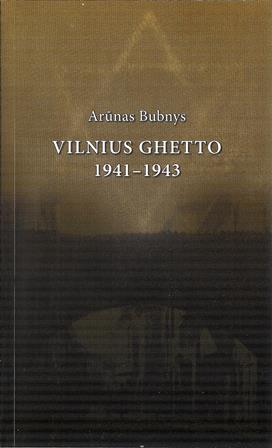 The unfortunate and wasteful campaign of Holocaust obfuscation waged by certain East European state institutions continues apace. The level of investment continues to strike outsiders as puzzling, given current economic and cultural issues and the younger population’s clear focus on the future and a better life for all in the new and multicultural European Union. Here in Lithuania, the first victims of the government’s (rather Soviet-style) “genocide industry” are the hard-working people of the country who deserve more judicious disbursement of their nation’s resources. The state-sponsored Genocide Center has just released three simultaneous editions (English, Lithuanian and Russian) of a new book on the Vilna Ghetto by historian Arūnas Bubnys, its own “director of the Genocide and Resistance Research Department.”
Dr. Bubnys is also a member of the state-sponsored “International Commission for the Evaluation of the Crimes of the Nazi and Soviet Occupation Regimes in Lithuania” (known for short as the “red-brown commission”). He was one of a minority of members of the Commission who refused to sign the (in the opinion of some, inadequate) letter of 14 October 2013 to Dr. Yitzhak Arad.
Posted in "Red-Brown Commission", Books, Double Games, Double Genocide: The New Form of Holocaust Revisionism & Denial, Dovid Katz, Dr. Arūnas Bubnys and State Holocaust Revisionism in Lithuania, Dr. Rokhl (Rachel) Margolis (1921-2015), EU, History, Lithuania, Litvak Affairs, News & Views, Opinion, Poland, Politics of Memory, Ponár (Ponary, Paneriai), Vilnius's Genocide Center and the Genocide Museum it Manages
Tagged Arunas Bubnys, Genocide Center Vilnius, Holocaust Obfuscation, International Commission for the Evaluation of the Crimes of the Nazi and Soviet Occupation Regimes in Lithuania, Lithuania, Vilna Ghetto, Vilnius, Yitzhak Arad
Comments Off on Vilnius Genocide Center Releases a New Graywash on the Vilna Ghetto
How Has Post-Soviet Lithuania Used Holocaust Remembrance to Project a “New” European Identity?
O P I N I O N
by Rachel Croucher (Melbourne, Australia)
Lithuania declared its restoration of independence from the Union of Soviet Socialist Republics (USSR) on March 11, 1990. The country then began to immediately seek closer ties with established Western European institutions as a means to consolidate its national and economic security. After centuries of subjugation at the hands of various foreign powers, this need for national and economic security was seen as being of primary and urgent concern to the fledgling democracy. This race to join as many Western European institutions as possible was also a way to prove to the rest of the world that Lithuania was now in practice a true European country, part of the post-1945 Western European order. The sentiment behind this is best expressed by Czech-born and naturalized French writer Milan Kundera when he stated in 1989 that
Posted in "Jewish" Events as Cover?, "Red-Brown Commission", A 21st Century Campaign Against Lithuanian Holocaust Survivors?, Double Games, Double Genocide: The New Form of Holocaust Revisionism & Denial, History, News & Views, Opinion, Politics of Memory, Rachel Croucher
Tagged Emanuelis Zingeris, Holocaust in Lithuania, International Commission for the Evaluation of the Crimes of the Nazi and Soviet Occupation Regimes in Lithuania, Rachel Croucher, Vytatuas Landsbergis, Yitzhak Arad
Comments Off on How Has Post-Soviet Lithuania Used Holocaust Remembrance to Project a “New” European Identity?
Dr. Clemens Heni’s Writings on the 2008 “Prague Declaration”
At the request of Defending History, Dr. Clemens Heni’s office in Berlin has kindly made available for our readers’ convenience a PDF comprising his writings and presentations between 2009 and 2013 that deal with the 2008 Prague Declaration and its subtle (and sometimes not so subtle) links with contemporary antisemitism. Dr. Heni is author, among other works, of Antisemitism: A Specific Phenomenon (Berlin 2013).
The PDF is available here. Dr. Heni’s website: www.ClemensHeni.net.
Posted in Clemens Heni, Double Genocide: The New Form of Holocaust Revisionism & Denial, Germany, News & Views, Opinion, Politics of Memory
Tagged 2008 Prague Declaration, Clemens Heni, Double Genocide
Comments Off on Dr. Clemens Heni’s Writings on the 2008 “Prague Declaration”
Where did the Money for a Monument to 1941 “Patriots” Come from? Why the Uncritical Reconstruction and Glorification Now?
O P I N I O N
by Evaldas Balčiūnas
Defending History reported earlier on the attempt to restore a monument in Obeliai (Abél in Yiddish), a town in northeastern Lithuania, not far from the Latvian border.
It is an unpleasant story and one that is still developing. Although seven decades have passed since the mass murder of the Jews of Abél, some people think that everyone has forgotten who carried out that mass murder.
Posted in Bold Citizens Speak Out, Collaborators Glorified, Evaldas Balčiūnas, News & Views, Opinion, Politics of Memory, Rákishok (Rokiškis), Vilnius's Genocide Center and the Genocide Museum it Manages
Comments Off on Where did the Money for a Monument to 1941 “Patriots” Come from? Why the Uncritical Reconstruction and Glorification Now?
Red-Brown Commission Member Takes Katz-Bashing Campaign to Litvak Culture Fest in Philadephia; LA Next?
O P I N I O N
A senior historian and his government’s “master fixer for foreign Jewish academics,” Professor Sarunas Liekis told an audience of hundreds in Philadelphia last Sunday that Dovid Katz had never been a professor of Yiddish at Vilnius University, and had been discontinued in 2010 by the American Friends of the Vilnius Yiddish Institute (led by Richard Maullin of Los Angeles) for not having turned up for class for several years (!).
Posted in "Jewish" Events as Cover?, A 21st Century Campaign Against Lithuanian Holocaust Survivors?, Double Games, Events, News & Views, Opinion, Richard Maullin, Views of Prof. Sarunas Liekis, Vilnius Yiddish Institute, What Do Fake Litvak Games Look Like?, Yiddish Affairs
Tagged American Friends of the Vilnius Yiddish Institute, Richard Maullin, Sarunas Liekis, Steven Spielberg + Dan Opatoshu, Steven Spielberg + Holocaust + Lithuania, Vilnius Yiddish Institute, Vilnius Yiddish Summer Program
Comments Off on Red-Brown Commission Member Takes Katz-Bashing Campaign to Litvak Culture Fest in Philadephia; LA Next?
Lithuanian MP’s Gay-Bashing Hits New Low of Adolescent Unseemliness and Social Immaturity
VILNIUS — Observers of the sometimes eerie human rights scene here thought they had seen it all, or most of it, but an elected parliamentarian’s latest stunt was seen as a new setback for Lithuania’s image even by conservatives on social issues.
Posted in Free Speech & Democracy, Human Rights, LGBTQ Equal Rights, News & Views, Opinion
Tagged Gay Rights in Lithuania, human rights in Lithuania, LGBT rights in Lithuania, Lithuanian Gay League (LGL)
Comments Off on Lithuanian MP’s Gay-Bashing Hits New Low of Adolescent Unseemliness and Social Immaturity
“Baltic Times” Does It Again: A Page of Hate Calling for Expulsion of a Million Legal Residents in Latvia
O P I N I O N / M E D I A W A T C H
Last May, this journal reported on a full page of racial hate directed at Latvia’s “Russians” (a cover term for Russian-speakers of a multitude of backgrounds). It had appeared in the Baltic Times, under cover of the responsibility-shirking label “Advertisement.” Heaven help us all if the word advertisement can in European Union and NATO countries cover for spreads of hate and incitement to violation of human rights. In this case, the demand is for the veritable expulsion of a million peaceful, legal residents of a member state of these international alliances, both of which are based on the shared commitment to uphold the human rights of all.
Rather than repeat the commentary offered at the page’s earlier appearance, we refer back to it here on the occasion of its reappearance in this month’s Baltic Times (dated 31 October — 27 November 2013), that occupies all of page 5 in the main news (!) section.
Posted in Human Rights, Latvia, Media Watch, News & Views, Opinion, Racism, Russian Speakers' Personal Status
Tagged Baltic Times, human rights (Latvia), Russian speakers in Latvia
Comments Off on “Baltic Times” Does It Again: A Page of Hate Calling for Expulsion of a Million Legal Residents in Latvia
If Israel Can Honor the USSR’s Unquestionable Role in Bringing Down Hitler, Why Can’t France and the European Union?
O P I N I O N
by Didier Bertin
From the very beginning, the source of our problems is to be found in an inaccurate narrative of World War II that is rather widespread here in France. This can be explained in part by France’s position as a de facto ally of the Axis at first, starting from the time of Petain’s surrender to Hitler’s forces in 1940. It was rather late in the war that a substantial segment of society in the country per se (as opposed to the heroic resisters who had joined the Allies outside surrendered France’s borders) became a stalwart ally of the United States and Great Britain, at a time when that was by a confluence of circumstances most convenient for all three countries.
Posted in Didier Bertin, Double Genocide: The New Form of Holocaust Revisionism & Denial, France, History, Israel, News & Views, Opinion, Politics of Memory
Tagged Didier Bertin, Double Genocide, Role of Red Army in defeating Hitler and Nazi Germany
Comments Off on If Israel Can Honor the USSR’s Unquestionable Role in Bringing Down Hitler, Why Can’t France and the European Union?