Tag Archives: Holocaust in Lithuania
Vilnius “Genocide Center” Defends Legacy of Holocaust Collaborator
Museum of The Lost Truth: A Lithuanian Drama
OPINION | MUSEUMS | SHEDUVA | POLITICS OF MEMORY | SHTETL COMMEMORATIONS | HUMOR (OF SORTS)
◊
by Evaldas Balčiūnas
Evaldas Balčiūnas informed the English speaking world of a series of state honors for alleged Holocaust collaborators, starting with Jonas Noreika back in 2012. He paid a hefty personal price for it (scroll down his DH section to 2014).
◊
PREAMBLE
The Lost Shtetl is a massive, holistic project to reclaim the Lithuanian Jewish heritage of Šeduva (Shádeve, older Shádev). Plans include a multimillion euro state-of-the-art museum complex scheduled to open in 2020 that is slated to become an international tourist attraction. Now is an excellent time for public comment and observers’ contemplation.
“The Lost Shtetl” will not be a generic community of faceless Litvaks. It will make tangible the lives of real individuals. But will we learn about the real individuals from the town and its region who destroyed them? Their names and faces? Or will we simply tuck them away into the phrase: “The Nazis and their local collaborators murdered 664 Šeduva Jews in Liaudiškiai forest”?
Landsbergis and Pavilionis Address June 23rd Rally in Central Vilnius
JUNE 23rd MEMORIALS | EVENTS | OPINION | COLLABORATORS GLORIFIED | ANTISEMITISM
◊
by Julius Norwilla
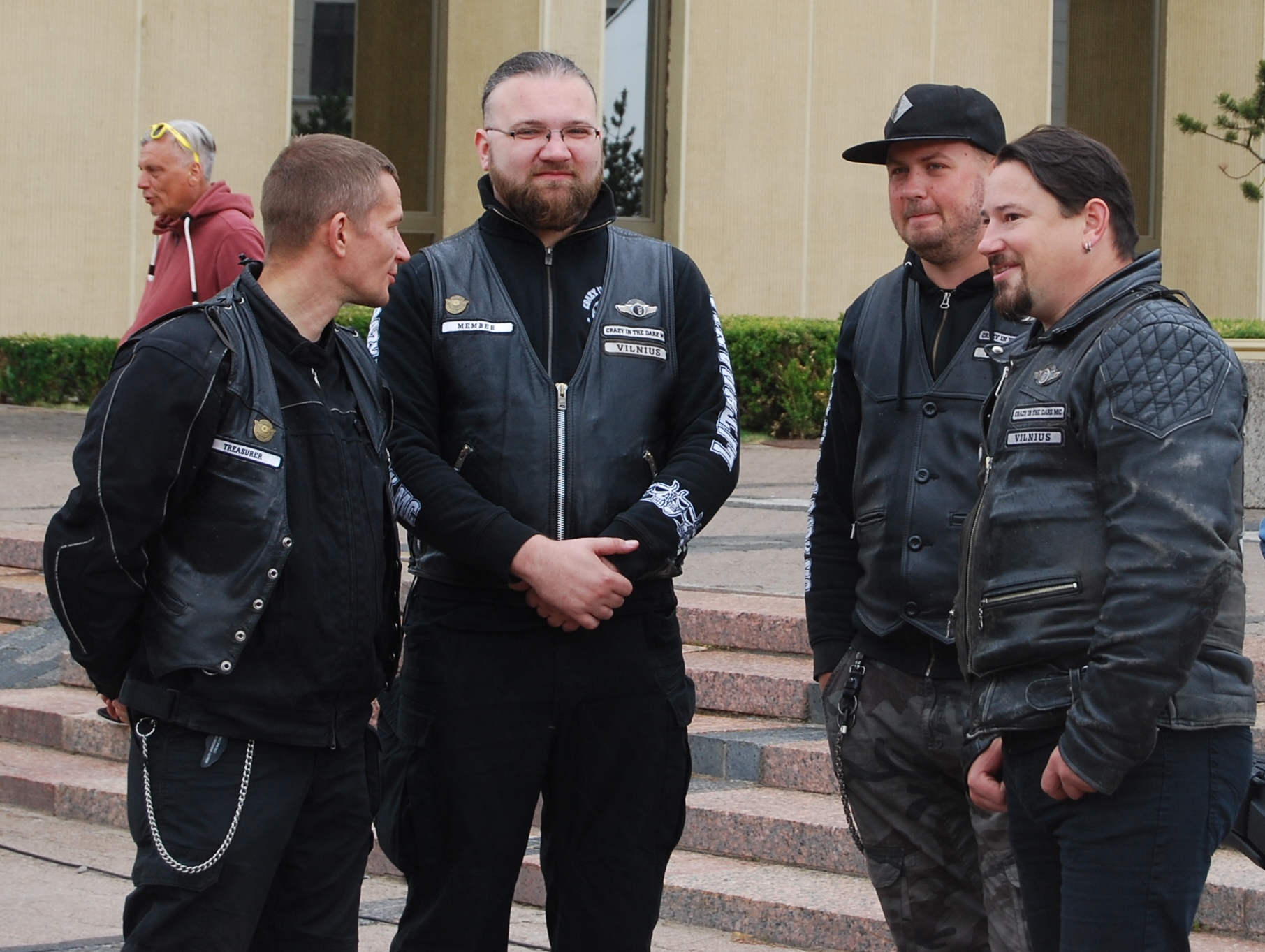
Today’s central Vilnius event celebrated the 77th anniversary of the 23 June 1941 “uprising.” Between fifty and sixty people took part. Half of them are members of the motorbike club. The event was organized by the Lithuanian Seimas (parliament). The Seimas was represented by three MPs – Žygimantas Pavilionis, former ambassador to USA; Audronius Ažubalis, former foreign minister; and Laurynas Kasčiūnas. One of the speakers was the Roman Catholic priest and motorbiker Egidijus Kazlauskas who spoke about the suffering and the perseverance of Lithuanians when persecuted by deportations to the eastern Soviet Union. Vilnius city Mayor Remigijus Šimašius was not present, but he has sent his greetings via advisor Mindaugas Kubilius.
A guest of honor was Vytautas Landsbergis, the elder statesman who was modern democratic Lithuania’s founding head of state. In the new century he became a European parliamentarian dedicated to revision of World War II history, most famously via the Prague Declaration which he signed. The event was co-organized by the Lithuanian Freedom Fighters Union (Lietuvos laisvės kovotojų sąjunga).
Prof. Lipstadt is Star at Lithuanian Government’s Latest One-Sided ‘Holocaust & Litvaks’ Conference on 29-30 May
◊
VILNIUS—Various officials of the Lithuanian government’s Genocide Research Center, its Genocide Museum, and its “International Commission for the Evaluation of the Crimes of the Nazi and Soviet Occupational Regimes in Lithuania” (known for short as the “Red-Brown Commission”) are rather gleeful this week at the latest master PR coup for the long hard road to “soft core” Western legitimization of East European Holocaust revisionism. One of the world’s leading Holocaust scholars, and the activist who did more than any other to bring to an end the era of classical 20th Century Holocaust Denial, Professor Deborah Lipstadt of Emory University, has been attracted to headline a “one-sided Holocaust conference in a Baltic capital” where the naive foreign star’s eminence may help provide cover for ongoing policies. The conference program has just been released in PDF format with, as usual, the star’s appearance artfully sandwiched between much else.
The “ham sandwich” model for political conferences made to look like pure, open, intellectually balanced academic conclaves?
Updated Headlines for Sad Saga in New Britain, Connecticut
OPINION | NEW BRITAIN’S PROPOSED MONUMENT FOR LEADER OF A 1941 HITLERIST MILITIA | GLORIFYING COLLABORATORS | USA | LITHUANIA | CHRISTIAN-JEWISH RELATIONS | ANTISEMITISM & BIAS | HUMAN RIGHTS
◊
Will New Britain, Connecticut really allow a public monument to an alleged Nazi collaborator? City Council member Professor Aram Ayalon launches petition calling for moratorium pending research; Latest.
Will Mayor Erin E. Stewart break her silence with some rapid words of simple moral clarity? This is even worse than Charlottesville: It’s about putting up a new monument for an alleged Nazi collaborator on public land in Connecticut. Where’s leadership?
Defending History in New Britain, Connecticut Against Plans to Glorify Alleged Holocaust Collaborator on Public Grounds
OPINION | NEW BRITAIN’S PROPOSED MONUMENT FOR LEADER OF A 1941 HITLERIST MILITIA | GLORIFYING COLLABORATORS | USA | LITHUANIA | CHRISTIAN-JEWISH RELATIONS | ANTISEMITISM & BIAS | HUMAN RIGHTS
◊
The New Britain Progressive, a newspaper in New Britain, Connecticut today carried a report entitled “Council Petition Would Halt Ramanauskas Monument, Pending Investigation”. It begins with the news that
“Alderman Aram Ayalon has introduced a City Council petition requesting, ‘a temporary halt of the building of a monument to commemorate Lithuanian militant, Adolfas Ramanauskas, until further research has been conducted to help confirm the history behind the man being memorialized.’ Ayalon cites concerns regarding accusations about Ramanauskas and the parts of the Holocaust that occurred in Lithuania in 1941.”
The paper’s report cites the Simon Wiesenthal’s October 2017 protest concerning the Lithuanian parliament’s decision to name the year 2018 for the alleged Nazi collaborator, as well as Defending History’s January 2018 plea to New Britain Mayor Erin E. Stewart to halt the project to glorify in the United States a leader of one of the marauding Hitlerist militias of June and July 1941 whose main “accomplishment” was unleashing the Holocaust starting even before the Germans arrived or before they managed to set up their functioning occupational administration. As it happens, the wider complex of these issues in Lithuania today was the subject of a New York Times report last Friday, 30 March.
Mažvydas National Library Wants Us to Listen to Valiušaitis, a Denier of Škirpa’s Atrocities
OPINION | HISTORY | COLLABORATORS GLORIFIED | CHRISTIAN-JEWISH RELATIONS | LITVAK AFFAIRS
◊
by Andrius Kulikauskas
◊
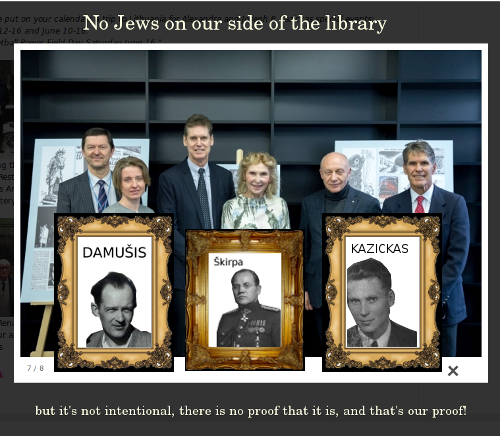
Lithuania’s Mažvydas National Library is curiously fostering two parallel cultures which have yet to engage each other. Up on the fifth floor, on the West side, an eminent Judaic studies scholar leads the Judaica Research Center (cosponsored by the Yivo institute in New York), and on the East side, journalist Vidmantas Valiušaitis leads the Adolfas Damušis Democracy Studies Center.
More on Mažvydas National Library; on Yivo’s history in Vilnius since 2011
Vanagaitė’s PR Rollout in Vilnius of (1) Romance with Wiesenthal Center Nazi Hunter, (2) New Book, Dual (3) Holocaust & (4) Postwar KGB Based Critique of Nationalist Hero — A Mix-&-Match Making for Mass Media Melee
[UPDATED; ORIGINAL PUBLICATION 29 OCT. 2017]
BOOKS (/Mūsiškiai) | COLLABORATORS GLORIFIED? | MEDIA WATCH | CHRISTIAN-JEWISH RELATIONS
◊
Jump to: English media section
Two Perspicacious Comments in Today’s Issue of “The Weekly of Vilnius”
OPINION | MEDIA WATCH | FOREIGN MINISTRIES AND HOLOCAUST ISSUES | CHRISTIAN-JEWISH RELATIONS | VILNIUS JEWISH LIFE | ISRAEL PAGE | ISRAEL SECTION | COLLABORATORS GLORIFIED
◊
VILNIUS—With the permission of the publishers of The Weekly of Vilnius, we are reproducing extracts of two comments from this week’s edition that covers Lithuanian news from 11 to 17 December 2017. The Weekly of Vilnius is sometimes considered to be this city’s most prestigious English-language news publication, famed for its editorial independence and capacity for presenting views that tend to be ignored in the nationalist and ultranationalist media that can be fixated with the “official line.” In the spirit of classic journalism, The Weekly of Vilnius has no online edition (there is an online description and Facebook page) and is available weekly by emailed PDF or hard copy to its elite circle of subscribers, known to include embassies, government agencies, captains of industry, politicians, academics, libraries, and think tanks.
See also: Does ambassador’s gesture “legitimize” naming of 2018 for an alleged collaborator?
First, on the subject of this week’s visit with flowers by the ambassador of Israel to the daughter and (successful) chief campaigner for 2018 to be named by the Lithuanian parliament for an alleged Holocaust collaborator (see Defending History‘s coverage), The Weekly of Vilnius highlights, accurately, we believe, the current Israeli embassy’s proclivity for implicitly claiming to act for “the interests of Lithuanian (or Litvak) Jewry” and to speak for “Lithuanian-Jewish relations” when in fact the (sometimes short-term) interests of the present Israeli government are (quite naturally) the determining factor. In fact, the embassy has arguably established a record of harming Lithuanian Jewish interests since it was opened in early 2015. Most shockingly, the Israeli Foreign Ministry seems to have “muscled in” even on restitution payments, deriving from the religious properties of the annihilated communities, now intended for the survival of the Lithuanian Jewish community. See the relevant entries in the grant items enumerated here and here.
21st Century Lowpoint for Israeli Diplomacy? Ambassador Poses with Photos of Holocaust Collaborator
OPINION | ISRAEL PAGE | ISRAEL SECTION | HONORING COLLABORATORS | LEGACY OF JOE MELAMED | LEGACY OF DOV LEVIN | FOREIGN MINISTRIES AND THE HOLOCAUST
◊
by Dovid Katz (Vilnius)
◊
VILNIUS—Israel may have crossed a red line today when it was flaunted on the major News portal Delfi.lt here, both in Lithuanian and in English, that Israeli ambassador Amir Maimon had found the time this week to stage a demonstrative PR-photographed visit to the chief campaigner for the parliament’s decision less than one month ago to name 2018 in honor of Adolfas Ramanauskas — his daughter in Vilnius, Auksutė Ramanauskaitė-Skokauskienė, who is a prime icon of the ultranationalist camp that often glorifies various collaborators and participants in the Holocaust on the grounds that they were also anti-Soviet activists. The PR move came just after a major political commentator asked what Lithuania is getting in return for its staunch political support for the Netanyahu government.
UPDATES TO THIS ARTICLE: WEEKLY OF VILNIUS COMMENTARY; AMBASSADOR’S BETRAYAL OF HOLOCAUST HISTORY A FIASCO AS LITHUANIA VOTES ANYWAY AGAINST U.S. DECISION TO MOVE ITS EMBASSY (PARTING WITH NEIGHBORING LATVIA)
One of the PR photos released shows the ambassador posing underneath adulatory photos of the 1941 pro-Nazi militiaman (from various other periods in his life). Of course Lithuania has a vast number of inspirational historical heroes, including many anti-Soviet heroes, who were not Holocaust collaborators, and state decisions to honor collaborators cause untold pain to survivors, their families, and the remnant Jewish communities in Eastern Europe. They all send a message that becomes part of the history-revision campaign to downgrade the Holocaust in the context of “Double Genocide” revisionism.
The Extraordinary Recent History of Holocaust Studies in Lithuania
OPINION | HISTORY | LITHUANIA’S STATE COMMISSION ON NAZI AND SOVIET CRIMES | LITVAK AFFAIRS
◊
by Dovid Katz
◊
This paper was published today by Taylor and Francis on its website. It appears in Dapim: Studies on the Holocaust, volume 31, no. 3, pp. 285-295 (Dec. 2017). Dapim is edited by the Strochlitz Institute for Holocaust Research at the University of Haifa.
◊
In Lithuania, the primary provider for Holocaust studies for close to two decades has been the state-sponsored International Commission for the Evaluation of the Crimes of the Nazi and Soviet Occupation Regimes in Lithuania (ICECNSORL), which was established in 1998 by decree of the nation’s president and is housed in the office of its prime minister, embedding it in the highest strata of Lithuanian politics. Several of its activities have enabled significant contributions in research, education, and public commemoration.
Joe Melamed, Litvak Champion (Images from the Last Years)
צו די שלשים פון יוסף (יאָסקע) מלמד ז″ל
◊
Memories of Joe Melamed Defending History
MORE ON JOE MELAMED (1924-2017)
◊
DEFENDING HISTORY’S JOE MELAMED SECTION. Scroll to end to review upwards in chronological order.
◊
“Weekly of Vilnius” Provides Exclusive English Language Coverage of the Vanagaitė Saga
FREE SPEECH | COLLABORATORS GLORIFIED | MEDIA WATCH | CHRISTIAN-JEWISH RELATIONS | VILNIUS JEWISH LIFE | HUMAN RIGHTS
◊
VILNIUS—The Weekly of Vilnius, sometimes considered to be this city’s most prestigious English-language news publication, today released its weekly issue which contains a highly documented summary of many of the sides in the debate over author and PR specialist Ruta Vanagaitė’s comments concerning state plans to name 2018 for someone who led a pro-Nazi militia during the early days of the Lithuanian Holocaust in 1941, but who is being honored for his postwar service in the anti-Soviet resistance. Defending History has published its own take along with a much more limited summary of the debate which readers may consult for comparison and helping “complete the picture” as best as it can be in English. Note that selections of Lithuanian articles on the subject from the major news portal Delfi.lt, and from BNS (Baltic News Service), in both cases generally representing government and “nationalist establishment” positions, are available in English translation on the English Delfi.lt (Lithuania Tribune) site (search “Vanagaitė” for rapid reference).
Linas Vildžiūnas’s Review of Rūta Vanagaitė’s ‘Mūsiškiai’ Now Available in English Translation
BOOKS | POLITICS OF MEMORY
◊
by Linas Vildžiūnas
◊
The following English translation, by Laurynas Vaičiūnas, of Linas Vildžiūnas’s review of Rūta Vanagaitė’s Mūsiškiai appeared today in New Eastern Europe (as PDF).
◊
A book review of Mūsiškiai (Ours). By: Rūta Vanagaitė. Publisher: Alma littera, Vilnius, 2016.
What makes Rūta Vanagaitė’s Ours (Mūsiškiai) very different from all other Lithuanian books on the Holocaust is that it was from the start written as a bestseller. Written by an experienced public relations professional as an appeal to the Lithuanian public, the book raises the painful issue of historical responsibility. The author does not refrain from giving a personal twist to the story (it would be impossible otherwise, as the Holocaust is an issue of individual position and individual responsibility). The author is piercingly direct and uses black comedy. She approaches the topic with composure and a sense of supremacy. These two features may irritate the reader. However, she is entitled to it as she aims to confront the reader, which she so eloquently achieves.
READ MORE. AS PDF.
Full Transcript of the “Fania Brantsovsky Witch Hunt Ceremony” on Lithuania’s Independence Day
OPINION | DOCUMENTS | BLAMING THE VICTIMS? | DOUBLE GENOCIDE | VILNIUS GENOCIDE CENTER | ANTISEMITISM | PRO-NAZI MARCHES | VILNIUS MARCHES
◊
VILNIUS—This year’s March 11th independence day march here last month was again granted the route of highest prestige, from Cathedral Square, up the whole of the capital’s main thoroughfare, Gedimino Boulevard, and ending at Parliament Square. Defending History’s eyewitness report recounted this year’s “detour” to the presidential palace for the bizarre ceremony of attacking Lithuania’s oldest Holocaust survivor, Fania Yocheles Brantsovsky (Brancovskaja), 95 next month, one of the Jewish partisans subjected to defamation by the state’s campaign of Holocaust revisionism that has included a “blame the victims” components that started eleven years ago.
CAMPAIGN AGAINST (ONLY JEWISH) VETERANS OF THE ANTI-NAZI PARTISANS; RENEWED 2017 CAMPAIGN AGAINST FANIA YOCHELES BRANTSOVSKY
Baltic Holocaust: First Stahlecker Report (1941) Digitized
by Rafael Katz
◊
The two Stahlecker Reports summarize the inner workings of Einsatzgruppe A during the Baltic invasion of Operation Barbarossa, which set in motion the Holocaust. We herewith offer a digitized version of the two reports. For an introduction to the reports and links for download please see our earlier article in January 2015. As of now, we have digitized half of the reports, and will give notice once we complete the conversion. The full reports can be viewed in their JPG version via the link above. Below we offer a digitized version of 1-100 from 1-143 of the first report, and, on a separate page, 1-73 of 150 from the second report.
Media and Debate on Malát (Molėtai) Holocaust Remembrance Project
[UPDATED]
A Selection for English Readers
Project’s Facebook Page; Website
◊
22 November 2016. ISGAP Flashpoint: ‘Antisemitism in the 21st century shtetl’ by Dovid Katz.
22 September 2016. Tablet: ‘Holocaust commemorations planned throughout Lithuania this weekend’ by Anna Rudnistky.
9 September 2016. Defending History: ‘My take on Malát’ by Julius Norwilla [Norvila].
8 September 2016. En.Delfi.lt: ‘The day Lithuania became a culture of We’ by Alexandra Kudukis.
8 September 2016. Jewish Community of Lithuania website: ‘Molėtai Holocaust procession draws record crowd’ [unsigned article presumably representing the chairperson’s views].
Leonidas Donskis (1962—2016)
◊
The Defending History Community Mourns our Colleague
◊
LEONIDAS DONSKIS
13 August 1962 — 21 September 2016
HIS WORK IN DEFENDING HISTORY INCLUDES ESSAYS ON:
♦ Inflation of the word “genocide” and criminalization of debate
♦ The campaign against Holocaust survivors who joined the anti-Nazi Soviet partisans and its implications
♦ Response to proposals to “reevaluate” the Hitlerist LAF and Provisional Government collaborators of 1941
Yiddish Loses Last Global Position as Symbolic “First Jewish Language” in Vilnius
OPINION | COMMEMORATION OF DESTROYED COMMUNITIES | YIDDISH AFFAIRS | LITVAK AFFAIRS | IDENTITY-THEFT LITVAK INDUSTRY
by Dovid Katz
◊
VILNIUS—For close to three decades, Vilnius has been the only city in the world with municipally sponsored public plaques and signs that regularly include Yiddish. Symbologically for a small, weak, stateless, threatened and “threat-to-nobody” language in this part of the world, it was an equally important statement of respect for the language, literature and culture of the murdered Jewish people of the city that Yiddish sometimes came first, “on top,” and always so when it was a question between Yiddish and modern Israeli Hebrew.