


Eduard Dolinsky’s New York Times Op-Ed is a Game Changer in Rising Western Consciousness
On Twitter
Ukraine Updates
Posted in Collaborators Glorified, Human Rights, News & Views, Politics of Memory, Ukraine
Comments Off on Ukraine Updates
Full Transcript of the “Fania Brantsovsky Witch Hunt Ceremony” on Lithuania’s Independence Day
OPINION | DOCUMENTS | BLAMING THE VICTIMS? | DOUBLE GENOCIDE | VILNIUS GENOCIDE CENTER | ANTISEMITISM | PRO-NAZI MARCHES | VILNIUS MARCHES
◊
VILNIUS—This year’s March 11th independence day march here last month was again granted the route of highest prestige, from Cathedral Square, up the whole of the capital’s main thoroughfare, Gedimino Boulevard, and ending at Parliament Square. Defending History’s eyewitness report recounted this year’s “detour” to the presidential palace for the bizarre ceremony of attacking Lithuania’s oldest Holocaust survivor, Fania Yocheles Brantsovsky (Brancovskaja), 95 next month, one of the Jewish partisans subjected to defamation by the state’s campaign of Holocaust revisionism that has included a “blame the victims” components that started eleven years ago.
CAMPAIGN AGAINST (ONLY JEWISH) VETERANS OF THE ANTI-NAZI PARTISANS; RENEWED 2017 CAMPAIGN AGAINST FANIA YOCHELES BRANTSOVSKY
Posted in A 21st Century Campaign Against Lithuanian Holocaust Survivors?, Antisemitism & Bias, Celebrations of Fascism, Collaborators Glorified, Debates on the Postwar "Forest Brothers", Documents, Events, Fania Yocheles Brantsovsky (Fania Brancovskaja): 1922-2024, Human Rights, Lithuania, Litvak Affairs, Neo-Nazi & Fascist Marches, News & Views, Opinion, Vilnius, Vilnius's Genocide Center and the Genocide Museum it Manages
Tagged Arunas Eifirdas, Fania Jocheles Brancovskaja, Fania Yocheles Brantsovsky, Genocide Center Vilnius, Holocaust in Lithuania, Lithuanian Jewish partisans, Sakalas Gorodeckis, Vilnius neo-Nazi marches
Comments Off on Full Transcript of the “Fania Brantsovsky Witch Hunt Ceremony” on Lithuania’s Independence Day
Hon. Herbert Block’s Lithuanian Engagements and the Old Vilna Jewish Cemetery
OPINION | PIRAMÓNT | OPPOSITION | USCPAHA (US COMMISSION FOR AMERICAN HERITAGE ABROAD) | CPJCE | ADMAS KODESH | PAPER TRAIL | CEMETERIES
◊
VILNIUS—The Hon. Herbert Block, a prominent and popular personality known to New Yorkers from his days as the highly successful Jewish affairs liaison for the campaign and administration of New York City mayor David Dinkins years ago has emerged as a major force at the confluence of Jewish-Hasidic, American and Lithuanian-government politics on issues in Lithuanian-Jewish affairs. There are conflicting views about his myriad, and some would say conflict-of-interest laden, entanglements that include a Satmar group in Monroe, New York intent on fulfilling the wishes of Vilnius builders for a convention center and annex in the heart of the old Jewish cemetery of Vilnius (allegedly for the financial benefit of their London followers in the CPJCE), a US taxpayer funded agency that exists to preserve Jewish cemeteries (but has yet to issue a word of protest at the “convention center in the Jewish cemetery” project) and the Lithuanian government’s “Good Will Foundation” that allocates monies deriving from the religious properties of the annihilated Jewish communities of Lithuania.
NEW SECTION ON MR. BLOCK’S LITHUANIAN INVOLVEMENTS
Posted in "Admas Kodesh", "Good Will Foundation" (Jewish Restitution in Lithuania), CPJCE (London), Defense of Old Jewish Cemeteries and Mass Grave Sites, Herbert Block and Issues of Lithuanian Jewish Cemetery Preservation, Lithuania, Litvak Affairs, News & Views, Old Vilna Jewish Cemetery at Piramónt (in Šnipiškės / Shnípishok), Opinion, United States, USCPAHA (US Commission for Preservation of the American Heritage Abroad)
Tagged Admas Kodesh (New York), CPJCE (London), GWF (Good Will Foundation, Herbert Block + American Zionist Movement (AZM), Herbert Block + Lithuania, Herbert Block + WJRO, Satmar (Aaron branch), USCPAHA (Commission for Preservation of Heritage Abroad), Vilnius, World Jewish Restitution Organization
Comments Off on Hon. Herbert Block’s Lithuanian Engagements and the Old Vilna Jewish Cemetery
Spring 2017 Battle Over Public Honors in Vilnius for Holocaust Collaborators
[last update]
Škirpa and Noreika
17 Organizations in Lithuania Sign Petition in Favor of Central Vilnius Street Name Glorifying Holocaust Promoter K. Škirpa
Among the 17 who signed is Sąjūdis (Vilnius & Kaunas), whose honorary national chairman is Prof. V. Landsbergis, and whose national council includes MP Emanuelis Zingeris. Will Vilnius Mayor Remigijus Šimašius in his reply stand up for what’s right?
Posted in Collaborators Glorified, Debates on the Postwar "Forest Brothers", Lithuania, Litvak Affairs, News & Views, Politics of Memory, Vilnius Mayor Remigijus Šimašius
Comments Off on Spring 2017 Battle Over Public Honors in Vilnius for Holocaust Collaborators
Lithuanian Jews Call for Democracy in their Community
OPINION | HUMAN RIGHTS | VILNIUS JEWISH LIFE | LITVAK AFFAIRS
◊
VILNIUS—The human rights of even small, weak and demographically struggling minorities to enjoy a free and open website that offers a forum to people and groups of diverse opinions is well established. It is also a test of democracy that members of such groups feel able to speak out when those rights are abrogated. Against that backdrop, it was significant today that a group of older members of Lithuania’s Jewish community (including Holocaust survivors), spoke out on the subject, around a week after a pubic appeal for website democracy by a younger generation on Facebook. The older group blogs under the name of the semi-legendary 19th century Vilna Jewish “wisecracker and whistleblower” Mótke Chabád in the Russian-language Vilnius-based publication Obzor (not to be confused with Defending History’s “own” Motke Chabad…).
“Bravo to Vilnius’s Jewish community for their pre-Passover 2017 stand for democracy, the younger generation in Facebook, the survivor generation in Obzor.”
Posted in "Good Will Foundation" (Jewish Restitution in Lithuania), A Stolen Election and a Small Jewish Community's Protest, American Jewish Committee (AJC) in Lithuania, Free Speech & Democracy, Herbert Block and Issues of Lithuanian Jewish Cemetery Preservation, Human Rights, Lithuania, Lithuania: Textbook Case of East European Restitution (for Lost Jewish Assets) Abused to Dismantle a Vibrant Jewish Community, Lithuania's Jewish Community Issues, Litvak Affairs, News & Views, Opinion, Simon Gurevich (Simonas Gurevičius)
Comments Off on Lithuanian Jews Call for Democracy in their Community
Vilnius Workshop, Monday 10 April, on Self-Identity & Fate of Old Vilna Jewish Cemetery
EVENTS | OLD VILNA JEWISH CEMETERY | CHRISTIAN-JEWISH RELATIONS | ANDRIUS KULIKAUSKAS
◊
VILNIUS—An invitation has been extended by the office of Dr. Andrius Kulikauskas to all interested colleagues to attend a seminar in Vilnius Old Town this Monday, 10 April 2017, from 1 to 5 PM (1300 to 1700) at the campus of Vilnius Gediminas Technical University on “Self-Identity and the Old Jewish Cemetery.” People who can only stop in for part of the event may come and go as needed.
MONDAY 10 APRIL
Come and visit between 1 and 5 PM at Workshop on Self-Identity and the Old Jewish Cemetery, at Vilnius Gediminas Technical University, Traku Street 1, corner of Pylimo, entrance from Pylimo. Defending History’s section, opposition tracker, and paper trail.
EVERYBODY WELCOME
Posted in Andrius Kulikauskas, Andrius Kulikauskas on Vilnius's Oldest Jewish Cemetery, Bold Citizens Speak Out, Christian-Jewish Issues, Defense of Old Jewish Cemeteries and Mass Grave Sites, Human Rights, Lithuania, Litvak Affairs, News & Views, Old Vilna Jewish Cemetery at Piramónt (in Šnipiškės / Shnípishok)
Comments Off on Vilnius Workshop, Monday 10 April, on Self-Identity & Fate of Old Vilna Jewish Cemetery
Sign The Petition for the Old Vilna Jewish Cemetery Today!
Posted in Defense of Old Jewish Cemeteries and Mass Grave Sites, Lithuania, Lithuania's Jewish Community Issues, Litvak Affairs, News & Views, Old Vilna Jewish Cemetery at Piramónt (in Šnipiškės / Shnípishok)
Comments Off on Sign The Petition for the Old Vilna Jewish Cemetery Today!
Baltic Holocaust: First Stahlecker Report (1941) Digitized
by Rafael Katz
◊
The two Stahlecker Reports summarize the inner workings of Einsatzgruppe A during the Baltic invasion of Operation Barbarossa, which set in motion the Holocaust. We herewith offer a digitized version of the two reports. For an introduction to the reports and links for download please see our earlier article in January 2015. As of now, we have digitized half of the reports, and will give notice once we complete the conversion. The full reports can be viewed in their JPG version via the link above. Below we offer a digitized version of 1-100 from 1-143 of the first report, and, on a separate page, 1-73 of 150 from the second report.
Posted in Documents, History, Legacy of 23 June 1941, Lithuania, Litvak Affairs, News & Views, Rafael Katz, Raphael Katz
Tagged Holocaust in Lithuania, Rafael Katz, Stahlecker Report (1941)
Comments Off on Baltic Holocaust: First Stahlecker Report (1941) Digitized
Baltic Holocaust: Second Stahlecker Report (1941) Digitized
◊
by Rafael Katz
◊
Note: See for introductory remarks the author’s earlier January 2015 summary of the project and his posting today of the digitized text of the First Stahlecker Report.
Posted in Documents, History, Legacy of 23 June 1941, Lithuania, Litvak Affairs, News & Views, Rafael Katz, Raphael Katz
Comments Off on Baltic Holocaust: Second Stahlecker Report (1941) Digitized
Major German Holocaust Scholar Slips (Again) into Baltic Nationalist Discourse
OPINION | HISTORY | LITHUANIA | LITVAK AFAIRS | RED-BROWN COMMISSION
◊
by Dovid Katz
◊
East European state-sponsored “Holocaust Fixing” continues apace. The distinguished German scholar and author of a major two-volume work on the Lithuanian Holocaust, Professor Christoph Dieckmann, has given a major interview intended for the general public on the popular Delfi.lt news portal. He was in town for an IHRA conference held in intimate collaboration with the Lithuanian government’s units on the Holocaust and Jewish affairs, including the Red-Brown Commission, of which Prof. Dieckmann is, surprisingly for many of his genuine admirers, a longtime member and apologist.
Posted in "Red-Brown Commission", Double Genocide: The New Form of Holocaust Revisionism & Denial, Foreign Ministries: Holocaust Politics Abuse?, Germany, History, Legacy of 23 June 1941, Lithuania, Litvak Affairs, Media Watch, News & Views, Opinion, Politics of Memory, Views of Prof. Sarunas Liekis
Comments Off on Major German Holocaust Scholar Slips (Again) into Baltic Nationalist Discourse
US Taxpayer-Funded Commission Mixed Up in Desecration of Old Vilna Jewish Cemetery is Reported to Senate Oversight Committee
“US COMMISSION FOR AMERICAN HERITAGE ABROAD” | PIRAMÓNT | PAPER TRAIL | OPPOSITION | CEMETERIES
◊
VILNIUS—A member of the United States Congress today provided to Defending History the PDF of the letter sent by Senator Ron Johnson, then (and current) chair of the Senate’s Committee on Homeland Security and Governmental Affairs, to Ms. Lesley Weiss, then (and current) chair of the taxpayer-funded “United States Commission for the Preservation of America’s Heritage Abroad” (USCPAHA). The letter concerned scarcely believable levels of corruption and wastage of taxpayer money. The 12 page PDF follows below (note the page-turning arrows in the upper left hand corner).
Posted in "Admas Kodesh", Defense of Old Jewish Cemeteries and Mass Grave Sites, Herbert Block and Issues of Lithuanian Jewish Cemetery Preservation, Human Rights, Lithuania, Litvak Affairs, News & Views, Old Vilna Jewish Cemetery at Piramónt (in Šnipiškės / Shnípishok), United States, USCPAHA (US Commission for Preservation of the American Heritage Abroad)
Tagged Committee on Homeland Security and Governmental Affairs, Federal agency corruption in Washington DC, Herbert Block + Lithuania, Herbert Block + USCPAHA, Lesley Weiss, Ron, United States Commission for the Preservation (USCPAHA)
Comments Off on US Taxpayer-Funded Commission Mixed Up in Desecration of Old Vilna Jewish Cemetery is Reported to Senate Oversight Committee
State-Sponsored “Genocide Center” Issues Document that is “2017’s Jew-Witch Hunt” Against 95 Year Old Holocaust Survivor Fania Yocheles Brantsovsky
OPINION | DOCUMENTS | BLAMING THE VICTIMS? | DOUBLE GENOCIDE | VILNIUS GENOCIDE CENTER | ANTISEMITISM
◊
by Dovid Katz
◊
VILNIUS—The following (text below) is a translation from Lithuanian of the 2 March 2017 letter from the state-sponsored Genocide and Resistance Research Center of Lithuania (widely known as the Genocide Center) to a nationalist group that put on this year’s March 11th Independence Day neo-Nazi march, with authorities’ permission, in the center of Vilnius, the Lithuanian capital. The group had complained about Lithuania’s president, Dalia Grybauskaite, having granted an award on February 16th to Lithuania’s oldest Holocaust survivor, Fania Yocheles Brantsovsky, soon to turn 95, for her work in the field of Holocaust education. The president’s office had referred the complaint to the Genocide Center which issued this letter (facsimile of the original below). The correspondence was then read out at a bizarre ceremony that some observers thought bore the hallmarks of a 2017 “Jew-witch hunt” when the Independence day festivities announced a detour to the presidential palace to read out the various letters and condemn Fania Yocheles Brantsovsky, who is the only one of her family to survive the Holocaust precisely because she escaped the Vilna Ghetto in September 1943 and joined up with the anti-Nazi Soviet partisans, the only force seriously challenging Hitler’s rule of Lithuania.
Posted in A 21st Century Campaign Against Lithuanian Holocaust Survivors?, Antisemitism & Bias, Christian-Jewish Issues, Documents, Double Genocide: The New Form of Holocaust Revisionism & Denial, Dovid Katz, EU, Fania Yocheles Brantsovsky (Fania Brancovskaja): 1922-2024, Holocaust Policies of Mr. Ronaldas Račinskas and the State-Sponsored "International Commission" (ICECNSORL), Human Rights, Lithuania, Litvak Affairs, News & Views, Opinion, Politics of Memory, Vilnius, Vilnius's Genocide Center and the Genocide Museum it Manages
Tagged Arvydas Anusauskas, Dalia Grybauskaite, Fania Brancovskaja, Fania Brantsovsky, Genocide Center Vilnius, Jewish partisans in Lithuania, Vilna Ghetto
Comments Off on State-Sponsored “Genocide Center” Issues Document that is “2017’s Jew-Witch Hunt” Against 95 Year Old Holocaust Survivor Fania Yocheles Brantsovsky
Vilnius Jewish Community Board Issues “Historic Call” for Restoration of Democracy
VILNIUS JEWISH LIFE | LITVAK AFFAIRS | DEMOCRACY | DOCUMENTS
◊
VILNIUS—The Board of the Vilnius Jewish Community today issued a letter to the chairperson of both the Vilnius and Lithuanian Jewish communities, attorney Ms. Faina Kukliansky, calling on her to convene a meeting of the Board, as required by the Community’s bylaws. In the context of perceived silence over a number of years, the letter, signed by an overwhelming majority of members of the Board, is widely being taken as a sign of communal energy, courage and willingness to come together to act for the community’s democratic integrity, that some observers have felt has been lacking in the years since the death of the near-legendary longtime chairperson of the Jewish community, Dr. Simon Alperovich, in 2014. The facsimile follows.
Posted in A Stolen Election and a Small Jewish Community's Protest, Documents, Lithuania, Lithuania: Textbook Case of East European Restitution (for Lost Jewish Assets) Abused to Dismantle a Vibrant Jewish Community, Lithuania's Jewish Community Issues, Litvak Affairs, News & Views
Comments Off on Vilnius Jewish Community Board Issues “Historic Call” for Restoration of Democracy
Vilnius Author of Piramónt Petition, Head of Kaunas Synagogue Present Petition’s 39,000 Signatures to Lithuanian Government
PIRAMÓNT | PAPER TRAIL | OPPOSITION | CEMETERIES
◊
VILNIUS—Ruta Bloshtein, author of the international petition to save the old Jewish cemetery in Vilnius from a massive convention center project, and Meyshe Bairak, director of the Choral Synagogue of Kaunas and chair of the city’s religious community, today presented a copy of Ms. Bloshtein’s petition in the Lithuanian translation of Julius Norwilla to Government House in central Vilnius. The large swath of paper, visible in the informal photograph, on the public counter, is the printout of the nearly 39,000 signatures from all over the world garnered to date. Ms. Bloshtein is a native of Vilnius, Mr. Bairak of Kaunas. Both are scions of old Litvak Jewish families of many centuries’ vintage in the depths of Lithuania. Most of their relatives perished in the Holocaust.
Posted in Christian-Jewish Issues, Defense of Old Jewish Cemeteries and Mass Grave Sites, Lithuania, Lithuania's Jewish Community Issues, Litvak Affairs, News & Views, Old Vilna Jewish Cemetery at Piramónt (in Šnipiškės / Shnípishok)
Comments Off on Vilnius Author of Piramónt Petition, Head of Kaunas Synagogue Present Petition’s 39,000 Signatures to Lithuanian Government
Monica Lowenberg’s Speech at the Protest Outside the Latvian Embassy in Berlin
LATVIA | GERMANY | WAFFEN SS MARCHES IN RIGA | BALTIC MARCHES | GLORIFYING COLLABORATORS
◊
by Monica Lowenberg (London)
The following is an English translation of Monica Lowenberg’s speech that was read out at the protest at the Latvian Embassy in Berlin on 15 March 2017 also addressed by German member of parliament Volker Beck. Ms. Lowenberg could not be in attendance and her speech, published here in the author’s English translation, was read to the assembled by historian Dr. Hans Coppi, chairman of the VVN (Union of Persecutees of the Nazi Regime in Berlin).
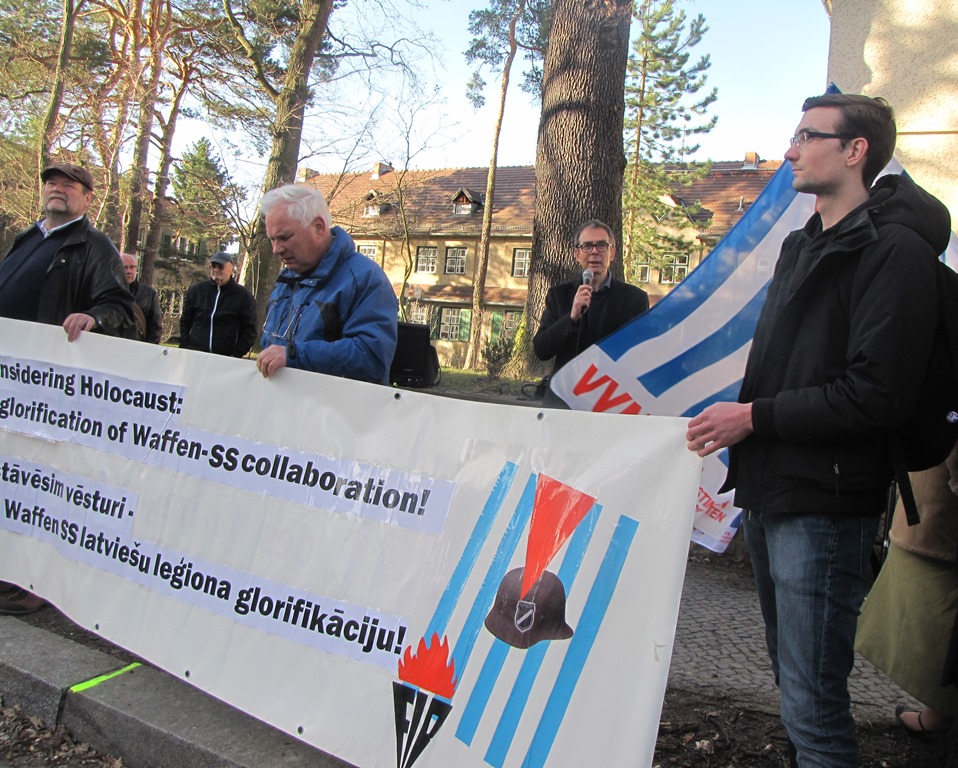
Historian Dr. Hans Coppi (with microphone, center rear) addressing protesters at the Latvian Embassy in Berlin on the eve of the 2017 annual Waffen SS march in central Riga. PHOTO: LOTHAR EBERHARDT.
Posted in Collaborators Glorified, Germany, Human Rights, Latvia, Monica Lowenberg, Neo-Nazi & Fascist Marches, News & Views, Opinion, Politics of Memory, Riga's Waffen SS Marches
Comments Off on Monica Lowenberg’s Speech at the Protest Outside the Latvian Embassy in Berlin
German Member of Parliament Volker Beck Joins Protest at the Latvian Embassy in Berlin
LATVIA | GERMANY | WAFFEN SS MARCHES IN RIGA | BALTIC MARCHES | GLORIFYING COLLABORATORS
◊
by Monica Lowenberg (London)
Last Wednesday, on 15 March 2017, eve of the annual events glorifying Latvia’s Waffen SS in the very heart of the capital city, Riga, one German member of parliament (the Bundestag), Volker Beck, came to the Latvian Embassy in the heart of Germany’s capital, Berlin, to give a speech of support to the protesters. Beck, a member of the Greens, is president of the German-Israeli Parliamentary Friendship Group. The following is the text of his speech, which I have translated into English.
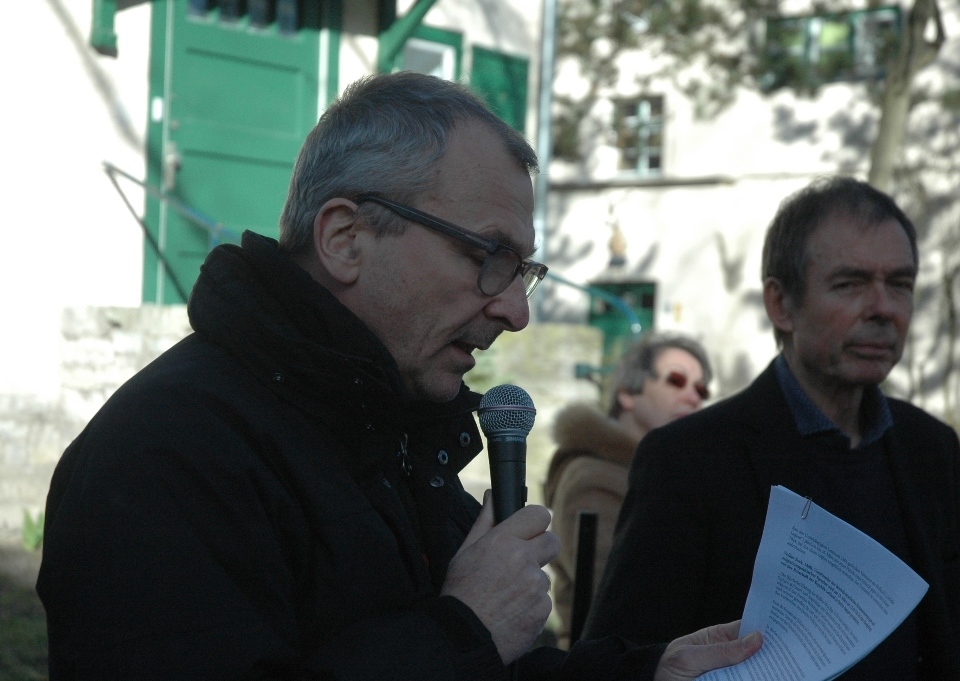
Volker Beck gives a speech of support to protesters at the Latvian Embassy in Berlin on the eve of the 2017 annual Waffen SS march in central Riga. PHOTO: LOTHAR EBERHARDT.
Posted in Collaborators Glorified, Events, Germany, Human Rights, Latvia, Monica Lowenberg, Neo-Nazi & Fascist Marches, News & Views, Opinion, Politics of Memory, Riga's Waffen SS Marches
Tagged Latvia, Latvian Waffen SS, March 16th in Riga, Monica Lowenberg, Volker Beck, Waffen SS
Comments Off on German Member of Parliament Volker Beck Joins Protest at the Latvian Embassy in Berlin
“Statistics” Posted by the “Good Will Foundation” in Vilnius
OPINION | GOOD WILL FOUNDATION | VILNIUS JEWISH LIFE | LITVAK AFFAIRS | HUMAN RIGHTS
◊
VILNIUS—The following list of “Statistics: Project Funding Allocations” is a screenshot taken today of the page of that name on the website of the Lithuanian government’s Good Will Foundation (GWF). It is also available (with some browsers) in the alternative interactive Tableau format (below the screenshot).
Posted in "Admas Kodesh", "Good Will Foundation" (Jewish Restitution in Lithuania), A Stolen Election and a Small Jewish Community's Protest, Documents, Herbert Block and Issues of Lithuanian Jewish Cemetery Preservation, Lithuania, Lithuania: Textbook Case of East European Restitution (for Lost Jewish Assets) Abused to Dismantle a Vibrant Jewish Community, Lithuania's Jewish Community Issues, Litvak Affairs, News & Views, Old Vilna Jewish Cemetery at Piramónt (in Šnipiškės / Shnípishok), Opinion
Tagged "American Zionist Movement" + Lithuania, Commission for Preservation of America's Heritage Abroad, CPJCE (London), Geros valios fondas (Vilnius), Good Will Foundation (Vilnius), Herbert Block, Herbert Block + American Zionist Movement, Herbert Block + Good Will Foundation, Herbert Block + USCPAHA, Jewish Community of Lithuania, Piramont (Snipiskes), Ruta Bloshtein petition, Snipiskes Jewish cemetery, USCPAHA, Vilnius Jewish cemetery
Comments Off on “Statistics” Posted by the “Good Will Foundation” in Vilnius
Defending History’s Statement on Need for Announcement of Democratic Elections for Leadership of Lithuanian Jewish Community
OPINION | DEMOCRACY | VILNIUS JEWISH LIFE | LITVAK AFFAIRS
◊
Can small East European Jewish communities preserve their independence in the face of powerful state (and non-state) interests? Should the granting of restitution deriving from the value of properties of annihilated Jewish communities be directed to preserving free, democratic, vibrant and diverse Jewish life into the future as opposed to the interests of certain environments of governments and other elites, and their tiny cliques of so-called “Court Jews” — an endeavor that has, at times, here in Lithuania, declined into a race to the PR status of “Ah, but I am the last real Litvak, the rest of them, I don’t know…”
Events are now coming to a head. Simon Gurevich, longtime former executive director of the Lithuanian Jewish Community, has announced his candidacy for the community’s leadership. The country’s chief rabbi, former chief rabbi, and hundreds of younger, everyday community members rapidly signaled their support on Mr. Gurevich’s Facebook page. (Older members of the community, who tend not to use the web, do not yet by and large know of the looming elections.) The incumbent, the eminent attorney Faina Kukliansky, has a significant base of support too. The stage is set for a lively and dignified contest of ideas, plans and dreams for a small but beautiful Jewish future in the country. What with a substantial diaspora of diverse kinds of Litvak identification and rediscovery of roots, the implications are to some degree international. Incidentally, both candidates are scions of centuries-old Litvak families hailing from the depths of Lithuania.
Posted in "Good Will Foundation" (Jewish Restitution in Lithuania), A Stolen Election and a Small Jewish Community's Protest, Lithuania, Lithuania: Textbook Case of East European Restitution (for Lost Jewish Assets) Abused to Dismantle a Vibrant Jewish Community, Lithuania's Jewish Community Issues, Litvak Affairs, News & Views, Simon Gurevich (Simonas Gurevičius)
Comments Off on Defending History’s Statement on Need for Announcement of Democratic Elections for Leadership of Lithuanian Jewish Community
“List of Allocations” of the “Good Will Foundation” in Vilnius
GOOD WILL FOUNDATION | VILNIUS JEWISH LIFE | LITVAK AFFAIRS | HUMAN RIGHTS
◊
VILNIUS—The following “List of Project Allocations” is a screenshot taken today of the page of that name on the website of the Lithuanian government’s Good Will Foundation. It is also available in the alternative interactive Tableau format (below the screenshot).
It bears the date 1 July 2016 and includes the following introductory text: “We thank all the applicants who submitted project applications to the Good Will Foundation (Geros valios fondas). You may find a list of all projects, including the ones that received funding allocation from the Foundation. All applicants will be contacted individually and informed about the results and decisions taken.”
See also the “Statistics” page that covers several recent years.
The decisions on these allocations are taken by the Foundation’s Board.
Posted in "Good Will Foundation" (Jewish Restitution in Lithuania), A Stolen Election and a Small Jewish Community's Protest, Herbert Block and Issues of Lithuanian Jewish Cemetery Preservation, Human Rights, Lithuania, Lithuania: Textbook Case of East European Restitution (for Lost Jewish Assets) Abused to Dismantle a Vibrant Jewish Community, Lithuania's Jewish Community Issues, Litvak Affairs
Comments Off on “List of Allocations” of the “Good Will Foundation” in Vilnius
Simóntshik Launches Campaign for Leadership of Lithuanian Jewish Community
VILNIUS JEWISH LIFE | LITVAK AFFAIRS | LITHUANIA
◊
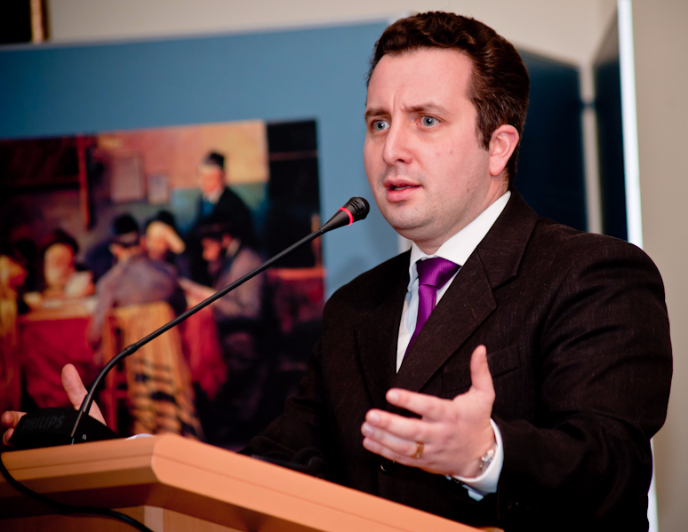
Simóntshik (Shimen Gurevich) addressing a Vilnius conference
VILNIUS—Thirty-something Simonas Gurevičius (Yiddish — Shímen Gurévitsh, English — Simon Gurevich), who was from his earliest teens a Jewish camp counselor, head of the Jewish Students Union in his college years, and then, for years until spring 2015 executive director of the Jewish Community of Lithuania, this morning effectively announced his candidacy for the Community’s chairpersonship in a brief Lithuanian-language Facebook post (reproduced below). Universally known, with love and warmth, to Lithuanian Jews and to many non-Jewish friends who follow Jewish affairs as just Simóntshik, he is a native speaker of Yiddish (very rare for young people here outside the family of Chabad Rabbi Sholom Ber Krinsky), as well as Lithuanian and Russian, with practiced command of English and growing sophistication in Hebrew, both ancient and modern.
Is the mantle of Litvak leadership passing on to a new generation?
Posted in "Good Will Foundation" (Jewish Restitution in Lithuania), A Stolen Election and a Small Jewish Community's Protest, Lithuania, Lithuania: Textbook Case of East European Restitution (for Lost Jewish Assets) Abused to Dismantle a Vibrant Jewish Community, Lithuania's Jewish Community Issues, Litvak Affairs, News & Views, Simon Gurevich (Simonas Gurevičius)
Tagged "Simontshik" + Lithuanian Jewish Community, Faina Kukliansky, Lithuanian Jewish community 2017 leadership elections, Shimen Gurevich, Simonas Gurevicius
Comments Off on Simóntshik Launches Campaign for Leadership of Lithuanian Jewish Community


