OPINION | NEW BRITAIN’S PROPOSED MONUMENT FOR LEADER OF A 1941 HITLERIST MILITIA | GLORIFYING COLLABORATORS | USA | LITHUANIA | CHRISTIAN-JEWISH RELATIONS | ANTISEMITISM & BIAS | HUMAN RIGHTS
◊
◊
◊
The New Britain Progressive, a newspaper in New Britain, Connecticut today carried a report entitled “Council Petition Would Halt Ramanauskas Monument, Pending Investigation”. It begins with the news that
“Alderman Aram Ayalon has introduced a City Council petition requesting, ‘a temporary halt of the building of a monument to commemorate Lithuanian militant, Adolfas Ramanauskas, until further research has been conducted to help confirm the history behind the man being memorialized.’ Ayalon cites concerns regarding accusations about Ramanauskas and the parts of the Holocaust that occurred in Lithuania in 1941.”
The paper’s report cites the Simon Wiesenthal’s October 2017 protest concerning the Lithuanian parliament’s decision to name the year 2018 for the alleged Nazi collaborator, as well as Defending History’s January 2018 plea to New Britain Mayor Erin E. Stewart to halt the project to glorify in the United States a leader of one of the marauding Hitlerist militias of June and July 1941 whose main “accomplishment” was unleashing the Holocaust starting even before the Germans arrived or before they managed to set up their functioning occupational administration. As it happens, the wider complex of these issues in Lithuania today was the subject of a New York Times report last Friday, 30 March.
◊
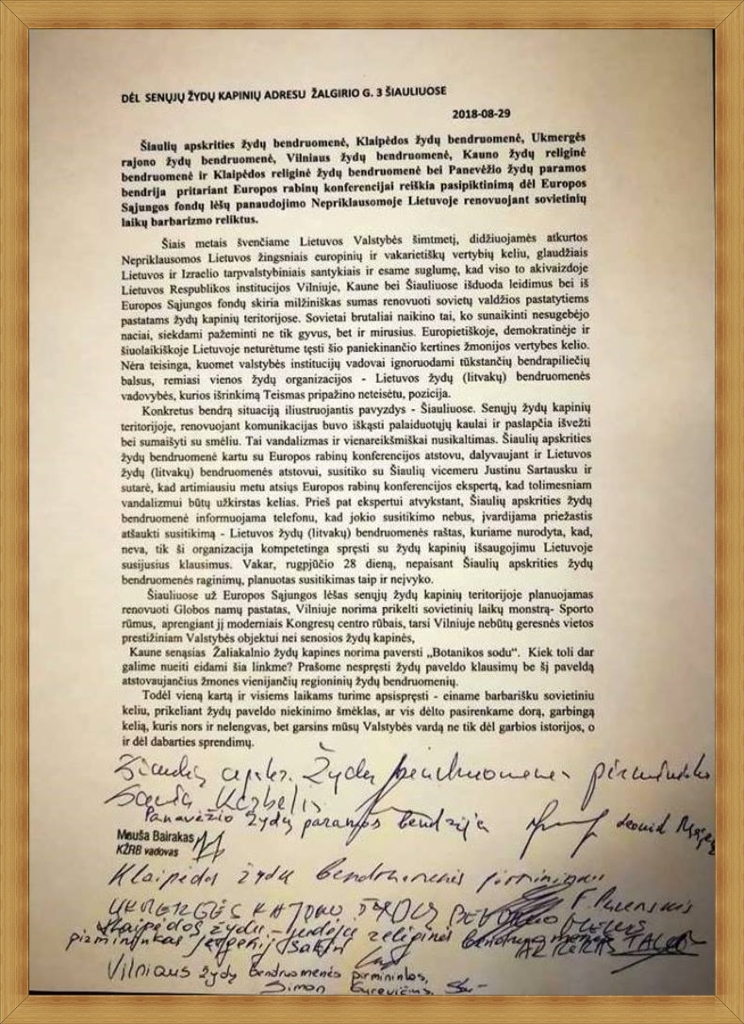
VILNIUS—Baltic News Service (BNS) carried today the text of a public statement issued by the Vilnius Jewish Community (VJC), joined by the Jewish communities of Klaipėda, Šiauliai, and Ukmergė (known in Jewish history as Meml, Shavl and Vilkomir, respectively). For its readers’ information, Defending History is providing a translation below. Please note that in the event of any query arising, the Lithuanian text alone is authoritative; items in square brackets [] have been added in the translation for clarity.
Readers wishing to look at the background are invited to our tracking section, Lithuania’s Jewish Community Issues. As our readers know, the Defending History community tends to see in the sad events of recent years the ominous hand of manipulation of a small but creative and proud Jewish community, by way of restitution monies that, some believe, are being channeled in ways that are not according to the democratic wishes of the members of the nation’s Jewish community. During last year’s election campaign, the rules were changed mid-campaign to disenfranchise the Jewish community’s living members via a new system based on a handful of organization chiefs, one of whom lives in Brussels. In one of the saga’s lowpoints, picking up on local antisemitic tropes, the official, government-sponsored community, where various ex-government or political officials and/or their children occupy some of the major positions, accused the actual Vilnius Jewish Community of being Russian speakers who pretend to be Jews, leading to international media coverage.
Translation of Text from BNS, 23 March 2017:
◊
Photos by Julius Norwilla, Ruta Ostrovskaya, and Dovid Katz
VILNIUS—For the 11th year running, the center of Lithuania’s beautiful capital, Vilnius, was gifted in the high afternoon hours this past Sunday, Match 11th, to far-righters and neo-Nazis on the annual holiday cherished by the free world for its historic importance, in 1990, in the series of events that toppled the Soviet Union’s hated misrule. The Defending History community, all resolute admirers of Lithuania who celebrate its success, has monitored this event annually. The international outcry after the 2008 event, which featured “Juden raus” and a throng of swastikas had led to curious “compromises” each year between organizers and the municipality on what will and will not be done. But no sign yet of the mayor’s office, municipality or government finding the moral backbone to just say, “No, not in the center of our capital on our independence day.”
◊
◊
◊
Latvia’s Minister for Foreign Affairs Edgars Rinkēvičs seems to have found a brand new idol and role model — Ludwig Seya, who had been a diplomat in the prewar Latvian Republic for 22 years. For a short time he was a minister, but mostly he held ambassadorships to various countries. After Latvia was annexed to the Soviet Union he taught at the main Latvian university in Riga. In 1944 he was arrested by the Nazis for underground activities in the Latvian Central Council, a union of pre-war politicians and intellectuals who tried to persuade the West to insist on the independence of Latvia after World War II. After being liberated from the concentration camp on the territory of Poland, Seya was arrested by the Soviet military authorities and sent to a Stalinist gulag.
◊
JERUSALEM—The 1 February 2018 letter of Rabbi Shmuel Rabinowitz, Rabbi of the Western Wall and Holy Sites in Israel to the president of Lithuania, Dalia Grybauskaitė, was released here today for publication. In it, the world-renowned rabbi who heads the Western Wall Heritage Foundation, pleads with the president of Lithuania to “cancel this plan to make this site a convention center.” He reminds her of the tens of thousands of Jews buried at the old Piramónt cemetery of Vilna, now in the Šnipiškės district of Vilnius, capital of Lithuania. His letter follows the 7 January 2018 letter from the Chief Rabbi of Israel, Rabbi David Lau, and the pleas of virtually all the world’s leading rabbis of Litvak heritage (and many others) over recent years, in addition to many people of good faith of all backgrounds.
◊

Lead banner reads: “WE KNOW WHO OUR NATION’S HEROES ARE. This year’s “sanitized” event in central Vilnius featured a lead banner glorifying six Nazi collaborators, five of them deeply implicated in the Lithuanian Holocaust. The torchlit march, the day’s final event, made its way from Vilnius’s most sacred Catholic shrine down through the Old City, culminating at a street named for one of the collaborators who had advocated “only” ethnic cleansing of the country’s Jewish minority in 1941.

Ninety years ago today: Jewish community of Darbėnai (Yiddish: Dorbyán) celebrating the 10th anniversary of Lithuania’s independence on 16 February 1928. Photo: DOV LEVIN COLLECTION.

Lithuania’s Minister Dr. Shimshon Rosenbaum and Seimas member Leib Garfunkel visiting Alytus (Alíte) in 1924. Photo: DOV LEVIN COLLECTION.
◊
Lithuania’s Mažvydas National Library is curiously fostering two parallel cultures which have yet to engage each other. Up on the fifth floor, on the West side, an eminent Judaic studies scholar leads the Judaica Research Center (cosponsored by the Yivo institute in New York), and on the East side, journalist Vidmantas Valiušaitis leads the Adolfas Damušis Democracy Studies Center.
More on Mažvydas National Library; on Yivo’s history in Vilnius since 2011
◊
VILNIUS—An important factual report on the fate of the old Gwarna Street Jewish cemetery in Wrocław, western Poland, written by a young Judaic Studies scholar in the city, Agnieszka Jablonska, has been circulating among specialists internationally since last August. It was at the time one of the sources noted in Defending History’s editorial on the subject. The report, entitled On Saving Memory: The Jewish Cemetery on Gwarna Street in Wrocław, Poland provides an abstract that summarizes the narrative:
Jump to: English media section
AVENTURA, FLORIDA—Targum Shlishi, one of the world’s leading voices in creative thinking and innovative problem solving when it comes to Jewish survival — and the survival of Jewish memory — featured various aspects of Defending History’s Vilnius-based work today, in its blogpost on the occasion of Holocaust Remembrance Day. A PDF facsimile of the post follows (please use handles at upper left to turn pages).
◊
VILNIUS—Copies began to circulate in recent days of the letter, dated 7 January 2018, from Rabbi David Lau, chief rabbi of Israel and president of the country’s Chief Rabbinic Council, to Lithuania’s president, Dalia Grybauskaitė, concerning plans for a new national convention center in the heart of the Old Vilna Jewish Cemetery at Piramónt, in today’s Šnipiškės district of the Lithuanian capital. A facsimile follows this report.
◊
VILNIUS—At the suggestion of a number of our readers in Connecticut and neighboring states, Defending History has contacted the office of the Hon. Erin E. Stewart, mayor of New Britain, Connecticut, to ask if her team was aware of the alleged pro-Nazi and Holocaust collaborator background of a Lithuanian militant, Adolfas Ramanauskas (“Vanagas”) who became a major leader of the anti-Soviet resistance in the years after the war. We urge the mayor to reconsider plans for him to be glorified in New Britain, Connecticut this year. It would make much more sense to honor Lithuania’s 100th anniversary of its inspirational 1918 independence in a way that is dignified and can be celebrated by all the peoples of Lithuania, at home and in its far-flung diaspora.
◊
VILNIUS—The following is the automated reply received this morning (last night US EST) from the office of Mayor Erin E. Stewart concerning reports that her city had agreed for a monument to an alleged Nazi collaborator to be erected on public lands in the heart of her city, New Britain, Connecticut. The alleged collaborator, Adolfas Ramanauskas led a Hitlerist militia in the early days of the Lithuanian Holocaust in June and July of 1941, when such militias were busy murdering, plundering and humiliating Jewish neighbors even before the Germans managed to set up their administration in the territories they were conquering in Operation Barbarossa, that launched the genocidal phase of the Holocaust. Hopefully Mayor Stewart will rapidly inform her council of the issue concerning which Defending History provided her with ample documentation as a point of departure for free and open debate (see the message reproduced in the automated acknowledgment).
◊
KIEV—The last surviving organizer of the revolt at Sobibor death camp Arkady Vaispapir, has died at th age of 96.
Vaispapir belied the unfortunate stereotype of Jews going quietly to their deaths. during the Holocaust. He was a Red Army soldier who was wounded in battle, captured by the Nazis and sent to Sobibor. Realizing they were doomed and with nothing to lose, Vaispapir and other Jewish inmates, led by a Jewish Red Army lieutenant named Alexander Pechersky staged an effective and full-scale revolt against their SS guards.
◊
KAUNAS—The Religious Jewish Community of Kaunas, centered in the city’s storied Choral Synagogue, has just produced something very rare in the contemporary Lithuanian Jewish scene. It is a commemorative coin that is both traditional and novel, while honoring the language of the actual annihilated Jewish communities of Kaunas (also known historically as Kovno, Yiddish Kóvne).