◊
All Welcome!
Sunday 29 August 2021
Eighty years ago to the day, 29 Aug. 1941, all the town’s Jewish residents were massacred in the Holocaust, mostly by local white-armbander (“LAF”) fascists in partnership with occupying Nazi forces
◊
Eighty years ago to the day, 29 Aug. 1941, all the town’s Jewish residents were massacred in the Holocaust, mostly by local white-armbander (“LAF”) fascists in partnership with occupying Nazi forces
◊
VILNIUS—Famed Lithuanian playwright Marius Ivaškevičius interviewed Dovid Katz as his Vilnius apartment on 20 March 2017 as part of the filming for Tzvi Kritzer’s documtentary “The Last Sunday in August” about the slaughter of the Jews of Malát (today: Molėtai) Lithuania. The much more general interview offers sweeping discourse on the Lithuanian Holocaust and its legacies, and sundry difficult related issues. There was a cameo appearance by the film’s producer Tzvi Kritzer. The footage released is unedited but not complete. Unfortunately, the beginning, with Marius’s detailed opening statement and set of questions, is missing from this footage. The documentary, released in 2018, is on youtube.
The plaintiffs in the court case, descendants of people buried in the old Vilna Jewish cemetery, employ a new law firm in Vilnius which files the appeal in June 2021 in accordance with the thirty-day deadline imposed by the court that handed down the May 2021 decision. Meanwhile, on 16 June, officials of the US taxpayer funded “USCPAHA” revel in tweets of lavish photo-ops with high officials in Vilnius, without even meeting Ruta Bloshtein, author of the petition whose number of signatories on this date was 53,486. DH reports.
◊
◊
Almost five years ago, an exceptional March of Jewish Remembrance took place in Molėtai, on 29 August 2016. On that occasion, an impressive monument was erected at the site of the mass murder of the Jewish citizens of Molėtai (known in Yiddish as Malát). For that, we are grateful to Tzvi Kritzer, a descendant of Molėtai Jews now living in Israel. Leonas Kaplanas, another son of survivors from the town, now living in Vilnius, also contributed significantly to organizing the March.
◊
◊
The decision announced by leaders of the three major universities in Lithuania, and of its History Institute, to belatedly break off ties with the antisemitic, ultranationalist, far-right, history-revisionist “Genocide Center,” a state-sponsored institution, is both “better than nothing” and “better late than never.” For over a dozen years now, Defending History has documented the Center’s role in spewing antisemitism, while underpinning ultraright Nazi-sympathetic nationalism and Holocaust obfuscation and denial wrapped up in pseudo-historical research; a similar record has been kept of its obedient showcase of fake history to the outside world, the “Genocide Museum”). The shocking wall of skittish silence on the part of professors, diplomats, and political leaders has been apparent not only within Lithuania, but also from some Holocaust, history and international (particularly American-based) Jewish organizations whose leaders covet the local medals, honors, photo-ops and junkets that give them that certain godlike ego-boost that is only to be had, it seems, east of the former Iron Curtain.
On December 16, 2020, the sixth day of Hanukkah, defenders of the oldest Jewish cemetery in Vilnius (at Piramont-Šnipiškės) won a major, decisive, surprising, timeless victory. Lithuania’s government, acting on our campaign’s and Seimas member Kęstutis Masiulis’s proposals to the Seimas (parliament) Budget and Finance Committee, struck from the 2021 budget all funding for the reconstruction of the Vilnius Sports Palace into a Vilnius Congress Center. This building, which the Soviets had erected in the middle of the Cemetery, had fallen into disuse. The Lithuanian government acquired the building in 2015 with plans to remake it as a center for international conferences, further desecrating the Cemetery for untold years to come. Thankfully, the newly elected Government has eliminated funding.
BROOKLYN, NEW YORK—Rabbi Pinchos Hecht, director of New York’s famed Mirrer Yeshiva, issued a two-page letter today expressing an impassioned appeal to Lithuania’s president, prime minister, finance minister, and the Seimas (parliament) budget review team, imploring them to halt the misguided project to erect the nation’s central convention center in the heart of the Old Vilna Jewish Cemetery, where thousands still lie buried on all four sides of a Soviet eyesore slated for reconstruction. Protests have been lodged by virtually all the leading Lithuanian tradition (Litvak) rabbis internationally, as well as over 53,000 people who have signed a petition. The saga has been dragging on for years.
“Human rights and dignity do not end with one’s death. The individuals buried in the Snipisek cemetery are the most helpless type of individuals, as they are unable to speak for themselves. The Holocaust wiped out the very community in whose care the preservation of the cemetery would have been entrusted.”
Thank you once again to all who wrote emails to Lithuania’s Parliament (Seimas) to oppose the financing of the reconstruction of the Vilnius Concert and Sports Building Complex which the Soviets built in the heart of the oldest Jewish Cemetery in Vilnius at Piramont-Šnipiškės. As things stand, the budget for 2021 includes 515,000 euros to organize the contests to select the operator and the contractor for the complex, and further foresees 16,685,000 euros in 2022 and 10,173,000 euros in 2023 for the building works involved.
We now need to write letters to Lithuania’s Finance Ministry and even the President of Lithuania. Today, December 11, 2020, the new Government has been sworn in, including the Finance Minister. This new Government will have just a few days to revise the budget for 2021 before it returns it to Seimas on December 17 for the second review.
A heartfelt thank you for all who responded to our urgent call to write the Budget and Finance Committee of Lithuania’s Seimas (Parliament), which met on November 11, 2020. The Committee acknowledged that it received recommendations from 54 groups and individuals to not finance the reconstruction of the Vilnius Concert and Sports Palace Building Complex, which the Soviets built in the center of the historic Jewish cemetery at Piramónt-Šnipiškės. The Committee neither approved nor rejected this proposal but simply passed it on to the Lithuanian government.
At this stage in the budget process, we urge concerned readers to send a second email to the Seimas leadership, as described below, before the Seimas’s crucial session on November 24, 2020.
◊
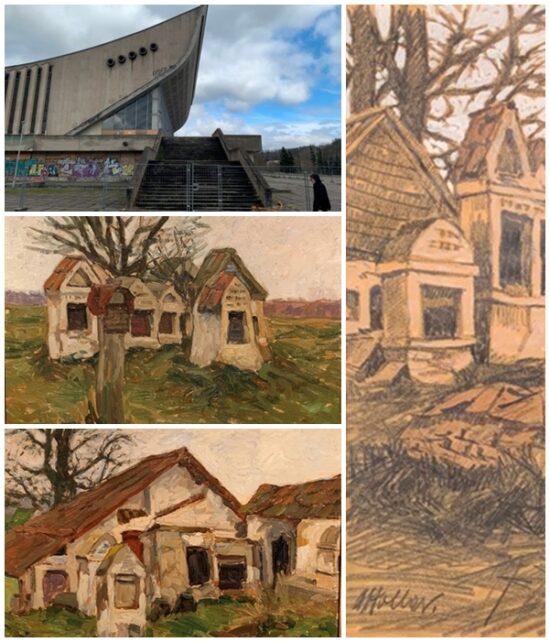
Iconic roof of the dereleict Soviet sports palace in the heart of the Old Vilna Jewish Cemetery. Graphic by D. Umbrasas / Lrt.lt. In the original publication.
Vilnius’s historical and literary sources confirm that there are a number of burial sites in the city, mostly near Christian and Orthodox churches. Larger cemeteries, including Rasos, Antakalnis (soldiers), Bernardines, Orthodox (Liepkalnis), Jewish cemeteries (Piramont / Snipiskes and Zarétshe / Olandų), Evangelicals (Kalinauskas) and others. The legal regulation of Vilnius city cemeteries started only in the second half of the eighteenth century, when cemeteries near Christian and Orthodox churches were full to capacity (burials ceased in 1865) and separate parishes began burials outside the city.
As readers of Defending History know from Julius Norwilla’s recent article, this week is the rare and perfect opportunity for our concerns about the fate of the Vilnius Jewish Cemetery at Piramónt to be heard by Lithuania‘s Seimas.
The Seimas (Lithuanian parliament) is approving a package of investments that it will be making in 2021-2023 to pump Lithuania‘s economy as it battles the pandemic. Among the 49 billion euros of expenditures is a line item of 27 million euros for reconstruction of the Vilnius Sports and Congress Building Complex Project. (See page 3 here and page 84 here). In other words, this is money that will fund the endless desecration of the oldest Jewish Cemetery in Vilnius.
◊
The head of the Conference of European Rabbis (CER), chief rabbi Pinchas Goldschmidt, wrote today to Lithuania’s culture minister, Mindaugas Kvietkauskas, who is often deployed by Lithuanian government agencies to placate Jewish groups with his “love of Yiddish”. The letter forcefully strips the London-based “CPJCE” of any further involvement in the Vilna cemetery saga.
The issue at hand is the fate of the old Vilna Jewish Cemetery, that Lithuania’s state-owned Property Bank (Turto bankas) is determined, in alliance with politicians, builders and other partners for profit, to use for a new national convention center, where thousands would each night cheer and clap, drink at bars and flush toilets, surrounded by a multitude of graves of Vilna Jewish citizens going back to the fifteenth century, if not earlier, including many famous rabbinic scholars and close family of the Gaon of Vilna. There has been massive international opposition to the project.
Hopefully, the Yiddish-loving culture minister will raise his voice for the cultural preservation of Vilna’s holiest Jewish site, where so many generations of Yiddish speaking Vilna Jews lie buried. The cemetery lovingly known to generations of Jews in the Lithuanian capital as Der alter feld (‘the old [burial] field’), or simply as Piramónt.
Besides its being addressed to the culture minister, the text of Rabbi Goldschmidt’s letter is especially significant for its issuing an actual edict concerning the “permission” for the “convention center in the cemetery” by the allegedly corrupt London-based CPJCE (“Committee for the Preservation of Jewish Cemeteries in Europe“) who were caught years ago on Wikileaks cables demanding secret payments for their “supervision” of works at the same cemetery.
In his letter, the chief rabbi makes clear the stance of the Conference of European rabbis:
“The Committee for the Preservation of Jewish Cemeteries in Europe does not have the authority to, God forbid, approve the continued desecration of the cemetery […]. On behalf of the Conference of European Rabbis, I want to clarify that the CPJCE lost the authority to liaise with the Lithuanian government on this vital issue, because they did not respond to a summons of the Rabbinical Court, and subsequently do not represent the voice of European Jewry. Let me also be clear that the Conference of European Rabbis no longer maintains an official affiliation with the group. We therefore urge the Lithuanian government to cease all communications with the CPJCE […].”
A facsimile of Rabbi Goldsmith’s letter follows (also available as PDF). Observers eagerly look forward to the response of Minister Kvietkauskas.
CONFERENCE OF EUROPEAN RABBISLithuanian journalists are raising questions that the Lithuanian government has yet to answer regarding its plans to repurpose as a modern convention center the Vilnius Sports Palace which the Soviets built on the oldest Jewish cemetery in Šnipiškės. These journalists are informing the Lithuanian public about spectacular increases in projected costs, the rabbinical court’s ruling which prohibits use of the building, the architects who propose reconsidering the future of the building, and the historical documents which show that the Soviets seized the Cemetery in 1940 from the Vilnius Jewish Community, whose rights have yet to be restored.
◊
Skirmantas Malinauskas Publishes Expected Construction Costs of 64 Million Euros
Most dramatically, on September 12, 2020, independent journalist Skirmantas Malinauskas uploaded an hour-long You Tube video. “For the sake of the public interest”, he presented portions of a document leaked to him, namely the technical project submitted in March, 2020 by Karolis Maciulevičius of UAB “ArchiMenai” to Turto Bankas (the State Property Bank). Malinauskas’s investigative videos are supported by 4,000 Patreon subscribers (at about 3 euros per month) and typically viewed by more than 100,000 viewers, and this bombshell may reverberate across Lithuanian media. Skirmantas Malinauskas was until March, 2020 an advisor to Prime Minister Saulius Skvernelis. Prior to that he worked as a journalist for 15min.lt, where he wrote detailed articles on September 20, 2016 and June 7, 2016 about problems in the bidding process for reconstruction of the Vilnius Sports Palace.
In 2015, Ruta Bloshtein first publicly spoke out against the Lithuanian government’s unseemly decision that Lithuania’s premiere convention center should be the Soviet Sports Palace, a monstrosity which desecrates the oldest Jewish cemetery in Vilnius. Her article (that appeared (in Lithuanian and in English translation) in DefendingHistory.com included her plea, “Palikite ramybėje mūsų didžių protėvių Vilniaus žydų kapus” (Leave in Peace the Graves of Our Great Vilnius Jewish Ancestors).
On August 1, 2020, her words became the headline of the main article on the front page of Lithuania’s leading nationalist weekly, “Lietuvos Aidas”. The weekly was founded in 1917 by Antanas Smetona, who in 1918 became Lithuania’s first president. It was revived in 1990, controversially, as the state newspaper of newly independent Lithuania, and privatized a few years later. The weekly has grown in quality under editor Rasa Pilvelytė-Čemeškienė and claims a circulation of 7,000.
◊
◊
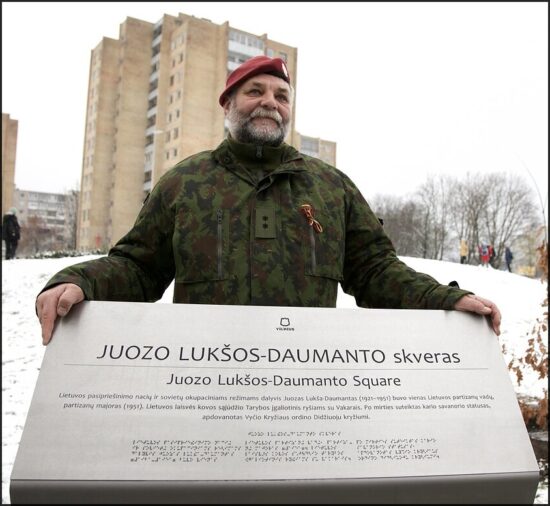
The resolution of the Seimas (Lithuanian parliament) to declare 2021 the “Year of Juozas Lukša” has resulted in heated discussions. They are attentively chronicled by Defending History.
Those who remember the Holocaust and its lessons for history and for life discuss the name Juozas Lukša in conjunction with the LAF (Lithuanian Activist Front) of June and July 1941, including the versions that link him to a barbaric massacre of Jews at the Lietukis Garage in central Kaunas where some seventy innocent Jewish people, caught in the streets, were brutally killed before cheering crowds.
Juozas Lukša looks very similar to one of the murderers in one of the photos (and he was identified by some from a photo of himself after the war). It links him to one of the versions noting that the Garage Massacre was committed largely by prisoners who had been released from a Kaunas jail (we know that Lukša was released from a Kaunas jail). Opponents to those versions claim that Juozas Lukša is innocent and level accusations of slander against those who implicate him. This discussion is not new and there have not really been any new proofs offered on either side since the flare-up of the argument over the last month.
◊

Where the old Soviet Sports Palace stands within the old Cemetery Wall. A group of Lithuanians and Litvaks are working together to ensure that the wall’s historic path will be clearly marked for future generations of visitors to Vilnius.
“Gerbkime kapines” (Respect Cemeteries) at www.kapines.com is our small team of Lithuanians and Litvaks who are working together locally to defend the honor of the oldest Vilnius Jewish Cemetery, known variously as the Piramont or Šnipiškės Cemetery. The Soviets desecrated the site by building a Sports Palace there. The Republic of Lithuania and the City of Vilnius are moving ahead with their plans to open a convention center there in 2023.
Our team is now reaching out internationally with a variety of activities to join or support. We need writers, translators, researcher, web page creators and maintainers, and we also need donations.
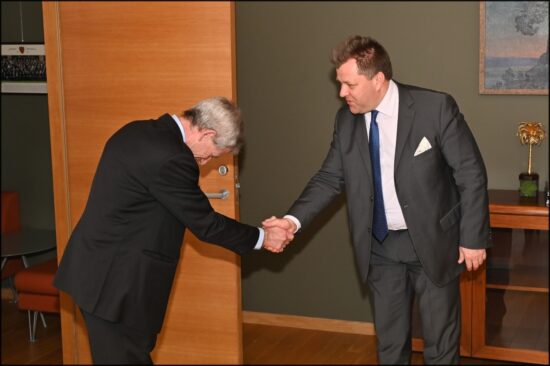
VILNIUS—According to a report by the website Save Vilna that also appeared in the Christian News Journal, the Lithuanian ambassador to the United States, HE Rolandas Kriščiūnas has personally assured the chairman of the U.S. Senate’s Foreign Relations Committee, Jim (James E.) Risch “that there will be no conference centre on the cemetery.” The meeting resulted from months-long diplomacy by Christian Evangelical journalist Dr. Matthew Anthony Harper of InterMountain Christian News, a prominent campaigner against the desecration of Jewish cemeteries. Over the past year, he has passionately represented the cause in Vilnius and Tel Aviv, in addition to his work as a White House correspondent representing Christian media. Together with a delegation of top Lithuanian tradition rabbis in Israel, he spoke eloquently at a videotaped meeting with the Lithuanian ambassador to Tel Aviv.
◊
◊
Respect Cemeteries (Gerbkime kapines) is a group of individuals in Lithuania who are working together to keep our country from operating a convention center at the Vilnius Sports Palace on top of the oldest Jewish cemetery in Vilnius. We are focusing on this crisis as the most vital issue to address in fostering Lithuanian and Litvak friendship.
Our approach is to embrace and explore the value of respecting all cemeteries with special attention to Lithuanian points of view. Arkadij Kurliandchik, an elected member of the board of the Vilnius Jewish Community, advises that we won’t be heard in Lithuania if we portray the fate of the Vilnius Jewish Cemetery as a Jewish special interest issue. Instead, if we care about our general humanity, and if we appreciate Lithuanian issues, then we hope to discover the righteous Lithuanians who will argue with us against cynical Lithuanian politicians and developers, and against their ally, the official Lithuanian Jewish Community.