


For the first time, there has appeared to be a ‘coordinated antisemitic campaign’ among Lithuanian mass circulation daily newspapers of very different orientations. As reported on DefendingHistory.com yesterday, a massive three page tabloid spread on the 3 December weekend edition of the mainstream paper considered the country’s best, Lietuvos rytas, was replete with the kind of inflammatory language, references and images sure to cause a noticeable upturn in antisemitism in the country.
Second Mass Circulation Daily Prints Antisemitic Yarn, Revised and with New Images
Posted in Antisemitism & Bias, Human Rights, Media Watch, News & Views
Comments Off on Second Mass Circulation Daily Prints Antisemitic Yarn, Revised and with New Images
Three Page Antisemitic Mini-Tract runs in Lithuania’s Mainstream Daily
The weekend edition (dated 3 December 2011) of Lithuania’s most prestigious daily, Lietuvos rytas, contained a massive three tabloid-page antisemitic article on the subject of the restitution law finally passed by the Seimas (parliament) last June. It was constructed as a journalistic inquiry but is replete with multiple and inflammatory antisemitic referencing.
A PDF of the article, which is announced on a front page blurb (titled ‘Mystery of the Millions’), is available here. The web version is here. A full English translation is available here.
Posted in Antisemitism & Bias, Human Rights, Media Watch, News & Views
Comments Off on Three Page Antisemitic Mini-Tract runs in Lithuania’s Mainstream Daily
Text of the Restitution Law Passed by the Lithuanian Parliament
D O C U M E N T S
According to sources familiar with the negotiations, the following is the mutually accepted English text of the property restitution/compensation law passed by the Lithuanian Parliament on 21 June 2011, subsequently signed by the president, and coming into effect today, 1 December 2011. It is also available on the website of the Lithuanian parliament, in Lithuanian and in English (a Word doc version is also provided). [Update of 2012:Nina Bruskina’s paper in Lithuanian; in the event of future URL changes, the law can be searched via “Lietuvos Respublikos geros valios kompensacijos už žydų religinių bendruomenių nekilnojamąjį turtą įstatymas. Valstybės žinios, 2011, nr. 803897”.
LAW TEXT (translation)
Draft -XIP -968(4)
LAW OF THE REPUBLIC OF LITHUANIA
ON THE GOOD WILL COMPENSATION FOR THE IMMOVABLE PROPERTY OF JEWISH RELIGIOUS COMMUNITIES
2011 Vilnius
The Seimas of the Republic of Lithuania,
Posted in "Good Will Foundation" (Jewish Restitution in Lithuania), Documents, Lithuania: Textbook Case of East European Restitution (for Lost Jewish Assets) Abused to Dismantle a Vibrant Jewish Community
Tagged Jewish property restitution/compensation in Lithuania, Restitution Law Jewish communal property in Lithuania
Comments Off on Text of the Restitution Law Passed by the Lithuanian Parliament
Dovid Katz’s Review of Timothy Snyder’s ‘Bloodlands’ & Alexander Prusin’s ‘Lands Between’
◊
by Dovid Katz (Vilnius)
◊
NOTE: This review appeared today in East European Jewish Affairs under the title “Detonation of the Holocaust in 1941: A Tale of Two Books” (proof as PDF).
*
Not for the first time, two fine historians have published in the same year their very different syntheses for the wider public, on the same topic, and based largely o known published sources, both having long proven their mettle as master researchers in previous publications rooted in archives and primary documents. On this occasion the resulting contrast is unusually startling. One of these books, Alexander Prusin’s The Lands Between, is a meticulously balanced and historically authoritative, but conventional and somewhat lackluster history that will appeal to lecturers looking for a solid textbook on twentieth-century East European history and, of course, history buffs ever fascinated by the Second World War.
Timothy Snyder’s Bloodlands, by contrast, is the work of a literary master who has what it takes to write a thriller. Deservedly, his book has captured the imagination of vast numbers of readers and pundits alike. It is also the work of a humanistic thinker who does not beat around the bush and has – very justifiably – made willful state mass murder his topic, leading him to grapple with murder en masse, a forever captivating topic, all the more so within the Hitler–Stalin complex of issues that continue to fascinate, daunt and rebound potently in today’s geopolitics.
Yet Snyder’s Bloodlands suffers from some cardinal biases that are all the more regrettable in such a masterly and popular work. First, though, it is prudent to briefly cover the book’s scope and at least a few of its highly consequential virtues.
READ MORE
◊
Posted in Double Genocide: The New Form of Holocaust Revisionism & Denial, Dovid Katz, History, Legacy of 23 June 1941, Lithuania, Litvak Affairs, Media Watch, News & Views, Opinion, Politics of Memory
Tagged Alexander Purssin, Dovid Katz reviews Timothy Snyder, Timothy Snyder Bloodlands, Timothy Snyder on Holocaust
Comments Off on Dovid Katz’s Review of Timothy Snyder’s ‘Bloodlands’ & Alexander Prusin’s ‘Lands Between’
Yad Vashem’s Exhibit on the Holocaust in Lithuania
O P I N I O N
by David Goshen (Kiryat Ono)
[Editor’s note of 1 December 2012: The letter below refers to the revised Yad Vashem exhibit of recent years, rather than the long-time exhibit removed. Cf. the final point made in DH editor’s June 2009 letter to Yad Vashem.]
The following letter was recently sent by me to the editor of the Jerusalem Post. It had one main object, namely to point out that a major portion of the responsibility for the murder of the Jews of Lithuania lies on the shoulders of the local Lithuanian population and to persuade the Yad Vashem Holocaust Museum that the description “killed by the Nazis with the assistance of their local allies” does not by far describe what really took place in Lithuania in the Holocaust. A much abridged version of the letter was published on 30 November 2011.
Posted in Israel, Opinion, Politics of Memory, Yad Vashem and Lithuania
Comments Off on Yad Vashem’s Exhibit on the Holocaust in Lithuania
‘That Awful Summer’ — Conference at Efrata College in Jerusalem
E Y E W I T N E S S R E P O R T / O P I N I O N
by Joshua Markovitz (Jerusalem)
It was Thursday November 24th. Thanksgiving. One couldn’t really feel it in Jerusalem, though; the city was bustling as it would on any other crisp autumn morning. I made my way through its fashionable Baka neighborhood, asking several passersby where to find Efrata College. (One of them couldn’t understand my question, and asked me if I spoke English. I happily replied in the affirmative. When one is an immigrant to a faraway land, it’s quite delicious to be mistaken for a native!)
Posted in Double Games, Events, Israel, News & Views, Opinion, Politics of Memory, Views of Prof. Sarunas Liekis, Yiddish Affairs
Comments Off on ‘That Awful Summer’ — Conference at Efrata College in Jerusalem
Owning a Massacre: ‘Ukraine’s Katyn’
O P I N I O N
by Ivan Katchanovski
Preface
Ukrainska pravda, Dzerkalo tyzhnia, Zaxid.net, Den, Gazeta.ua, Glavred, and UNIAN, which all devote either special sections or many publications to such historical issues as newly uncovered World War II era mass graves, refused to publish a Ukrainian-language version of the following Open Democracy article on the misrepresentation of the Nazi mass execution of Jews in Volodymyr-Volynskyi as a Soviet massacre of Poles. The Ukrainian service of Radio Liberty published a Ukrainian version of my article in the op-ed section of their website. However, the article was removed from their website without any explanation a few hours after its online publication. My email to the director and the webmaster of the Ukrainian service of the Radio Liberty got no response. In contrast, a report claiming that the victims uncovered in Volodymyr-Volynskyi were Poles executed by the Soviet secret police remains on the website of this radio station funded by the US government.
Introduction
Such historical issues as Stalin’s policies of mass murder and activities of the Organization of Ukrainian Nationalists (OUN) and the Ukrainian Insurgent Army (UPA), attract a great deal of the media coverage in contemporary Ukraine. However, the media reporting on these issues is often politically biased, and it even involves a self-imposed censorship concerning the involvement of the OUN and the UPA in Nazi genocide.
Posted in History, Opinion, Politics of Memory, Ukraine
Comments Off on Owning a Massacre: ‘Ukraine’s Katyn’
How the Zingeris-Račinskas Red-Brown Commission “Gently” Pushed Along the Conversion of Holocaust Studies into Double Genocide Studies
O P I N I O N
by Rachel Croucher (Melbourne)
Although not seeking to deny the Holocaust, the ultimate consequence of the movement to redefine genocide is the equalization of National Socialist and Soviet crimes. The characterization of Soviet crimes as genocide is a misrepresentation that hinders authentic remembrance of the Holocaust in Lithuania by helping to obscure the extent and nature of Lithuanian complicity in the killings of the local Jewish population.
The idea that the crimes of Hitler and successive Soviet regimes are in fact equal has been a growing force behind public discourse on the Holocaust since the formulation of the national Holocaust and Genocide Education Program at the sixth meeting of The International Commission for the Evaluation of the Crimes of the Nazi and Soviet Occupation Regimes in Lithuania in June 2002.
Posted in "Jewish" Events as Cover?, "Red-Brown Commission", Australia, Double Genocide: The New Form of Holocaust Revisionism & Denial, EU, Free Speech & Democracy, History, Holocaust Policies of Mr. Ronaldas Račinskas and the State-Sponsored "International Commission" (ICECNSORL), Opinion, Politics of Memory, Rachel Croucher
Tagged Double Genocide, Emanuelis Zingeris, Holocaust Obfuscation, International Commission for the Evaluation of the Crimes of the Nazi and Soviet Regimes in Lithuania, Rachel Croucher, Red-Brown Commission, Red-Brown Equation, Ronaldas Racinskas
Comments Off on How the Zingeris-Račinskas Red-Brown Commission “Gently” Pushed Along the Conversion of Holocaust Studies into Double Genocide Studies
The Brand New Holocaust CUBICLE in the BASEMENT of the City Center GENOCIDE Museum in Vilnius
Photos by Richard Schofield (© R. Schofield). Text by Dovid Katz. From a visit on 18 November 2011.
Which is worse?
A Genocide Museum on ground zero of the Holocaust in Eastern Europe that does not mention the Holocaust,
Or
One that, more than a year after being exposed in this journal in the summer of 2010, and a confluence of international pressures, has added, in October 2011, a single solitary cell in the basement, unannounced on the main floor, that distorts the Lithuanian Holocaust and actually glorifies (as ‘rebels’) the local killers who unleashed the Holocaust in the country, while failing to mention their Holocaust role in an exhibit on the Holocaust?
You decide. . .
Posted in Collaborators Glorified, Exotic Jewish Tourism, History, Legacy of 23 June 1941, Museums, News & Views, Politics of Memory, Ponár (Ponary, Paneriai), Symbology, The Green House, Vilnius's Genocide Center and the Genocide Museum it Manages
Comments Off on The Brand New Holocaust CUBICLE in the BASEMENT of the City Center GENOCIDE Museum in Vilnius
Strasti za Banderoju (‘Bandera Passion’)
B O O K S / O P I N I O N
by Franziska Bruder
The 2010 anthology Strasti za Banderoju (Bandera Passion, alternate translations include Bandera Ecstasy or Bandera-mania), edited by Tarik Syril Amar, Ihor Balyns’kyi and Iaroslav Hrytsak, assembles key contributions to three debates conducted in the years 2009-2010 around the person of Stepan Bandera, leader of the main wing of the Organization of Ukrainian Nationalists (OUN).
The first debate, staged on an Internet platform in L’viv in 2009, was occasioned by Bandera’s 100th birthday and the 50th anniversary of his assassination. It was followed in 2010 by another round triggered by then-Ukrainian president Viktor Iushchenko’s decision to convey upon Bandera the title Hero of Ukraine. The editors divided that second round into two parts: the debate conducted in Ukraine and the debate conducted in North America.
Posted in Bandera, Books, Canada, Franziska Bruder, History, Opinion, Politics of Memory, Ukraine
Comments Off on Strasti za Banderoju (‘Bandera Passion’)
A Conference for Tolerance Day
O P I N I O N
by Geoff Vasil
On Wednesday, November 16th 2011, the Tolerance Center in Vilnius hosted a conference called: Tolerance and Totalitarianism. Challenges to Freedom.
Posted in "Jewish" Events as Cover?, Double Games, Events, Geoff Vasil, Holocaust Policies of Mr. Ronaldas Račinskas and the State-Sponsored "International Commission" (ICECNSORL), LGBTQ Equal Rights, News & Views, Opinion, Politics of Memory, United States
Tagged Antisemitism in Lithuania, Commission for the Evaluation of the Crimes of the Nazi and Soviet Occupation Regimes in Lithuania, Emanuelis Zingeris, Hannah Rosenthal, Holocaust commemoration in the Baltics, Holocaust in Lithuania, Irena Veisaite, Jewish Affairs in Lithuania, Jewish Community of Lithuania, Jews in Lithuania, Litvaks, Markas Zingeris, President Obama's Envoy on Antisemitism, Red-Brown Commission, Ronaldas Racinskas, Sarunas Liekis, Simon Gurevich, Simonas Gurevicius, Tolerance Center
Comments Off on A Conference for Tolerance Day
Algirdas Paleckis Speaks Out at a Vilnius Conference that Obfuscates Antisemitism and Racism
O P I N I O N
by Algirdas Paleckis
Note: Translation of Algirdas Paleckis’s comments from the floor at the conference “Tolerance and Totalitarianism: Challenges to Freedom” held on 16 November 2011 in Vilnius. The comments were contributed following the session on “Antisemitism, xenophobia, racism, discrimination. Totalitarian temptations and new trials of tolerance.”
The videotape from which this translation was made is available at: www.youtube.com/watch?v=Odd44ZP-hk0.
See also coverage of the conference by Geoff Vasil and Dovid Katz, and the editor’s comment on prosecutors’ campaign against Mr. Paleckis.
“Thank you very much. I should probably introduce myself. I’m Algirdas Paleckis, a member of the newly-formed Lithuania Without Nazism and chairman of the Socialist People’s Front. It’s really encouraging that this conference is taking place, but Lithuania Without Nazism as an association was founded because of concerns about double standards.
“The fact is, the Lithuanian courts, the one in Klaipeda, recognized the swastika as a symbol is a sort of pagan symbol, which can be displayed in public. We do not have a suitably clear reaction to this from our government.
Posted in Bold Citizens Speak Out, Double Games, Double Genocide: The New Form of Holocaust Revisionism & Denial, Events, Human Rights, News & Views, Opinion, Politics of Memory
Comments Off on Algirdas Paleckis Speaks Out at a Vilnius Conference that Obfuscates Antisemitism and Racism
Yivo Director’s Statements on Legal Swastikas in Lithuania, Plus Some Facts
[updated to May 2013]
“One of the most important statements in the article is that the swastika is banned by Lithuanian law, something that Katz and others have refused to acknowledge.”
———
“Fact: It is illegal to display the swastika in Lithuania today.”
Chronology of events, including the United Nations Human Rights Committee statement of 2012, provided below…
Posted in "Jewish" Events as Cover?, Antisemitism & Bias, Bloomington-Borns Program Manipulated?, Foreign Ministries: Holocaust Politics Abuse?, Human Rights, In the Era of Yivo's 100th, News & Views, Swastikas in Lithuania, Symbology, United Nations, United States
Tagged Dr. Jonathan Brent (Yivo)
Comments Off on Yivo Director’s Statements on Legal Swastikas in Lithuania, Plus Some Facts
Yivo and Lithuania: Rolling summary coverage to 9 Nov 2011
Will Yivo Capitulate to East European ‘State Looting’ of its Archives in Vilnius? Provide Name as Cover for Holocaust Obfuscation & Antisemitism?Continue reading
Posted in A 21st Century Campaign Against Lithuanian Holocaust Survivors?, Dr. Rokhl (Rachel) Margolis (1921-2015), In the Era of Yivo's 100th, News & Views
Tagged Dr. Jonathan Brent (Yivo)
Comments Off on Yivo and Lithuania: Rolling summary coverage to 9 Nov 2011
Open Debate, Open Society, and Secret Societies
O P I N I O N
by Dovid Katz
Last Thursday, 3 November, an article I’d submitted to the Jerusalem Post for consideration appeared on the op-ed page (PDF of the print edition here). In democratic societies, sending an opinion piece to a respectable publication, signing it with one’s real name, and opening it (and oneself) to further open debate and discussion are rather standard. As usual, I linked to the article on my Facebook page, expecting some to agree and some to disagree, moving debate forward.
But a number of Facebook Friends who did not react on my page, or any other open forum, did for some reason find it appropriate to join a kind of witch hunt against the article and its author on a page of a “Secret Group” called Lietuva be neonacizmo (Lithuania Without Neo-Nazism), located at: www.facebook.com/groups/135816956486382.
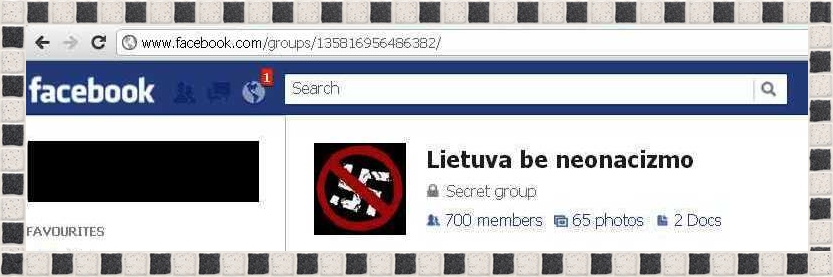
The original discussion of 3 and 4 November 2011 is available here. A full English translation is appended below and is also available as PDF.
Posted in Antisemitism & Bias, Bold Citizens Speak Out, Double Games, Dovid Katz, Fania Yocheles Brantsovsky (Fania Brancovskaja): 1922-2024, Free Speech & Democracy, Human Rights, Lithuania, Litvak Affairs, Media Watch, News & Views, Opinion, Russian Speakers' Personal Status, What Do Fake Litvak Games Look Like?
Tagged Jewish partisans in Lithuania, Justinas Žilinskas, Lara Lempert (Larisa Lempertiene), Lietuva be neonacizmo, Lithuania Without Fascism, Rachel Margolis, Toleikis + Holocaust, Vytautas Toleikis
Comments Off on Open Debate, Open Society, and Secret Societies
Is it Science, or Football?
E Y E W I T N E S S R E P O R T / O P I N I O N / B O O K S
by Geoff Vasil (Vilnius)
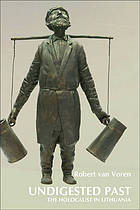 A few friends asked me if I could attend a book presentation in Kaunas, since they couldn’t make it. The book is called Undigested Past: The Holocaust in Lithuania by Robert van Voren. It was published in English first as part of a series by the Rodopi publishing house on Eastern Europe. I’d never heard of van Voren, but people told me he was known for his books on psychiatric abuses in the Soviet Union. The poster for the event proclaimed boldly in Lithuanian that the conference’s official language would be English, which made me smirk, but an English-language version of the poster became available on the morning of the event.
Posted in Events, Geoff Vasil, History, News & Views, Opinion
Comments Off on Is it Science, or Football?
Lithuania Assaults Holocaust Memory
O P I N I O N
by Danny Ben-Moshe
NOTE: This op-ed appeared in today’s Jerusalem Post (and in the Jerusalem Report).
Recent developments suggest Holocaust remembrance has fallen by the wayside as a key element of Jewish Foreign Policy, at least as far as Lithuania is concerned.
Holocaust remembrance is a central plank of Jewish Foreign Policy (JFP), a term that encompasses how Israel and Diaspora organizations act on issues of common Jewish concern. The establishment of Yad Vashem in 1953 and the Eichmann trial in 1961 showed how central the memory of the Holocaust was to Israeli public and foreign policy.
Posted in Collaborators Glorified, Danny Ben-Moshe, Double Games, Foreign Ministries: Holocaust Politics Abuse?, In the Era of Yivo's 100th, Israel, Joseph Melamed, Lithuania, Litvak Affairs, News & Views, Opinion, Politics of Memory
Comments Off on Lithuania Assaults Holocaust Memory
Tripletalk on the New ‘Looted Books Room’ at the National Library in Vilnius
Yivo’s director, one of the current Lithuanian government’s staunchest PR providers in the west (see here, here, here, here), recently told the English Forward that ‘he would continue to work with the Lithuanian government to reach a permanent settlement over the archive’, implying that the Yivo Board would be making its decision in due course.
Posted in Books, Foreign Ministries: Holocaust Politics Abuse?, In the Era of Yivo's 100th, News & Views
Comments Off on Tripletalk on the New ‘Looted Books Room’ at the National Library in Vilnius
Volhynia and the Noxious Weed of Antisemitism
O P I N I O N
by Jared McBride
During my dissertation research in Rivne, I’ve been going through a number of contemporary Volhynian newspapers for articles on a range of historical matters. As a historian of the Second World War, I do not tend to spend as much time with contemporary publications, yet at the end of the day, every activity and research experience is a lesson in some manner when you’re “in country” working.
I spent time working through what I already understood to be the right-wing nationalist newspaper, Volyn’, which is a Rivne oblast’ level paper that comes out once a week. The paper sees itself as the reincarnation of the Nazi occupation newspaper of the same name, which was edited by Volhynian writer Ulas Samchuk, if that tells you anything about the orientation just to start out.
When one orders a run of a paper, you get an entire year at once bound together. I’ll now take you through some of what I saw in the collection for 2002.
Posted in Antisemitism & Bias, Human Rights, News & Views, Opinion, Racism, Ukraine
Comments Off on Volhynia and the Noxious Weed of Antisemitism
Red Equals Brown Iconography
The governing establishments in Eastern European states sometimes produce red-brown symbols as part of the wider campaign to give the notion of red-brown equality an aura of official sanctioned status. The effects are obvious: People are being desensitized to the swastika, Soviet symbols are ‘artistically’ (i.e. via political kitsch) recombinated into the new Dual Equal Evil symbols making the revisionist history ‘true’. Severe pain is caused to families of Holocaust Survivors and anti-Nazi Soviet war veterans alike. The continued silence of the European Union, the OSCE and NATO encourages the drift toward the far right, which includes clean-up of the image of Nazi collaborators in elite circles, and glorification of Nazi symbols in more uncouth environments.
Posted in Double Genocide: The New Form of Holocaust Revisionism & Denial, Foreign Ministries: Holocaust Politics Abuse?, History, Litvak Affairs, Politics of Memory, Symbology
Comments Off on Red Equals Brown Iconography


