O P I N I O N
◊
VILNIUS–Genocide Center historian Dr. Arūnas Bubnys has posted on Facebook the following comment about this journal’s editor.
VILNIUS—At yet another frivolous-case hearing this morning, four supporters of Defending History author Evaldas Balčiūnas turned out to provide moral support. Balčiūnas is a major critic of public shrines, street names and monuments that honor Holocaust perpetrators, as well as an active opponent of neo-Nazi marches and activities, especially those with tacit support from elements of government.
—————
G
ood afternoon to everybody. I’m very happy to be given the opportunity to address this conference, even if it has to be by film. Unfortunately I could not be present personally, but because of the importance of the topic and the rare opportunity that this is to discuss these issues in a very serious way, I am addressing you through this film.
◊
VILNIUS—Yiddish comedy is alive and kicking. Here’s the plot for the new play. The World Jewish Congress gets millions from a Kyrgyz-Kazachstani donor with Lithuanian connections to set up the International Yiddish Center in Vilnius that will save the Yiddish language, a high priority for both the Kyrgyz and Kazachstani peoples. There are just a few strings attached from Lithuanian government-related units and commissions about who may not have a Yiddish teaching job there (for example those who oppose Holocaust Denial or have stood up for Yiddish speaking survivors accused by Lithuanian authorities of war crimes). The new International Yiddish Center is offered an opportunity one day to raise its profile bigtime by being showcased in the Lithuanian Parliament. Who could refuse that? There may even be some medals to go around. But what is it they have to pull off to get there?
◊
Good afternoon. Sincerest thanks to everyone who made today possible, above all to dear Rūta Vanagaitė for successfully bringing together folks from many sides of today’s issues here in Vilnius for the first time in the twenty-first century, in the fine spirit of openness and tolerance that is particularly important, now, when politics and current events can easily deflate freedom of opinion on history, the progress of civil discourse, and the dignity of education.
The following excerpt from the Lithuanian government’s documents, released today, explains the purposes of the new state commission on Jewish heritage. It is excerpted from longer documents available here and here. Updates on the commission’s history will appear on this page.
The following English version of the Lithuanian government’s announcement of its new state commission on Jewish heritage was released today. A PDF of the entire document is available here. An excerpt containing the mission statement is available here.
◊
This small book, brought out in three separate editions (English, Lithuanian, Russian) by the state-supported Genocide Center, looks more like a brochure than anything else. The cover features the author’s name, in small type, above all else, then a larger Kaunas Ghetto, then a line with the years 1941-1944, against a backdrop of a computerized dark blue sky above a “tasteful” black-and-white picture of Jews lined up in columns inside Kaunas ghetto. The computerized dark blue wraps around the spine to the back cover where some vague lines comprise a hand-drawn map of the streets making up Kaunas ghetto, an ISBN number in white above UPC Bookland barcode featuring the same number again, and then a web address, www.genocid.lt. I found myself staring at the internet address and wondering what language that was supposed to be. Lithuanian is always “genocidas” and “genocid” isn’t possible as any permutation or declension of the noun, and of course English is “genocide.” Perhaps it’s Russian in Latin-letter transcription? But that would contradict the nationalist and ethnic bias of the publisher, the Center for the Study of the Genocide and Resistance of Lithuanian Residents where Arūnas Bubnys is a leading figure. Perhaps “genocid” is someone’s notion of a non-English and yet international form of the word, formed by reducing it from the Lithuanian nominative case ending -as? I checked my favorite search engine, and of course the Lithuanian organization’s webpage came up first, but was soon followed by a wikipedia and wiktionary entry for the Croatian word.
◊
On November 17, 2013 I was invited and participated as a guest speaker at the Yizkor memorial event organized by the “Jewish Survivors of Latvia, Inc.” (New York). The event was held at the Park East Synagogue at 163 East 67th Street in Manhattan.
The really important speech, though, was given by Douglas Davidson, the US Special Envoy for Holocaust Issues. He dealt with the results of his numerous visits to Latvia pertaining to that specific issue: due restitution to the Jewish victims or their heirs. Their properties were stolen or requisitioned during the war and the massacres.
◊
When I wrote several years ago (Lithuanian; English) about the monument erected to Juozas Barzda at Iešnalis Lake, I thought it must have been some sort of misunderstanding.
JERUSALEM—The Simon Wiesenthal Center’s Israel office today released the following letter from its director, Dr. Efraim Zuroff, to the mayor of Vilnius, Artūras Zuokas, concerning next week’s planned neo-Nazi march slated for the center of the city on the nation’s independence day.
Editor’s note: The following is a translation of the open letter by Professor Pinchos Fridberg, a Holocaust survivor in Vilnius, and the reply by Yivo’s director, Dr. Jonathan Brent. Both were published in the Yiddish Forward (Forverts) on 1 March 2015. Prof. Fridberg has also posted an audio file of his reading his letter aloud in his native Vilna Yiddish. In the case of any issue arising, the Yiddish text is authoritative. For readers’ reference, hyperlinks have been added (by Defending History) to various of the documents and topics cited. See also the Pinchos Fridberg page and section in Defending History, page and section on the state-sponsored commission discussed, and section on Yivo issues.

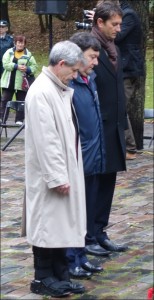
September 2014 at Ponár, the mass muder site of Vilna Jewry: Three representatives of the controversial state sponsored commission on Nazi and Soviet crimes pay respects in unison: (from left): Dr. Jonathan Brent, Emanuelis Zingeris, Ronaldas Račinskas. Photo: Defending History.
D
ear Dr. Jonathan Brent,
I appeal to you in Yiddish. Do you know why? Because I believe, that a person who is the leader of the Yivo institute will understand me. My name is Pinchos Fridberg. I was born in Vilna before the war and am a survivor of the Holocaust. My grandmother and grandfather, and all our relatives on my mother’s side — 28 people — lie [at the mass murder site] Ponár.
The following is an English translation of a book review by Valentinas Brandišauskas of Algimantas Liekis’s Lietuvos laikinoji vyriausybė (1941 06 22–08 05) that appeared in the Lithuanian publication Genocidas ir Rezistencija No. 8, 2000, and is posted online.
The negative predictions have been fulfilled, unfortunately, even beyond expectations. That’s what can be said about a news item that appeared in the Lithuanian exile community’s monthly Akiračiai regarding preparations by Lithuanian historian Algimatas Liekis, who did some work at the Lithuanian Studies Research and Studies Center in Chicago, to write a book about the June Uprising of 1941 and the Provisional Government (PG). Recalling the historian’s past (“during the Soviet era […] he was the komsorg [Communist Youth Party minder] in the Soviet navy, Party secretary of the History Institute of the Lithuanian Soviet Socialist Republic…”) and doubting his reputation as an academic, it was said that “Frontist successors” to the Lithuanian Activist Front (LAF) had invited Liekis
“to write a book that would help the Lithuanian parliament push through the legislation needed to ‘legalize’ the Provisional Government and to proclaim the day of the uprising a national holiday.”
◊
During World War II, numerous proofs of the systematic massacre of the Jews on a large scale had made known to the allied leaders. As the British had very early in the course of the war cracked the Enigma code, their Intelligence Service could read nearly all military dispatches sent by the German units to their headquarters, including those daily reports sent by the Einsatzgruppen leaders who duly sent the daily figures of the Jews and other “enemies” they had killed. One of these reports told of some 30,000 Jews having been killed.[1]
Editor’s note: This article has been translated for our readers at the suggestion of Professor Pinchos Fridberg, whose note to us (here translated from the original Yiddish) reads: “As a Holocaust survivor, I respectfully request that Defending History arrange for translation and publication of this article, in which the director-general of the Genocide Center in Vilnius is quoted as saying that ‘Not all people who contributed to the Holocaust should be considered murderers of Jews’.”