TAURAGĖ (TÁVRIK), LITHUANIA—The Simon Wiesenthal Center today praised an op-ed in the popular Lithuanian news portal Lrytas.lt by prominent journalist Vytautas Bruveris calling upon the government to finally undertake a comprehensive investigation of the scope of Lithuanian complicity in Holocaust crimes. In a statement issued here today by its chief Nazi hunter, Dr. Efraim Zuroff, who is currently in Lithuania on a research expedition, the Center expressed its appreciation and support for the content of the article and expressed the hope that the government would indeed implement the ideas raised by Bruveris.
Opinion
Wiesenthal Center Praises Vytautas Bruveris’s Call for Investigating Scope of Local Holocaust Participation
Vilnius Professor of Architectural & Civil Engineering Speaks Out on Sports Palace at the Old Piramónt (Šnipiškės) Jewish Cemetery
O P I N I O N / C E M E T E R I E S / P I R A M Ó N T
by Josifas Parasonis
◊
While serving as deputy chairman of the Jewish Community of Lithuania in July and August of 2005 I participated in discussions at the Urban Development Department of the Vilnius City Municipality Administration regarding the construction of an apartment building near the Mindaugas Bridge. My own profession is civil engineering. Supported by representatives of the United States Senate, delegates of the American Jewish community demanded that the capital’s municipality halt the construction, as the site of the construction once used to be a Jewish cemetery.
“Absolute Barbarism”: An Orthodox Jewish Resident of Vilnius Speaks Out on Piramónt (Šnipiškės) Cemetery
O P I N I O N / T H E C E M E T E R Y A T P I R A M Ó N T
by Ruta (Reyzke) Bloshtein
◊
This week we Jews observed the saddest day in our people’s tradition — Tisha B’Av (Yiddish: Tíshebov), the annual fast day which commemorates the anniversary of a number of disasters in Jewish history, primarily the destruction of both the first and second temples in Jerusalem. On this day of mourning and lamentation we fast. While sitting on the floor and reading the Book of Lamentations and the Kinoys (sacred poems of mourning), I thought about the Tíshebov tradition of visiting graves of our great sages and of departed family members.
In Vílne (Vilnius), this tradition was observed for ages by visiting the Piramónt cemetery, where throughout a period of more than five hundred years hundreds of thousands have been buried there — the Jews of Vílne, our ancestors among them — and so many illustrious rabbis and sages, who passed on the infinite treasures of their wisdom to us, to help us find the most honest and ethical way of life. It is, in our belief, on account of their merits that the rebuilding of the third temple will come sooner.
Absoliutus barbarizmas: senosios žydų Piramónto kapinės
O P I N I O N / C E M E T E R I E S / P I R A M Ó N T (Š N I P I Š K Ė S)
Rūta (Reyzke) Bloshtein
◊
Šią savaitę mes, žydai, minėjome tragiškiausią mūsų tautos istorijos datą — Tiša b’Av (jidiš: Tišebov) — abiejų Jeruzalės Šventyklų sugriovimą. Gedulą ir netekties skausmą išreiškiame pasninkaudami. Sėdėdama ant grindų ir skaitydama Kinojs knygą (gedulingas elegijas), mąsčiau ir apie tradiciją šią dieną lankyti mūsų didžių išminčių kapus.
Vilniuje ši tradicija buvo puoselėjama lankant Piramont kapines, kuriose per penkis šimtmečius palaidoti šimtai tūkstančių mano protėvių — Vilniaus žydų, tarp jų iškilių rabinų ir išminčių, palikusių neišsemiamus išminties lobius mums, siekiantiems kilniai ir dorai eiti gyvenimo keliu. Per jų nuopelnus bus, duok Dieve, pagreitintas Trečiosios Šventyklos atstatymas.
Double Genocide Discourse Now Standard for the New York Times?
O P I N I O N / M E D I A W A T C H
VILNIUS—Naturally the New York Times cannot publish or even post very many of the Letters to the Editor that it receives. But when a dozen or so reactions from different parts of the world to a single article are all discarded, it is perhaps worth someone posting a submitted letter elsewhere for the record. This is especially true where there is a larger concern. In this case, it is the paper’s imposition, in recent years, of a wall of silence about the Holocaust Obfuscation, World War II revisionism and far-right historiography peddled by East European countries. These are, as it happens, the same countries who are in today’s geopolitics America’s and the West’s most reliable European allies in the New Cold War against the authoritarian, revanchist Putin regime.
The Times’ policy has sometimes extended to misrepresenting the East European far right’s history revisionism as accepted fact by publishing multiple op-eds from only one side of the argument. When the Times did (obliquely) cover the Seventy Years Declaration in early 2012, its reporter, tightly controlled by the State Department, would not mention the declaration by name, would not meet any of the government’s critics to hear their views, confused the two declarations in contest, and quoted a famous Brandeis professor without mentioning he was in town to receive a medal from the Lithuanian president for helping the state’s PR.
Who Has Yet to Express a Public View on the Wisdom of Planting a Convention Center in the Middle of the Old Jewish Cemetery in Vilnius?
VILNIUS—Public opposition to the placing of a twenty-five million dollar convention center in the heart of Vilna’s old Jewish cemetery has come from an array of individuals and organizations, in Vilnius and internationally.
Open Letter to Members of CPJCE in the UK: Do You Really Want a Convention Center in the Heart of Vilna’s Old Jewish Cemetery?
O P I N I O N / O P E N L E T T E R
◊
Dear Esteemed Associates of the “Committee for the Preservation of Jewish Cemeteries in Europe” enumerated on the CPJCE letterhead [more than one eminent personage on the list is deceased; their precious names might perhaps best not be invoked for the organization’s current adventures?]
S.B.E. Berger, Rabbi B.Z. Blum, L. Davis, Rabbi J.H. Dunner, Rabbi Z. Feldman, D. Frand, B.S.E. Freshwater, A.C. Ginsberg, Rabbi H. Gluck OBE, A. Goldman, S. Grosz, M. Hershaft, D. Herzka, M.B. Krausz, J. Kruskal, J. Lobenstein MBE, Y. Marmorstein, Rabbi A. Pinter, Rabbi E. Schlesinger, Rabbi E. Shechter, J. Shik, M.E. Stern, S.B. Stern, Rabbi C. M. Wosner
◊
What’s The Story With the Mass Grave Uncovered near Šiauliai (Shavl)?
O P I N I O N
by Evaldas Balčiūnas
◊
Last week, there was a flurry of reports in the Lithuanian media about human skeletons and personal effects turning up during routine roadworks at Pročiūnai in the region of Šiauliai (in Jewish history: Shavl). Reports and gory pictures appeared among other places in 15min.lt; Etaplius.lt; Skrastas.lt and Snaujienos.lt. I myself, a concerned resident of Šiauliai, commented on the subject on my own blog (here and here). Various articles published contained theorizations about the buried here being victims of Soviet crimes or even equally of Nazi and Soviet crimes.
Monday 13 July. It is probably correct to say that the international scandal was set alight when the “routine” BNS (Baltic News Service) report appeared in English in the Lithuania Tribune (amalgamated with English Delfi). The archaeologist placed in charge by the local government of the investigation of the human remains, Audronė Šapaitė, is quoted in the article as presenting the following certain conclusions. Excerpts follow:
London Based “CPJCE” Rushes to Take Credit for Provincial Mass Grave Site Preservation; Fails to Mention Involvement in “Sale” of Vilna’s Old Jewish Cemetery
O P I N I O N
LONDON—The same London-based European cemetery-preservation group that allegedly takes money (for supervision fees) for “supervising” cemetery “conversions” in Eastern Europe forbidden by other rabbinical authorities, today issued a triumphant press release (image below) about its “rescue” of a provincial mass grave site uncovered during routine roadworks in northern Lithuania, near Šiauliai (Yiddish Shavl). The group is the CPJCE (Committee for the Preservation of Jewish Cemeteries in Europe), which was recently received by the prime minister of Lithuania upon its agreeing to a convention center in the middle of Vilna’s old Jewish cemetery, with no reference to any of the local rabbis or to universal decency on the question of what is appropriate in an old cemetery.
What Does the Mayor of Vilnius Think About His City’s Thousands of Jewish Graves?
O P I N I O N
by Julius Norwilla
◊
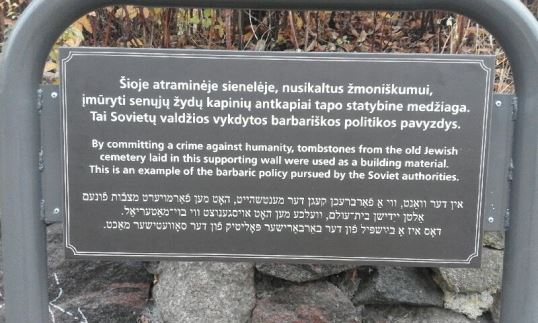
Back in May, the story broke about an electrical station on an uninhabited hillside by a highway here in the Lithuanian capital, Vilnius, being made out of pilfered old Jewish gravestones. It quickly spread to the international press, including London’s Daily Mail. The city’s recently elected mayor, Remigijus Šimašius reacted with lightning speed, getting the city’s sign-making maestros to create and mount a handsome solid-metal smartly round-edged bilingual sign condemning the “example of Soviet barbarism” and promising the rapid removal of the stones to a place of dignity where they will form part of a memorial. A PR disaster was spun into a rapid reaction force’s PR triumph against discrimination that could only do our great city proud.
A Letter from Leffond, France to the Mayor of Vilnius, Capital of Lithuania
O P I N I O N
by Christian Bonneville
◊
Leffond, France, 5 July 2015
Hon. Remigijus Šimašius, Mayor of Vilnius, Lithuania
Monsieur le Maire,
- Convention and Congress Center
- Conversion of the Sport Palace Center along the Neris at the Piramónt Location
Congratulations on your election and your determination to develop the cohesion and the attractiveness of the city to be enriched with new facilities and services including a new Conference and Congress Center.
Dancing on Jewish Graves in Vilna
O P I N I O N
by Pinchos Fridberg
Editor’s note: Reprint from The Times of Israel, where this article, with several photographs, appeared on 25 June 2016.
◊
I am a Holocaust survivor. I was born here in Vilnius (Yiddish: Vílne), today’s capital of Lithuania, known forever as the “Jerusalem of Lithuania” for its vibrant Jewish culture, religious and secular, for hundreds of years. Today our post-Holocaust Jewish community is a tiny remnant, just a few thousand people, but we are vibrant, and, as always, a community of many opinions. Once again, a question has arisen that calls for robust discourse.
Vilnius’s Shnipishek Jewish Cemetery
O P I N I O N
by Bernard Fryshman, PhD
This article appeared in today’s edition of Yated Ne’eman. The PDF of the original is available here.
◊
First, a brief review: In June 2005, Reb Chizkiya Kalmanowitz discovered construction taking place in the Shnipishek Jewish Cemetery in Vilnius. The Shnipishek Cemetery is where the Gaon of Vilna was buried, as was the Ger Tzedek. Even now, the cemetery contains the bodies of the Chayei Adam and the Be’er Hagolah among many others.
The June 2015 Memorial for the Lietūkis Garage Massacre in Kaunas, Lithuania
O P I N I O N / E Y E W I T N E S S A C C O U N T
by Julius Norwilla
◊
To mark the 74th anniversary of one of the iconic events of the Lithuanian Holocaust, the infamous Lietūkis Garage Massacre of 27 June 1941, the Kaunas Jewish Community organized its annual memorial event at the site, last Friday, 26 June 2015. The massacre, carried out by local Lithuanian “patriots” wearing the white armbands of the Lithuanian Activist Front (LAF), butchered dozens of Jewish passers-by at a garage on Kaunas’s Vytautas Avenue, using a variety of execution methods, including clubbing to death with crowbars, and particularly, forcing water from high-pressure hoses into bodily orifices of the victims until they burst. A growing crowd, including women holding up their young children to get the best views, cheered them on.
Rewriting History in Latvia
B O O K S / L A T V I A
by Roland Binet (Braine-l’Alleud/Belgium)
◊
Since I became interested in the fate of the Jewish victims of the Holocaust in Latvia, rather late (2009), I never failed to buy books when I visited that country, first and foremost written by Jewish survivors of these terrible times, but, also, some books written by non-Jewish Latvians in order to see how they perceived these tragic events, how they related to the Jewish victims of the Holocaust and how they presented the history of the German occupation and the mass slaughter of more than 95% of the Jewish population of their country (using the figures of Jews on site at the time of the Nazi invasion as the basis for historians’ estimates).
Why Was Richard Maullin, Head of California ISO, Honored by the Foreign Minister of Lithuania?
O P I N I O N
◊
LOS ANGELES—Richard A. Maullin, elected less than a year ago as the chair of the California Independent System Operator (ISO) Board, was lavishly honored here on May 31st by both the Lithuanian ambassador to the United States and the Foreign Minister of Lithuania. The latter, in the tradition of royalty, meticulously placed the Lithuanian Diplomatic Star around the neck of Dr. Maullin, a major American pollster and principal of the LA polling and public policy research firm FM3, often still known by its older name Fairbank, Maslin, Maullin, Metz & Associates.
In Defense of Transparency at the Milwaukee Symphony Orchestra
O P I N I O N / M U S I C
by Ronald C. Kent
◊
In January 2012 I became aware of a then-upcoming performance of Carl Orff’s “Carmina Burana” by the Milwaukee Symphony Orchestra. Since I knew that Carl Orff was a Nazi-approved composer, who created this work in 1936, I wrote a letter to Maestro Andreas Delfs and Music Director Edo de Waart, requesting that they place the biography of Orff during the Nazi period in the program, in the interest of enlightenment, transparency, and full disclosure, thereby situating “Carmina Burana” in its historical context for listeners.
Ukrainian Hitlerist Icons Celebrated in Weston-on-Trent in Derbyshire, England
O P I N I O N / U K / U K R A I N E
by J. North
◊
Earlier this month, the Ukrainian Youth Association (CYM Great Britain) held a remembrance day at the Tarasivka camp at Weston-on-Trent in Derbyshire. They advertised the event on their website (http://cym.org/uk) and with a poster replete with (ultra)nationalist imagery.