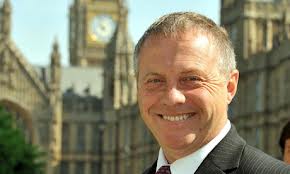
MP John Mann (photo: Guardian)
2013: “It is an industrial rewriting of history in Eastern Europe to excuse mass murders carried out on behalf of the Nazis.”
— John Mann, 5 October 2013

MP John Mann (photo: Guardian)
The Contemporary Art Center’s reading room in Vilnius is hosting an unusual-for-Lithuania Holocaust event called Keep Me in Mind. Briefly, visitors are invited to wander among different tables where good-looking and polite people await them with small boxes and sheaves of papers. When you sit down the narrator at the table tells the story of an individual Holocaust survivor, from childhood to the present. Almost all of the survivors seem to now live in Haifa, Israel. One survivor, Benjamin Ginzburg, came from Vilnius.
As I watch the news of tourists excluded from national parks in America, as Federal Government is shutdown, I recall my visit to Washington DC’s famous National Mall, when I was recently in the city for a screening of Rewriting History.
I viewed several memorials of inspiring individuals: Jefferson, Lincoln and Roosevelt. People who said no to hate and tried to foster positive political change. Physically I was in the American capital, but in the midst of Rewriting History screenings, my head was in an East European space, and this was the prism through which I saw many of the city’s magnificent exhibits. One memorial resonated with me more than any other: The Martin Luther King Memorial.
The concept “Holocaust memoir” encompasses many subgenres in time and place. This review will cover the interlocking treatments by three very different types of witnesses:
At the edge of downtown Vilnius, along the river Neris where the buildings suddenly turn old and worn and bushes, trees and grass take on unmanicured forms, across the bridge whose entree is gated by the Danish and British embassies to Lithuania, there is a strange park nestled in between some very empty Soviet-looking and much older buildings.
In 1998 the “International Commission for the Evaluation of the Crimes of the Nazi and Soviet Occupational Regimes in Lithuania” was established by Lithuanian presidential decree.
The commission is directed in tandem by Emanuelis Zingeris and Ronaldas Račinskas. The former is the commission’s chairman and a Conservative MP in the Lithuanian Seimas, while the latter is the commission’s executive director. The Lithuanian Jewish Community has no representation on the commission.
On Friday, September 13, 2013, the Baltos Lankos publishing firm in Vilnius held a discussion at their main book sales outlet in Vilnius to present a book edited by Professor Jurgita Verbickienė about the Jews of Lithuania.
The discussion on this doubly auspicious day—eve of Yom Kippur and Friday the 13th—began with Verbickienė presenting a short sketch of the book and two other participants in the discussion, Zigmas Vitkus and Simonas Gurevičius. The latter is the executive director of the Lithuanian Jewish Community. The topic was how Lithuanians view Jews.
◊
The following are translated (and edited) excerpts from a longer letter in Yiddish received from a survivor who has asked to remain anonymous, about the Jewish gravestones that form the steps going up to the Reformed Evangelical Church at Pylimo 18 in Vilnius.
O P I N I O N
NOTE: This article was submitted to the South African Jewish Report last spring. It never appeared and is therefore posted here for information and in the spirit of the ongoing discussion. It is again poignantly relevant in view of the South African contingent to be courted by government officials at the Fourth International Litvak Congress to be held in Vilnius later this month.
I have just returned from the United States Holocaust Memorial Museum. The newly launched special exhibition, “Some Were Neighbors: Collaboration and Complicity in the Holocaust,” left me feeling drained. It’s not that I learned anything I didn’t already know. It’s just that the message, delivered in marquee-style displays, old photographs, video footage from the period, and recent oral testimonies, juxtaposed to create the sensation that I had been there — a victim.
“But what do we learn that resembles what we have seen? We have barely begun to understand the killing fields of Lithuania. . . .” writes Edward Rothstein in his review of the new exhibition (“Bystanders, Not So Innocent,” April 25, 2013, New York Times).
The renowned philosopher and current Liberal MEP representing Lithuania, Professor Leonidas Donskis, has spoken out again on the interrelationships between current antisemitism and Double Genocide discourse, and on the enormous credit due Lithuanian authors who dare confront the historic truth. The following article appeared in the print edition of The Baltic Times on 29 August 2013. Daiva Čepauskaitė’s 2011 play, Day and Night, referred to in the article, was reviewed in Defending History in December 2011. See also our Bold Citizens page.
I recently returned home to Belgium from a visit to Vilnius, Lithuania. As is my custom, I visited different museums where the memory of the victims of the Holocaust is kept alive. I went first to the Green House on Pamenkalnio St 12. Not easy to find for foreigners as there are few indications on the streets. I also went to the Center for Tolerance. Apart from my wife and me there was no one else in either museum at the time of our visits there (in the high tourist season in August).
Three members of the Lithuanian government’s renewed “Red-Brown Commission” are to headline its next American PR event, scheduled for Philadelphia on 10 November. The Commission is widely seen as one of the politico-academic engines of Holocaust revisionism in the European Union in the spirit of “Double Genocide.” Moreover the body publicly supports the (2008) Prague Declaration, the “bible” of the Double Genocide movement. Its website does not mention existence of the European parliamentary rejoinder, the (2012) Seventy Years Declaration, signed by seventy-one EU parliamentarians, including six courageous MPs and MEPs from Lithuania.
This op-ed was first published in Jerusalem Report in August 2013.
I remember my first visit to Yad Vashem as a 16-year-old visitor to Jerusalem. It had a profound, and indeed formative, effect on me. I left there with a badge clipped to my lapel inscribed with the motto, zakhor, the Hebrew word for remember.
Authorized translation into Russian by Milan Chersonski of Danny Ben-Moshe’s op-ed, Yad Vashem and the “Two Genocides” in the 26 August 2013 edition of Jerusalem Report.
Я помню своё первое посещение Яд Вашем, когда 16-летним подростком я оказался в Иерусалиме. Он произвел на меня глубокое впечатление, можно сказать, потряс меня. Когда я уходил оттуда, к лацкану моего пиджака был приколот значок со словом «Захор», что на иврите значит – «Память».
ANNOUNCES CANCELLATION
Editor’s note: Professor Pinchos Fridberg today released for publication the following email exchange. His most recent publication on the issue at hand is “Lithuania paying with its image for an official’s ambitions” which has appeared in Russian (English translation here; background).
The following, for readers’ reference, is a translation of Professor Pinchos Fridberg’s article that appeared in Russian in Zman.com (on 9 April 2013). It was reprinted in Obzor and Shofar7.
It is gratifying that numerous scholars from different parts of the world, and indeed of differing opinions on the contentious issues that lie at the heart of Defending History, have on occasion found it a useful resource for data and views on various topics, including the Double Genocide movement, the Prague Declaration (2008), the Seventy Years Declaration (2012), the politics of memory, Holocaust Obfuscation, glorification of Holocaust perpetrators (and attempted criminalization of resistance heroes), East European antisemitism, racism, homophobia, and Litvak identity theft (more on contents and quick intro page).