Lithuania
DH Staff Writer Evaldas Balčiūnas is Investigated by Lithuanian Police
A Jewish Tragedy (Flute and Composition)
M U S I C
by Roland Binet (Braine-l’Alleud, Belgium)
Starting in 2009, after my first visit in Riga, I became interested in the fate of the Jews in the Baltic States during the war. I returned several times to Latvia and also visited Estonia and Lithuania. In 2013 while in Riga, I went to see the Rumbula Memorial to see for myself what that well-known and fateful place looked like. That year in Vilnius, I visited the Ponár (Paneriai) memorial site, another of those well-known fateful places.
The Stones Tell Me. After All, They Lived Here.
O P I N I O N
by Genrich Agranovski
Genrich Agranovski is co-author (with Irina Guzenberg) of Vilnius: Sites of Jewish Memory as well as other works on Jewish Vilna. This comment was translated from the Russian by Ludmila Makedonskaya. See also DH’s section on old Jewish cemeteries and mass graves.
At the beginning of the 1990s a commission tentatively called “Memorial” was founded at the Jewish Community of Lithuania. Its aims included collecting information about the mass murder and burial sites of the World war II period, Jewish cemeteries, as well as other issues connected with the memory of the perished. The commission was headed by Joseph Levinson. Being a member of the commission, I was in charge of collecting information on Jewish cemeteries in Vilnius. There had been two large Jewish cemeteries in Vilnius before the war: the “old one,” founded, according to Vilna Jewish lore, at the end of the fifteenth century and used till 1830, and Zarechenskoye [“beyond the river”; in Yiddish Zarétshe] (Antokolskoye), which was used from 1828 up to June 1941. The latter was the biggest in the city. According to the Jewish ethnographer Solomon Shik, seventy thousand people had been buried there by 1937. In Soviet times both cemeteries were destroyed and the gravestones were used for construction purposes.
Мне камни говорят — они здесь жили
МНЕНИЕ
Генрих Аграновский
В начале 1990-х годов при еврейской Общине Литвы была создана комиссия, условно называвшаяся «Мемориал», в задачи которой входил сбор информации о местах массовых убийств,захоронений евреев в годы 2-й Мировой войны, еврейских кладбищах и другие проблемы, связанные с памятью о погибших и умерших евреях. Комиссию возглавил Иосиф Левеинсон. Я, как член комиссии, отвечал за сбор информации о еврейских кладбищах Вильнюса. До войны в Вильнюсе было два еврейских кладбища-Старое,основанное по преданию в конце 15-го столетия и действовававшее до 1830 года, и Зареченское (Антокольское), действовавшее с 1828г. вплоть до июня 1941 года. Последнее было самым большим в городе-на нем ,по данным еврейского краеведа Соломона Шика, до 1937 г. было похоронено 70 000 человек. В советские времена оба кладбища были разрушены ,и могильные камни были использованы для строительных целей.
Revisionism and Resurrection
B O O K S
by Peter Jukes
The following review of Laima Vince’s Journeys through the Backwaters of the Heart originally appeared in Aspen Review (Dec. 2013). The review is now republished here by permission of Peter Jukes, whose latest book is The Fall of the House of Murdoch.
Ms. Vince’s Journeys was also reviewed in Defending History by Geoff Vasil.
◊
While filming a re-enactment of a battle between Lithuanian nationalists and their Soviet- backed NKVD persecutors, Jonas Kadzionis (a survivor of the “Forest Brothers” partisans) warned the author Laima Vince: “Don’t get lost in the forest, and don’t lose your conscience.”
Unfortunately, in her book Journeys through the Backwaters of the Heart Vince has managed to do both.
Translation of Donatas Glodenis’s Article on a Troubling Conviction for “Genocide” . . .
The following, for our readers’ interest, is a translation by Geoff Vasil of a recent article that appeared on Donatas Glodenis’s website. The translation appears here with the author’s permission.
Cases, Part IV. Vasiliauskas Convicted of Genocide without Foundation
by Donatas Glodenis
Roma: Presumption of Guilt
O P I N I O N
by Vilma Fiokla Kiurė

Vilma Fiokla Kiurė (photo: Benediktas Januševičius)
The first international congress of Roma was held on April 8, 1971 in Oprington, England. In 1990, the date was designated International Roma Day.
On this day Roma celebrate and hold concerts, but also remember the most tragic eras in the history of the Roma: persecution by the Nazis and their collaborators in World War II and the resulting genocide of the Roma people. On this day the Vilnius Roma community floats wreaths of flowers on the Neris River in remembrance of their compatriots.
Roma who survived the Second World War, ethnic cleansing and genocide remember that the Nazi soldiers and their local police collaborators used simple external recognition to persecute the Roma. At that time the Roma were still wanderers, and it was a rare member of the community who had identification documents. Few had relationships with sedentary residents, making physical resemblance to the typical Roma the main indicator of ethnicity, in many cases guaranteeing death.
Is the Vilnius Police Criminal Division Harassing a Veteran Holocaust Researcher?
VILNIUS—Defending History confirmed today that renowned documentary film maker and Holocaust researcher Saulius Beržinis, founding director of the Independent Holocaust Archive of Lithuania (IHAL), has been the latest recipient of a letter from police on account of his work documenting the alleged Nazi collaboration of various Lithuanian “1941 freedom fighters” who allegedly collaborated with the Nazi regime and in the murder of their civilian Jewish-citizen neighbors in the days, weeks and months following 22 June 1941. The letter demands he turn over a “list” of criminals which it was never his, nor the Archives’ intention, to produce or comment upon. Over the years, the Holocaust specialist has won the confidence of groups worldwide for his willingness to seek out and tell the unvarnished truth, among them the Wiesenthal Center’s Israel office.
The March 19th letter to IHAL’s director, letterheaded “Vilnius District Senior Police Commission, Vilnius City First Police Commission, Police Criminal Division” is reproduced below (followed by translation into English).
Saulius Beržinis has been collecting testimonies on the Holocaust for a quarter of a century. He is known internationally for his singular achievement of interviewing on camera actual admitted killers (some are in the film Lovely Faces of the Killers, 2002), and his extensive documentation work with survivors and witnesses. He has partnered over the years with BBC, The United States Holocaust Museum, the Vilna Gaon Jewish State Museum of Lithuania, Yad Vashem, and other international bodies, in addition to dozens of Holocaust survivors. His Holocaust documentaries include Farewell Jerusalem of Lithuania (1994), Yudel’s Unwritten Diary (2004), The Road to Treblinka (1997). Most recently, his film on the Holocaust in Jurbarkas (Yúrberik) became controversial for daring to name the killers of the town’s Jewish citizens in 1941 (see reviews by Milan Chersonski and Geoff Vasil).
Simon Wiesenthal Center’s Statement on the Death of Lithuanian Jewish Community Leader Dr. Shimon Alperovich
JERUSALEM—The Simon Wiesenthal Center’s Israel Office issued this statement today in the wake of the passing of Dr. Shimon Alperovich, the former Chairman of the Lithuanian Jewish community (PDF here):
Wiesenthal Center Mourns the Passing Today of Courageous Leader of Lithuanian Jewish Community
“It is with great sorrow that we learned of the passing last night of Dr. Shimon Alperovich, the venerable leader for many years of the Lithuanian Jewish community. Dr. Alperovich displayed great courage and fortitude in leading the renewed Lithuanian Jewish community and fought bravely against the ongoing efforts to minimize local participation in Nazi crimes and the promotion of the canard of equivalency between Nazi and Communist atrocities.
Footprints of Adolfas Ramanauskas-Vanagas in the Mass Murder of the Jews of Druskininkai
O P I N I O N
by Evaldas Balčiūnas
Adolfas Ramanauskas Vanagas was a well-known post-war partisan commander. Here’s what the Center for the Study of the Genocide of the Residents of Lithuania has to say about him on their website:
Beloved Leader of Lithuanian Jewry, Simon Alperovich, Dies at 85
Dr. Shimon Alperovich
(Simonas Alperavičius)
11 Oct. 1928 — 27 March 2014
ד″ר שמעון אַלפּעראָוויטש ז″ל
Lithuanian Constitutional Court Further Enables “Double Genocide”
The Lithuanian Constitutional Court has made public its findings, dated March 18, 2014, on the constitutionality of revising the meaning of the crime of “genocide” to include Soviet counterinsurgency operations in post-World War II Lithuania aimed at destroying a relatively small group of Lithuanian partisans fighting the Soviet government.
In its March 17, 2014 accompanying press release the court first claimed there is some “discretion” by states in the definition of genocide, and then claimed for Lithuania the right to completely redefine the term to include actions aimed against “social and political groups.” The court said the post-war Lithuanian partisans constituted a sort of political elite and that the targeting of elites in society “influences” the entire nation.
Yivo Conference: Unresolved History
O P I N I O N
by Geoff Vasil
This comment on the event “Unresolved History: Jews and Lithuanians After the Holocaust,” held February 14, 2014 in New York City is based on the videotape of the event that Yivo has posted on its website. Readers may also wish to see Olga Zabludoff’s articles before and after the event, and the comments accruing during last month’s discussion in New York’s Algemeiner.Com. Geoff Vasil has covered a number of state-sponsored Holocaust events over the years, including one featuring some of the same participants last summer in Vilnius. Defending History’s openly critical views of the “red-brown commission” are available in the section dedicated to various of the debates in recent years. The commission’s own website is here.
On February 14, 2014, a small panel spoke at YIVO world headquarters in NYC. There weren’t many people in the audience, to judge from the crowd sounds, and at least one panelist wasn’t there. It had been delayed a day earlier when a massive ice storm hit the city and temperatures plummeted. Tomas Venclova wasn’t able to make it because of the weather and poor health.
2014 Baltic Marching Season Concluded
Interface of Pro-Fascist Marches, Holocaust Revisionism, and Contemporary Racism
EFRAIM ZUROFF IN THE HUFFINGTON POST, JERUSALEM POST AND TABLET
Holocaust Survivor Stands Up Against Proposal to Close Down Russian Language Media in Lithuania
VILNIUS—Pinchos Fridberg, retired professor of physics and Defending History’s 2014 Person of the Year, has again stood up for human rights, going where some “human rights NGOs” seem to fear to tread.
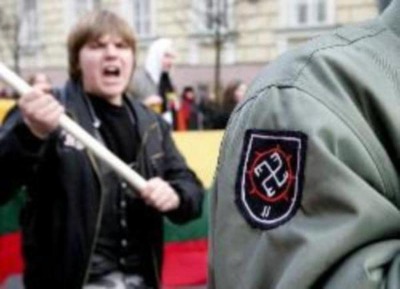
For Seventh Year Running, Neo-Nazis and Ultranationalists Given Center of Vilnius on Independence Day
O P I N I O N / E Y E W I T N E S S R E P O R T
by Dovid Katz
Lithuania’s March 11th independence day is celebrated by the free world, not least by those who remember the incredible news that spread around the globe in March 1990, when Lithuania’s parliament (Seimas) voted 124 to zero to break away from the Soviet Union. The courage of the parliamentarians from a broad spectrum of parties and movements was stark; the country was still occupied by ominous Soviet forces (and blood would be spilled by Soviet forces’ violence less than a year later, in January 1991). The March 11th celebration has been anchored over the years by a record of achievement that includes the transition to democracy, the joining of the European Union and NATO, and the rapid integration with Western society, economy and mores.
Run-up to the March 11th 2014 Neo-Nazi / Ultranationalist March in Central Vilnius
Vilnius, Tuesday March 11th 2014:
Neo-Nazis Announce March Through Old Town and City Center to Nation’s Parliament
Efraim Zuroff Will Lead Silent, Peaceful Remembrance as Protest
Colleagues of all backgrounds are invited to meet Dr. Zuroff, Holocaust historian, Nazi-hunter, author, director of the Simon Wiesenthal Center’s Israel office. He will lead a silent, peaceful remembrance of the annihilated Jewish citizens of Vilnius and Lithuania, in protest against the neo-Nazi marchers and the continued granting of city center venues on independence day. Meeting on Tuesday, 11 March 2014, 3 PM at Old Town Hall (Rotušė) Square. First meeting at edge of square, on the corner of Stiklių and Didžioji outside Amatininkai Café, monitoring the march (itself scheduled for 4 PM) to its conclusion on Gedimino near the Seimas (parliament).
Olga Zabludoff’s Comment on a February 2014 Yivo Symposium
The following 7 March 2014 comment by Olga Zabludoff on the video posted of the 14 February 2014 event at Yivo appears in the Comments section for her earlier article in the Algemeiner Journal, where readers can follow the entire discussion.
Many thanks to Yivo for posting the video of the discussion “Unresolved History: Jews and Lithuanians after the Holocaust.” In my opinion, the champion panelist was Leonidas Donskis who opened his heart with conviction and courage. As a Jewish Lithuanian his understanding of and sympathy for both Jews and Lithuanians have generated wise insights and pervasive truths. Among his magnitude of analytical comments to be applauded, Donskis explained that the Far Right in Lithuania has managed to get close to the center of power where they have been “mainstreamed” rather than marginalized. He also reflected on how difficult it is for Lithuanians who have decided to tell the truth. As a nation “we lack the political courage,” he remarked.
Exhibit Honoring Jewish World War II Veterans Disappears Into Vilnius Thin Air
O P I N I O N
by Dovid Katz
VILNIUS—Three Vilnius-based members of the Defending History team visited the Pylimo Street section of the Vilna Gaon Jewish State Museum of Lithuania this week, and asked to be shown the famous and widely admired exhibit honoring the Jewish veterans of the war against Hitler in Lithuania. The exhibit, titled Lithuania’s Jews in the Struggle Against Nazism, was opened in a spirit of unity, reconciliation and mutual respect, some fourteen years ago (PDF of the report in the Spring 2000 English edition of the Jewish community’s then quadrilingual newspaper, Jerusalem of Lithuania, which was edited by Milan Chersonski from 1999 until 2011; JPEG; reduced image below). Its primary creators are Joseph Levinson and Rachel Kostanian.