[last updated]
◊
THE LATEST
Reviews of Bloodlands
Reviews of Black Earth
Instrumentalization?
2012 2013 2014 2015 2016
THE LATEST
Reviews of Bloodlands
Reviews of Black Earth
Instrumentalization?
2012 2013 2014 2015 2016
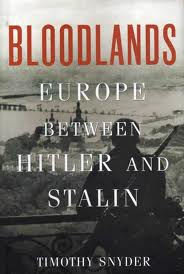
This journal holds leading historian Professor Timothy Snyder (Yale University) in the highest esteem, and trusts that this select list of reviews taking issue with aspects of Bloodlands of direct concern to DefendingHistory.com will not be taken amiss. It does not include reviews which have engaged in personal attack or pursued grudges, or which focus on other issues.OPINION | RED-BROWN COMMISSION | MR. RAČINSKAS ON THE HOLOCAUST | LITHUANIA | DOUBLE GENOCIDE
◊
VILNIUS—With nearly all local Holocaust Survivors now gone, or effectively out of public circulation, Lithuania’s “Red-Brown Commission,” a major European engine for the downgrade of the Holocaust via far-right “Double Genocide” history revisionism is again in the forefront of PR efforts to bowl over naive foreign visitors and delegations to this city, particularly on September 23rd each year, with “moving Holocaust elegies.” For Lithuanian Holocaust survivors, the very choice of Sept. 23 (day of the 1943 liquidation of the Vilna Ghetto by the Germans, two years after the murder of the majority of Lithuanian Jews in hundreds of towns across the land) was seen as a decoy. The day each of them had etched in the heart in perpetuity was June 23rd, when in 1941, violence against Jews broke out in hundreds of locations, with murder documented in around forty — before the first German forces arrived or managed to set up their authority. It was the day when six hundred years of peaceful, harmonious coexistence turned overnight, under Hitlerist propaganda, to dehumanization, humiliation, plunder, rape, injury and murder. To this day, an industrial grade revisionist industry continues to obfuscate or outright deny the history of the First Week (i.e. the last week of June 1941). Indeed, June 23rd is celebrated by far-right government historians each year as the date of a supposed “uprising” against the Soviets by the white-armbanded Jew killers who did not “rebel” until the Soviets fled in disarray from Hitler’s invasion, when they began to murder Jewish neighbors across the land unleashing the Lithuanian Holocaust, in which 96.4% of Lithuanian Jewry perished. In 2020, Dr. Arunas Bubnys, the chief historian of the second “Holocaust entity financed by the state,” the Genocide Center, celebrated the “holiday ” alongside banners of two major Holocaust collaborators. He was rewarded a year later with directorship of the Center.
◊

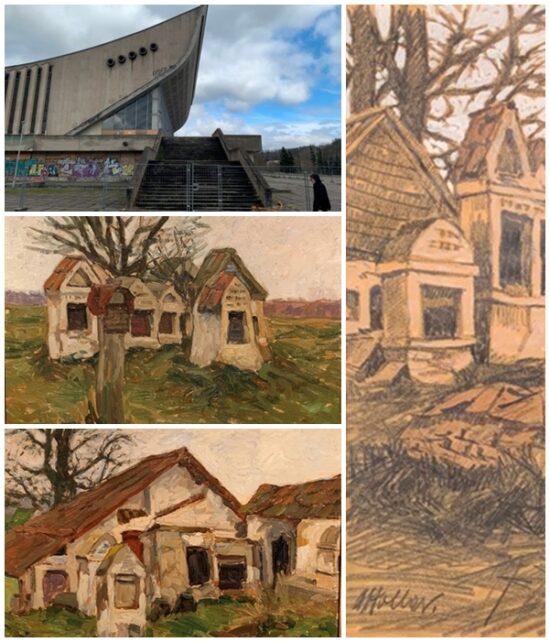
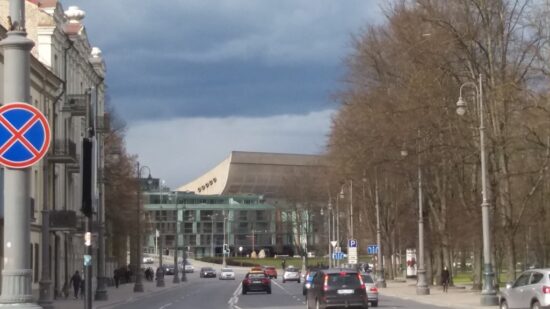
Look what you can see standing right by Vilnius’s Cathedral Square: The Soviet “Sports Palace” ruin that symbolizes not only antisemitism but also: Soviet/Russian Empire spiritual and political domination of Lithuania’s free spirit. High time to be rid of this carbuncle on the beautiful face of modern Vilnius?
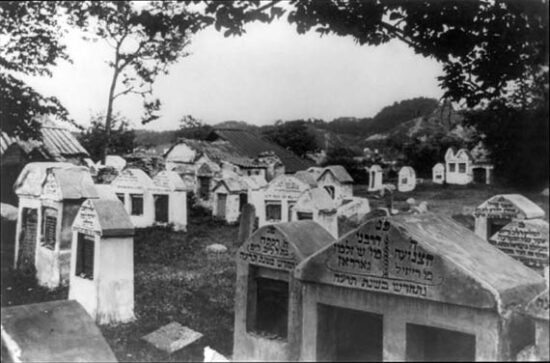
The first phase of the eradication of the Old Vilna Jewish Cemetery at Piramónt in Shnípishok — modern Šnipiškės — and of the people buried there, started back in 1830, contemporaneous with an uprising against the Russian Empire. The November Uprising, as it is now known, started with the will to resist the czarist government’s plans to send the army of Poland — at the time an autonomous kingdom within the Russian Empire — to Belgium and France, as well as with the dreams of restoring Polish independence. In 1831, seeing that the uprising for independence would soon take over Vilna, the Russian Imperial government expropriated a section of the Jewish cemetery by the bank of the Viliya (now Neris), and established an artillery citadel to keep the freedom-loving city at all times in the crosshairs of its cannon barrels. But even after the establishment of the citadel, more than three quarters of the actual graves (and their stoness or mini-mausoleums, oyhólim) remained untouched. This legendary cemetery is a Litvak pantheon, a monument to the civilization of Lithuanian Jewry. So it is meaningful that its first phase of destruction got underway just as the Russian imperial government’s project to enhance its military presence in Vilna, by making sure that the city’s inhabitants live in constant fear.

A small section of the Old Vilna Jewish Cemetery at Piramónt. The Soviet Sport Palace was built in its heart. All stones and inscriptions were trashed but thousands of graves survive on all four sides of the building, now an eyesore in the heart of modern Vilnius.
◊
Congratulations to the city of Kaunas, Lithuania, once known also as Kovno (in Yiddish forever: Kóvne) on its selection as Europe’s “Capital of European Culture” in 2022, sharing the title with Esch-sur-Alzette in Luxembourg. But as the midpoint of the city’s co-reign rapidly approaches, it is necessary, albeit sad, to have to note that not a single public-space glorification of local Holocaust collaborators had been removed. Zero. No city on the planet has as many monuments to local partners in the genocide of that city’s Jews. The 30,000 Litvaks (Lithuanian Jews) of Kaunas were brutally murdered, and the city played the primary role in the launch of the Lithuanian genocide on 23 June 1941, before the arrival of the first German forces. Thousands were murdered before the Germans arrived and/or set up their administration.
See Lev Golinkin’s updated 2022 catalogue in the Forward of public space shrines to Nazi collaborators worldwide
Lithuanian government authorities have reportedly invested large sums to lure “Useful Jewish Idiots” from the UK, US, Israel, and further afield to participate in “cultural events” intended to obfuscate and deflect from the primary issue: Why are the enablers of the slaughter of Kovno Jewry still honored by street names, plaques and university lecture halls and statues in the city? Local Jewish leaders who have dared to speak up have rapidly been smeared as “Putinists” for daring to criticize the far right’s hold over national history policy (and indeed, the need for such a policy to start with).
But in the waning days of 2021, a “waterfall of truth” began to cascade from an unanticipated quarter. Michael Levinas, son of the celebrated Lithuanian-Jewish born French philosopher Emanuel Levinas, forbade authorities to name a fancy new institute after his father. This was kept under wraps until his 21 Dec. Le Figaro opinion piece broke the story, and it was duly reported in Lithuania by LRT.lt. See Defending History’s media tracker page for background and updates.
◊

It has not been easy for our embattled team to keep Defending History going for over a dozen years now, based here in Vilnius. But as with other small but committed projects committed to speaking out for historic justice whomever it will please or displease, misconceptions can flourish. For example, this journal has indeed opposed the misuse of millions of Lithuanian citizens’ hard earned tax euros for campaigns to “equalize” for new generations (and today’s West) Nazi and Soviet crimes (the “Red-Brown” Commission); to target Holocaust survivors who joined the anti-Nazi resistance by smearing them as “war criminals” (state prosecutors); to establish as European heroes brutal participants in the Holocaust (the Genocide Center and Museum); efforts by government bodies (foreign ministry under some governments) to insist on European Union cave-in to the revised Baltic far-right historiography (note the Prague Declaration and DH’s response: the Seventy Years Declaration received personally a decade ago by the president of the European Parliament).
◊
Most Lithuanian government officials in diverse branches of its democratic government, including so many in its Culture and Education ministries, its local museums and libraries, its schools and cultural centers, have a warm and healthy attitude toward both the historic weight and tragic fate of the nation’s Jewish minority. This is important to keep in mind as we come yet again to provide a voice for the voiceless: the manipulation of the fragile Litvak and Yiddish culture, of the last survivors and their families, and of Holocaust history by some small and lavishly financed “Jewish fix-it units” including the Genocide Center, Genocide Museum, Red-Brown Commission, and a scattering of “Jewish, Yiddish and Litvak” centers in central Vilnius, a good part of which exclude from all professional participation people — including top specialists in the relevant field — who dare disagree with state revisionism on the Holocaust. In some cases, this policy brings about the succeeding phase of “Jewish” addresses without a single Jewish member of staff (think African American Cultural Center in Alabama, staffed by pure lily-whites who won’t mess up and peradventure say something contrary to local “patriotic” history-book narratives demanded by nationalists).
Even as the civilized world joins in condemning the barbaric, medieval Putinist invasion of peaceful Ukraine, and unites to embrace its people, and the freedom and simple peace they seek, the Lithuanian Seimas (parliament), is hosting the grand opening of the latest “Litvak Congress” (program here and here), at which none of Lithuania’s great Litvak achievers of recent years, have been invited to speak, or in most cases to even attend. They are being cancelled during their lifetime. The list is long. Just a few examples: Genrich Agranovski, Anna Avidan, Chaim Bargman, Roza Bieliauskienė, Ruta Bloshtein, Fania Yocheles Brantsovsky (Brancovskaja), Dalija Epšteinaitė, Prof. Pinchos Fridberg, Simon Gurevich (Simonas Gurevičius), Irina Guzenberg, Elen Janovskaja, Regina Kopilevich, Arkady Kurliandchik, Polina Pailis, Prof. Josif Parasonis, and (now in retirement in Berlin) Rachel Kostanian. These and others have made empirically demonstrable and durable contributions to the Litvak heritage and its documentation and perpetuation well into the future, and have valiantly and selflessly fought for Litvak causes, a category in which defense of history is a cause as paramount as any.
◊

Just another street name in a pleasant part of Kaunas, this year’s Capital of European Culture? Author thinks that “Kaunas and its people deserve better”…
◊
Antanas Baltūsis-Žvejas (1915–1948) is remembered by the Republic of Lithuania for his anti-Soviet guerilla activities after the war but without regard for the three separate periods of his activity in service to Nazi activities to exterminate the Jewish people. He did indeed join the anti-Soviet partisan resistance movement in the spring of 1945. And, before his death, he did become the head of its Tauras County unit. Those who heroize this period of his activities emphasize his efforts in establishing military discipline and order in the county. His critics, in turn, are more likely to make reference to his order to the Žalgiris Detachment, subordinate to the Tauras County, to annihilate Russian (Soviet) civilian settlers (“colonists”) in Opšrūtai, who had been transferred to Lithuania according to the Soviet-Nazi repatriation agreement (often with little or no input from these folks themselves). Thirty-one persons perished in Opšrūtai, including fourteen children. In the partisans’ descriptions of the battle, it is easy to notice that their task was to eradicate all colonists, including children. Those who justify the atrocity against civilians, including children, say that it was necessary to thwart the russification of Lithuania.
Lithuania’s policy of historical memory was quite straightforward on this issue: it built a monument to the partisans of the Žalgiris Detachment in Opšrūtai. Ethnic cleansing of Jews, if done by “our own nationalist heroes” in Lithuania, is still seen, it seems, as acceptable.
◊
◊
Arūnas Bubnys’s book The Holocaust in the Lithuanian Provinces (Holokaustas Lietuvos provincijoje, Margi
raštai, Vilnius, 2021) is another publication of the International Commission for the Evaluation of the Crimes of the Nazi and Soviet Occupation Regimes in Lithuania (ICECNSORL). Up until now, books published by the Commission were academically written and appreciated by a sophisticated readership. Moreover, they were always published in both Lithuanian and English. This book is different. It is available only in Lithuanian. Previously published monographs would also include Commission-approved conclusions; this book has no such thing. As far as I have been able to ascertain, the Commission’s academics did not discuss the book among themselves before its publication. But let’s start at the beginning.
The book is geographically quite extensive: 23 counties and 140 towns are cited. This is really a lot, but it is also quite obvious that the coverage of towns in different counties is unequal. When it comes to Šilutė county in western Lithuania, for example, several camps and fates of individual Jews are mentioned in passing, but no single town is described. For the Marijampolė county, only the fate of the Jews of Marijampolė itself is presented. Šiauliai xounty (15 towns) and Alytus County (12 towns) are the most extensively covered.
◊
◊
Antisemitism takes many forms in the twenty-first century. It includes the religion-based, the anti-Israel-based, the globalization-based, the envy-based, and the drunk-violence based — all the way to sophisticated and elegant forms that are so sublimated that it is hard to discern what’s what. In Eastern Europe, some rather exotic forms flourish: hatred of remnant local Jewish communities (who know the truth about the Holocaust-relevant roles played by local nationalists during the Holocaust years of 1941-1944/45) alongside love of rich, distant foreign Jews (who can be charmed right to the high heavens with medals, junkets and photo-ops to help underpin Double Genocide revisionism — and sometimes cover for glorification of local collaborators — as part, naturally, of “Holocaust remembrance” or “commemoration of the victims of equal genocidal regimes”).
Then there is the occasionally encountered East European love of substantial Jewish sacred sites that are suitably far from the center of town (“best place is the forest, you know!”) and provide a fine niche in-season tourism without upsetting the ethnic-purity concocted versions of town-center history that want it to be say pure Ukrainian (Lviv/Lvov/Lemberg), pure Latvian (Riga), or pure Lithuanian (Vilnius/Vilna/Wilno/Vílne).
The hard fought battle to keep the convention center out of the old Vilna Jewish cemetery was won last summer (report in the AJ). It will go down in history as a victory for Lithuania and all the country’s true friends. Now comes Part II.
◊
◊
Tracking media coverage.
Composer and pianist Michael Levinas, the son (and heir and exclusive legal holder of the moral rights to his father’s works) of French philosopher Emmanuel Levinas, has publicly protested Lithuania’s naming an institute in Kaunas for his father. See his op-ed in Le Figaro (21 Dec. 2021) [in English]) and his interview in Actualité Juive (13 Jan. 2022) [in English]). Initial coverage by JTA (19 Jan.) does not mention Michael Levinas’s protest, but unusually, the protest has been covered in some detail by Lithuanian mainstream media’s Lrt.lt (9 Jan., updated 17 Jan. 2022) which reported on the refusal of the French Embassy in Vilnius to send any representation to the center’s opening ceremony in Dec. 2021. A report also appeared on the website of the official Lithuanian Jewish Community (10 Jan.). However, a second local Kaunas community posting on 12 Jan. was alone cited by the European Jewish Congress website as an uncontroversial news item.
“Question on everybody’s mind”:
Will the Levinas Center leaders, staff, sponsors and visitors politely ask, with dignity, that the city of Kaunas now, in its year as “Capital of European Culture” rapidly remove state-sponsored shrines to the local murderers of Levinas’s family and the other 30,000 Jewish citizens of Kaunas? Or will the Levinas Center become one of the “Useful Jewish Idiot (UJI) addresses” that are used to cover for current Kaunas policies of glorification of Nazi perpetrators, while providing handsome photo-ops, lavish hospitality and generous amenities to visiting foreign Jewish dignitaries who maintain studious silence on current policies of honoring Holocaust collaborators in the public space (in some cases, a very short walk from the new “Levinas Center”).
◊
PARIS—The French Jewish journal Actualité Juive published in its print edition a full-page interview (as PDF) with the eminent French composer and pianist Michaël Levinas, concerning his protest at a new center in Lithuania’s second city, Kaunas (once Kovno, Yiddish Kóvne), being named for his late father, the great French philosopher Emmanuel Levinas (1906-1995). An authorized translation is available. Coinciding with the European Union’s naming of Kaunas as “Capital of European Culture” for 2022 and the city’s refusal to remove even one of the many street names, shrines, plaques and monuments to local Nazi collaborators who helped ensure the massacre of nearly all the city’s Jewish residents in 1941, and who participated in the unleashing of the Holocaust in Lithuania even before the arrival of the first German soldiers in late late 1941, the composer’s powerful moral protest represents a singular voice of justice, reason and moral courage to date.
See also op-ed in Le Figaro
&
Levinas Center Media Tracker
The composer’s stance stands in marked contrast with many others, including artists, assorted academics and a wide range of Western wannabees, who are accepting funding, honors, junkets, invites, and photo-ops with “important people” in return for an unspoken assurance of silence in face of the city’s refusal to take down a single shrine to the local perpetrators of the Holocaust.
The following is a PDF of Michaël Levinas’s interview in the print edition of Actualité Juive of 13 January 2022:
◊
◊
Finally, a “feminine government” for Lithuania. Having won the 2020 election, the right-wing parties formed a “feminine” government, led by Prime Minister Ingrida Šimonytė, with liberal Viktorija Čmilytė-Nielsen taking the chair of the Speaker of the Seimas. One could be tempted to see this as a victory for liberalism and feminism in the Baltics, since the Social Democrats, who were in the majority for several terms, would either include no women in their government or at best, entrust to them one or two ministries of lesser importance.
◊
Back in 2017, I tried to acquaint the outside world, in Defending History, with some issues concerning the “Roma Integration Program” that was initiated by the Lithuanian Government and Vilnius Municipality in 2016. I noted that the main goal of the program was to raze the Roma settlement in Kirtimai to the ground and remove the Roma that used to live there, resettling them in scattered different places through Vilnius County.
Several years have passed. We can see how this Program has impacted Roma living conditions.
“Around half of the inmates in Lithuania’s only women’s prison are Roma women—while there are only a bit more than two thousand Roma in Lithuania, less than one percent of Lithuania’s estimated population of 2,795,000 for 2021.”
◊

Carbuncle in the heart of the EU? Monument in Belgium glorifies Latvian Waffen SS who fought for Hitler
Note: for background on the monument to Latvian SS war criminals in Zeldelgem, Belgium, please see DH’s Zedelgem section, and for Latvia more generally, Roland Binet’s contributions and DH’s Latvia section.
◊
Flemish historian Pieter Lagrou had this to say in an exchange of correspondence pertaining to the quandary of what to do with that monument in Zedelgem glorifying Latvian Hitlerist Waffen SS men. It so happens that he is the one whose official opinion in this matter will be asked on how to further proceed with the “Latvian Beehive” as the pro-Nazi monument on Belgium soil is known:
◊

Click on the image for details of 21 Sept. conference in Kaunas on role of museums in remembering the past
◊
Vytautas Magnus University, once considered a beacon of tolerance and liberalism, suffered extensive (utterly self-inflicted) reputational damage back in 2009 when it inaugurated a lecture hall and bas-relief glorifying Juozas Ambrezevicius Brazaitis, “prime minister” in Lithuania’s Nazi puppet “provisional government” in 1941. During his brief period as Hitler’s chief puppet in the country, he signed documents confirming transfer of numerous Jewish fellow citizens of his native Kaunas to the nearby Seventh Fort for torture and murder, and later signed the Nazi-ordered documents ordering all remaining Jews of Kaunas into a ghetto, to become the infamous Kovno Ghetto. During his later American career, as a CIA asset and academic, he never once expressed regret over what had happened to the 30,000 Jewish residents of Kaunas.
Then, in 2012, when an international scandal broke out over the Lithuanian government’s decision to fly over and rebury with full honors the Nazi puppet prime minister’s remains, it was, alas a top historian and academic official at Vytautas Magnus who described the reburial as a grand act of Lithuania’s historic drama, while denouncing the Leonidas Donskis led effort to pull the university out of national ceremonies honoring the Nazi collaborator, in these terms: “This wasn’t the academic community but a decision of the VMU administration which became frightened that they were going to get hit over the head with a club by the Jews.” For context, see events of May 2012.
LEONIDAS DONSKIS SECTION IN DEFENDING HISTORY