OPINION | YAD VASHEM MANIPULATED | GENOCIDE CENTER
◊
◊
◊
The annual marches of March the 16th in Riga, Latvia, honor veterans of the local Waffen SS legion. These marches, sponsored by the co-ruling National Alliance, are consistently criticized by bodies of the European Union, the United Nations, and the Council of Europe. The most recent criticism came from the European Parliament resolution of 25 October 2018 on the rise of neo-fascist violence in Europe:
“AC. whereas every year on 16 March thousands of people gather in Riga for Latvian Legion Day to honor Latvians who served in the Waffen-SS;”
◊
◊
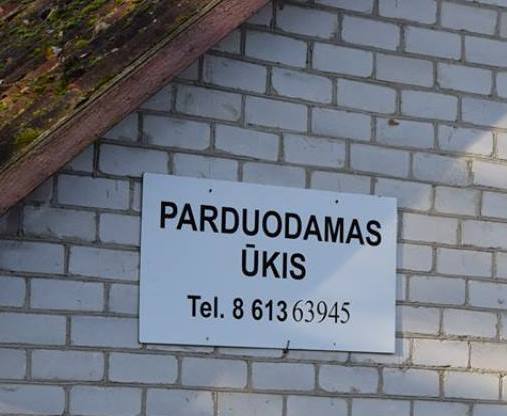
I was taken aback by the news being informally reported. “They came and they fenced off a part of the Radviliškis (Radvíleshik, Radvílishok) Jewish cemetery for themselves,” people told me. This was a well-known Jewish shtetl before the Holocaust. Without further ado I went to check it. A house and big chunk of property with it, were fenced off and for sale, clearly within the cemetery perimeter (of course with gravestones long pilfered from that section, and buried people underneath undisturbed). My photos of all parts of the cemetery are here.
◊
VILNIUS—The elected leadership of the Vilnius Jewish Community (VJC) today published on its website, and on its Facebook page, an English version of the Lithuanian original that appeared on 10 October on the website as well as, on the same date, in the form of a Baltic News Service (BNS) press release, providing the contact name of Simon Gurevich (Simonas Gurevičius), chair of the community and one of its twenty-one member elected council. The VJC, representing the more than 2,000 Jews of Vilnius in affiliation with groups in Šiauliai, Klaipeda and others, represents the vast majority of today’s living Jewish citizens in Lithuania. In fact, its electoral conference of May 2017 was the largest electoral conference of Jewish citizens in Lithuania this century.
“And most importantly […], to provide new elections for the chairpersonship of the Lithuanian Jewish Community in accordance with the honest rules that have been in place for many years, taking into account the votes of all the Jews of Lithuania, and not the ‘associations’ of ‘close friends’ who are themselves dependent for funding on the grace of the chairperson.”
Pope Francis’s two-day visit to Lithuania this weekend includes a symbolic stop at the Vilna Ghetto on his second day, September 23, at roughly 4 PM at Rūdininkai Square. On that day, 75 years ago, Nazi Germans liquidated the Vilna Ghetto, murdering some of its Jews in Paneriai Forest (Ponár), and moving the rest to concentration camps in Latvia, Estonia and Germany. Since 1994, it has been the National Day of Commemoration of the Genocide of Lithuania’s Jews. Now it will surely be linked in the Lithuanian psyche with this visit by Pope Francis, and perhaps some day, Saint Francis.
However, his visit is also a chance for him to make plain to the children of God our lack of empathy for Lithuania’s Jews. A very short detour to the “Vilnius Sports Palace” — and a heavenly nod by the Pope — would let us tear down that “Soviet temple”, resurrect the holy Jewish cemetery beneath it, and enjoy a symbol of Litvak and Lithuanian friendship forever. This brings to mind the detour Jesus made in Jericho, when two blind men called out, “Lord, have mercy on us, you son of David!” And Jesus halted the crowd.
◊
VILNIUS—The central office of the World Jewish Congress (WJC) today tweeted uncritical support for “Black Ribbon Day” failing to note that the August 23rd remembrance day sponsored by ultranationalist elements in Eastern Europe, has been one of the most cunning tools for writing the Holocaust out of history via the “Double Genocide” movement that seeks to “equalize” Nazi and Soviet crimes as per the Prague Declaration of 2008 (which indeed has the day among its “requirements”). Defending History is proud to have been part of the team that produced the Europarliamentary rejoinder, the 2012 Seventy Years Declaration (SYD), which was signed by 71 European Union parliamentarians, including eight enormously courageous Lithuanian MPs and MEPs. SYD calls for “distinct days and distinct programs to remember the Holocaust and other victims of other twentieth century totalitarian regimes”.
◊
Lithuanian citizen Grant Gochin, a Litvak born in South Africa and living in California, has relentlessly challenged Lithuania’s Genocide Center to tell the truth about Jonas Noreika, whom the Center maintains can be considered an anti-Soviet and anti-Nazi hero despite his role as a Holocaust perpetrator. Gochin’s 40 page Query Regarding Jonas Noreika’s criminal gang, submitted on June 15, 2018, is available in a PDF file which includes the Lithuanian original (pages 49-89), the English translation (pages 1-45), and an extensive list of source materials (pages 90-100). Jonas Noreika’s granddaughter Silvia Foti also contributed a letter in support of Grant’s query (pages 47-48). The Genocide Center has posted its 18 page response in Lithuanian. On its website it warns that “G.A.G Gochin’s ‘investigation’ of J. Noreika, without providing substantial proof, possibly violating the Republic of Lithuania’s Constitution and the Republic of Lithuania’s Criminal Code, accuses many individuals […]”.
◊
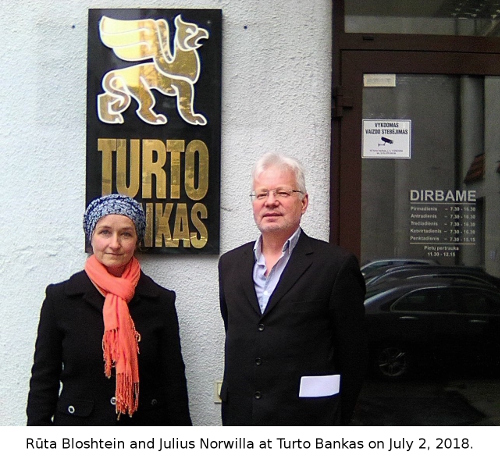
On July 2, 2018, at 11 AM, Lithuania’s state property bank, Turto Bankas, led an open meeting to discuss the rental terms for the operator of the Vilnius Concert and Sports House, previously known as the Soviet Sports Palace (Sporto rūmai), which the Soviets built on Vilnius’s oldest Jewish cemetery. The search for an operator is part of a plan by the Lithuanian government to remake the decrepit building as a modern convention center and a symbol of Vilnius. According to critics, the plan is senseless and the symbol shameful.
◊
I have been involved in Jewish community, heritage and Holocaust-restitution issues in Lithuania for almost two decades, through various professional and personal capacities. While I have worked on these matters in other European countries, I have a special interest in and bond with these subjects as almost all my family came to America from Litvak areas. In the past few years I have spent a lot of time on the issue of the Old Vilna Jewish Cemetery in Šnipiškės (Piramónt) and the future plans for the Sports Palace building which has been on that site for decades. I met with many rabbis and community leaders with vastly different views and no meeting or photo should be interpreted as an endorsement of any position.
◊
◊
We develop a concept of “spiritual capital” which has suggested itself in the public debate regarding the future of the Vilnius Sports Palace, a large forum which the Soviets built in the 1960s on a Jewish cemetery which is the oldest in Vilnius and perhaps all of the Baltic states. This concept of spiritual capital is relevant for analyzing cultural surroundings but could also perhaps ground a healthy human relationship with natural surroundings.
◊
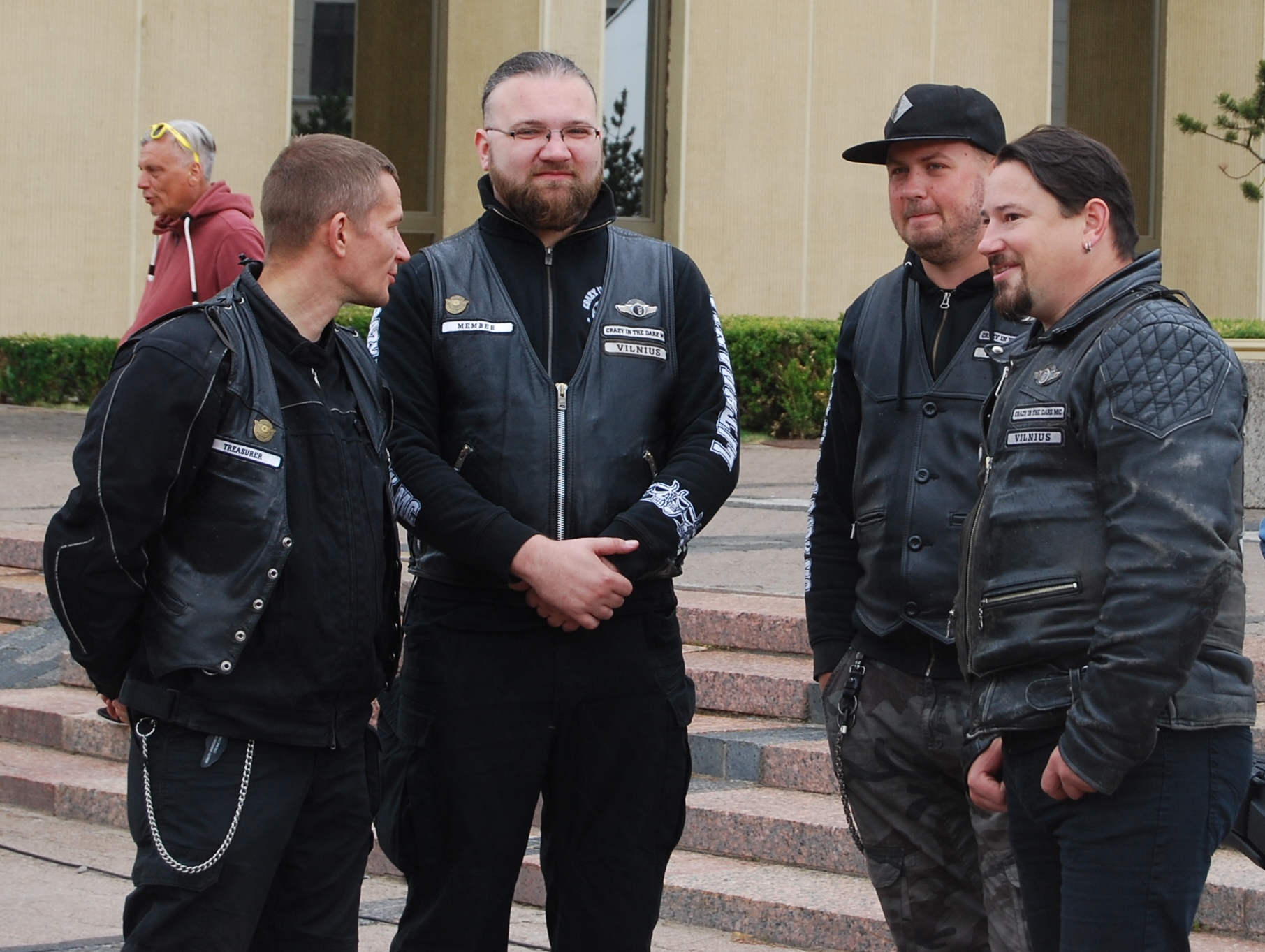
Today’s central Vilnius event celebrated the 77th anniversary of the 23 June 1941 “uprising.” Between fifty and sixty people took part. Half of them are members of the motorbike club. The event was organized by the Lithuanian Seimas (parliament). The Seimas was represented by three MPs – Žygimantas Pavilionis, former ambassador to USA; Audronius Ažubalis, former foreign minister; and Laurynas Kasčiūnas. One of the speakers was the Roman Catholic priest and motorbiker Egidijus Kazlauskas who spoke about the suffering and the perseverance of Lithuanians when persecuted by deportations to the eastern Soviet Union. Vilnius city Mayor Remigijus Šimašius was not present, but he has sent his greetings via advisor Mindaugas Kubilius.
A guest of honor was Vytautas Landsbergis, the elder statesman who was modern democratic Lithuania’s founding head of state. In the new century he became a European parliamentarian dedicated to revision of World War II history, most famously via the Prague Declaration which he signed. The event was co-organized by the Lithuanian Freedom Fighters Union (Lietuvos laisvės kovotojų sąjunga).
◊
VILNIUS—This week, Wednesday the 23rd of May, as for a number of years, Vilnius and its Jewish community will be welcoming a group of truly inspiring Israelis who have made the bold decision to visit the land of their forefathers, to honor the memory of the victims of the Holocaust and to work to increase awareness about the historic truth of history’s worst genocide while establishing relations with the delightful citizens —of all backgrounds — of modern democratic Lithuania. The blossoming of Lithuanian-Jewish and Lithuanian-Israeli relations is a blessing to be nurtured. But not to be abused.
◊
VILNIUS—Various officials of the Lithuanian government’s Genocide Research Center, its Genocide Museum, and its “International Commission for the Evaluation of the Crimes of the Nazi and Soviet Occupational Regimes in Lithuania” (known for short as the “Red-Brown Commission”) are rather gleeful this week at the latest master PR coup for the long hard road to “soft core” Western legitimization of East European Holocaust revisionism. One of the world’s leading Holocaust scholars, and the activist who did more than any other to bring to an end the era of classical 20th Century Holocaust Denial, Professor Deborah Lipstadt of Emory University, has been attracted to headline a “one-sided Holocaust conference in a Baltic capital” where the naive foreign star’s eminence may help provide cover for ongoing policies. The conference program has just been released in PDF format with, as usual, the star’s appearance artfully sandwiched between much else.
The “ham sandwich” model for political conferences made to look like pure, open, intellectually balanced academic conclaves?
◊
This past winter here in Vilnius, the charming capital of Lithuania, was much like any other. During long solid weeks of subzero temperatures, as the flow of tourists and roots-seekers slowed to a trickle, I adjusted the route of my daily walk to pass by up to a dozen top tourist sights. Day after day, there was one constant: The most popular, winter-defying “must-visit” for foreigners is “The Museum of Genocide Victims.” Perhaps there is something grotesquely sexy about “genocide.” Maybe the promise of (real) former KGB interrogation rooms and isolation chambers in the basement is less run-of-the-mill and more strikingly authentic than much usual museum fare. Estimates obtained from the museum’s administrators suggest about a million visitors total to date.
Our national Ministry for Jewish Control’s website editors were recently faced with a daunting quagmire. An article in the New York Times (one written, to make matters worse, by a Pulitzer Prize winning journalist), had featured, right on top, a large beautiful photo of a handsome young Lithuanian Jewish man, Simon Gurevich, who was elected head of the Vilnius Jewish Community by an overwhelming majority, one year ago. Even worse, he is of pure Litvak heritage going back seven hundred years on all sides of his family. Shockingly, the article quoted him as saying that the government might find a better place for its new national convention center than on top of the old Vilna Jewish cemetery. (Obviously he was misled by those 42,500 people who signed some petition or other. By the way, a few years ago I helped the Commissariat in its search at the time for a suitable new rabbi with that question in mind.)
Who’s afraid of Simon Gurevich and The New York Times?
Naturally, all those local Jews who voted for Mr. Gurevich are Russians who claim to be Jewish, as the Commissariat demonstrated brilliantly last May beyond any shadow of a doubt. The challenge became to ensure that readers from the lands of the capitalist leaches, those who speak English, never find out about this article. Easy enough, who will ever hear about a New York Times article about our distant country? Mum’s the word.
◊
Today’s edition of The Architects’ Journal (AJ) gracefully announces that Tszwai So, director of Spheron Architects, has been declared the winner of the “international competition to design a pan-European Memorial for the Victims of Totalitarianism.” Mr. So, named a rising star in British Architecture in 2016, is widely acclaimed as one of the most illustrious younger talents of European architecture in our time. Our team feels certain that he would be the first to wish to be apprised of an ulterior political program behind a seemingly neutral architectural project which will now be exploiting his reputation, and his firm’s, as well as his actual design, in promoting a political project that is vastly more controversial than meets the eye at first acquaintance.
Mr. So and Spheron Architects, like the other contestants, were most likely unaware that the sponsor of the competition, the Prague-based Platform of European Memory and Conscience, known for short in Eurocircles as the Prague Platform, is the prime European engine for the far-right movement of World War II history revisionism that is increasingly becoming known as Double Genocide. That phenomenon was recently among the main points of a New York Times article by Pulitzer Prize winning correspondent Rod Nordland concerning the “Genocide Museum” here in Vilnius, which has close ties with the “Prague Platform” in the pursuit of Double Genocide politics in the European Union.
◊
The team at Defending History has witnessed quite a lot in Eastern Europe over the last decade when it comes to Holocaust obfuscation and its related ills, including glorification of actual Holocaust collaborators, defamation of Holocaust survivors who joined the resistance, and a progressive chipping away at Western norms of free speech and tolerance. It is almost as if the Western powers don’t care whether folks in the “Eastern EU” have the same rights of expression as others.
During these last few weeks, an unusually intensive convergence of events has been noticed here in Vilnius. To bring our loyal readers up to speed we thought it might be useful to summarize what’s been happening on the Lithuanian Holocaust obfuscation and history rewriting front. Links to articles are included for those interested in reading more.
◊