DOCUMENTS | THE OLD VILNA JEWISH CEMETERY | OPPOSITION TO CONVENTION CENTER PROJECT | INTERNATIONAL PETITION | CHRISTIAN-JEWISH RELATIONS | CEMETERIES | VILNIUS JEWISH LIFE | HUMAN RIGHTS
◊
◊
◊
VILNIUS—The following statement by Professor Shnayer (Sid) Leiman, appeared today in the respected American weekly Five Towns Jewish Times. It is a reaction to the comments by Lithuania’s top leaders, made after receiving a letter of protest from twelve United States congressmen concerning plans to site a projected new national convention center in the heart of the territory of the Old Vilna Jewish Cemetery at Piramónt (in the Šnipiškės district of modern Vilnius). International opposition to “the convention center in the old Jewish cemetery” continues to mount.
◊
VILNIUS—The following statement by Vilnius native and resident Ruta Bloshtein, an active member of the city’s religious Jewish community, appeared today as an update to her international petition, which has just approached the 40,000 signature mark. Her update was issued as a reaction to the comments by Lithuania’s top leaders, made after receiving a letter of protest from twelve United States congressmen concerning plans to site a projected new national convention center in the heart of the territory of the Old Vilna Jewish Cemetery at Piramónt (in the Šnipiškės district of modern Vilnius). International opposition to “the convention center in the old Jewish cemetery” continues to mount.
◊
VILNIUS—Defending History today released here a Yiddish version of Julius Norwilla’s Lithuanian and English posters produced in the course of the current campaign to save the Old Vilna Jewish Cemetery from becoming the “geo-basis” for a new national convention center where revelers would cheer, clap, sing, and dance, and use bars and toilets, surrounded by thousands of Jewish graves from the fifteenth to the nineteenth centuries. Human rights specialists concur that such a fate would not be contemplated for a Christian cemetery in the European Union, much less with the proposed EU contribution of millions of euros in “structural funds”.
As in the case of the Lithuanian and English posters, readers are invited to make as many printouts as possible, and to distribute them far and wide, mentioning wherever possible the ongoing international petition which has to date attracted some 40,000 signatures from many parts of the globe. The Yiddish poster is also available as PDF and higher-res image.
◊
VILNIUS—Following his recent release of a Lithuanian-language poster calling for restoration of the Old Vilna Jewish Cemetery at Piramónt, Julius Norwilla (Norvila) today released the English-language version, which follows. Readers are invited to print out copies of the poster to help in the campaign (as PDF; as image). [UPDATE: A Yiddish version of the poster was subsequently published.]
◊
Dr. Andrius Kulikauskas of Vilnius Gediminas Technical University is scheduled to speak at the XIII Philosophers’ Rally on “Determining Personal Responsibility for a Social Calamity: The Origins of the Holocaust in Lithuania”. The event is Poland’s annual philosophy conference and will take place on 6-8 July at the University of Wrocław, at the Faculty of Law, Administration and Economics (LAE), Building D. He will speak on Saturday, 8 July, 12:30−13:00, in Lecture Hall 2D, which is the main hall. The LAE faculty is especially interested in how philosophy addresses challenges from the contemporary sociopolitical world. Dr. Kulikauskas’s talk will be based on his findings, which have appeared in English in Defending History: “How Did Lithuanians Wrong Litvaks?” and, in particular, his analysis of champions and facilitators of the Holocaust in Lithuania. His abstract for the upcoming Wrocław conference follows his analytic chart below.
On June 23, 2017, the Lithuanian Freedom Fighters Association (Lietuvos laisvės kovotojų sąjunga) organized a commemoration of the June 23, 1941 anti-Soviet uprising with a complete lack of sensitivity for Lithuanian victims of the Holocaust.
The official celebration at the Parliament’s Independence Square included an elaborately choreographed flag raising by the Lithuanian Army’s Honor Guard, music by the Armed Forces Orchestra, a reenactment of the Declaration of Independence with its hopes for a place for Lithuania in Hitler’s New Europe, and a speech by Vytautas Landsbergis, patriarch of modern-day Lithuania.
More by Andrius Kulikauskas. Articles by Evaldas Balčiūnas; Milan Chersonski; Leonidas Donskis; Nida Vasiliauskaitė. See also:
DH section on The Legacy of 23 June 1941. DH pages on: LAF intentions; painful street names; dry-clean of the week of 23 June 1941.
◊
A Vilnius street named for 23 June 1941, and once again: events to honor the shameful day in Lithuanian history, when, guided by the LAF and its provisional government, political, moral and religious leaders turned on their Jewish neighbors in a hate campaign that was to end with the highest rate of Holocaust murder in Europe. More here. More on this and other offensive street names and public shrines. And — How are members of the tiny surviving Jewish minority in Lithuania supposed to feel about this? Holocaust survivors and their families and descendants internationally?
INTERNATIONAL PETITION. See also DH articles by Andrius Kulikauskas, Evaldas Balčiūnas, Milan Chersonski, Leonidas Donskis, Nida Vasiliauskaitė. Also: DH section on The Legacy of 23 June 1941. DH pages on: LAF intentions; painful street names; dry-clean of the week of 23 June 1941.
◊
A new section has been added today to Defending History’s existing repertoire, one dedicated to the legacy of 23 June 1941, which for the Jews of Lithuania and other countries represents the onset of the Holocaust east of the 1939 Molotov-Ribbentrop line, a day after the launch of Hitler’s Operation Barbarossa, his attack on the then Soviet Union. On this day in a number of countries, including Lithuania, Latvia and (western) Ukraine, local “freedom fighters” began to molest, humiliate and butcher innocent Jewish neighbors before the arrival of the first German forces. Nothing can be more painful in the 21st century than pro-Western governments, elites, institutions and societal leaders glorifying the day as one of alleged uprising against the Soviet Union. For one thing, it is falsification of history: the Soviet forces were fleeing Hitler’s invasion, the largest in human history, not the local Jew-killers. For another, the current glorification of the Holocaust’s first local perpetrators is an affront to civilized society, human rights and basic decency. The new section is The Legacy of 23 June.
Historically, it is important to note that the mischaracterization of the onset of the Holocaust in a number of East European countries as a “rebellion against the Soviets” is worse than mistaken, it is a distortion in the interests of ultranationalist, far-right rewriting of history. These “rebels” did not fire a shot when the Soviets were in control. You cannot rebel against an army that is fleeing an external invasion. The Soviets were fleeing Hitler’s Operation Barbarossa, the largest invasion in human history, not the LAF Jew-killers. . .
◊
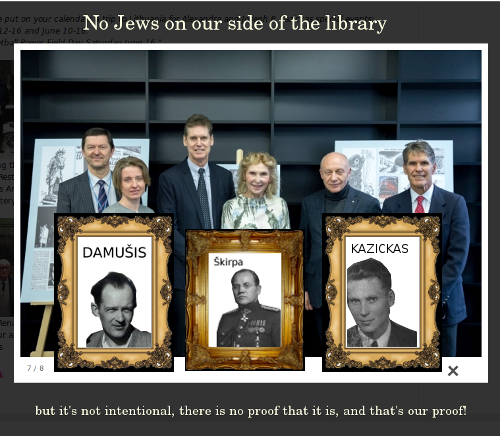
The Martynas Mažvydas National Library of Lithuania has just celebrated the opening of the Adolfas Damušis Democratic Studies Center on June 15-16, 2017 with a one-sided view of his life. Gintė Damušytė, Lithuania’s ambassador to Denmark, and Mykolas Romeris University in Vilnius founded the Center in 2013 to honor the memory of her father, Adolfas Damušis (1908-2003). He was a chemist and lifelong idealist. As a Catholic youth activist, he was arrested in 1931 by Smetona’s autocratic regime and held at the Varniai concentration camp for half a year. In 1941, he was one of the organizers in Kaunas of the anti-Soviet uprising on June 23, 1941, the leader of the Lithuanian Activist Front’s military staff in Kaunas, and the Minister of Industry in Lithuania’s short-lived Provisional Government. In 1944-1945, he was held by the Gestapo in a prison in Bayreuth, northern Bavaria, for his anti-Nazi activities. In the US, he served as the leader of the Lithuanian Catholic youth organization “Ateitis” (the Future) and many other organizations, and worked as an editor for “Radio Free Europe”.
VILNIUS—Lithuania’s top neo-Nazi blogger “Zeppelinus” has republished with some noticeable relish, in a post dated 27 May 2017, parts of the 19 May official “Lithuanian Jewish Community website” attack (as PDF) on this journal’s editor, Dovid Katz. The attack was, some would say shamefully, signed “LJC staff” though sources rapidly revealed its prime author (see our rapid response on the day). It is not the first time that the antisemitic far-right has found its material on the website of the official Jewish Community under its current leadership (that is under legal challenge after the recent allegedly rigged election), at a time when the website is, disturbingly, allegedly under control of elements very far from the interests of Lithuania’s Jews. Last autumn’s website attacks on Rabbi Sholom-Ber Krinsky were picked up and elaborated by another key antisemitic blogger who went so far as to dig up the 1790s antisemitic attacks on a prime founder of Lithuanian Hasidism.
You know something is wrong when the neo-Nazis are finding their material on the “website of an official Jewish community”. It’s a website funded in fact by the state via restitution funds deriving from the communal religious properties of the annihilated Jewish communities of Lithuania, administered by a (this one’s for you, George Orwell) “Good Will Foundation”.
Then there was the most recent fiasco, a comparison of the democratic electoral congress of the Vilnius Jewish Community on 24 May to Russia’s “Zapad 2017” military exercises, and the charge that the assembled 300 or so Vilnius Jews were “mainly Russian speakers calling themselves Jews, with only a minority of people with Litvak blood” (see our report which led to JTA’s coverage, and the essays by Professor Pinchos Fridberg and by Leonas Kaplanas). This was a proverbial gift of the gods to the local antisemitic establishment here that revels in delegitimizing the country’s living Jews while embracing a de-Judaized ersatz “Litvak heritage” for PR, with some help from a tiny elite of privileged “court Jews” who themselves at times, it seems, become conduits for antisemitic invective against the local Jewish community. Prof. Fridberg has pointed out that a subsequent vague and unclear “apology” posted failed to disclose the author(s) of the offending text, and never even appeared in the Russian-language section of the website. Is the author of the offending text still employed by the official “Lithuanian Jewish (Litvak) Community”? Why is his or her identity a secret?
◊
We have watched in horror the events leading up to and concluding with your “election” as the leader of the Lithuanian Jewish community. Having grown up in the world’s greatest democracy, it appalls me to see how you have ruthlessly and illegally managed to maintain your power base.
I am a proud Litvak, but you would not consider me a Litvak because I do not fit your definition of a Litvak. My mother was a Litvak and my father was a Jew born in Zhitomir. I grew up with my grandmother who was born in Kaunas. My grandfather was also from Kaunas, though he had died before I was born. Yiddish and Russian were spoken in my home as I grew up. You have disenfranchised Litvaks whose native language was not Lithuanian or whose parents were not both Litvaks or who was not born and raised in Lithuania. Your rhetoric on this subject is dangerously close to that of the Nazis who tried to destroy us. Within that concept of yours, you remind me of a Kapo who will do anything to her own people to ensure her own survival.
VILNIUS—The following is an English translation (by Ludmilla Makedonskaya) of Professor Pinchos Fridberg’s article in Russian that appeared in the Vilnius-based publication Obzor on 26 May 2017. Note that the original Russian version is the only authoritative text for any issues arising. Professor Fridberg is a native of Vilna, a Holocaust survivor, a retired physics professor and the author of numerous articles and studies. For translations of a selection of his work on Defending History’s issues, in English translation, see our Pinchos Fridberg section.
For more information on the issue see the Lithuanian Jewish Community (LJC) website report on the 24 May elections held by the Vilnius Jewish Community (VJC), Defending History’s initial real-time report and rejoinder, the second version posted, the JTA report on the affair, the subsequent LJC “apology” and Leon Kaplan’s essay on these pages.
VILNIUS—In one of the most remarkable events in post-Soviet Jewish Lithuania, around a hundred Jewish residents of this city, most of them from younger generations, came today to the Pylimo 4 headquarters of the “official” Jewish community to monitor the quadrennial elections for chairperson of the Jewish Community of Lithuania which they believed to be rigged. First, the rules had been changed right in the middle of the campaign, on 19 April, disenfranchising the small Jewish population of Lithuania by reducing to one vote each Jewish community and abandoning the long-standing formula of 1 vote for 100 persons which gave a voice to actual Jewish people (while retaining one, two or even three votes for various oligarchs from NGOs and other organizations, associations, and entities, including a not-yet built museum in a town with no Jews). That meant that the 2,200 or so Jews of Vilnius would have one vote rather than around 22.
UPDATES OF 29 MAY:
Vilnius District Court today nullified the Lithuanian Jewish Community’s decision to eliminate proportional representation and reduce the electoral weight of Vilnius Jewry to one vote. It offered temporary relief with a right to appeal within seven days. Net moral effect of the decision is to delegitimize the “re-coronation” of the incumbent chairperson.
Also: The “Good Will Foundation” released its latest allocation figures of funds deriving from the communal religious properties of the annihilated Jewish communities. Incredibly, it contains money for the state-sponsored “Red-Brown Commission” that is dedicated to the 2008 Prague Declaration…
Second, the fifteen representatives which the newly elected Vilnius Jewish Community Board designated to attend the election conference were not admitted to the conference. Last Wednesday evening, the VJC elected Simon Gurevich (Simonas Gurevičius) its chairperson. He is the challenger candidate for the national chairpersonship position.
Third, a massive multi-layered security presence (guards in the building wore at least three kinds of fancy uniforms, police and security cars graced the sidewalk outside) added both bad will and farce to a day that will invariably go down in Vilna Jewish history on a number of counts. The Vilnius Jewish Community’s report on the day’s events (in Lithuanian) is available on its Facebook page.
◊
The Simon Wiesenthal Center issued the following statement on 18 May, bringing it into full de facto support of Ruta Bloshtein’s petition which now approaches 40,000 signatures from around the world.
LOS ANGELES AND JERUSALEM—The leaders of the Simon Wiesenthal Center have appealed to Lithuanian President Dalia Grybauskaite to change the current plans of the government to build a convention center on the grounds of the ancient Jewish cemetery at Piramónt in the heart of the Lithuanian capital.
◊
VILNIUS—Arkadijus Vinokuras, the highly talented and successful Lithuanian Jewish author, journalist, and comedian, has today jumped into the fray of the official Jewish Community’s elections for the post of chairperson of the Vilnius Jewish Community. In contrast to Simon Gurevich (Simonas Gurevičius), who declared his candidacy at the start of the election season and whose candidacy has (as of the time of this posting) not even been reported on the official community website, Mr. Vinokuras’s effort comes one week before the scheduled May 24th Vilnius Jewish Community conference, and has been announced with respect and a fine photograph on the website today (the same moment it came out on his own Facebook page). But that is not the main reason his candidacy is thought by many in the community, on first reaction, to be in the service of chairperson Faina Kukliansky, whose democratic terms as chief of both the Lithuanian Jewish Community (LJC) and the Vilnius Jewish Community (VJC) ran out last month.
◊
VILNIUS—The official trilingual (English-Lithuanian-Russian) website of the Jewish Community of Lithuania, generously financed from the restitution funds (deriving from prewar Jewish religious communal properties) allocated by the state-sponsored Good Will Foundation, is in the nature of things meant to represent that community. Once a community chairperson’s tenure was expired and a democratic election campaign was underway, it was widely expected that the website and its editor, Lithuanian journalist Ilona Rūkienė, would take every care to ensure evenhandedness, giving the various candidates equal space and each campaign the same respect, coverage, and democratic tools for reaching the electorate, thereby enabling voters to make an informed decision.
◊
◊
A“designer menorah” proposed as an official “new Litvak logo” featuring the candelabrum’s center replaced by a Lithuanian national symbol that is perfectly legitimate but has in recent years frequently been adopted by neo-Nazi and far-right nationalist groups? One that is also at the center of the logo of the far-right organization that sponsored a demonstration defaming 95 year old Holocaust survivor (and anti-Nazi partisan hero) Fania Yocheles Brantsovsky just a few months ago? One over which women’s rights campaigners have been prosecuted in recent years (at the whim of far-right groups) for “desecrating”? One which a far right political candidate has used on his poster along with swastikas?
The official Lithuanian Jewish Community website, lavishly financed in three languages by the restitution-funded “Good Will Foundation” has this week featured on its English and Lithuanian pages the design, under the headline A New Litvak Logo. The accompanying unsigned editorial purporting to represent the “Jewish community” boasts with some potentially obsequious glee that the Justice Ministry has graciously given the community “permission” to use the symbol in its “Jewish” logo, going on to announce for the benefit of readers that incorporating the symbol “into a Litvak logo makes perfect sense” and indeed, to warn any would-be copycats that this dazzling invention is being “patented”. There is no mention anywhere about any local Jewish people (in other words the members of the community in whose name various pronouncements are being made) being surveyed, questioned or consulted.
Lithuanian Jewry may be small and fragile but it is vibrant as ever. The first published protest came within minutes of its publication in the “Motke Chabad” blog on the website of the Vilnius Russian-language publication Obzor [update: following this article, a report appeared in Izrus.il].
◊
VILNIUS—Coming hard on the heels of the mid-campaign rule-change of 19 April that effectively disenfranchised over 2,000 Vilnius Jews, by “recounting” their collective vote as one vote instead of over 20 (via the long-established formula of 100 persons = one vote), the chairperson of the Lithuanian Jewish Community, eminent attorney Faina Kukliansky, on 4 May placed an announcement on the Lithuanian-language page of the official community website (followed by the Russian section), Lzb.lt, cancelling the widely announced 24 May 2017 conference of the Vilnius Jewish Community decided upon by a clear majority vote of its Council (15 of 21 active members), for which the large hall of Hotel Karolina had already been booked. This was followed on 5 May by an English language version complete with “Red-Ink Warnings from the Leader” which seems to inaccurately report that the planned 24 May conference was an “arbitrary” act of “one” Council of the Vilnius Jewish Community member, presumably referring to her opponent in the race, Simonas Gurevičius.
UPDATES TO 12 MAY 2017:
8 May 2017: Vilnius Jewish Community board member Simon Ceitlin posts a notice on his Facebook page confirming that the 24 May event at Hotel Karolina will proceed as announced.
10 May 2017: Simonas Gurevičius posts refutation of official Community website notice and confirms that the 24 May meeting, decided by all present at the most recent Vilnius Jewish Community board meeting, will proceed.
12 May 2017: Faina Kukliansky reposts announcement on community website assuring readers that the meeting will not occur.
◊
The following is a full translation of the radio debate on the fate of the Old Vilna Jewish Cemetery at Piramónt (in the capital’s Snipiskes district), aired by LRT.lt radio as part of its People and Ideas series on 1 March and again on 5 March 2017 and available in the original Lithuanian on the station’s website. The debate was hosted by Audra Girijotė with the participants (in alphabetical order here): Renaldas Augustinavičius, Ruta Bloshtein, Faina Kukliansky, Andrius Kulikauskas, Shnayer Leiman, Remigijus Šimašius.
Note that this translation works from the Lithuanian voice-over on Professor Leiman’s originally English contribution, rather than from a separate tape of the full English interview with Professor Leiman used by the organizers (who put together the “debate” after separate interviews with the participants). This was decided upon in the spirit of trying to characterize, as best we can, the text and texture actually received by the Lithuanian language audience.