DOUBLE GENOCIDE | EU | PRAGUE PLATFORM | PRAGUE DECLARATION | THE SEVENTY YEARS DECLARATION
◊
OPINION
◊
◊
◊
VILNIUS—The Double Genocide movement’s long-held wish of major legitimization at or near the European Parliament in Brussels via a huge monument effectively equalizing Nazi and Soviet crimes has come a step closer. This journal’s opinion has been consistent for some eighteen years, since these issues were forced on to the European Parliament’s agenda by some eastern member states (normally, in democratic alliances of sovereign states, it is understood that freedom of speech and thought includes healthy debates on history within each state). Our take: 1. Brussels needs a major new monument to the victims of Communism and its brutality, including mass murder and horrendous crimes against humanity. 2. Brussels does not need a mix-and-match monument for victims of Nazism and Communism together which is a ruse of the red-equals-brown (Double Genocide) revisionism movement, emanating from the East European far right, and seeking to downgrade (and relativize) the Holocaust, criminalize those who joined the anti-Nazi resistance, and glorify local killers in the east as freedom fighters (they were after all “anti-Communist”). The effects of “Double Genocide” pressure on various European museums has been manifest for years.VILNIUS—A deeply ethical and conscientious Vilnius scholar, flabbergasted by the local “mainstream” media’s rehashing of the mantra (and sheer antisemitic nonsense) that “the Jews sold the Old Vilna Jewish Cemetery to the czar in 1830” decided to look in the archives. When he succeeded to find the document, issued by Stalin’s USSR on 22 October 1940 ordering the confiscation (i.e. theft) of the Jewish cemeteries under the aegis of the Vilnius Jewish Community, he just did the right thing and released it to the public domain. That Stalinist order came very soon after the summer 1940 forcible annexation of Lithuania and its two Baltic state neighbors, into the Soviet Union.
VILNIUS—The following is a draft English translation of the official Lithuanian transcript (which follows the English text) of the debate held on 12 May in the Seimas, Lithuania’s parliament, on the question of plans to refurbish with state funding the Soviet-era “Sports Palace” (Sporto rumai) ruin that sits in the middle of the Old Vilna Jewish Cemetery of Piramónt (Shnípishok, Šnipiškės), and turn it into a national convention center that would be surrounded by thousands of extant Jewish graves going back to the cemetery’s founding in the fifteenth century.
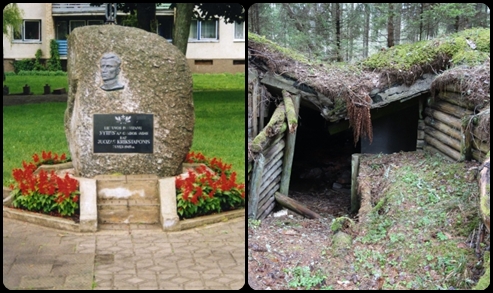
Fania Yocheles Brantsovsky showing us around the Jewish partisan fort, in her Vilna Yiddish, in 2007 (video). Her last request to future generations. DH’s section on the Jewish partisan fort (also in ascending chronological order).
◊

The poster for the June 3rd 2026 demonstration at the Old Vilna Jewish Cemetery calling for the building the Soviets plonked in its center to become the new national conference center
◊
VILNIUS—The poster in question invites people to a protest action on June 3 at the Vilnius Palace of Concerts and Sports. Three prominent public figures and their quotes are depicted:
◊
On March 18, 2026, twenty-three members of Lithuania’s parliament, Seimas, sponsored a bill to Promptly Renovate the Vilnius Concert and Sports Palace. On April 21, twenty-five members, representing all of Lithuania’s political parties, with the support of President Gitanas Nausėda, sponsored a revised bill On the Further Utilization of the Vilnius Concert and Sports Palace, cherishing it as a masterpiece of 20th century brutalist architecture which must be revived and exploited as a conference center and tourist site.
◊

Which of these two visions for Piramónt (Shnípishok, today’s Snipiskes on modern, beautiful Vilnius) reflects true love of modern Lithuania? The historic cemetery restored or a convention center that would haunt the capital for centuries to come? DH images by Vulovakas of Kaunas (not to scale).
◊
◊
OPINION
◊
VILNIUS—There was sadness and shock in the international Litvak community this week as news spread that famed Lithuanian mezzo-soprano Judita Leitaitė, a professor at the Lithuanian Academy of Music and Theatre, was featured in the program of the free 18 May 2026 concert arranged to promote the project to situate a new national convention center in a Soviet ruin that lies in the middle of the Old Vilna Jewish Cemetery where many thousands still lie buried. The Soviets pillaged all the stones, but left untouched the graves that were not under the building of the “Sporto Rumai” building.
◊
The following is Defending History’s translation of the transcript of the speech made by member of parliament and former mayor of Vilnius Artūras Zuokas at the Lithuanian Academy of Sciences on 18 May 2026 (souvenir program). The original Lithuanian speech is available on youtube (courtesy of Willian Adan Pahl). The Defending History community continues to hope that the late London rabbi the former mayor invokes was himself deeply deceived by others in the name-out-of-Orwell “CPJCE” (Committee for the Preservation of Jewish Cemeteries in Europe), a group exposed inter alia by Wikileaks for receiving secret payments for “supervising” the destruction of the Old Vilna Jewish Cemetery, currently via plans for establishment of a convention center in a Soviet ruin where thousands would cheer, clap, drink and flush lavatories surrounded by thousands of Jewish graves, including some of the greatest Lithuanian rabbis of the last half millennium. See one of the historic complaints to the UK Charity Commission. The long-term damage caused by foreign Jewish groups who in effect “sell permissions” to destroy Jewish cemeteries becomes obvious from this citation at this rally all these years later. For the actual international rabbinic consensus see here and here. There is widespread agreement, moreover, that the “convention center in the cemetery” would not be happening if it were a five hundred year old cemetery of the majority ethnicity and religion.
◊
◊
VILNIUS—At a BNS (Baltic News Service) press conference today called by Rabbi Sholom Ber Krinsky, Vilnius’s one resident rabbi over the last 32 years, he was joined by Defending History editor Dovid Katz, former professor of Yiddish language, literature and culture at Vilnius University. Both pleaded with the Lithuanian government to preserve the Old Vilna Jewish Cemetery at Piramónt (Shnípishok, modern Vilnius’s Šnipiškės section), where many thousands still lie buried. The oldest recorded stone was from 1487. They called on the government to abandon plans for a convention center and or museum/memorial complex, now planned for a dilapidated Soviet-era building (“Sporto rumai”) on the site.
◊
◊
Having previously produced two documentaries related to monuments in honor of Nazis and their collaborators, Paula Kirman and Adam Bentley journeyed to the three Baltic States and to Finland in order to track and unearth monuments to Nazi collaborators displaying a hero-worship in these countries, eighty years after the war. In their own words, the purpose of the documentary is ‘exposing monuments that commemorate Nazis and their local collaborators.’ In the documentary, of one hour and twelve minutes, Kirman is our guide and narrator.
The following is Defending History’s translation into Lithuanian of Rabbi Sholom Ber Krinsky’s statement of 11 March 2026, Lithuania’s Independence Day. The original English appeared the same day in DH, and on 17 March it was published in The Times of Israel. See also Professor Sid Leiman’s response from New York. For some weeks, there was no mention of it in Lithuanian language media, a priori rather curious given the rabbi’s thirty-two years of resident service in the Lithuanian capital. But by mid April there were cracks in the efforts to keep from Lithuanian language readership the very existence of the opinion that it is in Lithuania’s interest to honor, not humiliate, the five hundred year Old Vilna Jewish Cemetery, not to reconstruct a Soviet ruin where throngs would cheer, drink and flush lavatories surrounded by thousands of extant graves of fellow citizens of Vilna. Would this even be contemplated if it were about a half-millennium old cemetery that was the resting place of the great scholars of the ethnic and religious majority?
The ice started to break with veteran journalist Arvydas Jockus’s article in Alfa.lt (16 April), a survey of views that exposed the misimpression that the state-financed official “Lithuanian Jewish Community” is somehow representative of Jewish views (whether local or international). Then, the Vilnius-area Vilniaus kraštas published a translation, on 22 April, albeit with a classic “biased headline” implying that the “purpose of the Jews” is to take away the Soviet Sports Palace. This was somewhat rectified by the publication of a Lithuanian translation with the correct author’s title, carried as a press release by BNS (Baltic News Service) and by Elta.lt, among others, on 24 April. Since 2015, Defending History has offered a section in Lithuanian on these issues.
◊
◊
VILNIUS—For several decades, the Defending History community has been providing commentary on Jewish and history related museums in Lithuania and the wider region, primarily in our Museums section, initiated nearly eighteen years ago. Here in Vilnius, we have endeavored to give voice to sectors of modern Jewish (and sometimes non-Jewish) life whose views have had no other channel, especially since the closure, over a decade and a half ago, of the Jewish community’s long-beloved quadrilingual Jewish newspaper, Jerusalem of Lithuania, that was home to open and vigorous debate for decades, under the inspired editorship of the late Milan Chersonski. Ultimately, it was replaced by a PR type website dedicated to one view only, that of the tiny clique in control of the tens of millions of euros in restitution funding that has excluded the interests of today’s Jewish community, and its healthy diversity of views.
◊
Takis Würger, Noah. Von einem, der überlebte, Penguin: München 2021, 188 pp., ISBN: 978-3-328-60167-8.
Reading “NOAH”, by Der Spiegel journalist Takis Würger, here in Dutch (originally published in 2021 in German), I felt that Noah Klieger had been made of the stuff of heroes. Klieger was born in 1925 in Strasbourg, France. When he started school in Brussels, Belgium, his teachers quickly ascertained that this small-sized boy of five years had a prodigious memory. Whether arithmetic or written text he seemed to never forget what he had heard or read. At the same time, he seemed not to show any actual interest for the subjects taught. He was therefore shifted to higher grades with pupils sometimes two or three years older.
◊
It was known as “the Jewish fort” (or “the Yiddish speaking fort”) within the network of anti-Nazi Soviet partisan forest enclaves (the only de facto resistance to Hitler’s occupation of Lithuania, then in alliance with Great Britain, the United States, and the other Allies). It’s 100 or so occupants were all Vilna Ghetto escapees whose families were murdered and who went on to survive, and to become decorated heroes of the free world in the anti-Nazi resistance.
Then, after the rise of free, democratic Lithuania in 1990/1991, they become major educators whose last wish was that the Jewish fort’s remnants be preserved.
Whether coincidence or by sheer majesty of history (or: Higher Powers), the beloved remnants of the Jewish partisan fort have ended up abutting the massive new training ground of the German Army’s 45th Panzer Brigade arriving in Lithuania in the democratic context of NATO and the free world. It is a magnificent opportunity for Germany, and the thousands of young troops being sent “back east” to be educated and educate others about the Holocaust in Lithuania and beyond. Including — the extraordinary saga of Jewish resistance.
◊

Fania Yocheles Brantsovsky (1922-2024) shows us where she and 99 other Jewish escapees from certain death in the Vilna Ghetto lived and fought the Nazis in this underground fort in the forest now right next door to the German Army’s new Brigade in Lithuania. Click on image for 2007 video. Fania explains that this was known as “the Jewish fort” within the wider partisan movement, and is so known in Holocaust resistance history. Yiddish was the everyday language of its 100 or so occupants.