EVENTS
◊
◊
◊
◊
Latvia’s Minister for Foreign Affairs Edgars Rinkēvičs seems to have found a brand new idol and role model — Ludwig Seya, who had been a diplomat in the prewar Latvian Republic for 22 years. For a short time he was a minister, but mostly he held ambassadorships to various countries. After Latvia was annexed to the Soviet Union he taught at the main Latvian university in Riga. In 1944 he was arrested by the Nazis for underground activities in the Latvian Central Council, a union of pre-war politicians and intellectuals who tried to persuade the West to insist on the independence of Latvia after World War II. After being liberated from the concentration camp on the territory of Poland, Seya was arrested by the Soviet military authorities and sent to a Stalinist gulag.
◊
JERUSALEM—The 1 February 2018 letter of Rabbi Shmuel Rabinowitz, Rabbi of the Western Wall and Holy Sites in Israel to the president of Lithuania, Dalia Grybauskaitė, was released here today for publication. In it, the world-renowned rabbi who heads the Western Wall Heritage Foundation, pleads with the president of Lithuania to “cancel this plan to make this site a convention center.” He reminds her of the tens of thousands of Jews buried at the old Piramónt cemetery of Vilna, now in the Šnipiškės district of Vilnius, capital of Lithuania. His letter follows the 7 January 2018 letter from the Chief Rabbi of Israel, Rabbi David Lau, and the pleas of virtually all the world’s leading rabbis of Litvak heritage (and many others) over recent years, in addition to many people of good faith of all backgrounds.
◊

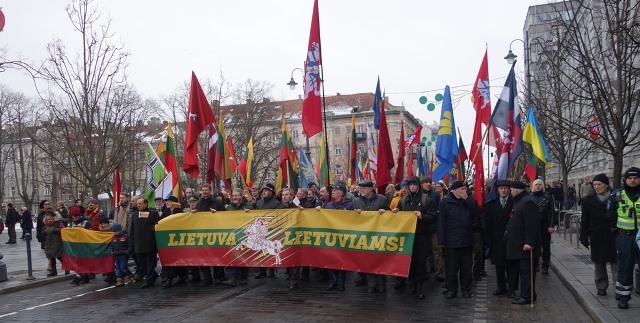
Lead banner reads: “WE KNOW WHO OUR NATION’S HEROES ARE. This year’s “sanitized” event in central Vilnius featured a lead banner glorifying six Nazi collaborators, five of them deeply implicated in the Lithuanian Holocaust. The torchlit march, the day’s final event, made its way from Vilnius’s most sacred Catholic shrine down through the Old City, culminating at a street named for one of the collaborators who had advocated “only” ethnic cleansing of the country’s Jewish minority in 1941.
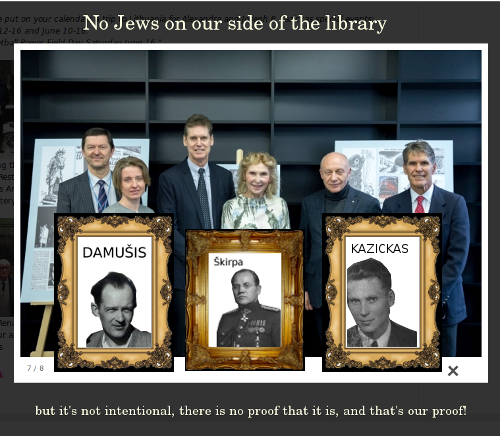
Lithuania’s Mažvydas National Library is curiously fostering two parallel cultures which have yet to engage each other. Up on the fifth floor, on the West side, an eminent Judaic studies scholar leads the Judaica Research Center (cosponsored by the Yivo institute in New York), and on the East side, journalist Vidmantas Valiušaitis leads the Adolfas Damušis Democracy Studies Center.
More on Mažvydas National Library; on Yivo’s history in Vilnius since 2011
◊
VILNIUS—An important factual report on the fate of the old Gwarna Street Jewish cemetery in Wrocław, western Poland, written by a young Judaic Studies scholar in the city, Agnieszka Jablonska, has been circulating among specialists internationally since last August. It was at the time one of the sources noted in Defending History’s editorial on the subject. The report, entitled On Saving Memory: The Jewish Cemetery on Gwarna Street in Wrocław, Poland provides an abstract that summarizes the narrative:
Jump to: English media section
AVENTURA, FLORIDA—Targum Shlishi, one of the world’s leading voices in creative thinking and innovative problem solving when it comes to Jewish survival — and the survival of Jewish memory — featured various aspects of Defending History’s Vilnius-based work today, in its blogpost on the occasion of Holocaust Remembrance Day. A PDF facsimile of the post follows (please use handles at upper left to turn pages).
◊
VILNIUS—At the suggestion of a number of our readers in Connecticut and neighboring states, Defending History has contacted the office of the Hon. Erin E. Stewart, mayor of New Britain, Connecticut, to ask if her team was aware of the alleged pro-Nazi and Holocaust collaborator background of a Lithuanian militant, Adolfas Ramanauskas (“Vanagas”) who became a major leader of the anti-Soviet resistance in the years after the war. We urge the mayor to reconsider plans for him to be glorified in New Britain, Connecticut this year. It would make much more sense to honor Lithuania’s 100th anniversary of its inspirational 1918 independence in a way that is dignified and can be celebrated by all the peoples of Lithuania, at home and in its far-flung diaspora.
◊
VILNIUS—The following is the automated reply received this morning (last night US EST) from the office of Mayor Erin E. Stewart concerning reports that her city had agreed for a monument to an alleged Nazi collaborator to be erected on public lands in the heart of her city, New Britain, Connecticut. The alleged collaborator, Adolfas Ramanauskas led a Hitlerist militia in the early days of the Lithuanian Holocaust in June and July of 1941, when such militias were busy murdering, plundering and humiliating Jewish neighbors even before the Germans managed to set up their administration in the territories they were conquering in Operation Barbarossa, that launched the genocidal phase of the Holocaust. Hopefully Mayor Stewart will rapidly inform her council of the issue concerning which Defending History provided her with ample documentation as a point of departure for free and open debate (see the message reproduced in the automated acknowledgment).
While much is said in some American media outlets about “fake news” in the US, the smallness of the matters being discussed might come into focus when compared with Ukraine, which is of late producing rather much fake news about the Holocaust and elementary points in World War II history.
As we reported back in October, Ukrainian media outlet Radio Svoboda — the Ukrainian arm of the US Government-funded arm of RFERL — posted a picture from the US Holocaust Museum. It is an image of Polish Jews being deported to a death camp. There was just one problem. Radio Svoboda claimed the picture was from 1949 of Ukrainians being deported to Siberia. In fact, so effective was Radio Svoboda’s forgery that President Poroshenko himself tweeted it claiming it showed Ukrainians being deported. To Poroshenko’s credit, his office took it down almost immediately after we pointed this out.
VILNIUS—We had the painful responsibility last week to record the folly of the Israeli embassy in an East European country that would go out of its way to lend “Jewish legitimacy” to a lamentable decision of a national parliament to name the incoming year 2018 in honor of a man, who in addition to whatever acts of bravery as a resistance figure in the postwar Soviet period, was also a leader of an armed pro-Nazi militia in the early days of the Lithuanian Holocaust, in late June and early July of 1941. The primary achievement of these groups, many affiliated with the LAF (Lithuanian Activist Front) fascist “white-armbanders” was the unleashing of pillage, humiliation, harm and murder of their Jewish citizen neighbors. Make no mistake, the Soviets were fleeing, in June 1941, from Hitler’s invasion, the largest in human history, not from the local Jew-killers.
◊◊
Not only the living turn to dust; the dead do so as well. So too the tombstones we erect in their memory. Some people merit having their tombstone stand for one generation; others merit having their tombstone stand for two generations. But in the end, it gradually sinks until it is swallowed up by the earth.
S. Y. Agnon, A City in Its Fullness

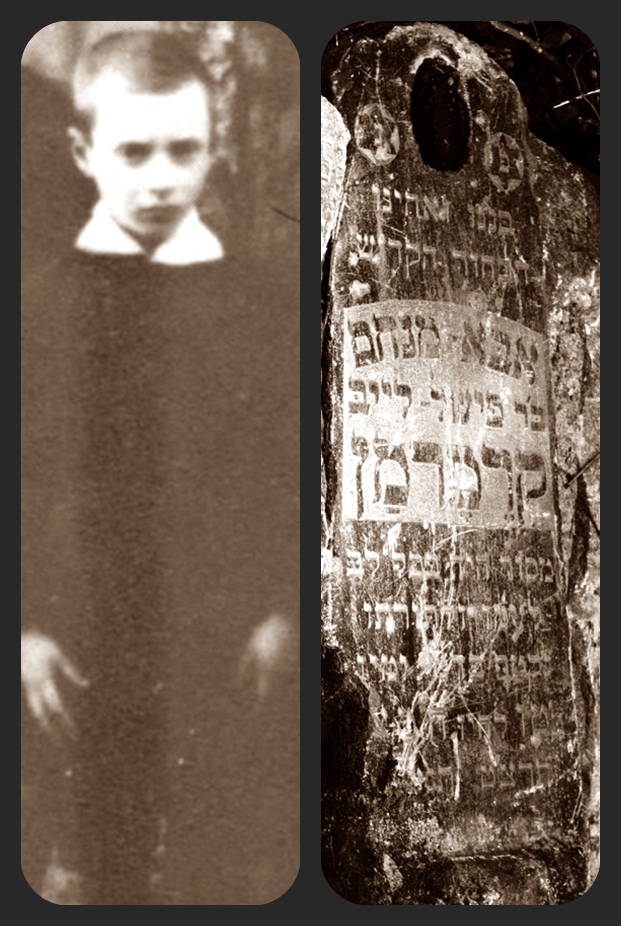
Abba-Menachem Kremerman, who died at 15 in Vilna in 1939. He was buried at the Zaretsha (Užupis) Jewish cemetery. For years now, his gravestone, along with many others, lay in a heap at a garden center. And now, in 2017 it was among a batch dumped by Vilnius municipal authorities on the site of a different Jewish cemetery, the Old Vilna Jewish Cemetery at Piramónt (in Šnipiškės), now reconceived as real estate for a national convention center. What’s going on?
◊
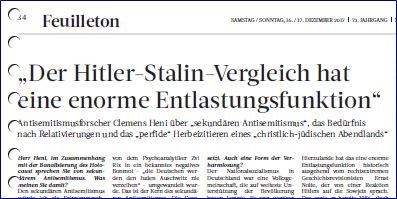
BERLIN—In a groundbreaking interview with Dr. Clemens Heni, director of the Berlin International Center for the Study of Antisemitism (BICSA) in the leading German liberal daily Frankfurter Rundschau, Heni criticizes the ongoing comparison of Hitler and Stalin and the relativization of the Holocaust. He reminds readers, in the interview conducted by journalist Katja Thorwarth, what psychoanalyst Zvi Rix had to say about German reception of the Holocaust: “The Germans will never forgive the Jews for Auschwitz.”
VILNIUS—Israel may have crossed a red line today when it was flaunted on the major News portal Delfi.lt here, both in Lithuanian and in English, that Israeli ambassador Amir Maimon had found the time this week to stage a demonstrative PR-photographed visit to the chief campaigner for the parliament’s decision less than one month ago to name 2018 in honor of Adolfas Ramanauskas — his daughter in Vilnius, Auksutė Ramanauskaitė-Skokauskienė, who is a prime icon of the ultranationalist camp that often glorifies various collaborators and participants in the Holocaust on the grounds that they were also anti-Soviet activists. The PR move came just after a major political commentator asked what Lithuania is getting in return for its staunch political support for the Netanyahu government.
UPDATES TO THIS ARTICLE: WEEKLY OF VILNIUS COMMENTARY; AMBASSADOR’S BETRAYAL OF HOLOCAUST HISTORY A FIASCO AS LITHUANIA VOTES ANYWAY AGAINST U.S. DECISION TO MOVE ITS EMBASSY (PARTING WITH NEIGHBORING LATVIA)
One of the PR photos released shows the ambassador posing underneath adulatory photos of the 1941 pro-Nazi militiaman (from various other periods in his life). Of course Lithuania has a vast number of inspirational historical heroes, including many anti-Soviet heroes, who were not Holocaust collaborators, and state decisions to honor collaborators cause untold pain to survivors, their families, and the remnant Jewish communities in Eastern Europe. They all send a message that becomes part of the history-revision campaign to downgrade the Holocaust in the context of “Double Genocide” revisionism.
As anyone who has been following events in Lithuania for the last several years surely knows by now, the country sports street names and monuments honoring locals who collaborated with the Nazis during World War Two. It was in this context that I attended an event in Washington, DC yesterday at the Wilson Center’s Kennan Institute discussing Ruta Vanagaite’s controversial book “Our People” (it appeared in Lithuanian in 2016) that blows open the door describing the true extent of Lithuanian collaboration in the Holocaust. Vanagaite and her co-author Efraim Zuroff , director of the Simon Wiesenthal Center’s Israel Office, spoke at the event.
◊
The national scandal unleashed by the Lithuanian Rūta Vanagaitė and the Jewish Efraim Zuroff via their statements about Adolfas Ramanauskas-Vanagas, is gradually losing momentum. The Seimas (parliament) went right ahead and declared the incoming year, 2018, to be The Year of Ramanauskas-Vanagas. That is sad. Three years ago, I wrote about this person’s activities in Druskininkai in 1941. Society back then was silent about it. It was only the desire of some politicians to glorify this personage that led to the aforementioned Lithuanian and Jewish commentators to talk about him. They spoke loudly and an antisemitic bubble burst. Vanagaitė’s statement had some inaccuracies. The very statement was taken as an insult by the mainstream. Public details about Zuroff’s statement were scarce. My 2014 article was among those details.
This paper was published today by Taylor and Francis on its website. It appears in Dapim: Studies on the Holocaust, volume 31, no. 3, pp. 285-295 (Dec. 2017). Dapim is edited by the Strochlitz Institute for Holocaust Research at the University of Haifa.
In Lithuania, the primary provider for Holocaust studies for close to two decades has been the state-sponsored International Commission for the Evaluation of the Crimes of the Nazi and Soviet Occupation Regimes in Lithuania (ICECNSORL), which was established in 1998 by decree of the nation’s president and is housed in the office of its prime minister, embedding it in the highest strata of Lithuanian politics. Several of its activities have enabled significant contributions in research, education, and public commemoration.