THE RAMANAUSKAS SAGA | OPINION | MEDIA WATCH | COLLABORATORS GLORIFIED | WHEN FOREIGN MINISTRIES PLAY WITH THE HOLOCAUST
◊


◊
This weekend, the new monument to 2,400 Biržai Jews, massacred on August 8, 1941, will be unveiled in Biržai, a town in northern Lithuania known in Yiddish as Birzh. On that fateful day in Pakamponys forest, German Gestapo officers and their Lithuanian accomplices murdered 900 children, because they were Jewish children, 780 women, because they were Jewish women, and 720 men, because they were Jewish, too. The locals call the site “the Biržai Jews’ grave”.
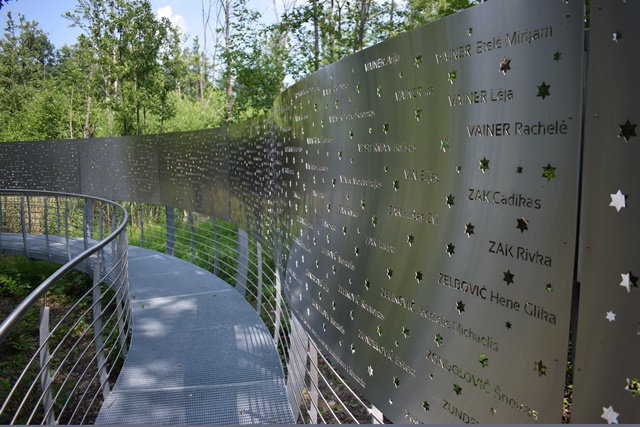
That day, more than one third of the inhabitants of that old historical city were massacred. A vibrant community was destroyed and trust in Biržai as a safe place to live was wholly undermined. This old wound had not been taken care of properly up until now. There is a memorial stone at the site of the massacre, the site itself is covered with tiles. There is a memorial inscription, too. However, all those people with their lives and their dreams remained but a number in stone. People behind the new memorial decided to fix this, and now we have more than five hundred names carved on a steel wall. This difficult task required a lot of effort. Alongside with the people, the murderers also destroyed the documents attesting to their lives.
What does the Town’s Official Museum Think?
Question: Is this city really ready to be the Capital of European Culture for 2022?
◊
You just could not make this stuff up. A powerful government unit of an East European democracy that is a member of the EU and NATO wants nothing more than to plonk a monument in America for someone who was not only an alleged Holocaust collaborator (see Evaldas Balčiūnas’s articles of 2014, 2017 and 2019), but who is today a prime icon of the country’s neo-Nazis. Indeed, his visage is first on their banner of “national heroes” used to front torch-lit neo-Nazi parades in the nation’s capital. The monument is unveiled in Chicago on May 4, 2019.
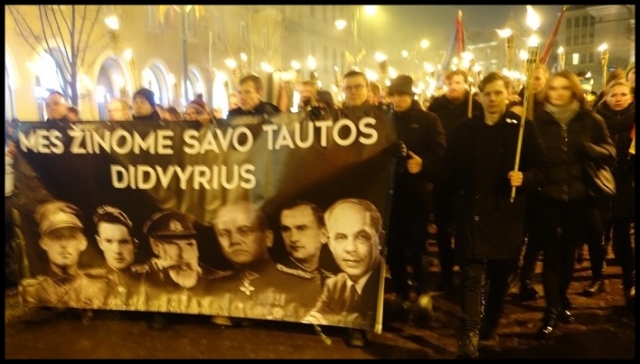
Ramanauskas is first (at left) on neo-Nazis’ front banner at torchlit parade in Vilnius
RAMANAUSKAS: A FIVE YEAR SAGA. BEYOND THE HISTORY: WHY A MONUMENT TO A PRIME ICON OF TODAY’S NEO-NAZIS IN EASTERN EUROPE?
From left to right on the neo-Nazis’ “We know our national heroes” banner (torchlit neo-Nazi parade of Feb. 2018): Adolfas Ramanauskas-Vanagas, Jonas Noreika, Povilas Plechavičius, Kazys Škirpa, Antanas Baltūsis-Žvejas, and Juozas Ambrazevičius-Brazaitis
◊
Chona Leibovich (Leibovičius)
In our country, there has for decades now been a ceaseless series of battles in the mass media, social media and other nooks and crannies of the public space.
A new surge has emerged. The subject of the various high-voltage disputes? The attitude of members of society, and particularly the cultural elite and the authorities to the collaboration of the Lithuanian population with the two adversarial branches of “socialism”: the so-called workers’ and peasants’ variety (Communist) and national socialism (Nazism). During the year before the entry of Nazi troops onto the territory of the Lithuanian Soviet republic in June of 1941, and after World War II ended here in July 1944, many local people cooperated with the Soviets. The cooperation of an overwhelming part of the country’s population with the Soviet occupational authorities became especially enthusiastic and active during the long, peaceful postwar period. To a certain extent, it was natural because one always wants to live, and not just to survive, but also to find oneself, to be able to create something. However, by the sharpest of contrasts, during the Nazi occupation,considerable numbers became not just willing and active accomplices of the “general” Nazi policies pursued by the occupiers, but also initiators and enthusiasts of repressions and mass murder directed against Jews and, selectively, against members of other sections of the civilian population.
Some naively believed that Hitler’s invasion would help the nation break free of the “friendly” embrace of the USSR and restore independence. Others were guided by more prosaic considerations, such as robbing and killing their neighbors and fellow citizens. Others still did not disdain either and combined the useful with the pleasing. And it never occurred to the many elites leading these activities that killing a peaceful unarmed people in their own country, a whole people declared an enemy by the nationalist propaganda, cannot bring a nation the good luck it years for, even if you somehow assume that they really all were your enemies.
◊
Five years ago, I wrote about the alleged connections of Adolfas Ramanauskas to the persecution of Jews in Druskininkai. Following publication of the Lithuanian version, the English version appeared here in Defending History in 2014. The connections are based in the first instance on Ramanauskas’s own memoirs, published in post-Soviet independent Lithuania, where he boasts that he served as leader of “the rebels’ squad” during the precise days and weeks of June and July 1941 when these “rebels” of the Lithuanian Activist Front (LAF) were in fact unleashing humiliation, plunder, violence and indeed murder against Jewish neighbors (the Soviet army was escaping Hitler’s invasion, not these white-armbanded LAFers). Following upon Ramanauskas’s own memoir and boast came research into the actual police records of the summer of 1941, as well as the postwar Soviet war crimes trials’ transcripts.
When writing that first article in 2014, my goal was not to find or prove something directly compromising. I was simply disturbed by the obvious collision of this heroic myth and its historical circumstances. It was part of my series of articles in Defending History, starting in 2012, that was launched by my essay “Why does the State Commemorate Murderers?”.
LATEST MEDIA:
Algemeiner; BBC; Independent; Simon Wiesenthal Center; Telegraph.
RAMANAUSKAS: A FIVE YEAR SAGA
But then, in late 2017, the Seimas (parliament) of the Republic of Lithuania declared 2018 to be the Year of Adolfas Ramanauskas-Vanagas. Indignant at the uncritical worship, Dr. Efraim Zuroff, director of the Simon Wiesenthal Center’s department of East European affairs, brought a copy of my article to the members of the Seimas and was condemned without them even attempting to read it. During that period, I published a second, follow-up article focused on the moral issues.
Successful resistance to the plans of the Genocide and Resistance Research Center of Lithuania to erect a monument to Ramanauskas in his native city of New Britain, Conn., were enabled exactly by the facts mentioned in the 2014 piece (that saga can be followed in Defending History). One year ago, the City Council of New Britain “just said No.”
◊
VILNIUS—On Friday, April 26, 18:00-18:20, Dr. Andrius Kulikauskas, curator of the Captain Jonas Noreika Museum, Archive and Forum, will give the final talk at the conference “The Territories of Interaction of Aesthetics, Art Philosophy and Art History: Intercultural Fields of the Functions of Representation”, organized by Prof. Antanas Andrijauskas at the Lithuanian Cultural Studies Institute, at Saltoniškių St. 58, Vilnius.
Dr. Kulikauskas will be speaking in Lithuanian on “How to Forego, Through Dialogue, Monumental Images of Those Who Voiced the Will of the Lithuanian Nation in 1941 But Committed Crimes Against Humanity”.
His talk will be followed by an hour of open dialogue on two questions:
VILNIUS—In a shock both to human rights activists here and the small but vibrant Jewish community, the “Open House Vilnius” project of the NGO “Architektūros fondas”, in partnership with M. K. Čiurlionis House and Museum is organizing a major event this coming weekend to feature an “audio-visual installation by the composer Vytautas Paukštelis”. The event is being sponsored by European Union taxpayer euros via the EU’s “Creative Europe and European Music Paths” program.
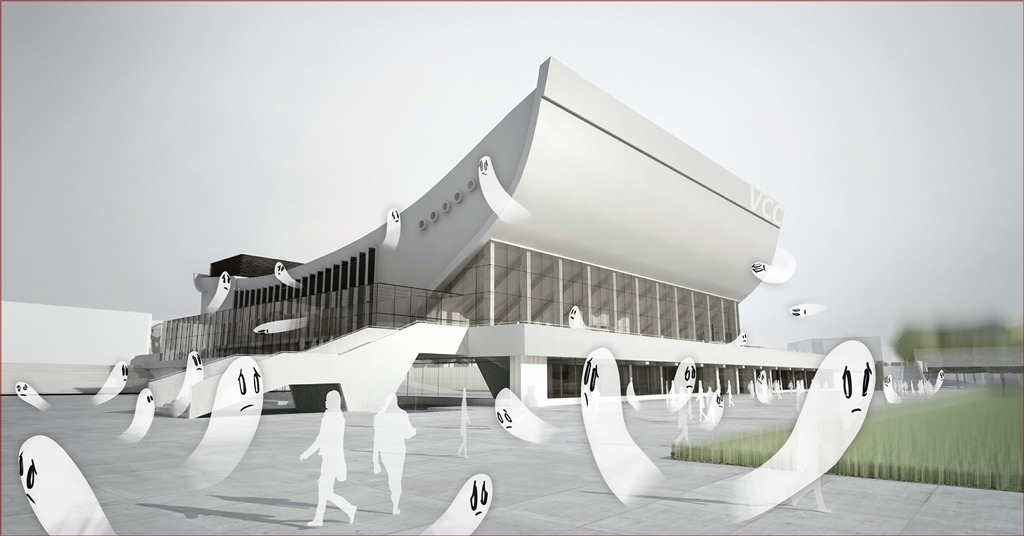
“The Ghosts of Vilna Will Not be Silenced” (by Vulovak for DefendingHistory)
The problem? It is being staged right smack in the middle of the Old Vilna Jewish at Piramónt (in today’s Šnipiškės district, Shnípeshok in Yiddish). In fact, the staging could not be some kind of clerical error resulting from lack of being informed. For years now, there has been an international (and local!) movement beseeching the Lithuanian government and its state-owned Turto bankas, and the City of Vilnius, to move the convention center project away from the old Jewish cemetery, so that it might be lovingly restored, as, for example, per the Frankfurt model, and become an international site that will attract people from around the world, instead of a mark of racism and antisemitism in the city that was once the “Jerusalem of Lithuania” and even today uses that phrase for marketing and PR.
◊
On March 27, 2019, the Vilnius Regional Administrative Court ruled against Grant Gochin as to his complaint against the Lithuanian Genocide and Resistance Research Center. He will have to pay the Center’s legal fees. The Genocide Center proceeded to triumphantly depict Jonas Noreika as a flawless hero, yet in places the contrary view is breaking through the one-sided, subservient reporting by most of the Lithuanian press.
The essence of Grant Gochin’s complaint was that the Center had been unobjective, incomplete, and abused its power in replying to his “Query Regarding Jonas Noreika’s Criminal Gang” and in refusing to change its certificate about Jonas Noreika. Holocaust perpetrator Captain Jonas Noreika is celebrated in Lithuania with honors, statues, plaques, and street names.
The Court ruled that “…the Court cannot take on the Center’s prescribed functions nor its powers…”
The Center’s main argument had been that Gochin had no material interest in the certificate about Jonas Noreika. This was most callous, given that Gochin counts 100 relatives as victims of the Holocaust, with quite a number of them in Šiauliai District, where Jonas Noreika was District Chief. Government agencies refer to the certificate as the basis for honoring Noreika.
DH’s eyewitness report with links to (scant) media coverage
◊
VILNIUS—On March 27, Wednesday, at 1 PM here in Vilnius, the Vilnius Regional Administrative Court will be reading its verdict on the case filed by California resident Grant Gochin calling on the state-sponsored Lithuanian Genocide and Resistance Research Center, widely known as the Genocide Center, to revise its evaluation of Holocaust perpetrator Jonas Noreika as a hero who is worthy of state honors. Hundreds of documents have been produced demonstrating beyond all doubt his participation in the Lithuanian Holocaust (see sample document). One of the case’s sensations was the powerful and historic statement condemning Noreik’a crimes produced by his granddaughter, the American educator and author Silvia Foti.
The public and the press are welcome to attend the conclusion of this historic trial at Žygimantų Street 2 in central Vilnius.
BACKGROUND
DH’s take. Report on 15 Jan. hearing. Report on 5 March hearing. Evaldas Balčiūnas’s 2012 article that brought Noreika to the attention of the English speaking world. Balčiūnas’s DH section.
◊
Last Tuesday, 5 March 2019, a Vilnius court sat in judgment over an appeal to the state-sponsored “Genocide Center” by Grant Arthur Gochin, a financial advisor in California who is of Litvak heritage and was himself born in South Africa (he did not come in for the trial but was represented by attorney Rokas Rudzinskas and academic specialist Dr. Andrius Kulikauskas). The request in effect asked the Genocide Center (formally “The Genocide and Resistance Research Center of Lithuania” or LGGRTC) to revisit their refusal to re-examine the historical certificate they issued whitewashing Holocaust collaborator Jonas Noreika. In support, the plaintiff submitted a big stack of documents from Lithuania’s own archives, and claimed that the Center’s conclusions ignore or misinterpret a whole series of documents and that they are biased in their justification of Noreika and taking into account only “positive aspects” of his activities. The Center explained away some documents signed by Noreika by using other documents that were signed by the German administration much later, but failed to properly name the criteria according to which some witnesses and documents are deemed important and others are rejected. Gochin’s lawyer noted that responsibility for crimes to humanity is not canceled out by the fact that the perpetrator held office and was following orders.
◊
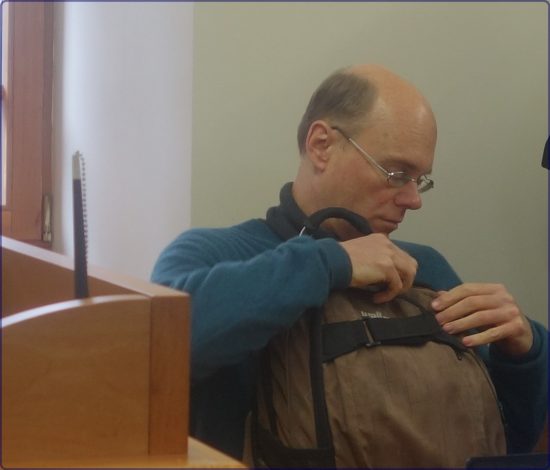
Dr. Andrius Kulikauskas, moments before his historic address before the Vilnius court on state-funded Genocide Center’s policy of glorifying Holocaust collaborators. The center’s “decisions” are cited by high officials as “justification” for street names, university hall plaques and other public-space state-funded glorifications of Holocaust collaborators. Around 96% of Lithuanian Jewry was massacred in the Holocaust.
◊

◊
On February 14, BBC World Service Outlook presented a 23 minute conversation with Silvia Foti and Grant Gochin about Lithuanian Holocaust perpetrator Jonas Noreika. Silvia Foti, born in Chicago, is the granddaughter of Noreika, and Grant Gochin, born in South Africa, and resident in California, is related to a hundred of his victims in the Šiauliai region. The radio show, “The truth about my ‘hero’ grandfather”, reached about 75 million listeners, a well-informed 1% of humanity.
Global interest is growing as Lithuania’s Genocide Center chooses to defend in court its refusal to reconsider its estimation of Jonas Noreika. In a similar spirit, on February 5, the State Security Department together with the Defense Ministry’s Intelligence and Counterintelligence Department warned in their 2019 National Threat Assessment Report to the Seimas: “Russian officials and subordinate propagandists seek to shape the attitude that only Nazi collaborators and Holocaust-complicit criminals supported the resistance against the Soviet occupation. To compromise the Lithuanian resistance the Kremlin cynically manipulates the Holocaust tragedy to achieve the goals of its history policy.”
See also: Defending History’s take. Evaldas Balčiūnas’s series of articles which brought this issue to the English speaking world starting in 2012. Prof. Pinchos Fridberg’s position that the Noreika issue cannot be about one single plaque in the sea of national glorification. DH’s section on Collaborators Glorified. Illustrations of a number of street names and state plaques that glorify alleged Holocaust collaborators. 2012 reburial with full honors of the 1941 Holocaust collaborator prime minister. More. DH Editor’s academic papers on the wider historical and intellectual background.
◊
VILNIUS—The international uproar over Poland’s 2018 law criminalizing certain opinions about World War II and the Holocaust has led to coverage in mainstream mass media internationally (our own take). What seems to have been largely lost is that other East European countries have for many years been passing laws criminalizing opinions on these matters, laws that are arguably much worse, because they go beyond state anger at stereotyping or historic accusation to criminalizing opposition to a false narrative of history, specifically the Double Genocide model espoused by the nationalist establishment in much of Eastern Europe, particularly the Baltics and Ukraine. Such laws have been passed in Hungary (2010, maxing out at three years potential imprisonment), Lithuania (2010, two years), Latvia (2014, five years max) and Ukraine (2015, ten years). Then there was Estonia’s particularly curious “Valentine Day’s Law” of 2012. It could well be, that the parliamentarians who came up with the idea in Lithuania long before passage were the most honest about the motives. They made it clear that “in the Lithuanian legal system, acts regarding the crimes of Soviet genocide, i.e., their denial or justification, are not criminalized, and, experts say, this is an obstacle in attempting to equate the crimes of Soviet genocide with the Nazi genocide.”
JUMP TO 2018
◊
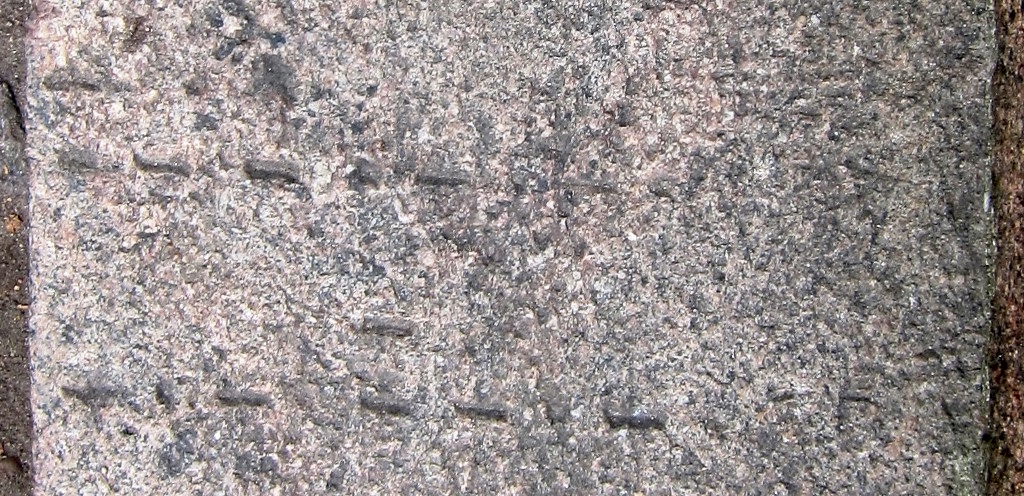
One of the stones with visible Jewish lettering stepped on for decades during its stint as a step at the front entrance of the Reformed Evangelical Church on central Vilnius’s Pylimo Street. Photo: DefendingHistory.com.
VILNIUS—More than five years after Defending History’s September 2013 article (“Where You Have to Step on Old Jewish Gravestones to go to Church”), almost four years after Julius Norwilla’s May 2015 impassioned plea (“A Protestant Pastor in Vilnius Speaks Out About Church Steps Still Made of Pilfered Jewish Gravestones”), and almost five since Genrich Agranovski’s 2014 survey (“The Stones Tell Me. After All, They Lived Here”) of Jewish gravestones pilfered for public space in Vilnius, the steps were finally removed last week in the face of mounting international pressure.
See Defending History reports over the years on the Jewish gravestones at the Reformed Evangelical Church in Vilnius