O P I N I O N
◊
VILNIUS–Genocide Center historian Dr. Arūnas Bubnys has posted on Facebook the following comment about this journal’s editor.
Back in 1989 I had become a minister in our Reformed Evangelical Church here in Vilnius. The end of the 1980s in Lithuania had been a particularly pivotal period for church-state relations. The government changed its policy radically. There was a liberalization of religious activities and along with religious revivals came the idea of restitution of church properties that had been nationalized under the communist policies of the Soviet state. In order to bring to realization that idea, and to speed the process of restitution, we as reformed protestants organized a number of open air meetings and worship services on the street in front of historical church buildings in Vilnius and Kaunas, Lithuania’s two major cities.
◊
Vilijampolė — a part of Kaunas — wintertime. The project is “Being a Jew.” A group of thirty teachers led by a Jewish guide is standing in the former Kaunas ghetto. Houses, garages, storage spaces, wood piles where during the war thousands of Jews, herded here like animals by the Nazis, milled about, yards where Jewish children played, and were later taken to the square or to one of the Kaunas forts and shot. The houses and storage buildings have been rebuilt, renovated, replaced, and there are Kaunas residents living in them now who don’t know where they live and what happened here before they were here. And how could they know? There is no written notice, nothing preserved, only a stone next to the entrance. And a building is being renovated which was the store whose display window once featured the head cut off of the rabbi who lived here.
VILNIUS—Defending History has still had no reply to its open letter of August 2013 to the Minister of the Economy, asking him to look into multiple media reports that the pseudonymous “Zeppelinus,” Lithuania’s best-known purveyor of hate-popart on the internet is indeed a senior civil servant in his own ministry. The issue came to the fore once again in recent weeks with his “appeal” to the head of the Jewish community, and his latest production following a recent controversial conference (conference report).
The following are samples of his “art” in the service of racism, misogyny, homophobia, antisemitism alongside glorification of Nazism. Samples can readily be found for other prejudices, including anti-Polish and anti-Russian hate. Hopefully human rights organizations will continue to counter such materials, first and foremost by establishing, in partnership with law enforcement, the identity of the purveyor of the hate materials, and the answer to the question about alleged continued high employment in a government ministry. An earlier smaller sampling with full translation is available here. Full disclosure: This journal’s editor has on occasion been a target of Mr. Zeppelinus, too.
◊

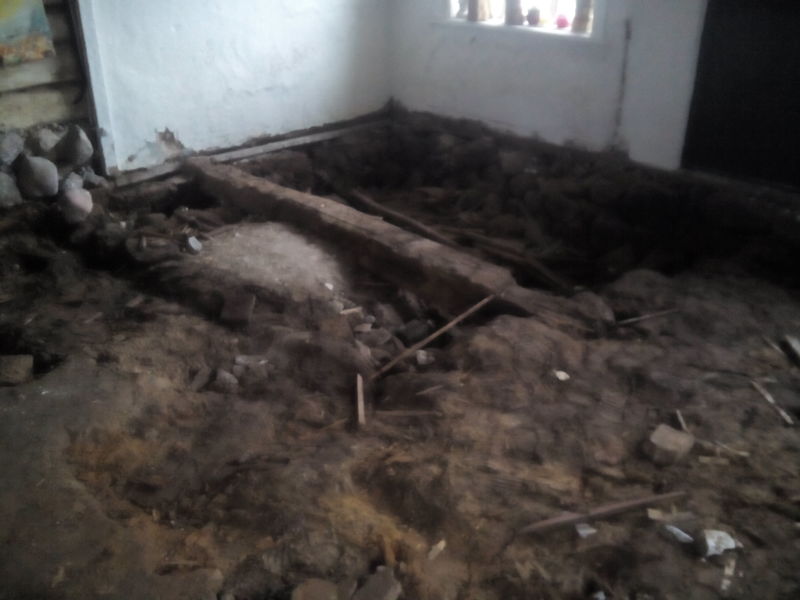
Renovation of the ground floor of an art gallery in the town of Butrimonys, Lithuania has revealed the existence of an unusual cellar that was apparently a Jewish hideout during the Holocaust. Daina Nemeikštienė, the owner of the gallery, “Dainos galerija”, is moving forward with the renovation, which means that what remains of the cellar will be cemented over, at least for now. Could some day this hideout offer an opportunity for respecting, valuing, studying, preserving and highlighting Litvak and Lithuanian heritage? For now, it illustrates the challenges in honoring even the most heroic aspects of the Holocaust.
—————
G
ood afternoon to everybody. I’m very happy to be given the opportunity to address this conference, even if it has to be by film. Unfortunately I could not be present personally, but because of the importance of the topic and the rare opportunity that this is to discuss these issues in a very serious way, I am addressing you through this film.
◊
VILNIUS—Yiddish comedy is alive and kicking. Here’s the plot for the new play. The World Jewish Congress gets millions from a Kyrgyz-Kazachstani donor with Lithuanian connections to set up the International Yiddish Center in Vilnius that will save the Yiddish language, a high priority for both the Kyrgyz and Kazachstani peoples. There are just a few strings attached from Lithuanian government-related units and commissions about who may not have a Yiddish teaching job there (for example those who oppose Holocaust Denial or have stood up for Yiddish speaking survivors accused by Lithuanian authorities of war crimes). The new International Yiddish Center is offered an opportunity one day to raise its profile bigtime by being showcased in the Lithuanian Parliament. Who could refuse that? There may even be some medals to go around. But what is it they have to pull off to get there?
◊
VILNIUS—Ronaldas Račinskas, executive director of the Lithuanian-government financed “International Commission for the Evaluation of the Crimes of the Nazi and Soviet Occupation Regimes in Lithuania,” widely known for brevity as the “Red-Brown Commission,” has revealed — on camera, to the producers of the documentary film Liza Ruft — his thoughts about the “war crimes investigation” into Fania Brantsovsky. The video clip of his statement was released today on Youtube.
◊
Good afternoon. Sincerest thanks to everyone who made today possible, above all to dear Rūta Vanagaitė for successfully bringing together folks from many sides of today’s issues here in Vilnius for the first time in the twenty-first century, in the fine spirit of openness and tolerance that is particularly important, now, when politics and current events can easily deflate freedom of opinion on history, the progress of civil discourse, and the dignity of education.
◊
VILNIUS—Waves of shock laced with the “actual” human rights community’s usual black humor undulated through the different struggling branches of that community this week as the Council of Europe announced the appointment of one of the most multiply-titled intellectuals of modern Lithuania (or Europe), Prof. Dr. S. Liekis, as a new member of the Commission Against Racism and Intolerance (CARI). Professor Liekis is professor at Vilnius University, Romeris University, Vytautas Magnus University, and a crack member of the government’s red-brown commission, formally known by its somewhat Orwellian name, The International Commission for the Evaluation of the Crimes of the Nazi and Soviet Occupation Regimes in Lithuania. The local term “actual human rights” community in Lithuania refers to those who monitor and publicly post on issues, as opposed to those on endless government and EU budgets who are sometimes accused of covering up issues and shirking from anything that is not nationalist PR meant for naive Westerners.
One immediate opportunity presents itself. CARI and the Council of Europe could quickly make clear their view of the Lithuanian government’s decision to allow an SS banner with a swastika to be foisted at the nation’s Parliament (the Seimas) for over an hour on the nation’s hallowed independence day, 11 March 2015. Reports on the day, which funded human rights organizations here generally failed to monitor, in Defending History and on the website of the Jewish Community of Lithuania.◊
This small book, brought out in three separate editions (English, Lithuanian, Russian) by the state-supported Genocide Center, looks more like a brochure than anything else. The cover features the author’s name, in small type, above all else, then a larger Kaunas Ghetto, then a line with the years 1941-1944, against a backdrop of a computerized dark blue sky above a “tasteful” black-and-white picture of Jews lined up in columns inside Kaunas ghetto. The computerized dark blue wraps around the spine to the back cover where some vague lines comprise a hand-drawn map of the streets making up Kaunas ghetto, an ISBN number in white above UPC Bookland barcode featuring the same number again, and then a web address, www.genocid.lt. I found myself staring at the internet address and wondering what language that was supposed to be. Lithuanian is always “genocidas” and “genocid” isn’t possible as any permutation or declension of the noun, and of course English is “genocide.” Perhaps it’s Russian in Latin-letter transcription? But that would contradict the nationalist and ethnic bias of the publisher, the Center for the Study of the Genocide and Resistance of Lithuanian Residents where Arūnas Bubnys is a leading figure. Perhaps “genocid” is someone’s notion of a non-English and yet international form of the word, formed by reducing it from the Lithuanian nominative case ending -as? I checked my favorite search engine, and of course the Lithuanian organization’s webpage came up first, but was soon followed by a wikipedia and wiktionary entry for the Croatian word.
◊
On November 17, 2013 I was invited and participated as a guest speaker at the Yizkor memorial event organized by the “Jewish Survivors of Latvia, Inc.” (New York). The event was held at the Park East Synagogue at 163 East 67th Street in Manhattan.
The really important speech, though, was given by Douglas Davidson, the US Special Envoy for Holocaust Issues. He dealt with the results of his numerous visits to Latvia pertaining to that specific issue: due restitution to the Jewish victims or their heirs. Their properties were stolen or requisitioned during the war and the massacres.
◊
When I wrote several years ago (Lithuanian; English) about the monument erected to Juozas Barzda at Iešnalis Lake, I thought it must have been some sort of misunderstanding.
Reposted from the LGL site with permission
◊
On the 19th of March, 2015, the spring work agenda of the Parliament of the Republic of Lithuania (the Seimas) was approved. First, it contains a long list of initiatives seeking to limit LGBT* rights.
Afunny thing happened on the way to the neo-Nazi march. I saw a man walking towards me, and thought I knew him. Apparently he thought the same thing, and we both said hello in Lithuanian as we passed one another. As I pondered how we might know each other, it came to me: I had seen him at an earlier neo-Nazi march, probably the one in Kaunas a month earlier. He thought I was a fellow marcher, apparently, or at least not an enemy to the cause.
VILNIUS—The Jewish Community of Lithuania today issued a statement concerning yesterday’s far-right march for which state powers again allocated the capital’s most prestigious central boulevard and a march route starting at Gediminas’ Hill and the Cathedral, and passing by the offices of the prime minister and government and concluding at the nation’s parliament.
The text of the statement, which follows earlier statements and discussions, is as follows:
The Lithuanian Jewish Community does not approve of the march by the Union of Lithuanian Nationalist Youth held on March 11, Lithuanian Independence Day, in Vilnius, because we believe the values publicly espoused by the marchers do not correspond to the principles of the modern democratic state which has been the basis for the creation of Lithuania for the last 25 years.
Editor’s note: The following open letter has been translated from the original Yiddish which will appear separately. See also the English version of the statement referred to in the open letter.
For many years now I have been starting the day by reading the latest on the website of the Jewish Community of Lithunia. Today for the first time in a long time I saw a published statement by chairperson Faina Kukliansky which I would happily sign on to. I would like to say: Bravo, Faina Kukliansky!
VILNIUS—On the eve of the planned neo-Nazi march in central Vilnius, slated for 3 PM on March 11th, Lithuania’s independence day, the chairperson of the Jewish Community of Lithuania, Faina Kukliansky, issued a statement on the community’s website, which was followed within minutes by a statement from the Simon Wiesenthal Center’s Director of East European Affairs, Dr. Efraim Zuroff. The full text of both statements follows:
◊
VILNIUS—It seems the best way for Jewish wannabees to score points with the ultranationalist and elite-antisemitic establishment here is to throw well-crafted darts at Defending History. Back in 2011, former clown (and outstanding comedian and talented author) Arkadijus Vinokuras, when he was “official advisor to the government on Jewish affairs” accused the editor of this journal of participation in “Goebbels-worthy” misinformation, without citing a single error of fact. At various points in time, he issued personal attacks against the late head of the Jewish Community of Lithuania, Dr. Shimon Alperovich, and more general attacks on the community per se when its opinions happened to differ from the state’s on this or that issue, though such disagreements are quite a prosaic phenomenon in democratic societies.