DOCUMENTS | THE OLD VILNA JEWISH CEMETERY | OPPOSITION TO CONVENTION CENTER PROJECT | INTERNATIONAL PETITION | CHRISTIAN-JEWISH RELATIONS | CEMETERIES | VILNIUS JEWISH LIFE | HUMAN RIGHTS
◊
◊
◊
VILNIUS—The following statement by Professor Shnayer (Sid) Leiman, appeared today in the respected American weekly Five Towns Jewish Times. It is a reaction to the comments by Lithuania’s top leaders, made after receiving a letter of protest from twelve United States congressmen concerning plans to site a projected new national convention center in the heart of the territory of the Old Vilna Jewish Cemetery at Piramónt (in the Šnipiškės district of modern Vilnius). International opposition to “the convention center in the old Jewish cemetery” continues to mount.
◊
VILNIUS—The following statement by Vilnius native and resident Ruta Bloshtein, an active member of the city’s religious Jewish community, appeared today as an update to her international petition, which has just approached the 40,000 signature mark. Her update was issued as a reaction to the comments by Lithuania’s top leaders, made after receiving a letter of protest from twelve United States congressmen concerning plans to site a projected new national convention center in the heart of the territory of the Old Vilna Jewish Cemetery at Piramónt (in the Šnipiškės district of modern Vilnius). International opposition to “the convention center in the old Jewish cemetery” continues to mount.
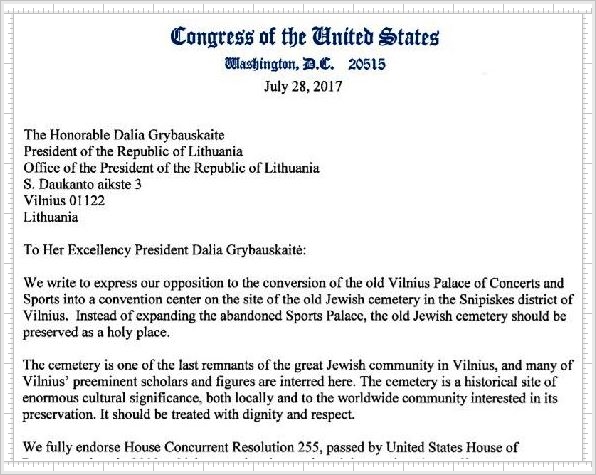
WASHINGTON—A resolute letter (facsimile below; as PDF) signed by twelve United States congressmen to the president of Lithuania, Dalia Grybauskaitė, was released here today. Dated 28 July 2017, the letter expresses American “opposition to the conversion of the old Vilnius Palace of Concerts and Sports into a convention center on the site of the old Jewish cemetery.” It asserts that “the very presence of the existing structure in the middle of the old Jewish cemetery desecrates it and conflicts with the respect for human dignity that forms the basis of Western Civilization. By contrast, moving the convention center project to another site, and permitting the dismantling of the abandoned Sports Palace it was to replace, would affirm the Lithuanian government’s commitment to basic human rights.”
◊
VILNIUS—Following his recent release of a Lithuanian-language poster calling for restoration of the Old Vilna Jewish Cemetery at Piramónt, Julius Norwilla (Norvila) today released the English-language version, which follows. Readers are invited to print out copies of the poster to help in the campaign (as PDF; as image). [UPDATE: A Yiddish version of the poster was subsequently published.]
◊
VILNIUS—For the first time in the history of modern Lithuania, a non-Jewish campaign initiative for a Jewish cause has seen its poster flood the streets of this city’s storied Old Town at the height of the summer tourist season. Conceived and produced by Julius Norwilla (Norvila), a former Protestant minister, using a quote from Dr. Andrius Kulikauskas, a Catholic philosopher, and based on an artistic visualization of a young Vilnius artist who supports the campaign, the poster is entitled “Vilnius Without its Ugliest Soviet Eyesore”. That is a reference to the hated ruin of the Soviet Sports Palace which stands in the middle of the old Vilna cemetery, where the city’s Jewish residents were buried in graves paid for by their families as freehold property, from the 15th to the 19th century. The poster makes reference to Vilnius native Ruta Bloshtein’s international petition, which is, at 40,000 signatures to date, arguably the largest Litvak initiative since the Holocaust. Members of Lithuania’s Jewish community who have spoken out to date include Moyshe Bairak, Ruta Bloshtein, Milan Chersonski, Pinchos Fridberg, Dovid Katz, and Josif Parasonis (more here). Current and recent rabbis in Vilnius who have taken a public stand include Chaim Burshtein, Shmuel Jacob Feffer, Kalev Krelin, and Sholom Ber Krinsky.
◊
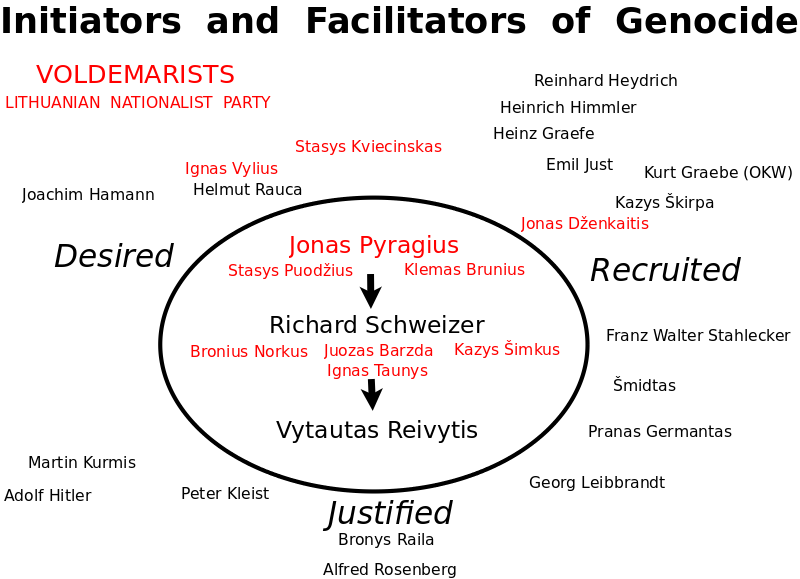
Dr. Andrius Kulikauskas of Vilnius Gediminas Technical University is scheduled to speak at the XIII Philosophers’ Rally on “Determining Personal Responsibility for a Social Calamity: The Origins of the Holocaust in Lithuania”. The event is Poland’s annual philosophy conference and will take place on 6-8 July at the University of Wrocław, at the Faculty of Law, Administration and Economics (LAE), Building D. He will speak on Saturday, 8 July, 12:30−13:00, in Lecture Hall 2D, which is the main hall. The LAE faculty is especially interested in how philosophy addresses challenges from the contemporary sociopolitical world. Dr. Kulikauskas’s talk will be based on his findings, which have appeared in English in Defending History: “How Did Lithuanians Wrong Litvaks?” and, in particular, his analysis of champions and facilitators of the Holocaust in Lithuania. His abstract for the upcoming Wrocław conference follows his analytic chart below.
On June 23, 2017, the Lithuanian Freedom Fighters Association (Lietuvos laisvės kovotojų sąjunga) organized a commemoration of the June 23, 1941 anti-Soviet uprising with a complete lack of sensitivity for Lithuanian victims of the Holocaust.
The official celebration at the Parliament’s Independence Square included an elaborately choreographed flag raising by the Lithuanian Army’s Honor Guard, music by the Armed Forces Orchestra, a reenactment of the Declaration of Independence with its hopes for a place for Lithuania in Hitler’s New Europe, and a speech by Vytautas Landsbergis, patriarch of modern-day Lithuania.
More by Andrius Kulikauskas. Articles by Evaldas Balčiūnas; Milan Chersonski; Leonidas Donskis; Nida Vasiliauskaitė. See also:
DH section on The Legacy of 23 June 1941. DH pages on: LAF intentions; painful street names; dry-clean of the week of 23 June 1941.
◊
A Vilnius street named for 23 June 1941, and once again: events to honor the shameful day in Lithuanian history, when, guided by the LAF and its provisional government, political, moral and religious leaders turned on their Jewish neighbors in a hate campaign that was to end with the highest rate of Holocaust murder in Europe. More here. More on this and other offensive street names and public shrines. And — How are members of the tiny surviving Jewish minority in Lithuania supposed to feel about this? Holocaust survivors and their families and descendants internationally?
INTERNATIONAL PETITION. See also DH articles by Andrius Kulikauskas, Evaldas Balčiūnas, Milan Chersonski, Leonidas Donskis, Nida Vasiliauskaitė. Also: DH section on The Legacy of 23 June 1941. DH pages on: LAF intentions; painful street names; dry-clean of the week of 23 June 1941.
◊
A new section has been added today to Defending History’s existing repertoire, one dedicated to the legacy of 23 June 1941, which for the Jews of Lithuania and other countries represents the onset of the Holocaust east of the 1939 Molotov-Ribbentrop line, a day after the launch of Hitler’s Operation Barbarossa, his attack on the then Soviet Union. On this day in a number of countries, including Lithuania, Latvia and (western) Ukraine, local “freedom fighters” began to molest, humiliate and butcher innocent Jewish neighbors before the arrival of the first German forces. Nothing can be more painful in the 21st century than pro-Western governments, elites, institutions and societal leaders glorifying the day as one of alleged uprising against the Soviet Union. For one thing, it is falsification of history: the Soviet forces were fleeing Hitler’s invasion, the largest in human history, not the local Jew-killers. For another, the current glorification of the Holocaust’s first local perpetrators is an affront to civilized society, human rights and basic decency. The new section is The Legacy of 23 June.
Historically, it is important to note that the mischaracterization of the onset of the Holocaust in a number of East European countries as a “rebellion against the Soviets” is worse than mistaken, it is a distortion in the interests of ultranationalist, far-right rewriting of history. These “rebels” did not fire a shot when the Soviets were in control. You cannot rebel against an army that is fleeing an external invasion. The Soviets were fleeing Hitler’s Operation Barbarossa, the largest invasion in human history, not the LAF Jew-killers. . .
VILNIUS—Lithuania’s top neo-Nazi blogger “Zeppelinus” has republished with some noticeable relish, in a post dated 27 May 2017, parts of the 19 May official “Lithuanian Jewish Community website” attack (as PDF) on this journal’s editor, Dovid Katz. The attack was, some would say shamefully, signed “LJC staff” though sources rapidly revealed its prime author (see our rapid response on the day). It is not the first time that the antisemitic far-right has found its material on the website of the official Jewish Community under its current leadership (that is under legal challenge after the recent allegedly rigged election), at a time when the website is, disturbingly, allegedly under control of elements very far from the interests of Lithuania’s Jews. Last autumn’s website attacks on Rabbi Sholom-Ber Krinsky were picked up and elaborated by another key antisemitic blogger who went so far as to dig up the 1790s antisemitic attacks on a prime founder of Lithuanian Hasidism.
You know something is wrong when the neo-Nazis are finding their material on the “website of an official Jewish community”. It’s a website funded in fact by the state via restitution funds deriving from the communal religious properties of the annihilated Jewish communities of Lithuania, administered by a (this one’s for you, George Orwell) “Good Will Foundation”.
Then there was the most recent fiasco, a comparison of the democratic electoral congress of the Vilnius Jewish Community on 24 May to Russia’s “Zapad 2017” military exercises, and the charge that the assembled 300 or so Vilnius Jews were “mainly Russian speakers calling themselves Jews, with only a minority of people with Litvak blood” (see our report which led to JTA’s coverage, and the essays by Professor Pinchos Fridberg and by Leonas Kaplanas). This was a proverbial gift of the gods to the local antisemitic establishment here that revels in delegitimizing the country’s living Jews while embracing a de-Judaized ersatz “Litvak heritage” for PR, with some help from a tiny elite of privileged “court Jews” who themselves at times, it seems, become conduits for antisemitic invective against the local Jewish community. Prof. Fridberg has pointed out that a subsequent vague and unclear “apology” posted failed to disclose the author(s) of the offending text, and never even appeared in the Russian-language section of the website. Is the author of the offending text still employed by the official “Lithuanian Jewish (Litvak) Community”? Why is his or her identity a secret?
◊
VILNIUS—In recent weeks, Lithuania’s Jewish community has been shaken by a number of vicious attacks against various of its members, apparently written by operatives out to provoke “senseless interethnic strife and division” who have infiltrated to echelons of the official community’s power structures, and published personal invective replete with “demonstrable falsehoods” under the imprimatur not of any named author but of the “Lithuanian Jewish Community” per se (examples here, here, and here). Against that backdrop many Jews and Lithuanians alike, who enjoy some of the best daily relations of any two groups in Eastern Europe, have been finding it necessary to stress that Lithuanian-Jewish relations are excellent and will not be disturbed by such mischief makers (see also today’s JTA report, and a 2015 paper by this journal’s editor). The ongoing passionate debates about the Holocaust, “Double Genocide”, defamation of Jewish partisans, glorification of local Nazi collaborators, city-center neo-Nazi marches on independence days, plans to have a new national convention center in the heart of the old Jewish cemetery, and the fair allocation of restitution funds, are not disputes between “Jews and Lithuanians”: there are, at least locally, proponents from both groups on all sides of each of these debates and various others.
Julius Norwilla’s speech at the Lithuanian Embassy in Tel Aviv: in English, in Lithuanian
VILNIUS—Over 300 members of the Vilnius Jewish Community (VJC), representing all adult age groups, and constituting the numerically largest such conference this century, this evening elected a new VJC chairman at the Karolina Hotel in Vilnius. Professionally organized, members with voting rights had to present their membership cards and separate ID at conference tables organized by initial letters of surnames. The proceedings, started with a few sentences of Yiddish by Simon Gurevich (Simonas Gurevicius), were meticulously conducted bilingually, with all proceedings in both Lithuanian (first) and (then) Russian in an atmosphere of democratic catharsis of an East European Jewish community, many of whose members have felt sidelined by the interests of a handful of elites close to government circles in recent years. The assembly included virtually all of the known personalities of Vilnius Jewry who do not happen to have employment at Pylimo Street 4, the official community’s headquarters (but there were a few of those too, as well as some from the official synagogue minyan).
ORIGINAL POST ON WEBSITE OF STATE-SPONSORED “JEWISH COMMUNITY”
After the election of the new chairperson came elections for twenty-one members of the Vilnius Board. Also, a resolution was adopted cancelling the recent attempt to disenfranchise some two thousand Vilnius Jews by recounting their votes as a single vote (while the heads of various NGOs, including the not-yet-built Sheduva Lost Shtetl Museum, have two or more votes each).
◊
The Simon Wiesenthal Center issued the following statement on 18 May, bringing it into full de facto support of Ruta Bloshtein’s petition which now approaches 40,000 signatures from around the world.
LOS ANGELES AND JERUSALEM—The leaders of the Simon Wiesenthal Center have appealed to Lithuanian President Dalia Grybauskaite to change the current plans of the government to build a convention center on the grounds of the ancient Jewish cemetery at Piramónt in the heart of the Lithuanian capital.
◊
VILNIUS—Coming hard on the heels of the mid-campaign rule-change of 19 April that effectively disenfranchised over 2,000 Vilnius Jews, by “recounting” their collective vote as one vote instead of over 20 (via the long-established formula of 100 persons = one vote), the chairperson of the Lithuanian Jewish Community, eminent attorney Faina Kukliansky, on 4 May placed an announcement on the Lithuanian-language page of the official community website (followed by the Russian section), Lzb.lt, cancelling the widely announced 24 May 2017 conference of the Vilnius Jewish Community decided upon by a clear majority vote of its Council (15 of 21 active members), for which the large hall of Hotel Karolina had already been booked. This was followed on 5 May by an English language version complete with “Red-Ink Warnings from the Leader” which seems to inaccurately report that the planned 24 May conference was an “arbitrary” act of “one” Council of the Vilnius Jewish Community member, presumably referring to her opponent in the race, Simonas Gurevičius.
UPDATES TO 12 MAY 2017:
8 May 2017: Vilnius Jewish Community board member Simon Ceitlin posts a notice on his Facebook page confirming that the 24 May event at Hotel Karolina will proceed as announced.
10 May 2017: Simonas Gurevičius posts refutation of official Community website notice and confirms that the 24 May meeting, decided by all present at the most recent Vilnius Jewish Community board meeting, will proceed.
12 May 2017: Faina Kukliansky reposts announcement on community website assuring readers that the meeting will not occur.
◊
I am studying How do people behave? How should they behave? and as part of that, How do issues come to matter? or no longer matter? Today I will share what I am learning about the theoretical power of our imagination to produce and resolve a real life controversy.
◊
VILNIUS—Interviews by several Defending History staffers with several dozen members of Vilnius’s Jewish community over the past several days have turned up what seems to be a widespread sense of (citing terms that recurred frequently in the conversations) “disappointment” or “shock” at the “unbelievable changing of the rules of an election in the middle of the campaign.” (Such mini-surveys are not scientific, and a professional survey of today’s Jewish community on a number of issues is a critical desideratum here.)
The change seems to be in the cause of in effect disenfranchising the actual living Jews of Lithuania by suddenly decoupling the numbers of living, resident Jews from votes cast for the leadership of the Lithuanian Jewish Community, for which elections are scheduled, as of today, for May 28th (for recent developments see the DH section on Vilnius Jewish Life). A number of those interviewed mentioned the role of the “Good Will Foundation” that allocates funding for the community’s administration, including elections, from the government finance provided as restitution for prewar communal religious Jewish property. Some of its allocations have been highly controversial.
VILNIUS—Two regular Sunday worshipers at the grand old church in Molėtai, a town of some 6,000 inhabitants in northeastern Lithuania, reported to the Defending History team in Vilnius earlier this week that their priest, Father Kęstutis Kazlauskas, has publicly announced that the church is organizing the production of a bas-relief to be commissioned from “a major Lithuanian artist” (?!) and erected within the sacred premises, to honor alleged Holocaust perpetrator Jonas Žvinys. Outside the two church goers, Defending History has been unable to obtain further corroboration of what would be a shocking development, and a very negative one for modern Lithuania, in a town where 100% of the Jewish residents were murdered in 1941 by the Nazis, with the majority of the actual killing, and its on-site organization, carried out by local nationalist elements.
What should be done with the Old Vilna Jewish Cemetery (Piramónt, in the Šnipiškės district of modern Vilnius)? It should be restored. For this to happen, the Soviet ruin in its center should be taken down to ground level, with no further earthworks in the cemetery, ever. Let it forever remain a testimonial to the vibrancy of Jewish life in Vilna.
THIS ARTICLE IN LITHUANIAN TRANSLATION
Two of Vilna’s greatest photographers and artists, Juozapas Kamarauskas (d. 1946) and Jan Bulhak (d. 1950) were mesmerized by Vilna’s Jewish sites, and especially by the Old Jewish Cemetery. They left us with an abundance of photographs and sketches of the Old Jewish Cemetery. Jewish scholars of the 19th and 20th centuries, residents of Vilna, recorded and published for posterity meticulous transcriptions of the texts of hundreds of epitaphs inscribed on the tombstones of the Old Jewish Cemetery.