Tag Archives: Holocaust in Lithuania
Exposé in Lithuania
In Obeliai (Abél) and Rokiškis (Rákishok): More State-Sponsored Glorification of Nazi Collaborators
O P I N I O N
by Geoff Vasil
Years ago, when I first started doubting the veracity of certain propaganda intended to diminish the culpability of local forces in the Holocaust, I interviewed an elderly woman who was an eye-witness to what happened in late June of 1941 in Rokiškis (in Yiddish: Rákishok) in northern (or northeastern) Lithuania.

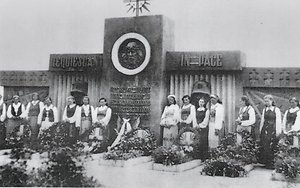
Obeliai (Abel) 1942: Is curiosity or concern sparked by this “celebration of 1941 partisans” coming from the apex of Nazi rule in Lithuania (1942, when the local Jews were already all murdered)? It seems not. This photo is of the 1942 Nazi-era memorial torn down by the Soviets, and just replaced by a new one, commemorating the same pro-Nazi “partisans” …
She told me how a bunch of young men turned savage, rounded up Jewish men, stuck them in what amounted to a pig sty surrounded by barbed wire in the center of town, and then tortured and humiliated them until they murdered them. She said this gang of savages went by the name of Savisaugos batalionas, which is Lithuanian for self-defense battalion. Were they led by Germans? No, she said, there hadn’t been a single German to be seen.
Charles Adès Fishman Adds Voice, on Yom Hashoah, to Sutzkever Prize Fracas
O P I N I O N
by Charles Adès Fishman
Dear Ed,
I could hardly believe it when I was told that you were participating in the Sutzkever Translation Prize competition as a judge. The Ed Hirsch whose work I’ve read and admired for years—the Ed Hirsch I’ve admired for years—wouldn’t allow himself to be used in a way that will help the Neo-Nazi forces in Lithuania remove the stain of antisemitism from its persecution of individuals who served as Jewish partisans during the Holocaust years.
Peter Thabit Jones Issues Open Letter on Sutzkever Translation Prize
O P I N I O N
by Peter Thabit Jones
Dear Mr. Hirsch
As a fellow poet and human being, I implore you to withdraw as a judge in a competition that will be part of a series of events misrepresenting things, in effect for the benefit of certain elements in the Lithuanian government. Alternatively, as suggested by colleagues, a simple requirement that each of the wrongfully defamed Jewish Holocaust Survivors who joined the anti-Nazi resistance be issued a full and public apology would bring the matter to a rapid close.
Vilnius Street Name Proposed for Rescuer Out in Boondocks; But Please Remove Nazi Collaborators from City Center!
O P I N I O N
The Defending History community welcomes today’s news that a street (and/or square) in the Verkiai district, Vilnius’s northernmost neighborhood (and popularly considered to be just north of the city), may be named for Ona Šimaitė, the enormously courageous librarian who defied the Nazis and their local collaborators by risking her life to save Jewish citizens of the country. But this is a confusing signal that can easily be construed to send the wrong message. Her street deserves to be right in the city center! Šimaitė’s life has recently come to new and deserved attention thanks to Julia Sukys’s important recent book, Epistolophilia: Writing the Life of Ona Simaite.
RELATED:
MORE STREETS, PLAQUES AND MONUMENTS HONORING HOLOCAUST COLLABORATORS
MUSEUM THAT HONORS PERPETRATORS
“PEACE PARK” THAT HONORS PERPETRATORS
INTERNATIONAL PETITION
Tolerance Education? State-Sponsored Commission Uses its Website to Call Holocaust Survivor a “Liar” & to Demand “Apology from Jewish Community”
O P I N I O N
by Dovid Katz

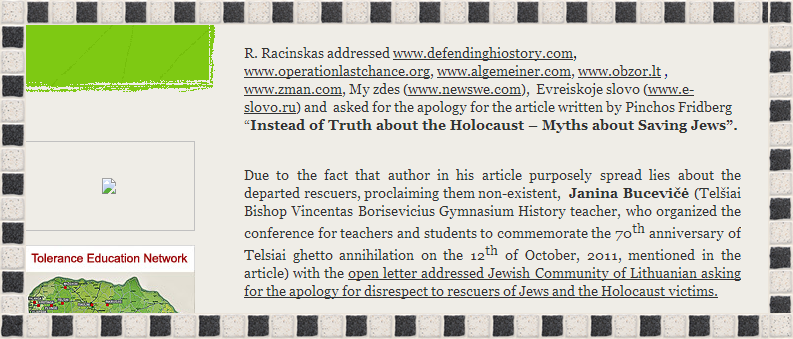
Somebody’s idea of “tolerance education”? Extract from the official website of the “International Commission for the Evaluation of the Crimes of the Nazi and Soviet Occupation Regimes in Lithuania” (known for short as the “red-brown commission”)
Educators, diplomats, historians and journalists thought they had seen it all when it came to Holocaust-in-Lithuania issues in recent times. But an online attack by the state sponsored “history commission” on a local Holocaust survivor, Professor Pinchos Fridberg, who is deeply involved in honoring righteous Lithuanians who saved a Jewish neighbor, because he expressed his views against distortion of the Holocaust? That is a bit much even for here.
UPDATE of 21 February 2014:
One year later: Defamation continues on Commission website;
See Chronology of a Debate and what Pinchos Fridberg actually said…
Professor Fridberg’s Question about Mr. Zingeris to Dr. Alperovich, and Dr. Alperovich’s Reply…
Vilnius native and life-long resident Professor Pinchos Fridberg sent the following question to the leadership of the Jewish Community of Lithuania (JCL), and received the following answer. These official English translations, accepted by JCL, are reprinted verbatim, with permission from the website of the Jewish Community of Lithuania, where the question appears here and the reply here.
US Researcher is Persuaded that the Problem in Lithuania is called “Zuroff and Katz”
O P I N I O N
by Dovid Katz
The blog Christine Beresniova and Rokas Beresniovas recently published the article “A lamentable absence of sexy scandals.” We will refrain from comment on their understanding of the concept “sexy scandals” and stick to the work of fellow human rights advocates, which entails standing up to powerful establishments on behalf of minorities, victims of prejudice, and in the case of Eastern Europe, the victims (and handful of survivors) of genocide. Those who stand up know all too well that to do so is not all that often convenient, easygoing or self-serving.
Instead of Truth about the Holocaust – Myths about Saving Jews
O P I N I O N
by Pinchos Fridberg
Editor’s note [updated 27 January 2013]:
Pinchos Fridberg, a native and resident of Vilnius, is a Holocaust survivor. He graduated from Vilnius University in 1961 and completed his PhD in theoretical and mathematical physics in 1965 and an additional doctoral science degree in radio physics in 1974. From 1961 to 1978 he was chair of the Laboratory of Theoretical Investigations at the Vilnius Scientific Institute of Radio Measuring Devices. In 1978 he joined Grodno State University, where he was named professor. In 1989 he became head of the Department of Theoretical Radio Physics at the Zondas Company in Vilnius.
Shock of 2012: 1941 Nazi Puppet Prime Minister Reburied with Full Honors
Compiled by Dovid Katz
◊
EU/NATO Ally Honors Holocaust Collaborator; Lithuanian Jewish Community Issues Protest; 3 US Congressmen Write to Prime Minister
Remains of 1941 fascist leader Juozas Ambrazevičius (Brazaitis) met by honor guard at Vilnius Airport on 17 May 2012 and reburied in Kaunas’s Church of the Resurrection on the 20th, as city’s mayor dismisses criticism.
Office of the prime minister, who signed off on government funding (€8,700 / US $11,000), defends reburial & honors of the 1941 Nazi puppet “prime minister” who personally signed the protocols confirming Nazi orders for (1) “all means” against Jews (but avoiding executions in public); (2) setting up a concentration camp for Lithuanian Jews [euphemism for the carnage underway at the Seventh Fort]; (3) all Kaunas Jews to be herded into a ghetto within 4 weeks (English here).
SEE ALSO:
Collaborators Glorified section
Previous sanitization program
UCL Hebrew-Jewish Studies Dept Rejects Request for Five Minutes for Holocaust Survivor to Read Petition at Lithuanian Gov. Sponsored Conference
London observers were wondering whether the medal Professor Antony Polonsky received earlier this year from the president of Lithuania for his PR work for the Lithuanian government may have something to do with his denial of Monica Lowenberg’s request, asking for five minutes for her father, a Holocaust survivor, to read out at next week’s conference her petition to the Lithuanian government, proposing constructive solutions to the issues at hand. The petition has to date garnered over 250 signatories from two dozen countries. The following is the correspondence, which started with Ms. Lowenberg’s appeal to Professor Ada Rapoport-Albert and Dr. Francois Guesnet. Dr. Guesnet, the Corob Reader in Jewish History at UCL is one of the conference coordinators on behalf of the Lithuanian government funded institutions financing the conference. Holocaust survivors consulted cannot understand why safe and secure academics who hold high posts at Western institutions should so fear “even to give five minutes for somebody else to come and disagree” with the conference’s pay-masters in the freedom of the British capital.
Landsbergis’s New Book Tries (Yet Again) to Sanitize the 1941 Hitlerist “Provisional Government” of Lithuania
B O O K S
by Geoff Vasil
Vytautas Landsbergis, Rezistencijos pradžia [“The Beginning of the Resistance: June 1941: Documents on the Six-Week Provisional Government of Lithuania”], Vilnius 2012.
MEP Vytautas Landsbergis, former speaker of the Lithuanian parliament and leader of the Lithuanian independence movement in the late ‘80s and early ‘90s, unveiled his latest polemic at a ceremony cum press conference held on the first floor of the Signatarų Namai building in Vilnius’s Old Town on September 11, 2012, the historic site where Lithuanian independence was proclaimed from the balcony to the street below sometime around February 16, 1918.
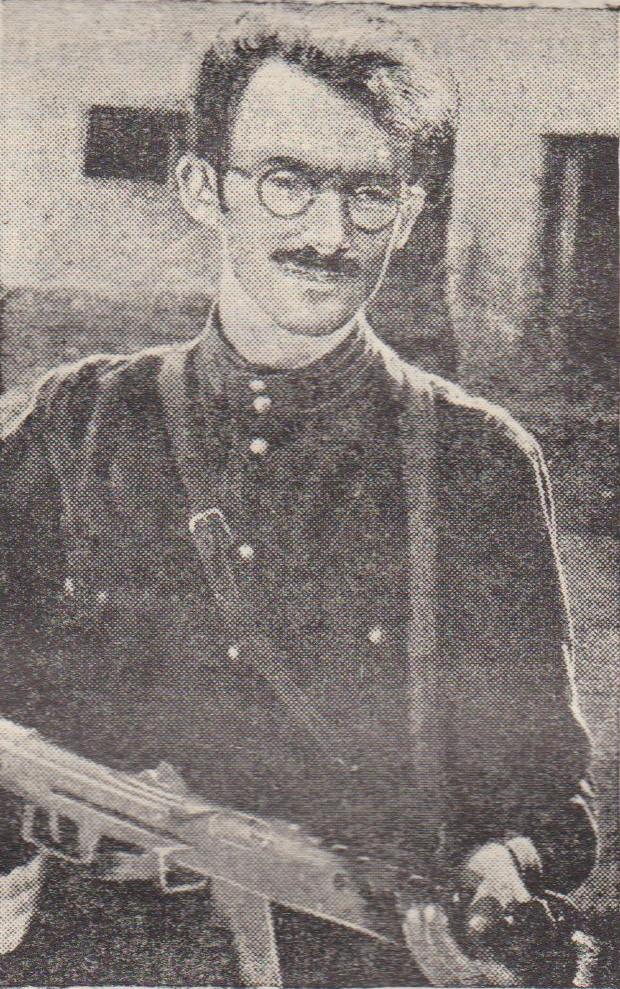
This small book—there’s only 22 pages written by Landsbergis, the rest is a motley collection of supposedly historic documents—is an attempt to answer criticism of the Lithuanian Government and Catholic Church’s ceremonial reburial of Lithuanian Nazi puppet prime minister Ambrazevičius-Brazaitis and other concurrent celebrations in the spring of 2012.
An Open Letter to Ed Hirsch
O P I N I O N
Dear Mr. Hirsch,
Congratulations on your selection as judge of the new literary translation contest named for the eminent late Yiddish poet Avrom (Abraham) Sutzkever (1913-2010). News of the contest was today disseminated far and wide (information affixed below, for readers’ rapid reference, and to help inspire more entries in your competition).

Will prosecutors (and the writers’ union) in Vilnius be told about Avrom Sutzkever’s days with the Soviet partisans?
You may know that in addition to being a major twentieth century Yiddish poet and editor, Sutzkever survived the Holocaust by escaping the Vilna Ghetto to join the anti-Nazi Jewish partisans. You may or may not know that elderly Lithuanian Jewish Holocaust survivors, who like Sutzkever escaped certain death by joining the partisans, but who are still alive and relatively well, have been defamed as “war criminals” by the same Lithuanian government that recently invested in a Sutzkever plaque in Vilnius, brought over his Israeli family for festivities, and invests in ever more Jewish and Yiddish PR stunts (complete with honors for compliant foreigners) to camouflage a campaign of revisionism.
This is on top of a disturbing toleration of serious antisemitism, including in recent years, state-sanctioned neo-Nazi marches in the heart of the capital city on independence day, the legalization of public swastikas (the UN Human Rights Committee has commented), and inaction regarding front pages of mass circulation newspapers worthy of the 1930s. The most famous examples in recent years are depictions of the Jew and the Gay controlling the world (2009), and, less than a year ago, of one of the city’s resident rabbis.
Monica Lowenberg’s Petition to the Lithuanian Ambassador to the UK, HE Asta Skaisgirytė-Liauškienė
The text of Monica Lowenberg’s petition that appeared today on Change.org. To sign please visit:
Abandon state sponsored Antisemitism and Holocaust Obfuscation
- To:
- HE Ambassador Asta Skaisgirytė-Liauškienė
- Lithuanian Ambassador for London, UK
Yitzhak Arad’s Paper
The Holocaust in Lithuania, and Its Obfuscation, in Lithuanian Sources
by Yitzhak Arad
◊
Editor’s note: Yitzhak Arad explained that Yad Vashem had refused to publish this paper, and that he did not accept the reasons given, believing that in fact politics were at work. The Defending History community is honored to be able to pubish Dr. Arad’s paper.
◊
C O N T E N T S:
Introduction
Lithuanian Nationalism and Antisemitism Prior to the Holocaust
The First Soviet Occupation of Lithuania, 15 June 1940 – 22 June 1941
The Lithuanian Activist Front: Antisemitic Incitement
The German Invasion and the Organization of an “Independent” Lithuanian Government
The Period of Pogroms: Late June to Mid July 1941
The Lithuanian Press at the Time of the Pogroms: A Source of Incitement
The Lithuanian Provisional Government: Anti-Jewish Legislation
Systematic Mass Murder: German Design and Command, Lithuanian Perpetration (late July–November 1941)
Lithuanian Police Battalions and Their Role in the Murder of the Jews
The Lithuanian Catholic Church and the Holocaust
The Rewriting of Holocaust History and the Double Genocide Thesis — “The Jewish Holocaust and the Lithuanian Holocaust”
Anti-Soviet Guerilla Warfare in Lithuania
The Prague Declaration of June 2008 and the European Parliament Resolution of April 2009
Conclusion
Notes
Introduction
In Lithuania, as in other places in Europe conquered by Nazi Germany, a thorough and comprehensive inquiry into the tragic events that occurred compels consideration of three factors:
David Cukier, Alumnus of UCL, Writes to the Provost on Lithuanian Government’s December Conference
O P I N I O N
by David Cukier
David Cukier, a child of two Holocaust Survivors, studied Pharmacology at University College London, 1975-1978, where he also participated in some Jewish and Yiddish studies activities. He has released to Defending History for publication his letter to the president and provost of UCL, Professor Malcolm Grant, expressing concern over the Hebrew and Jewish Studies Department hosting a second Lithuanian government sponsored one-sided Holocaust conference.
In his covering letter to DH.com, Mr. Cukier adds:
Lithuania’s Last Jewish Fort
This page has moved here.
The new URL is:
https://defendinghistory.com/the-last-jewish-fort
Apologies for any inconvenience.
Self-Induced Confusion
B O O K S
by Olga Zabludoff
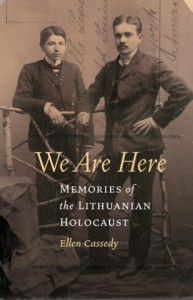
Review of We Are Here: Memories of the Lithuanian Holocaust by Ellen Cassedy. University of Nebraska Press, 2012.
Had this title been billed as a simple memoir of Cassedy’s trip to Lithuania in the summer of 2004, my criticism of her book would be tempered. She had gone to the land of her ancestors to study Yiddish at the Vilnius Yiddish Institute and to connect with her Jewish roots. The professors and mentors she encounters at the Yiddish Institute come alive, as do the various Lithuanians and Jews with whom she connects. Cassedy is a good writer who captures physical details well. But even at that, this reviewer found the memoir to be superficial.
The major problem is that Cassedy’s book is being promoted as the Bible of the Lithuanian Holocaust by advocates for the current Lithuanian government and elite establishment which aspire to paint for the outside world a distorted version of the Holocaust. A version defined in shades of gray and the confusion they generate. A version that incorporates the mythology of equivalency between crimes committed by the Nazi and Soviet occupation regimes.
SEE ALSO THE REVIEWS BY
Dovid Katz in the Algemeiner Journal
Allan Nadler in the Forward
Efraim Zuroff in Haaretz
Tel Aviv’s Leivick House Releases 2009 Video of Ambassador Chen Ivri Apter at Margolis Event

Israel’s Ambassador Chen Ivri Apter presenting Dr. Rachel Margolis with a certificate of merit at Leivick House in Tel Aviv. Dr. Margolis is seen wearing the medals won for her bravery fighting against the Nazis in the forests of Lithuania during the Holocaust. Her entire family perished.
Leivick House, one of Israel’s (and the world’s) last Yiddish-in-Yiddish cultural institutions, has released a video clip of the June 2009 visit to its Dov Hoz Street headquarters in central Tel Aviv by Israel’s then ambassador to Latvia and Lithuania, the late Chen Ivri Apter, at an event to honor Dr. Rachel Margolis. It is posted on YouTube (partial English translation here). The event itself was reported in DefendingHistory and the Leivick House website, among other venues.
Dr. Margolis, due to celebrate her 91st birthday next week, is a Vilna Ghetto survivor and anti-Nazi resistance hero who has been targeted by Lithuanian prosecutors, in effect according to some for “the crime of surviving.” Tributes to Dr. Margolis have come from around the world, including former UK prime minister Gordon Brown in 2011.
Ambassador Ivri Apter died last month at the age of 54 after a long battle with cancer that friends always said he never allowed to cloud his love of life and the day ahead.
His short speech at Leivick House is thought likely to go down in history for its courage and forthrightness at a time when his nation’s foreign policy was noticeably starting to tilt in a contrary direction. The Tel Aviv event was organized jointly by DefendingHistory.com and Leivick House.