


VILNIUS—Chaim Bargman, Jewish guide in Kaunas, asked today in Vilnius that DefendingHistory.com record a statement in Yiddish from him on an incident that occurred on 6 September (video here). Bargman, a beloved guide and genealogist for international Jewish-interest tourists in the Kaunas (Kovno) area for decades, was immortalized in the late Dan Jacobson’s Heshel’s Kingdom (1998). September 6th was the date of this year’s annual commemoration ceremony for the murdered Jews of Ukmergė (Yiddish: Vílkomir) held at the nearby mass grave, where, according to the Lithuanian Holocaust Atlas, between 6,358 and 10,000 Jews from the region were humiliated and murdered. There was massive local collaboration as well as large-scale local participation in the slaughter of one of Lithuania’s most famous Jewish communities over many centuries. Disturbingly, for many, a town square in the heart of Ukmergė has a monument dedicating it to the memory of a notorious Holocaust perpetrator.
Human Rights
Impressions of the Conference on “Antisemitism, Radicalization and Violent Extremism”
H U M A N R I G H T S / E V E N T S / O P I N I O N
by Vilma Fiokla Kiurė
◊
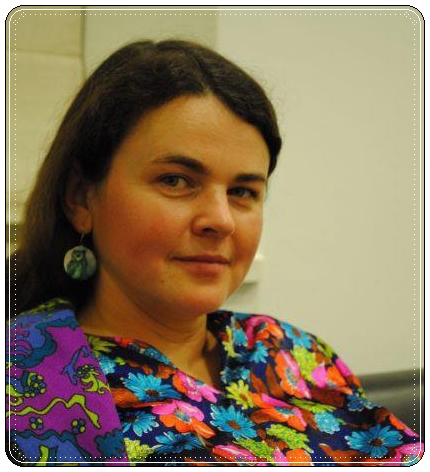
Vilma Fiokla Kiurė
A few days before the international conference on “Antisemitism, Radicalization and Violent Extremism” [DH report here], held at the Novotel on Vilnius’s central boulevard Gedimino on 30 September 2015, a friend’s acquaintance came from the United States to look for her ancestors’ Litvak heritage: the house in which they lived, the street on which they walked.
She said she did not find anything because the relevant archives in Kaunas no longer existed. Instead, she showed us pictures on her iphone of a pavement made out of crushed Jewish gravestones.
Looking at the photo of the continued use of the crushed gravestones, she said “This is very much an instance of antisemitism,” something she repeated more than once during our discussion.
Another “Conference on Antisemitism” in Lithuania
Human Rights / Antisemitism / Opinion
by Defending History Staff
◊
The well-organized conference “Antisemitism, Radicalization and Violent Extremism” was held on 30 September 2015 at Vilnius’s Novotel Hotel by the Human Rights Monitoring Institute (HMRI) with partners (see program). It will go down in history as one of the most remarkable capers yet in the fraught local “Dead Jew Business,” as it is increasingly becoming known. The biggest shock of the day was that one of the three keynote morning session speakers was Swedish-born Lithuania-resident filmmaker Jonas Ohman, known in town for his (far right style) glorification of postwar resistance fighters — one of the most painful issues of Baltic antisemitism in the twenty-first century — without the slightest mention of the alleged Holocaust perpetrator background of the precise figures glorified.
But the film maker chosen for the morning session manages at the same time to also be a (far left style) Israel baiter, whose current “humanitarian project” is a petition asking the mayor of Vilnius to sack a Jewish (Israeli-Lithuanian) advisor on the basis of social media “silly photos” that become bacteriologically antisemitic when recycled in his own petition, and beyond, in its recontextualized, politically charged incarnation. Far from doing the same to counter officials and advisors with neo-Nazi links, he boasted in his talk (amateur video) of his links to Right Sector and other Ukrainian groups that adulate wartime Holocaust perpetrators. When he was trashing Israel, the Israeli ambassador to Lithuania, Amir Maimon, sitting in the hall, boldly called out a question: “Are you rewriting the history?” (at time code 13:31).
On the Eve of the 30 Sept. 2015 “Conference on Antisemitism and Radicalism” in Vilnius
From our front page of 29 September 2015:
◊
Wednesday’s Conference in Vilnius on Antisemitism and Radicalism
Will it confront issues or be another de-facto government PR exercise?
Will the conference discuss neo-Nazi marches allowed to take over the center of Kaunas each February 16th and the center of Vilnius each March 11th? Shrines, plaques and street names that honor Holocaust collaborators? Attacks on Holocaust survivors by state commissions? Defamation of Jewish partisan veterans? Absence of state apologies to defamed Jewish partisan heroes? Prosecutorial persecution of Lithuanian Holocaust truth-tellers and other violations of freedom of speech? Whether neo-Nazi PR master “Zeppelinus” is still a high Economy Ministry official? The 2010 legalization of swastikas? 2010 criminalization of Western views of World War II? 2015 project to build a $25,000,000 convention center in the heart of Vilnius’s old Jewish cemetery? A Protestant pastor spoke out; so did Litvak rabbis from around the world, a Holocaust survivor, and the top expert on the cemetery’s history. But when the chief rabbi of 11 years supported the international consensus, he was fired for his opinion. His views on antisemitism in Lithuania could have enlightened this conference — but he was not invited to speak.
Public Shrines to a Holocaust Collaborator and a “Secret” Petition: A Summer’s Strange Media Circus
O P I N I O N / C O L L A B O R A T O R S G L O R I F I E D
by Evaldas Balčiūnas
◊
In the midst of this past summer’s heatwave here in Lithuania, Delfi.lt, one of the most popular news portals in the land, exploded with discussions on commemorations and memorials for Nazi collaborators in our country. Rimvydas Valatka, a columnist for the portal and signatory of the Declaration of Independence, started it all with his article of 26 July. The “current events background” was the recent removal of the controversial Soviet-era statues of soldiers on Vilnius’s Green Bridge. Valatka, a veteran of Lithuanian journalism with the rarefied street-cred of a Declaration of Independence signatory, appealed for removal of the memorial plaque for Nazi collaborator Jonas Noreika (“Generolas Vėtra”) from a central Vilnius library building, and wrote about a petition for its removal signed by a group of intellectuals and public figures, and addressed to the mayor of Vilnius as well as to the director of the relevant library (Library of the Lithuanian Academy of Sciences), where the plaque hangs prominently in the heart of Lithuania’s capital.
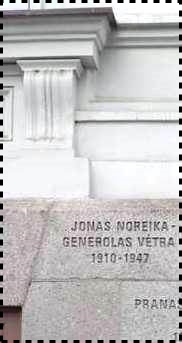 The stone honoring Holocaust collaborator Jonas Noreika tops the lot on the facade of the Genocide Museum on Gedimino Boulevard in the Lithuanian capital, a stone’s throw from the nation’s parliament. When are we going to stop glorifying those who helped annihilate Lithuanian Jewry during the Holocaust? When is this going to come down?
What It Is to Defend Your Own History
O P I N I O N / C O L L A B O R A T O R S G L O R I F I E D
by Kristina Apanavičiūtė Sulikienė
◊
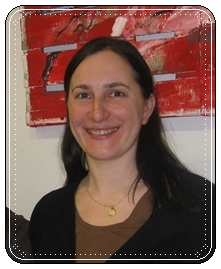
Kristina Apanavičiūtė Sulikienė
One can hear various stories about history here in Lithuania. The main narrative is about Bad Communists and Good Nazis. Yes, it is true. Especially very recently, after the civil (or whatever kind of) war broke out in Ukraine, the Nazis and those who justify and glorify them, both in Ukraine and Lithuania, have found new strength. Under the banner of “Ukraine Fights For All Of Us,” some have decided to bring back such “heroes” as the killer Antanas Baltūsis-Žvejas.
For my part, I would like to defend our Tauras district (in the Kaunas region) from the legacy of this genre of “hero.” For his history was not only one of guerilla warfare against Soviet forces but about what he was doing in 1941 when the wholesale slaughter of our Jewish population was underway. This has a lot to do with Lithuania, who we are as proud Lithuanians whose history, like every other people on this earth, has its high and its low moments.
Didier Bertin’s Letter to the President of the European Commission on the Old Vilnius Jewish Cemetery
Didier Bertin, president of the Association for the Promotion of a New Model of Human Rights and Duties, today sent this letter to the president of the European Commission, Jean-Claude Juncker. The text was released by the Association.
◊
- Monsieur Jean-Claude Juncker
- Président de la Commission Européenne
- president.juncker@ec.europa.eu
- Rue de la Loi / Wetstraat 200 – 1049 Bruxelles – Belgique
- Objet : Profanation du cimetière juif de Vilnius par les autorités lituaniennes utilisant pour cela des fonds de l’Union européenne.
- 22 Août 2015
Grant Arthur Gochin in the Jerusalem Post on Memorials for Holocaust Perpetrator J. Noreika in Central Vilnius
Wiesenthal Center Issues Statement on Old Jewish Cemetery in Vilnius
C E M E T E R I E S / P I R A M Ó N T
JERUSALEM—The Simon Wiesenthal Center today released a statement reaffirming its previously reported opposition to plans to place a $25,000,000 convention and congress center on Vilnius’s old Jewish cemetery at Piramónt (in today’s Šnipiškės). International opposition to the project has been mounting in recent weeks. The text was released by Dr. Efraim Zuroff, director of the Wiesenthal Center’s Israel office and head of its East European Affairs division. The text follows:
Lithuania’s Chief Rabbi Felt Threatened with Deportation after Opposing Convention Center Project at Old Jewish Cemetery
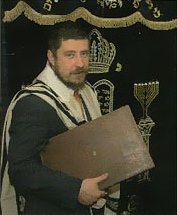
Rabbi Chaim Burshtein
VILNIUS—Flying today from Vilnius airport on a routine commute to Israel, the chief rabbi of Lithuania, Rabbi Chaim Burshtein, who has held the post for over a decade, experienced what he felt was effectively “an attempt at deportation” during the routine passport control check for passengers traveling to non-Schengen countries. He was threatened by the official, who explained he would no longer be free to enter Lithuania, an EU and NATO member state. Rabbi Burshtein explained to the official, quoting the prophet Jeremiah, that he has always followed the Jewish law of obeying the laws of the state in which one lives.
Open Letter to Members of CPJCE in the UK: Do You Really Want a Convention Center in the Heart of Vilna’s Old Jewish Cemetery?
O P I N I O N / O P E N L E T T E R
◊
Dear Esteemed Associates of the “Committee for the Preservation of Jewish Cemeteries in Europe” enumerated on the CPJCE letterhead [more than one eminent personage on the list is deceased; their precious names might perhaps best not be invoked for the organization’s current adventures?]
S.B.E. Berger, Rabbi B.Z. Blum, L. Davis, Rabbi J.H. Dunner, Rabbi Z. Feldman, D. Frand, B.S.E. Freshwater, A.C. Ginsberg, Rabbi H. Gluck OBE, A. Goldman, S. Grosz, M. Hershaft, D. Herzka, M.B. Krausz, J. Kruskal, J. Lobenstein MBE, Y. Marmorstein, Rabbi A. Pinter, Rabbi E. Schlesinger, Rabbi E. Shechter, J. Shik, M.E. Stern, S.B. Stern, Rabbi C. M. Wosner
◊
Piramónt in Šnipiškės: But What was Solemnly Agreed Back in 2009?
O P I N I O N
VILNIUS—After two apartment and business buildings started to go up a decade ago on the grounds of the old Jewish cemetery at Piramónt in the Šnipiškės (Shnípishok) district of this city, across the river from the city center, a damaging international conflict ensued between elements of the Lithuanian government on the one hand and Jewish groups around the world and a number of Western governments on the other.
What’s The Story With the Mass Grave Uncovered near Šiauliai (Shavl)?
O P I N I O N
by Evaldas Balčiūnas
◊
Last week, there was a flurry of reports in the Lithuanian media about human skeletons and personal effects turning up during routine roadworks at Pročiūnai in the region of Šiauliai (in Jewish history: Shavl). Reports and gory pictures appeared among other places in 15min.lt; Etaplius.lt; Skrastas.lt and Snaujienos.lt. I myself, a concerned resident of Šiauliai, commented on the subject on my own blog (here and here). Various articles published contained theorizations about the buried here being victims of Soviet crimes or even equally of Nazi and Soviet crimes.
Monday 13 July. It is probably correct to say that the international scandal was set alight when the “routine” BNS (Baltic News Service) report appeared in English in the Lithuania Tribune (amalgamated with English Delfi). The archaeologist placed in charge by the local government of the investigation of the human remains, Audronė Šapaitė, is quoted in the article as presenting the following certain conclusions. Excerpts follow:
Lithuania’s Chief Rabbi Pleads for Preservation of Holocaust-Era Mass Grave in Šiauliai
Rabbi Chaim Burshtein
VILNIUS—Rabbi Chaim Burshtein, chief rabbi of Lithuania (and of Vilnius) today issued a heartfelt appeal to both national government authorities, and to the municipal leadership of Šiauliai (known in Jewish history as Shavl), to call an immediate halt to the excavation of hundreds of victims’ remains from a Holocaust-era mass grave site uncovered during a highway construction project.
The discovery was widely reported in the Lithuanian and regional media, including the English-language Lithuania Tribune (English Delfi.lt). Various Lithuanian media outlets have reveled in publishing photos of skulls, bones and other remains from the mass grave being dismantled, sometimes including shoes and clothing (among others: 15min.lt; Etaplius.lt; Skrastas.lt; Snaujienos.lt).
The BNS (Baltic News Service) report quotes the official responsible archaeologist, Audronė Šapaitė on the decision reached (apparently without consultation with Jewish religious authorities): “It’s been decided to excavate the remains, do anthropological tests and then rebury them and also mark this place.”
UPDATE OF 16 JULY:
Protest leads to Rapid U-Turn by Authorities
Dancing on Jewish Graves in Vilna
O P I N I O N
by Pinchos Fridberg
Editor’s note: Reprint from The Times of Israel, where this article, with several photographs, appeared on 25 June 2016.
◊
I am a Holocaust survivor. I was born here in Vilnius (Yiddish: Vílne), today’s capital of Lithuania, known forever as the “Jerusalem of Lithuania” for its vibrant Jewish culture, religious and secular, for hundreds of years. Today our post-Holocaust Jewish community is a tiny remnant, just a few thousand people, but we are vibrant, and, as always, a community of many opinions. Once again, a question has arisen that calls for robust discourse.
Rabbi Shmuel Jacob Feffer: Rabbinic Judgment on the Old Vilna Jewish Cemetery
O P I N I O N
by Rabbi Shmuel Jacob Feffer
Editor’s note: The author is president of the World HaGró (Gaon of Vilna) Center in Israel, and co-editor of the Center’s seventy published volumes of the Gaon of Vilna’s works. He has been based in Vilnius around twenty-five years. The original handwritten document, with the rabbi’s signature and personal stamp, is available here. For background on the issue, see here. For the paper trail to date, see here. A registry of the mounting international agreement with Rabbi Feffer’s position is here.
◊
בס″ד ח′ תמוז התשע″ה לפ″ק פה ווילנא
◊
זעקת קודש
למען אוהביך שוכני עפר בבית העלמין הישן דווילנא
◊
אני הרב הדר בעיר הזאת זה קרוב ל-25 שנה ומכיר היטב תהלוכותי′ה ובעיותי′ה, וחרד לעתידה היהודי ועל זכרון עברה הק′ והחשוב כידוע לכל, ועתה ראיתי חובה גדולה בנפשי לצאת בגלוי ולהסיר הלוט בעניין הנשגב דלהלן, ולפרסם האמת ללא צל ספק – העובדות הברורות כשמש בצהרים ולעמוד בפרץ ולא לתת למשחיתים לבוא ולנגוף ח″ו, ואדרבה ביתר תוקף ועוז דקדושה לעמוד איתן על משמרת הקודש למען ה′ ותורתו הק′ והאמונה הטהורה.
Ukrainian Hitlerist Icons Celebrated in Weston-on-Trent in Derbyshire, England
O P I N I O N / U K / U K R A I N E
by J. North
◊
Earlier this month, the Ukrainian Youth Association (CYM Great Britain) held a remembrance day at the Tarasivka camp at Weston-on-Trent in Derbyshire. They advertised the event on their website (http://cym.org/uk) and with a poster replete with (ultra)nationalist imagery.
New Conflict Over Old Vilna Jewish Cemetery, As New Heritage Commission Gets Underway
Updates on the new conflict over the old Vilna Jewish cemetery site at Piramónt (now part of the Šnipiškės [Yiddish: Shnípishok] district), and the related issues surrounding a concurrently established new commission on Jewish heritage will be added here as they become available.
THE PAGE IS HERE
Would this Building Project be Pursued if the Cemetery Were the Resting Place of Christians?
O P I N I O N / C H R I S T I A N – J E W I S H R E L A T I O N S / C E M E T E R I E S
by Pastor Michael Maass
◊
I would like to make an observation concerning the use of Jewish cemeteries for building projects, as this has come to be a major issue of controversy in Lithuania, and in other nations as well.
I would like to pose a question: Would these building projects be pursued if the cemeteries in question were the resting places of Catholics, Protestant Christians, or other non-Jewish people?