◊
APOLOGIES. THIS PAGE HAS MOVED HERE
https://defendinghistory.com/mini-museum-of-jewish-life-in-interwar-lithuania


◊
APOLOGIES. THIS PAGE HAS MOVED HERE
https://defendinghistory.com/mini-museum-of-jewish-life-in-interwar-lithuania
VILNIUS—With the permission of the publishers of The Weekly of Vilnius, we are reproducing extracts of two comments from this week’s edition that covers Lithuanian news from 11 to 17 December 2017. The Weekly of Vilnius is sometimes considered to be this city’s most prestigious English-language news publication, famed for its editorial independence and capacity for presenting views that tend to be ignored in the nationalist and ultranationalist media that can be fixated with the “official line.” In the spirit of classic journalism, The Weekly of Vilnius has no online edition (there is an online description and Facebook page) and is available weekly by emailed PDF or hard copy to its elite circle of subscribers, known to include embassies, government agencies, captains of industry, politicians, academics, libraries, and think tanks.
See also: Does ambassador’s gesture “legitimize” naming of 2018 for an alleged collaborator?
First, on the subject of this week’s visit with flowers by the ambassador of Israel to the daughter and (successful) chief campaigner for 2018 to be named by the Lithuanian parliament for an alleged Holocaust collaborator (see Defending History‘s coverage), The Weekly of Vilnius highlights, accurately, we believe, the current Israeli embassy’s proclivity for implicitly claiming to act for “the interests of Lithuanian (or Litvak) Jewry” and to speak for “Lithuanian-Jewish relations” when in fact the (sometimes short-term) interests of the present Israeli government are (quite naturally) the determining factor. In fact, the embassy has arguably established a record of harming Lithuanian Jewish interests since it was opened in early 2015. Most shockingly, the Israeli Foreign Ministry seems to have “muscled in” even on restitution payments, deriving from the religious properties of the annihilated communities, now intended for the survival of the Lithuanian Jewish community. See the relevant entries in the grant items enumerated here and here.

PHOTO: DELFI.LT
VILNIUS—Israel may have crossed a red line today when it was flaunted on the major News portal Delfi.lt here, both in Lithuanian and in English, that Israeli ambassador Amir Maimon had found the time this week to stage a demonstrative PR-photographed visit to the chief campaigner for the parliament’s decision less than one month ago to name 2018 in honor of Adolfas Ramanauskas — his daughter in Vilnius, Auksutė Ramanauskaitė-Skokauskienė, who is a prime icon of the ultranationalist camp that often glorifies various collaborators and participants in the Holocaust on the grounds that they were also anti-Soviet activists. The PR move came just after a major political commentator asked what Lithuania is getting in return for its staunch political support for the Netanyahu government.
UPDATES TO THIS ARTICLE: WEEKLY OF VILNIUS COMMENTARY; AMBASSADOR’S BETRAYAL OF HOLOCAUST HISTORY A FIASCO AS LITHUANIA VOTES ANYWAY AGAINST U.S. DECISION TO MOVE ITS EMBASSY (PARTING WITH NEIGHBORING LATVIA)
One of the PR photos released shows the ambassador posing underneath adulatory photos of the 1941 pro-Nazi militiaman (from various other periods in his life). Of course Lithuania has a vast number of inspirational historical heroes, including many anti-Soviet heroes, who were not Holocaust collaborators, and state decisions to honor collaborators cause untold pain to survivors, their families, and the remnant Jewish communities in Eastern Europe. They all send a message that becomes part of the history-revision campaign to downgrade the Holocaust in the context of “Double Genocide” revisionism.
◊
VILNIUS—Herbert Block, a veteran member of the American government’s Commission for the Preservation of America’s Heritage Abroad, and chair of its committee on the old Vilnius Jewish cemetery, visited yesterday and today for two sessions with staff of the Defending History team here in the Lithuanian capital. Mr. Block is a well-known and beloved figure for the Lithuanian Jewish community, with whom he worked closely for many years (1999 to 2015), during his tenure as Assistant Executive Vice President of the Joint Distribution Committee (JDC or “Joint”), where his work included coordinating successful efforts to achieve restitution that could enable the Jewish community’s survival for generations to come. At present, he is executive director of the American Zionist Movement (AZM). Previously Mr. Block served as Assistant Director for Intergovernmental and Public Affairs for the New York City Independent Budget Office (1996-1999) and was Deputy Director for Intergovernmental Relations at the federal Corporation for National and Community Service in 1994-1995. He was Assistant to the Mayor of the City of New York from 1990 to 1993 and Special Assistant to the Manhattan Borough President from 1986 to 1989. For years he has been a member of the World Jewish Restitution Organization (WJRO) with specialization in the Baltic region and Poland.
Herb Block explained how hard he has been working behind the scenes to ensure the cemetery’s preservation, and pledged his firm personal commitment to work resolutely for the convention center project to be moved to another venue in town — away from Vilna’s Old Jewish Cemetery.
As anyone who has been following events in Lithuania for the last several years surely knows by now, the country sports street names and monuments honoring locals who collaborated with the Nazis during World War Two. It was in this context that I attended an event in Washington, DC yesterday at the Wilson Center’s Kennan Institute discussing Ruta Vanagaite’s controversial book “Our People” (it appeared in Lithuanian in 2016) that blows open the door describing the true extent of Lithuanian collaboration in the Holocaust. Vanagaite and her co-author Efraim Zuroff , director of the Simon Wiesenthal Center’s Israel Office, spoke at the event.
◊
The national scandal unleashed by the Lithuanian Rūta Vanagaitė and the Jewish Efraim Zuroff via their statements about Adolfas Ramanauskas-Vanagas, is gradually losing momentum. The Seimas (parliament) went right ahead and declared the incoming year, 2018, to be The Year of Ramanauskas-Vanagas. That is sad. Three years ago, I wrote about this person’s activities in Druskininkai in 1941. Society back then was silent about it. It was only the desire of some politicians to glorify this personage that led to the aforementioned Lithuanian and Jewish commentators to talk about him. They spoke loudly and an antisemitic bubble burst. Vanagaitė’s statement had some inaccuracies. The very statement was taken as an insult by the mainstream. Public details about Zuroff’s statement were scarce. My 2014 article was among those details.
This paper was published today by Taylor and Francis on its website. It appears in Dapim: Studies on the Holocaust, volume 31, no. 3, pp. 285-295 (Dec. 2017). Dapim is edited by the Strochlitz Institute for Holocaust Research at the University of Haifa.
In Lithuania, the primary provider for Holocaust studies for close to two decades has been the state-sponsored International Commission for the Evaluation of the Crimes of the Nazi and Soviet Occupation Regimes in Lithuania (ICECNSORL), which was established in 1998 by decree of the nation’s president and is housed in the office of its prime minister, embedding it in the highest strata of Lithuanian politics. Several of its activities have enabled significant contributions in research, education, and public commemoration.
◊
PEN America released this statement on its website today:
NEW YORK—The decision by the Alma Littera publishing house to cut all ties with their author Ruta Vanagaite, and to remove remaining copies of all of her five books from circulation and pulp them, is a troubling overreaction and should be reconsidered, said PEN America today.
The publisher’s decision to remove and destroy all of Vanagaite’s books was a response to her recent criticism of Adolfas Ramanauskas, a Lithuanian nationalist widely perceived as a hero. Vanagaite previously touched on sensitive historical issues in her most recent book, Mūsiškiai (Our People), published in Lithuania in 2016, which discusses the role of Lithuanian nationalists and freedom fighters in the persecution of Jewish Lithuanians and the Holocaust during World War II. Lithuania still denies their role in WWII and the Lithuanian authorities claimed that the book jeopardized national security. The destruction and removal of Vanagaite’s books demonstrates the tight borders of what is acceptable criticism of a national hero in Lithuania. Since the publication of the book, Vanagaite has received threats, which have escalated in recent weeks; a suit against her for slander and denigration of a deceased person has also been filed with the prosecutor by a patriotic group (the prosecutor has declined to take up the case, finding no evidence of malicious intent).
◊
◊
Delfi.lt, the major Lithuanian news portal, yesterday published an article by its correspondent Rūta Pukenė about the latest “activities” on the site of the five-century old Vilna Jewish cemetery at Piramónt, which houses the ruin of the old Soviet Sports Palace, surrounded by thousands of still extant graves, amid controversial plans to construct a national convention center using the Soviet building as its core. Many friends of Vilnius have argued forcefully that the city’s interests lie in preserving and restoring Lithuania’s oldest Jewish cemetery, where many rabbinic luminaries still lie buried, and for the convention center project to be moved to another venue in town.
◊
Although the scandal caused by statements made by author Rūta Vanagaitė about the partisan leader Adolfas Ramanauskas-Vanagas has by now subsided, the head of the Lithuanian Jewish Community, Faina Kukliansky believes that this is no more than a temporary calm. The English translation of R. Vanagaitė’s book Mūsiškiai should appear soon. Furthermore she has the support of the European Jewish Congress and she has many supporters in Israel.
◊
Не нужно быть великим теоретиком, чтобы заметить разительный контраст между двумя главными «продуктами» последней недели сентября, на которую приходится ежегодная поминальная активность Литвы по чествованию убитых в годы Холокоста литовских евреев – особенно в легендарной столице Литвы, в Вильнюсе. Под «продуктом» мы понимаем культурные события, имевшие вещественное воплощение, артефакты, которые надолго переживут недельное позерство, речи и встречи блестящих государственных чиновников и национальных лидеров.
◊
VILNIUS—Defending History today inaugurated a new section, in the Lithuanian language, on the international efforts calling for restoration of the old Vilna Jewish cemetery at Piramónt and for the Jewish heritage of Vilna and Lithuania to not be defiled by a convention center surrounded by a half millennium of Litvak graves. The convention center project can easily be moved to another appropriate venue. The section aims to provide content stemming from various communities within Lithuania as well as translations of the international outcry over the convention center project.
Vilniaus senosios žydų (Piramonto) kapinės Šnipiškėse
Lietuvių kalba
◊
Neseniai, 5775 žydų kalendoriaus metų Avo mėnesį (2015 m. liepos 16-rugpjūčio 15), buvo hebrajiškai ir angliškai paskelbta rabinų deklaracija dėl senųjų žydų kapinių Vilniuje (tekstas buvo paskelbtas abiem kalbomis 2015 m. liepos 30 d. „Hamodia“ numeryje; liepos 29 d. „Hamodia“ tinklapyje ir liepos 30 d. defendinghistory.com buvo paskelbta apie šį dokumentą).
◊
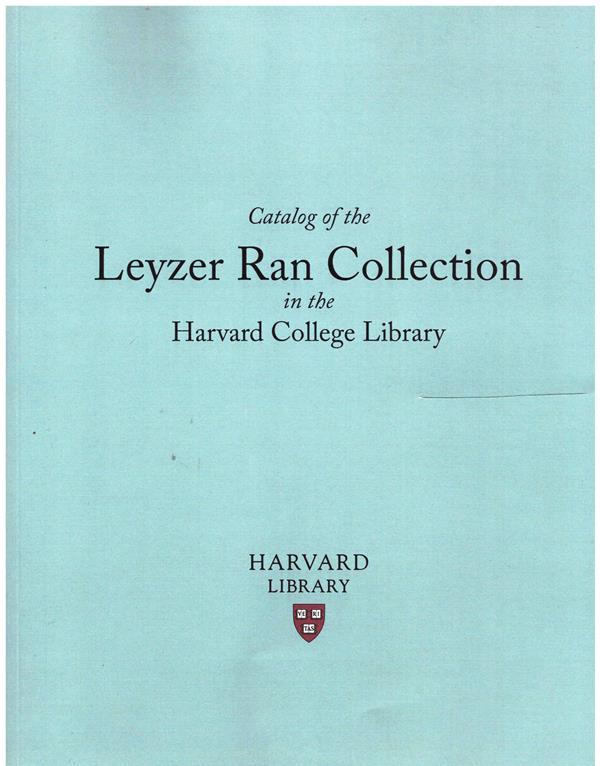 VILNIUS—As the first small shipment of Harvard Library’s new book, Catalog of the Leyzer Ran Collection in the Harvard College Library arrived this week in the Lithuanian capital, there was widespread satisfaction that at least a tabulation of the contents of Leyzer Ran’s extensive archive of Jewish Vilna is finally available. The collection was bequeathed to Harvard University where the Library maintains it as a distinct entity with its own name, space, and now, a handsome catalogue brought out by Harvard University. Leyzer Ran (1912-1995) is widely considered to be the primary postwar chronicler of the centuries-old unique Jewish civilization of the city known in Yiddish as Vílne, Yerusholáyim d’Líte — Vilna, Jerusalem of Lithuania. The newly appeared catalogue was compiled and edited by Dr. Charles Berlin, who is Head of Judaica at Harvard Library and Harvard University’s Lee M. Friedman Bibliographer in Judaica.
◊
VILNIUS—The Weekly of Vilnius, sometimes considered to be this city’s most prestigious English-language news publication, today released its weekly issue which contains a highly documented summary of many of the sides in the debate over author and PR specialist Ruta Vanagaitė’s comments concerning state plans to name 2018 for someone who led a pro-Nazi militia during the early days of the Lithuanian Holocaust in 1941, but who is being honored for his postwar service in the anti-Soviet resistance. Defending History has published its own take along with a much more limited summary of the debate which readers may consult for comparison and helping “complete the picture” as best as it can be in English. Note that selections of Lithuanian articles on the subject from the major news portal Delfi.lt, and from BNS (Baltic News Service), in both cases generally representing government and “nationalist establishment” positions, are available in English translation on the English Delfi.lt (Lithuania Tribune) site (search “Vanagaitė” for rapid reference).

Renowned Lithuanian-French thinker Algirdas Julius Greimas (1917-1992) was more forthcoming than most about his dubious, or frankly, criminal behavior as a young man.
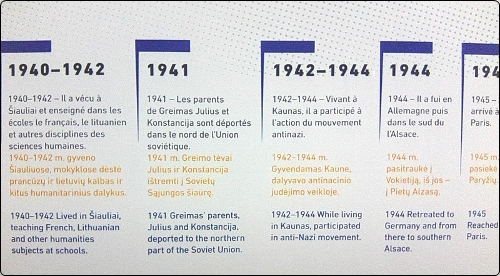
From his interviews we know that in 1940, he gave public speeches in support of Soviet annexation of Lithuania. And in 1941, he served as an editor for the newspaper Tėvynė in Šiauliai, which repeatedly called for ethnic cleansing of Jews from Lithuania.
◊
Vilnius District Court Judge Rima Bražinskienė’s 29 May 2017 ruling, concerning the “official” Lithuanian Jewish Community’s mid-campaign rule change during last spring’s leadership contest, effectively disenfranchising 2,200 Jewish people of Vilnius (the vast majority of Lithuania’s Jews today) in favor of a new voting system granting effective power over the election to a roomful of “oligarchs” (some of whom have two or three votes each, i.e. two or three times as much weight as the 2,200 Jews disenfranchised) is now publicly available.
The following, for the convenience of our readers, is an English translation. Note that in the case of any query arising, the Lithuanian original is alone authoritative.
◊
In response to a protest from the World Jewish Congress, after the Ukrainian city of Vinnitsa unveiled a statue celebrating nationalist leader Symon Petliura — whose troops killed tens of thousands of Jews in pogroms between 1918 and 1921 — a regional official from the extremist Svoboda party threatened Jewish citizens. In a Facebook rant, the Svoboda official warned Jews opposed to the Petliura statue to fall in line or face the consequences. The Svoboda official stated that “the only time we comfortably coexisted with kikes is Koliyvishchyna,” a reference to an 18th century pogrom against Jews in Ukraine.
Related: Ukraine’s Minister for Infrastructure Plans to Build Actual “Road to Bandera”
◊
See Defending History’s Joe Melamed section
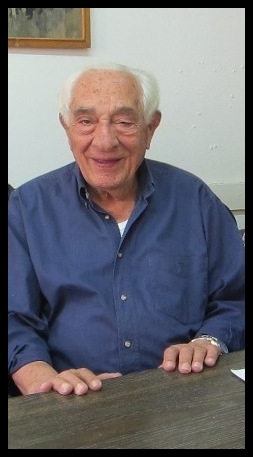
Joe Melamed in his Tel Aviv office on King David Boulevard in 2011. Photo ©DefendingHistory.com.