


News & Views
December 2012 London Conference at UCL and Protest (Box Coverage to 24 Dec)
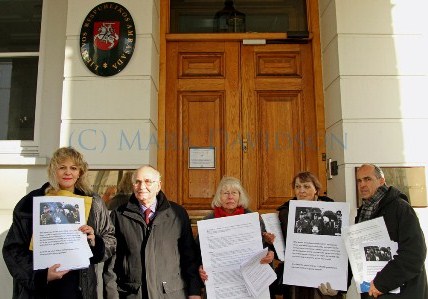

Posted in Double Games, Events, Litvak Affairs, Monica Lowenberg, News & Views, UCL Manipulated?, United Kingdom
Tagged Antony Polonsky + Lithuania, Dept of Hebrew and Jewish Studies UCL, Lionel Kopelowitz, Lithuanian Embassy in London, Monica Lowenberg
Comments Off on December 2012 London Conference at UCL and Protest (Box Coverage to 24 Dec)
Within Days of Monica Lowenberg’s Petition, Vilnius Municipality Tries to Move March 11th 2013 Neo-Nazi March Away from City Center
Several days after Monica Lowenberg’s petition was presented to the Lithuanian embassy in London, one of the petition’s points was partly acted on, at least as far as a press release goes, by a governmental agency in Lithuania, notably the Vilnius municipality.
PUBLIC PETITIONS HAVE AN EFFECT!
Point no. 4 of Ms. Lowenberg’s petition reads:
4) A commitment to disallow the neo-Nazi parades in the city centres of Vilnius and Kaunas on national Independence Day holidays in 2013 (with no prejudice to reassignment of venues on free speech grounds to sites and dates that do not heavily imply state support).
Posted in Antisemitism & Bias, Events, Human Rights, Litvak Affairs, Monica Lowenberg, Neo-Nazi & Fascist Marches, News & Views, Politics of Memory, Vilnius
Comments Off on Within Days of Monica Lowenberg’s Petition, Vilnius Municipality Tries to Move March 11th 2013 Neo-Nazi March Away from City Center
UCL Professor who Denied Holocaust Survivors Five Minutes to Read Petition to Lithuanian Government, Sings Different Tune Schnoring $$$ for Lithuanian “Study Trips”
Professor Michael Berkowitz of University College London’s Department of Hebrew and Jewish Studies, an expert on Lithuanian Jewish studies, was the member of staff who told London petitioner Monica Lowenberg on 14 December 2012 that Brandeis Professor Antony Polonsky’s banning of the reading of a five minute petition would be upheld by the UCL department (correspondence here; background on the UCL saga here—best enjoyed in chronological order from the bottom upwards…).
The text of the petition and list of international signatories to date is available on Change.org.
Professor Polonsky was knighted by the president of Lithuania earlier this year for services to that country’s efforts to improve its Jewish PR profile, a PR profile that has suffered difficulty from repeated state honoring of Nazi collaborators and perpetrators, state defamation of Holocaust survivors who joined the resistance, and state investment in a revised far-right-based historical model for World War II.
Posted in Double Games, Free Speech & Democracy, News & Views, Politics of Memory, UCL Manipulated?, United Kingdom
Tagged Michael Berkowitz + Lithuania, Michael Berkowitz Holocaust Survivors, Michael Berkowitz UCL
Comments Off on UCL Professor who Denied Holocaust Survivors Five Minutes to Read Petition to Lithuanian Government, Sings Different Tune Schnoring $$$ for Lithuanian “Study Trips”
Estonia’s Severe Case of Holocaust Amnesia
O P I N I O N
by Efraim Zuroff
From today’s Times of Israel.
The visit to Israel of a foreign prime minister used to be a big deal. That’s why there were so many photos of Burmese head of state U Nu’s visit in the early sixties. Those days, however, are long gone and today when most prime ministers visit us it’s usually of little or no interest to anybody and they get almost no coverage unless they are major world figures.
That would help explain why I only found out Tuesday morning that Estonian Prime Minister Andrus Ansip was to be touring Yad Vashem that day.
Ostensibly, that is no occasion of any particular significance, and the visit is more or less a pro forma requirement for any head of state coming to Israel in that capacity, especially if he or she has never been here before. But that is not true in the case of the Estonian leader, who heads a country that is suffering from a severe Baltic variant of post-Communist Eastern European Holocaust amnesia. This is an intellectual disease whose four main characteristics are a systematic minimization of crimes by local Nazi collaborators, a distinct lack of political will to prosecute and punish such individuals, a tendency to glorify locals who fought alongside the Nazis – in Estonia’s case in Waffen-SS units – and a determination to promote the historical canard of supposed equivalency between Nazi and Communist crimes.
Posted in Double Genocide: The New Form of Holocaust Revisionism & Denial, Efraim Zuroff, Estonia, Israel, News & Views, Opinion
Tagged Andrus Ansip, Efraim Zuroff, Holocaust and Israel, Holocaust in Estonia, Holocaust in the Baltics, Jaanika Kressa
Comments Off on Estonia’s Severe Case of Holocaust Amnesia
Gert Weisskirchen’s Open Letter to the Lithuanian Ambassador in London
The following letter was released today by Professor Weisskirchen’s office. It is followed by an English translation by Irene Fick.
Dezember 17, 2012
H.E. Ambassador Asta Skaisgiryte Liauskiene
The Embassy of Lithuania
Exzellenz, sehr geehrte Frau Botschafterin,
Posted in Events, Germany, Gert Weisskirchen, Lithuania, News & Views, Opinion, Politics of Memory, United Kingdom
Comments Off on Gert Weisskirchen’s Open Letter to the Lithuanian Ambassador in London
David Cukier’s Follow-up Letter to the Provost of University College London
O P I N I O N
by David Cukier
The following is the text of the author’s letter today to the provost of University College London, following up on his earlier communication of 29 November.
- From: David Cukier
- To: “provost@ucl.ac.uk” <provost@ucl.ac.uk>
- Sent: Thursday, December 13, 2012 3:38 PM
- Subject: UCL Conference on December 17th and 18th 2012: Jews and Non-Jews in Lithuania: Coexistence, Cooperation, Violence
Dear Professor Grant,
I attach an earlier communication to you in which I asked you to consider the wisdom of hosting the above conference at UCL as a former student who takes great pride in having studied at UCL and the objectives and principles established by its founders.
Posted in David Cukier, News & Views, Opinion, Politics of Memory, UCL Manipulated?, United Kingdom
Comments Off on David Cukier’s Follow-up Letter to the Provost of University College London
UCL Hebrew-Jewish Studies Dept Rejects Request for Five Minutes for Holocaust Survivor to Read Petition at Lithuanian Gov. Sponsored Conference
London observers were wondering whether the medal Professor Antony Polonsky received earlier this year from the president of Lithuania for his PR work for the Lithuanian government may have something to do with his denial of Monica Lowenberg’s request, asking for five minutes for her father, a Holocaust survivor, to read out at next week’s conference her petition to the Lithuanian government, proposing constructive solutions to the issues at hand. The petition has to date garnered over 250 signatories from two dozen countries. The following is the correspondence, which started with Ms. Lowenberg’s appeal to Professor Ada Rapoport-Albert and Dr. Francois Guesnet. Dr. Guesnet, the Corob Reader in Jewish History at UCL is one of the conference coordinators on behalf of the Lithuanian government funded institutions financing the conference. Holocaust survivors consulted cannot understand why safe and secure academics who hold high posts at Western institutions should so fear “even to give five minutes for somebody else to come and disagree” with the conference’s pay-masters in the freedom of the British capital.
Posted in "Tuskulėnai Peace Park", Documents, Double Games, Dr. Rokhl (Rachel) Margolis (1921-2015), Events, Foreign Ministries: Holocaust Politics Abuse?, Free Speech & Democracy, Monica Lowenberg, News & Views, Politics of Memory, UCL Manipulated?, United Kingdom
Tagged Antisemitism Lithuania, Antony Polonsky, Dept of Hebrew & Jewish Studies, Francois Guesnet (Corob Fellow), Holocaust in Lithuania, Holocaust Obfuscation, Michael Berkowitz + Lithuania, Michael Berkowitz UCL, Monica Lowenberg, UCL
Comments Off on UCL Hebrew-Jewish Studies Dept Rejects Request for Five Minutes for Holocaust Survivor to Read Petition at Lithuanian Gov. Sponsored Conference
On Free Speech at University College London
O P I N I O N
by Monica Lowenberg
The following letter to the provost of University College London was released for publication today by Ms. Lowenberg’s office.
To the Provost
Dear Professor Grant,
Please find pasted below correspondence between myself and Dr Francois Guenest of UCL and Professor Polonsky who together have organised with the Lithuanian government this year’s Part 2 conference ‘No Simple Stories’ to be held next week 17-19 December at the Lithuanian embassy in London and UCL.
I requested that I read out a petition that hundreds of people across the world, scholars, survivors and others agree with, a petition that disagrees with Polonsky’s and the Lithuanian government’s interpretation of events and action. Polonsky as designated organiser has refused me the opportunity to read out the petition.
Serious questions have to now be raised about the conference, its agenda and UCL.
Posted in Free Speech & Democracy, Human Rights, Monica Lowenberg, News & Views, Opinion, Politics of Memory, UCL Manipulated?, United Kingdom
Comments Off on On Free Speech at University College London
UCL Alumnus David Cukier Writes to the Lithuanian Ambassador in London
O P I N I O N
by David Cukier
HE Ambassador Asta Skaisgirytė Liauškienė
The Lithuanian Embassy,
Lithuania House,
2 Bessborough Gardens,
Westminster,
London, SW1V 2JE
13 December 2012
Dear Ambassador,
I write to you concerning the forthcoming conference to be hosted by UCL called ‘Simple Stories’ where the conference co-sponsored by your government is attempting to revise the accepted historical narrative concerning the events of 1941-1944 in Lithuania . In so doing it is encouraging divisive extremist fascist political opinion in your country, which as an EU and NATO member, it surely behoves Lithuania to seek to eliminate. Rather it should be incumbent on the Government of Lithuania to discourage prejudicial politics against all its minorities including the small Jewish minority in the country, and to respect human rights that were so lacking in the war years between 1941-41.
Posted in David Cukier, Events, News & Views, Opinion, Politics of Memory, UCL Manipulated?, United Kingdom
Comments Off on UCL Alumnus David Cukier Writes to the Lithuanian Ambassador in London
The Text of Monica Lowenberg’s Petition on Change.org
The following is a verbatim reprint of Monica Lowenberg’s December 2012 petition on Change.org. Embedded links have been added, marked by underlining, referring readers to further coverage on Defending History pages which link to various sources providing more background.
Petitioning HE Ambassador Asta Skaisgirytė Liauškienė
This petition will be delivered to:
- Lithuanian Ambassador for London, UK
- HE Ambassador Asta Skaisgirytė Liauškienė
Abandon state sponsored Anti-Semitism and Holocaust Obfuscation
- Petition by
- Monica Lowenberg
- London, United Kingdom
Following the announcement that the Lithuanian Embassy is one of the generous co-sponsors of this month’s London conference on Jewish-Lithuanian issues including the Holocaust, we the undersigned ask the Embassy’s public support on the following urgent matters:
1) Rapid and elegant public apologies, released prior to the conference, to the Jewish Holocaust Survivors defamed in recent years by Lithuanian prosecutors, media and some government officials. The survivors are in their late 80s and 90s, making time essential if there is going to be a symbolic amelioration in the manner in which the Lithuanian state is ending a 700 year old history of Jewish settlement, and on what note, with the last survivors of the bona fide pre Holocaust generation. Most urgently, Rachel Margolis; also: Yitzhak Arad and Fania Brantsovsky and Joseph Melamed.
Posted in Events, Lithuania, Litvak Affairs, Monica Lowenberg, News & Views, Opinion, Politics of Memory, United Kingdom
Tagged Ambrazevicius Brazaitis, Antisemitism in Lithuania, Asta Skaisgirytė-Liauškienė, Genocide Center in Vilnius, Genocide Museum in Vilnius, Lithuania, Lithuanian Embassy in London, Monica Lowenberg, neo-Nazi parades in Vilnius, United Kingdom, Vytautas Magnus University
Comments Off on The Text of Monica Lowenberg’s Petition on Change.org
Prankster Claiming to Represent Litvak Graveyard NGO Attempts to Divide Litvak Community
O P I N I O N
The run-up to next week’s controversial Lithuanian-government sponsored conference on Lithuanian Jewish issues in London, which is sowing enough confusion as it is, was put into further disarray as it emerged that an email received by hundreds of people (from various forwarders) is apparently part of a curious hoax. The only discernible purpose seemed to be bring discord into the fragile ranks of the surviving Litvak camp by spreading a set of “symmetrical” false rumors.
Some of the emails were identified as originally coming from an official of an NGO, “Maceva” that is dedicated to the laudable cause of maintaining Lithuanian Jewish graveyards, but it is increasingly thought that this shocking attribution could well be part of the hoaxter’s agenda, and that an unambiguous denial — or apology —will be forthcoming from Maceva’s board of directors at the earliest possible opportunity.
The major two — actually three — pieces of disinformation being disseminated are:
Posted in Double Games, Double Genocide: The New Form of Holocaust Revisionism & Denial, Events, Litvak Affairs, News & Views, Politics of Memory
Tagged International Commission for the Evaluation of the Crimes of the Nazi and Soviet Occupational Regimes in Lithuania, Leonidas Donskis, Litvak community, Maceva NGO (Lithuanian Jewish cemeteries), Monica Lowenberg, Saulius Suziedelis, Vytautas Landsbergis, Yitzhak Arad
Comments Off on Prankster Claiming to Represent Litvak Graveyard NGO Attempts to Divide Litvak Community
London Fog, Part II? The Second in the Lithuanian Government’s “London Series”
Lithuanian Government Invests in 2nd PR Conference at University College London, 17-18 Dec.
Another Graywash manipulation of a venerable Western institution? It happened once back in 2011. Open letter then issued was signed by the head of UCL’s Jewish Studies.
THE NEW PETITION
MONICA LOWENBERG LAUNCHES PUBLIC PETITION, BASED ON LETTER TO AMBASSADOR ASTA SKAISGIRYTĖ-LIAUŠKIENĖ (VETERAN OF 2009 BOOK FAIR FIASCO); UCL ALUMNUS PROTESTS TO PROVOST

After investing heavily in reburying with full honours and glorifying the 1941 Nazi puppet prime minister (in May 2012), sectors of the Lithuanian government are investing in a second lavish London conference (in Dec. 2012) to cover up these policies with Jewish PR. Issues on the table include the ongoing glorification of local Holocaust perpetrators (most recently in a “peace park” in the capital), and support for the Prague Declaration of 2008, and other Double Genocide revisionist projects. Defending History has proposed constructive solutions to the issues at hand.

Glittering 2012 events in Vilnius and Kaunas to mark the reburial with full honours of the 1941 Nazi puppet prime minister who signed the German orders for all of Kovno (Kaunas) Jewry to be herded into a ghetto. He also signed orders for a concentration camp that was actually a torture and mass murder site (Seventh Fort, Kaunas).
Posted in Foreign Ministries: Holocaust Politics Abuse?, News & Views, United Kingdom
Comments Off on London Fog, Part II? The Second in the Lithuanian Government’s “London Series”
Landsbergis’s New Book Tries (Yet Again) to Sanitize the 1941 Hitlerist “Provisional Government” of Lithuania
B O O K S
by Geoff Vasil
Vytautas Landsbergis, Rezistencijos pradžia [“The Beginning of the Resistance: June 1941: Documents on the Six-Week Provisional Government of Lithuania”], Vilnius 2012.
 MEP Vytautas Landsbergis, former speaker of the Lithuanian parliament and leader of the Lithuanian independence movement in the late ‘80s and early ‘90s, unveiled his latest polemic at a ceremony cum press conference held on the first floor of the Signatarų Namai building in Vilnius’s Old Town on September 11, 2012, the historic site where Lithuanian independence was proclaimed from the balcony to the street below sometime around February 16, 1918.
This small book—there’s only 22 pages written by Landsbergis, the rest is a motley collection of supposedly historic documents—is an attempt to answer criticism of the Lithuanian Government and Catholic Church’s ceremonial reburial of Lithuanian Nazi puppet prime minister Ambrazevičius-Brazaitis and other concurrent celebrations in the spring of 2012.
Posted in Books, Collaborators Glorified, Geoff Vasil, History, Lithuania, News & Views, Opinion, Politics of Memory
Tagged Efraim Zuroff, Geoff Vasil, Holocaust in Lithuania, Lithuanian Activist Front (LAF), Lithuanian Provisional Government (1941), SLS (Summer Literary Seminars), Theory of CIA prisons in Lithuania, Vytautas Landsberrgis
Comments Off on Landsbergis’s New Book Tries (Yet Again) to Sanitize the 1941 Hitlerist “Provisional Government” of Lithuania
An Open Letter to Ed Hirsch
O P I N I O N
Dear Mr. Hirsch,
Congratulations on your selection as judge of the new literary translation contest named for the eminent late Yiddish poet Avrom (Abraham) Sutzkever (1913-2010). News of the contest was today disseminated far and wide (information affixed below, for readers’ rapid reference, and to help inspire more entries in your competition).
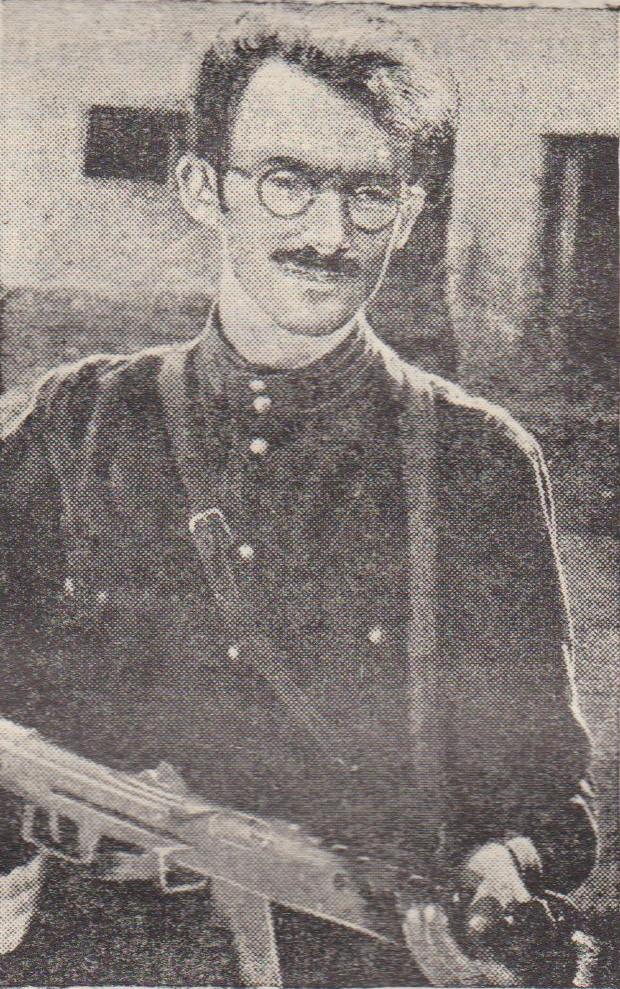
Will prosecutors (and the writers’ union) in Vilnius be told about Avrom Sutzkever’s days with the Soviet partisans?
You may know that in addition to being a major twentieth century Yiddish poet and editor, Sutzkever survived the Holocaust by escaping the Vilna Ghetto to join the anti-Nazi Jewish partisans. You may or may not know that elderly Lithuanian Jewish Holocaust survivors, who like Sutzkever escaped certain death by joining the partisans, but who are still alive and relatively well, have been defamed as “war criminals” by the same Lithuanian government that recently invested in a Sutzkever plaque in Vilnius, brought over his Israeli family for festivities, and invests in ever more Jewish and Yiddish PR stunts (complete with honors for compliant foreigners) to camouflage a campaign of revisionism.
This is on top of a disturbing toleration of serious antisemitism, including in recent years, state-sanctioned neo-Nazi marches in the heart of the capital city on independence day, the legalization of public swastikas (the UN Human Rights Committee has commented), and inaction regarding front pages of mass circulation newspapers worthy of the 1930s. The most famous examples in recent years are depictions of the Jew and the Gay controlling the world (2009), and, less than a year ago, of one of the city’s resident rabbis.
Posted in "Jewish" Events as Cover?, Double Games, Dovid Katz, Identity Theft of Litvak Heritage, Litvak Affairs, News & Views, Opinion, Politics of Memory, Sutzkever Prize in Lithuania, United States, Yiddish Affairs
Tagged Abraham Sutzkever, Ed Hirsch, Holocaust in Lithuania, Summer Literary Seminars, Sutzkever Prize in Lithuania, Writers Union in Vilnius
Comments Off on An Open Letter to Ed Hirsch
Why Monica Lowenberg’s Petition Is So Important
O P I N I O N
Londoner Monica Lowenberg, who has done so much, with a petition and via press coverage, to keep on Britain’s political agenda the Latvian government-blessed Waffen-SS parades in Riga each year, has in one fell swoop done a huge good for sadly analogous topics pertaining to neighboring Lithuania. By launching an international petition in advance of this month’s Lithuanian government sponsored PR conference in London, and focusing the petition on simple, virtually cost-free good-will solutions to the irksome issues in Lithuanian-Jewish relations, she has shown how easy the extant problems would be to solve if the political will were there from the state (and it is the state, not the everyday people of the country that is the cause of all these problems). A state has embarked on a foolhardy campaign to rewrite history in the direction of glorification of Hitlerist allies in Eastern Europe, precisely the opposite of the values that EU and NATO member states should be instilling in new generations of Europeans.
Ms. Lowenberg’s petition, signed by hundreds of people from a dozen countries in its first few days, begins with the simple request for a public apology by the Lithuanian government to the Holocaust survivors defamed by Lithuania’s antisemitic state prosecutors who have called the courageous Jewish ghetto survivors who joined the anti-Nazi partisans (and are heroes of the free world) — “war criminals.” For half a dozen years, the campaign has included everything from press releases saying that these survivors “cannot be found” to police actually turning up looking for two women in their late eighties.
Posted in "Red-Brown Commission", Antisemitism & Bias, Collaborators Glorified, Double Games, Events, Human Rights, Monica Lowenberg, News & Views, Opinion, UCL Manipulated?, United Kingdom
Comments Off on Why Monica Lowenberg’s Petition Is So Important
Monica Lowenberg’s Petition to the Lithuanian Ambassador to the UK, HE Asta Skaisgirytė-Liauškienė
The text of Monica Lowenberg’s petition that appeared today on Change.org. To sign please visit:
Abandon state sponsored Antisemitism and Holocaust Obfuscation
- To:
- HE Ambassador Asta Skaisgirytė-Liauškienė
- Lithuanian Ambassador for London, UK
Posted in 70 Years Declaration, Antisemitism & Bias, Double Games, Double Genocide: The New Form of Holocaust Revisionism & Denial, Human Rights, Litvak Affairs, Monica Lowenberg, News & Views, Opinion, Politics of Memory, UCL Manipulated?, United Kingdom
Tagged Asta Skaisgirytė-Liauškienė, East-Central Europe, Fania Brantsovsky, Holocaust in Lithuania, Joseph Melamed, Lithuanian-Jewish relations, Monica Lowenberg, Post-Communist Europe, Post-Communist views of the Holocaust, Prague Declaration on European Conscience and Communism, Rachel Margolis, Seventy Years Declaration, Yitzhak Arad
Comments Off on Monica Lowenberg’s Petition to the Lithuanian Ambassador to the UK, HE Asta Skaisgirytė-Liauškienė
Yitzhak Arad’s Paper
The Holocaust in Lithuania, and Its Obfuscation, in Lithuanian Sources
by Yitzhak Arad
◊
Editor’s note: Yitzhak Arad explained that Yad Vashem had refused to publish this paper, and that he did not accept the reasons given, believing that in fact politics were at work. The Defending History community is honored to be able to pubish Dr. Arad’s paper.
◊
C O N T E N T S:
Introduction
Lithuanian Nationalism and Antisemitism Prior to the Holocaust
The First Soviet Occupation of Lithuania, 15 June 1940 – 22 June 1941
The Lithuanian Activist Front: Antisemitic Incitement
The German Invasion and the Organization of an “Independent” Lithuanian Government
The Period of Pogroms: Late June to Mid July 1941
The Lithuanian Press at the Time of the Pogroms: A Source of Incitement
The Lithuanian Provisional Government: Anti-Jewish Legislation
Systematic Mass Murder: German Design and Command, Lithuanian Perpetration (late July–November 1941)
Lithuanian Police Battalions and Their Role in the Murder of the Jews
The Lithuanian Catholic Church and the Holocaust
The Rewriting of Holocaust History and the Double Genocide Thesis — “The Jewish Holocaust and the Lithuanian Holocaust”
Anti-Soviet Guerilla Warfare in Lithuania
The Prague Declaration of June 2008 and the European Parliament Resolution of April 2009
Conclusion
Notes
Introduction
In Lithuania, as in other places in Europe conquered by Nazi Germany, a thorough and comprehensive inquiry into the tragic events that occurred compels consideration of three factors:
Posted in "Red-Brown Commission", A 21st Century Campaign Against Lithuanian Holocaust Survivors?, Antisemitism & Bias, Christian-Jewish Issues, Double Genocide: The New Form of Holocaust Revisionism & Denial, Foreign Ministries: Holocaust Politics Abuse?, History, It Pays to Defend History: Success Over the Years..., Lithuania, News & Views, Opinion, Politics of Memory, Yitzhak Arad
Tagged Antisemitism in Lithuania, Emanuelis Zingeris, Holocaust in Lithuania, International Commission on the Evaluation of the Nazi and Soviet Occupation Regimes in Lithuania, Juozas Ambrazevicius Brazaitis, LAF (Lithuanian Activist Front), Lithuanian Activist Front (LAF), Lithuanian collaboration with Nazi Germany, Prague Declaration on European Conscience and Communism, Provisional Government (PG) of Lithuania in 1941, Yitzhak Arad, Zingeris-Racinskas commission
Comments Off on Yitzhak Arad’s Paper
New York Based Assistance to Lithuanian Jews Speaks Out on Lithuanian-Jewish Issues
The following is page 1 of the new (Fall 2012) issue of L’hava — The Litvak Flame, published in New York City by Assistance to Lithuanian Jews, Inc, that is headed by attorney Josef Griliches. The journal is edited by Mr. Griliches and Brian Biller.
Posted in Collaborators Glorified, Documents, Litvak Affairs, News & Views, Opinion, Politics of Memory, United States
Comments Off on New York Based Assistance to Lithuanian Jews Speaks Out on Lithuanian-Jewish Issues
David Cukier, Alumnus of UCL, Writes to the Provost on Lithuanian Government’s December Conference
O P I N I O N
by David Cukier
David Cukier, a child of two Holocaust Survivors, studied Pharmacology at University College London, 1975-1978, where he also participated in some Jewish and Yiddish studies activities. He has released to Defending History for publication his letter to the president and provost of UCL, Professor Malcolm Grant, expressing concern over the Hebrew and Jewish Studies Department hosting a second Lithuanian government sponsored one-sided Holocaust conference.
In his covering letter to DH.com, Mr. Cukier adds:
Posted in David Cukier, Double Games, News & Views, Opinion, Politics of Memory, UCL Manipulated?, United Kingdom
Tagged David Cukier, Holocaust in Lithuania, Professor Malcolm Grant, UCL Hebrew and Jewish Studies
Comments Off on David Cukier, Alumnus of UCL, Writes to the Provost on Lithuanian Government’s December Conference
Rachel Kostanian, Head of Vilnius’s ‘Green House’ and Champion of Holocaust Truth, Featured in New Documentary
Rachel Kostanian, the famed one-woman bastion holding off the state-sponsored hordes of ultranationalist Holocaust revisionism, continues to lead The Green House, as the Holocaust section of Lithuania’s state Jewish museum is known. It is a small wooden structure atop a hall hidden by a long driveway, invisible from the street, in contrast to the other sections of the Jewish museum. In contrast to all the others, The Green House’s exhibits and texts narrate the simple truth about June 1941 and the role of the “white armbander” Nazi militias in initiating the genocide of Lithuanian Jewry, as well as the later and massive collaboration with and participation in the killing throughout the genocide of Lithuanian Jewry. Like others who stand up, and especially those in prestigious academic or cultural positions in Lithuania, she is being subjected to extensive official harassment, degradation, demotion and a campaign of psychological warfare including defamation (see for example, Esther Goldberg Gilbert’s first and second articles in 2010).
It is against this backdrop that Ms. Kostanian’s prominent inclusion, at four separate points, in Professor Danny Ben-Moshe’s new documentary, Rewriting History, acquires special significance here in Vilnius.
The film is available online. Rachel Kostanian’s four appearances are at the following time c odes:
11:16 to 12:12
17:47 to 19:47
21:10 to 21:34
31:20 to 33:16
Posted in Arts, Film, It Pays to Defend History: Success Over the Years..., Lithuania, Litvak Affairs, Museums, News & Views, Rachel Kostanian, The Green House
Tagged Rachel Kostanian, The Green House
Comments Off on Rachel Kostanian, Head of Vilnius’s ‘Green House’ and Champion of Holocaust Truth, Featured in New Documentary